


 Claim Ownership
The Trading Floor with David Axtell
Subscribed: 0Played: 0
Subscribe

© Rondanini Publishing Ltd
Description
Thirty-five years. Four continents. 120+ currencies.
David Axtell bridges the gap between textbook theory and trading floor reality—real stories, real mistakes, hard-won lessons from institutional FX markets. From Saudi Riyal derivatives to Nigerian Naira, from building treasury functions to managing nostro networks across frontier markets.
Plus bonus episodes featuring traders, treasurers, and practitioners from leading institutions.
Co-authored with Luigi Rondanini.
David Axtell bridges the gap between textbook theory and trading floor reality—real stories, real mistakes, hard-won lessons from institutional FX markets. From Saudi Riyal derivatives to Nigerian Naira, from building treasury functions to managing nostro networks across frontier markets.
Plus bonus episodes featuring traders, treasurers, and practitioners from leading institutions.
Co-authored with Luigi Rondanini.
9 Episodes
Reverse
In this special episode of The Trading Floor, Luigi Pascal Rondanini walks through the Python toolkit that accompanies FX Cash Products — the first volume in the Foreign Exchange Markets Professional Series.This is not a beginner Python tutorial. It is a practitioner's guide to a professional-grade analytics package built to price, value, and test real FX cash products with the correct conventions, day count logic, and settlement mechanics that institutional work demands.Luigi covers the full toolkit architecture across four pricing modules — spot, forwards, FX swaps, and non-deliverable forwards — plus valuation, portfolio aggregation, and hedge accounting effectiveness testing under IFRS 9 and ASC 815.Topics covered in this episode:— ForwardPricer: covered interest parity with basis adjustment, EUR/USD worked example, day count fractions, discount factors, and forward points output.— FXSwapPricer: near leg and far leg mechanics, swap points, implied funding yield, spot-forward and forward-forward structures.— NDFPricer: NDF rate calculation, settlement formula, USD/CNY worked example with contracted rate, fixing, and cash settlement output.— MTMCalculator and PortfolioAggregator: marking positions to market, net exposure by currency, maturity profile, and total portfolio notional.— EffectivenessTester: dollar offset testing, regression-based testing, and hypothetical derivative testing for hedge accounting compliance.— Market data integration: Bloomberg, Refinitiv/Eikon, Yahoo Finance, and manual input — with the fx-toolkit provider-status command to check your environment.The toolkit is available with the standalone toolkit purchase or the book plus toolkit bundle from rondanini.com. It is not included with book-only purchases.New to Python? Build your foundation first at chapters.berta.one — a free, open-source platform covering Python fundamentals through to machine learning, with interactive notebooks and no installation required.FX Cash Products is co-authored by Luigi Pascal Rondanini and David Axtell. Published by Rondanini Publishing Ltd. Available through all major marketplaces and directly from rondanini.com.
You see the spread. You think that's what the trade costs. It's not even close.In Episode 7, David Axtell breaks down the real cost of executing in FX markets — and explains why the visible bid-offer spread is just the tip of the iceberg. For institutional-size orders, implicit costs from market impact, timing risk, and opportunity cost typically run two to five times higher than the spread itself.David walks through how market impact follows square-root scaling laws — doubling your order size doesn't double your cost, it increases it by roughly 40%. He explains why splitting a large order into four pieces can cut aggregate impact by half, and why executing too aggressively can cost more than executing too slowly — but sometimes you have no choice.The episode covers transaction cost analysis (TCA) — the systematic framework institutions use to measure what they're actually paying. From implementation shortfall methodology developed by André Perold in 1988 to modern multi-benchmark approaches comparing arrival price, VWAP, and peer performance, David explains how leading desks identify where execution quality is leaking and how to fix it.He also addresses best execution obligations under MiFID II and Dodd-Frank — the regulatory frameworks requiring firms to document their execution processes, monitor quality systematically, and demonstrate they're achieving the best possible outcomes for clients.Whether you're a corporate treasurer wondering if your bank is giving you fair pricing, a trader optimising execution strategy, or a risk manager building a TCA framework — this episode gives you the tools to understand what you're really paying.Next Episode: When Spot Goes Wrong — settlement risk, Herstatt risk, CLS, and what happens when trades fail to settle.Based on: Chapter 5 of FX Cash Products by Luigi Rondanini and David Axtell, forthcoming from Rondanini Publishing.
Episode 6 explores the evolution of FX execution from voice-based relationship trading to sophisticated electronic and algorithmic methods. David Axtell draws on 35 years of experience to explain when each execution channel makes sense and how to choose strategically.The episode covers voice trading's continued relevance for large trades (£50M+), complex structures, and stressed markets where electronic quotes disappear. Single-dealer platforms offer relationship-based pricing with comprehensive product coverage but sacrifice competitive tension. Multi-dealer platforms provide price competition that typically saves 2-4 pips through simultaneous quote comparison from 8-15 banks.David explains ECNs (Electronic Communication Networks) like EBS and Reuters Matching, algorithmic execution strategies including TWAP and VWAP, and high-frequency trading firms that now account for 15-20% of major pair volume. Real examples include his strategic approach to converting Saudi riyal receivables—using electronic platforms for routine $5M trades but voice relationships for a one-off $50M transaction that required negotiation.The episode concludes with a framework for execution method selection based on trade size, currency pair liquidity, time flexibility, and market conditions. Transaction cost analysis (TCA) receives practical coverage showing how to measure execution quality and drive systematic improvement.By the end of this episode, you will be able to:1. Distinguish between voice, single-dealer, multi-dealer, ECN, and algorithmic execution methods2. Select appropriate execution channels based on trade size, currency pair, and market conditions3. Understand when relationship-based voice trading outperforms competitive electronic platforms4. Recognize how algorithms minimize market impact for large orders5. Apply transaction cost analysis principles to measure and improve execution qualityNext Episode PreviewEpisode 7: "Transaction Costs: What You're Really Paying"- Spreads beyond the visible bid-offer- Market impact for different trade sizes- Timing costs and opportunity costs- Measuring total transaction costs- Building realistic execution expectationsFollow us on thetradingfloor.rondanini.com and look at our minimanuals site learn.rondanini.com where you will find everything you need to learn about FX and other asset classes
Luigi Rondanini takes over the mic to reveal Season One's roadmap: 18 episodes covering spot, forwards, swaps, and NDFs. Behind-the-scenes challenges of producing across 8 time zones, plus a teaser about a Riyadh story David doesn't know yet.Next Episode PreviewEpisode 6: Transaction Costs - David Axtell returns to explain how to measure what you're really paying when executing FX trades. Explicit costs, hidden costs, total cost of execution. Critical practical knowledge for anyone trading FX.
Episode 5 begins Part II: Spot FX with comprehensive coverage of how spot transactions actually work from trade agreement to final settlement. David Axtell draws on decades running treasury operations to explain the mechanics that underpin seven and a half trillion dollars of daily FX trading.The episode explains why spot settlement takes two business days (T+2) rather than being immediate, covering historical context from the telex era through modern electronic systems. Value date calculations receive detailed treatment including business day rules, holiday adjustments in both currencies, and complications from Middle Eastern Friday-Saturday weekends versus Western Saturday-Sunday weekends.David walks through the complete settlement flow: confirmation generation, payment instruction transmission to operations teams, movement through domestic payment systems (Fedwire for dollars, TARGET2 for euros, BOJ-NET for yen), and the critical timing around cut-off deadlines. The 1974 Herstatt Bank failure provides historical context for settlement risk—banks had paid Deutsche marks to Herstatt but never received promised dollars when German regulators closed the bank mid-settlement cycle.CLS (Continuous Linked Settlement) solved this principal risk through payment-versus-payment mechanisms across eighteen major currencies, processing over six trillion dollars daily during a seven-to-noon Central European Time window when all relevant payment systems operate simultaneously. The episode concludes with market session analysis showing how liquidity varies across Asian (quiet), European (building), and London-New York overlap (peak) sessions, plus introduction to the learn.rondanini.com education platform.The Trading Floor with David Axtell
Episode 4 completes Part I: Foundations by teaching listeners how to read and understand foreign exchange quotations. David Axtell breaks down the fundamental mechanics of FX quotes, explaining base versus quote currencies, pip calculations, bid-offer spreads, big figure conventions, and common mistakes that even experienced professionals make.Base and Quote Currencies (4 minutes)Pips and Pipettes (4 minutes)Bid-Offer Spreads (4 minutes)Big Figures and Abbreviated Quotations (3 minutes)Direct vs Indirect Quotations (2 minutes)Common Mistakes and How to Avoid Them (3 minutes)By the end of this episode, you will:Understand the difference between base and quote currenciesCalculate pip values across different currency pairsInterpret bid-offer spreads correctlyRead abbreviated quotations using big figuresAvoid common execution errorsHave the foundational knowledge to move into Part II: Spot FXReference sites:learn.rondanini.comSubscribe to this podcast on your favourite platform on:The Trading Floor with David Axtell
Foreign exchange is the largest financial market in the world—but who's actually in it?In Episode 3, David Axtell breaks down the five key player groups: banks and dealers who provide liquidity and take proprietary positions, corporates hedging commercial exposures, asset managers building currency allocations, central banks conducting monetary policy and market interventions, and hedge funds running speculative strategies.Each participant brings different objectives, time horizons, and information advantages. Understanding who's on the other side of your trade matters—because it shapes pricing, liquidity, and market behavior during both normal conditions and stress periods.David shares real examples: the Swiss National Bank's multi-year defense of the EUR/CHF floor (and its eventual abandonment in January 2015), corporate treasurers caught between FX volatility and board pressure, and George Soros' famous bet against the Bank of England in 1992.Whether you're executing hedges, managing portfolios, or trading directionally, knowing your counterparties' motivations gives you edge.This episode is part of The Trading Floor series—a practitioner's guide to FX markets based on 35 years of institutional experience across London, Riyadh, Doha, Dubai, and Singapore.Next Episode: Forward points and FX swaps—the mechanics that drive 60% of daily FX volume.Based on: FX Cash Products—the book soon available through Rondanini Publishing.
Why doesn't foreign exchange trade on an exchange like stocks? Why does it operate 24 hours? And why is the US dollar at the centre of everything? In this episode, David Axtell explains the fundamental architecture of the world's largest financial market—$7.5 trillion in daily turnover—and what that structure means for anyone operating in FX. From OTC markets to liquidity patterns to the dominance of FX swaps, this is the market structure knowledge that separates professionals from tourists.In this episode, we cover:Why FX is over-the-counter (OTC) instead of exchange-tradedThe three reasons scale, complexity, and customisation demand bilateral marketsHow the 24-hour market follows the sun through Asia, Europe, and New YorkWhy the London-New York overlap is the "golden window" for executionThe four main segments: Spot, Forwards, Swaps, and OptionsWhy FX swaps are the largest segment at $3.8 trillion dailyThe US dollar's role as the vehicle currency in 88% of all transactionsFive practical implications for treasury professionals and tradersKey Statistics:$7.5 trillion daily turnover (BIS)Spot: $2.1T | Forwards: $1.3T | Swaps: $3.8T | Options: $0.3TLondon handles 38% of global FX volume90%+ of spot trading in major pairs is now electronicAbout the Host:David Axtell has 35 years of experience in treasury and FX markets across four continents, including roles as Chief Dealer in Riyadh, Assistant General Manager at Qatar National Bank, and senior positions at HSBC Dubai, SHUAA Capital, and Crown Agents Bank.The Book:FX Cash Products: Spot, Forwards, Swaps & Non-Deliverable ForwardsCo-authored by Luigi Rondanini and David AxtellSoon a vailable through Rondanini Publishing
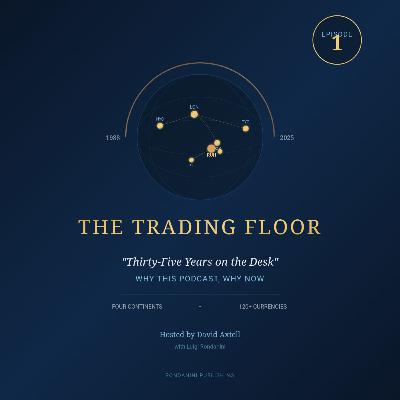
David Axtell introduces The Trading Floor—why this podcast exists, and why now. From NatWest in the 1980s to building nostro networks across 120 currencies at Crown Agents Bank, David shares the highlights of a 35-year career across London, Riyadh, Dubai, Doha, and beyond. He introduces co-author Luigi Rondanini, the young trader he hired in Saudi Arabia in 1995 who went on to systematise institutional FX knowledge into a comprehensive practitioner's guide. This episode sets out the podcast's mission: bridging the gap between academic theory and trading floor reality.Visit David at Rondaninini
Comments

Download from Google Play

Download from App Store
 United States