


 Claim Ownership
The Weekly Take from CBRE
Subscribed: 219Played: 9,780
Subscribe

© CBRE
Description
What matters most right now in Commercial Real Estate. Business leaders join economic, industry and subject matter experts to share their distinct views and latest thinking. The Weekly Take is hosted by Spencer Levy, CBRE’s Senior Economic Advisor and Global Client Strategist. More at cbre.com/TheWeeklyTake
304 Episodes
Reverse

Retail real estate has emerged as an increasingly attractive asset class. LBX Investment’s Phil Block and CBRE’s Chris DeCouflé discuss the strategies driving today's returns and where the smart money is headed.* Operational intensity is unlocking significant value.* Adding multifamily or event spaces to traditional retail can enhance investment returns.* Mispriced risk in retail presents opportunities for value-add and core strategies.* Incorporating grocers strategically can boost open-air center value.* Technology and data are crucial for underwriting retail real estate investments.
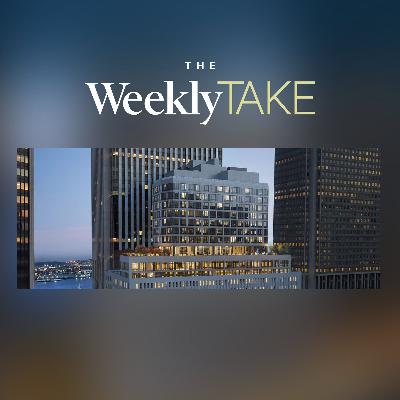
How did the largest office-to-residential conversion come about? Brian Steinwurtzel of GFP Real Estate offers an inside look at how lower Manhattan’s 25 Water Street, a struggling office tower that was transformed into more than 1,300 apartments. He discusses what this landmark project signals for urban resilience.· The right acquisition price and bold design and amenity choices can turn challenged office assets into world‑class residential properties.· Tax incentives can often be the deciding factor in whether a conversion is viable.· Fast execution is essential for controlling risks and costs in today’s market.· Office-to-residential conversions are highly bespoke, where building bones matter more than any rule-of-thumb formula.· Great residential conversions are redefining downtowns, but their future hinges on policy, pricing and how the next market cycle unfolds.

Two of the parking industry’s most influential leaders— LAZ Parking’s Alan Lazowski and Parkway Corporation’s Rob Zuritzky—explore parking’s role as critical infrastructure, a cash-flow-generating asset and a platform for EVs, autonomous vehicles and urban mobility innovation.* Parking is vital urban infrastructure, supporting economic growth.* Technology, like EV charging, revolutionizes parking operations.* Parking assets can deliver stable cash flow and attractive investment returns.* Parking structures of the future will become essential urban mobility hubs.

On this episode, we feature a wide-ranging discussion with Henry Chin, CBRE’s Global Head of Research—recorded at CBRE’s annual Capital Markets Symposium—where we explore global capital flows, the forces shaping investment strategies and why 2026 may be a compelling vintage for real estate investment.* 2026 offers prime investment opportunities in U.S. real estate.* Income growth, not cap rates, will drive future real estate returns.* Value-add industrial assets with access to power are positioned for strong returns.* Amenity-rich, well-located office space should continue to outperform.* Rekindled global capital inflows could boost U.S. real estate transaction volume.

Link Logistics’ Luke Petherbridge and CBRE’s John Morris dissect the powerful forces shaping industrial & logistics real estate. They explore continued e-commerce acceleration, the transformative impact of AI, driverless trucks, evolving supply chains, changing warehouse standards and much more.* Industrial real estate had its second-best leasing year ever in 2025.* New demand is being spurred by e-commerce and reindustrialization.* Prime industrial sites are being developed for data center use, contributing to a scarcity of modern warehouse facilities.* AI and automation transform operational efficiency and future warehouse design.* Driverless trucks will eventually alter supply chain networks and spatial economics.

Portugal has become an unexpected real estate powerhouse in Europe. Arrow Global’s John Calvao and CBRE's Francisco Horta e Costa discuss the revival of Portugal’s economy, surging investment in hospitality, logistics, data centers and student housing, the resilient Lisbon and Porto office markets and ways to address a chronic housing shortage.* Portugal's economic turnaround has fueled robust real estate opportunities.* Hospitality and logistics lead growth, attracting global capital.* Emerging sectors like data centers and student housing are seeing outsized growth.* Multifamily housing faces persistent supply challenges.* The Lisbon and Porto office markets are exhibiting strong performance.

AI’s massive investment surge is reshaping commercial real estate. Chemonics' Victoria Slivkoff and CBRE's Colin Yasukochi discuss AI's influence on tech talent and its role in revitalizing key office markets and driving physical infrastructure needs.* AI drives massive investment into data centers and physical infrastructure.* San Francisco's office market is experiencing an AI-driven turnaround.* The AI revolution is creating specialized talent hubs and increasing demand for sustainable energy.* AI will boost productivity and necessitate workforce adaptation.

Raleigh has long been one of the best-performing secondary markets. Its arena district is poised to be the next engine in its growth. Carolina Hurricanes CEO Brian Fork and Greater Raleigh Chamber CEO Adrienne Cole discuss how the Lenovo Center anchors a mixed-use redevelopment on state-owned land—structured through a complex public-private partnership.Public-Private Partnerships: The Lenovo Center anchors an 80-acre, 15-year, $1 billion arena-district redevelopment via a public-private/ground-lease structure.Talent, Talent, Talent: Raleigh’s three tier-one research universities and multi-node job base keep attracting talent, companies and capital.By the Numbers: Strong population growth (2.2 million to 2.6 million by 2027) plus low cost-of-living (around 3% below national average) signal opportunity for investors.Local Color: Lenovo Center preserves a tailgating culture while adding retail, restaurants, structured parking and year-round activation.

Food halls are no longer just a trend—they are a high-impact amenity for improving a property’s dwell time, leasing velocity and NOI. Recorded at Central Perk in Times Square, a quartet of experts from Colicchio Consulting and CBRE explain how the best food halls prioritize operations and programming, new beverage and evening strategies, the lowdown on operator selection and deal structures that offer better risk-sharing and returns.- Food halls aren’t food courts: Independent concepts + community + beverage drive performance.- Hybrid work has changed the operating model: Fewer office days demand longer-hour, programming-led models.- Conversions can happen everywhere: Converting buildings to their highest and best use can work for both offices and food halls, especially in suburban markets.- Alignment between operators and landlords: Vendor stall flexibility and percentage-rent leases can benefit operators and investors.- Market snapshot: Colicchio Consulting believes the sweet spot of sizing is around 10,000–15,000 sq. ft. with average buildout costs around $400/sq. ft., depending on the market.

AI is reshaping the business landscape, including commercial real estate. Data scientist and author Sandy Pentland and CBRE’s Sandeep Davé discuss how the intersection of emerging technologies and human insight is driving better decision-making for investors, occupiers and building operators.Commercial Real Estate & AI: For occupiers, AI can create significant operating efficiencies and enhance the workplace experience; for investors, increased efficiency can boost asset values.People and Technology: AI is enhancing—not replacing—human decision‑making across organizations.Data Quality: Good data management is the foundation for applying AI most impactfully.Productivity: Every organization is balancing innovation and productivity gains with responsible deployment that considers privacy, governance and human‑in‑the‑loop practicesLong-term Outlook: AI is broadening visibility across markets, helping to foresee unanticipated or exogenous events and surfacing new ideas.

Recorded at the CBRE Women’s Network Power of WE conference, this episode offers a rapid-fire, insights-rich tour of major U.S. commercial real estate markets. Our subject-matter experts provide inside views of how different regions are navigating supply, demand and economic forces—from industrial and logistics to multifamily, office and retail—and insights on where investors and occupiers may find value in 2026.National CRE outlook, including signs of asset repricing stabilization, improving liquidity and transactions momentum. Industrial dynamics in Southern California, from manufacturing fundamentals and port-driven demand to pockets of strength and ongoing vacancy challenges. Sector trends, including data centers, alternative assets, big‑box scarcity, rent trends, and how corporate occupiers are re‑entering the market. Multifamily performance across gateways, the Sun Belt and the Midwest, driven by slowing construction cycles, demographic patterns and evolving investor interest. Emerging and opportunity markets, from South Carolina’s growth to resurgent metros like San Francisco, Seattle, Phoenix and smaller high-growth cities such as Boise.

PwC’s Karl Russo and CBRE’s Henry Chin share their outlook for the U.S. economy and commercial real estate in 2026, exploring opportunities and risks to growth.Key Takeaways:The U.S. economy should remain resilient in 2026.While the labor market finds a new equilibrium, many companies are racing to upskill and retain talent as they adopt AI processes.Reshoring and infrastructure improvements are expected to drive industrial growth in secondary markets.Data centers are positioned as a leading sector amid structural undersupply.
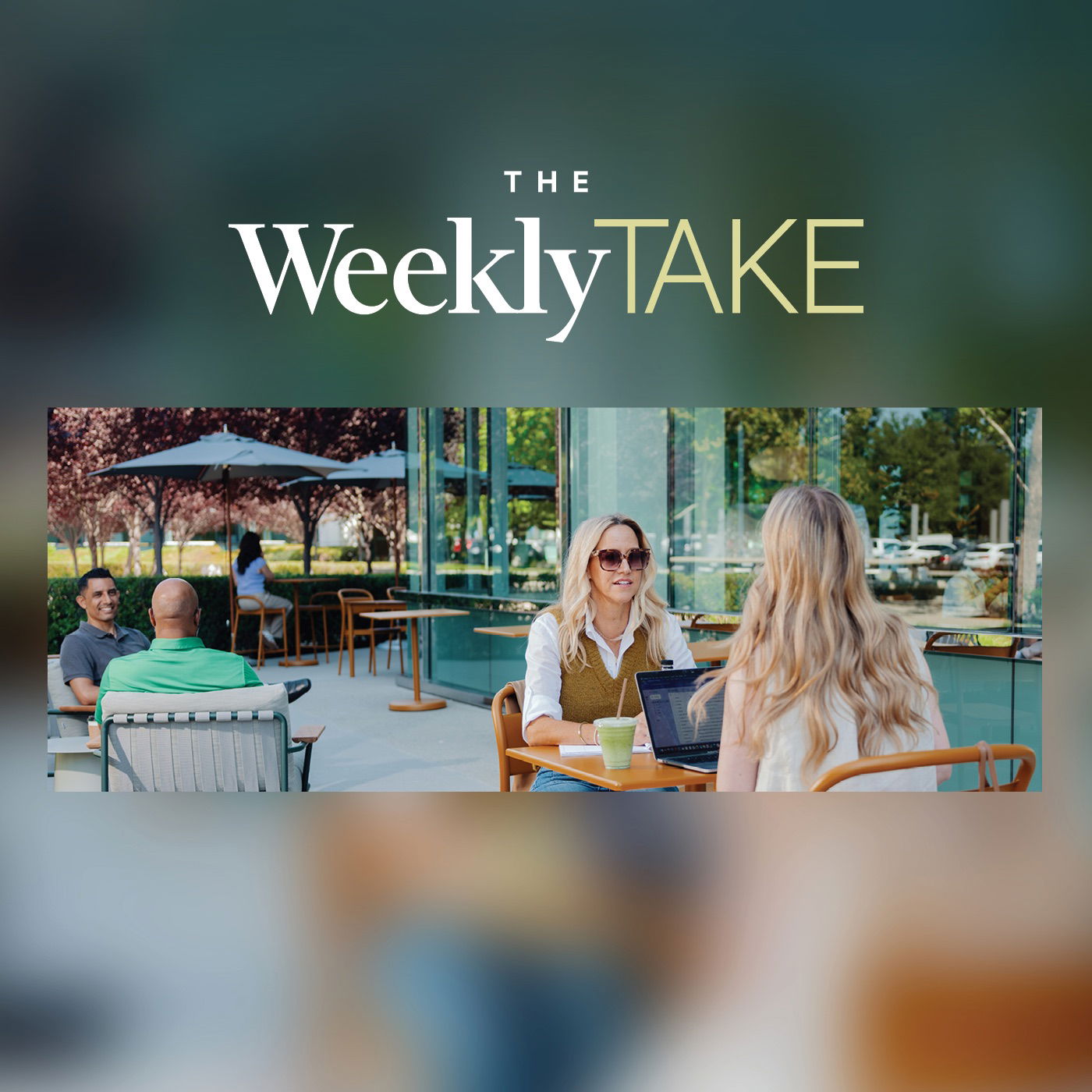
Alex Mehran Jr., CEO of a third-generation family developer, walks us through the transformation of Bishop Ranch—a master-planned community in San Ramon, CA. Mehran shares valuable lessons on reinventing a suburban office park into a vibrant, mixed-use destination. Mixed-use suburban developments are gaining strong appeal.· Amenity-rich office space drives tenant demand and retention.· Short-term, flexible leases can dovetail well with corporate occupier’s needs.· Residential conversions of obsolete suburban office parks can enhance long-term asset value.· Planned communities thrive with diverse housing and retail integration.

Alison Fragale, author of the provactively titled “Likeable Bad Ass," breaks down the science of status—offering practical advice on how leaders can use warmth and competence to drive respect and gain greater influence.Key Takeaways:1. Status—being respected and regarded—leads to influence, access to resources, and career advancement.2. People judge quickly, and have high regard for those who are well-intentioned and competent.3. Hard work needs to be seen to ensure effort is valued.4. You can leverage “swing thoughts” to improve your career. [SI1] [SI1]Do not really understand this. Remind me what “swing thoughts” are
![Adam Grant on questioning conventional wisdom and making better decisions [encore - 04.08.25]](https://s3.castbox.fm/21/e7/78/582a081a10cac108c4434e0c7cc38b28f4_scaled_v1_400.jpg "Adam Grant on questioning conventional wisdom and making better decisions [encore - 04.08.25]")
Wharton organizational psychologist and New York Times-bestselling author Adam Grant shares insights on making better business decisions, fostering innovation and how your personal "challenge network” can lead to superior products and delight your customers.1. Encourage[SI1] Humor and Humility: They help maintain a flexible and open-minded approach, making it easier to rethink and adapt.2. Have Pre-Mortems: Discuss as many potential failures as possible before launching. That way you can prevent or know how to handle problems when they occur.3. Eschew Best Practices for Better Practices: “Best Practices” implies there’s only one right way, while seeking “Better Practices” encourages people to innovate and try new things.4. Build a Challenge Network: Maintain a group of trusted critics who provide truly honest feedback to improve your decision-making.5. Reward Speaking Truth to Power: Encourage employees to ask questions, suggest improvements and challenge outdated ideas. [SI1]Please run these by Adam
![The business value of a desirable workplace [encore - 11.02.25]](https://files.cohostpodcasting.com/quill-file-prod/478d816a-5722-44ae-95b1-3c6acc9fd52d/shows/c5676b54-b94d-40b4-802e-04eb50a0ee7b/episodes/757f14a8-d10b-4c8c-a0b0-6503d5d3f755/cover-art/original_622372da52bef22579551fc20288c6e7.jpg "The business value of a desirable workplace [encore - 11.02.25]")
Jamie Hodari, CBRE's CEO of Building Operations & Experience, spotlights where he sees the biggest opportunity across commercial real estate: workplace experience. He discusses how a company’s space can attract tenants and enhance the employee experience, enriching people’s lives and increasing business effectiveness. Everything is operational real estate: Real estate companies are evolving from asset focused businesses to operating platforms, requiring high-quality management relentlessly focused on workplace experience.AI and data utilization are no longer nice-to-haves: Using AI to manage and interpret data is crucial for optimizing building operations.Markets are adapting to accommodate hybrid work models with flexible office usage: Urban markets especially put significant emphasis on making downtown areas vibrant.Finance institutions are catching up: The finance industry must recognize and adapt to the operational nature of modern real estate.Flight-to-quality is expanding: The focus for landlords and occupiers will increasingly be on creating spaces that people find enriching and valuable, not just functional.

J.P. Morgan Asset Management’s Josh Myerberg breaks down the 2026 real estate outlook, why quality assets and operational excellence matter, and where savvy investors are finding opportunity now. Don’t miss these timely insights from one of the industry’s top portfolio strategists.J.P. Morgan Asset Management is optimistic about 2026, driven by expectations of lower interest rates and resilient real estate fundamentals.Quality matters more than ever—top-performing assets and strong operators are expected to outperform, while tertiary markets and lower-tier properties carry greater risks.Retail real estate has made a strong comeback, and high-quality office space is showing positive momentum, especially in major markets like San Francisco and New York.Operational excellence and risk management—including attention to emerging risks—are critical for long-term portfolio success.Diversification remains key: even the best assets need to fit together strategically to reduce volatility and capture growth opportunities.

Shorenstein CEO Brandon Shorenstein and CBRE’s Patrick Gildea discuss why the office market is poised for a comeback. Hear what they have to say about risk-adjusted returns, property conversions, the importance of workplace amenities and more.Key takeaways on office investing: Office market is recovering: Investment activity in the office sector is rebounding with more bidders and increased debt availability. Investment strategies have shifted: Investors are focused on cash flow and downside protection, with cash-on-cash yields reaching 8%–15%. Micro-market dynamics are key amid a flight to quality: Prime assets in live-work-play submarkets are outperforming, while obsolete buildings face demolition or conversion, reducing overall supply. Conversions are limited: Selective repositioning is critical, as only a small percentage of office buildings are structurally viable for residential or hotel conversions. Occupier priorities have changed: Tenants now prioritize wellness, sustainability and experiential amenities, driving demand for high-quality spaces.

Clarion’s Brent Jenkins and CBRE’s Zaahir Syed discuss how capital raising for real estate is rapidly evolving. They provide insights on fund development, non-traded REITs, emerging opportunities in private wealth markets and more.Key takeaways on raising and deploying capital: Sourcing real estate capital is diversifying, with growing emphasis on private wealth and new opportunities to tap into the defined-contribution (DC) market.Accessing retail capital and 401k plans through DC channels is potentially a major area of growth, requiring new product structures and daily liquidity solutions.Fund managers must strategically align vehicle structures with investor objectives and market conditions for both short- and long-term capital needs.
![Powerhouse: The Future of Data Centers [Encore - 8.19.25]](https://s3.castbox.fm/1f/eb/d9/b0187d56d16415c284dac6c781b019a784_scaled_v1_400.jpg "Powerhouse: The Future of Data Centers [Encore - 8.19.25]")
Mortenson’s Maja Rosenquist and CBRE’s Gordon Dolven examine one of real estate’s most dynamic sectors. They discuss how AI’s growth has accelerated data center development, how site-selection strategies are evolving and the challenges posed by power constraints.


Download from Google Play

Download from App Store
 United States
✅✅▶️▶️ CLICK HERE Full HD✅1080p✅ 4K✅ WATCH ✅💻📺📱👉https://co.fastmovies.org