


 Claim Ownership
Educating to Be Human Podcast
Subscribed: 1Played: 16
Subscribe

© 2024
Description
A bi-weekly podcast hosted by Lisa Petrides, CEO and Founder of the Institute for the Study of Knowledge Management in Education (ISKME), "Educating to Be Human" explores what it means to be human in today's evolving cultural and societal landscape. In each episode, Lisa speaks with people whose work addresses the challenges and possibilities of how we might educate and inspire transformative change in modern society, which reaches beyond the traditional classroom.
In Season 2, we examine who controls access to knowledge, how learning is accelerated through embodied experiences, and how education is essential for resilience and connection in an evolving world.
Think if Big Ideas Fest were a podcast, Educating to Be Human is born from the desire to keep the conversations going and making the knowledge we have gained and stories we've heard accessible to all. By bringing these unique voices into the podcast world, we are furthering ISKME's commitment to make learning and knowledge-sharing participatory, equitable, and open.
Educating to be Human is hosted by Lisa Petrides, produced by Helene Theros, recorded by Nathan Sherman, and edited by Ty Mayer. Season 2 music is created by Orestis Koletsos.
In Season 2, we examine who controls access to knowledge, how learning is accelerated through embodied experiences, and how education is essential for resilience and connection in an evolving world.
Think if Big Ideas Fest were a podcast, Educating to Be Human is born from the desire to keep the conversations going and making the knowledge we have gained and stories we've heard accessible to all. By bringing these unique voices into the podcast world, we are furthering ISKME's commitment to make learning and knowledge-sharing participatory, equitable, and open.
Educating to be Human is hosted by Lisa Petrides, produced by Helene Theros, recorded by Nathan Sherman, and edited by Ty Mayer. Season 2 music is created by Orestis Koletsos.
26 Episodes
Reverse

In the Season 3 premiere of Educating to Be Human, we launch a series-long exploration of "open", in conversations with people who are working to ensure that public data, knowledge, and research remain open and freely accessible for all. Host Lisa Petrides is joined by sociologist and open science advocate Christopher Marcum, former Assistant Director for Open Science and Data Policy at the White House Office of Science and Technology Policy (OSTP). In this conversation, Lisa and Chris trace the origins of open from its 17th-century roots and Robert Merton's 1940s ideal of knowledge as a non-excludable public good to the modern policies governing taxpayer-funded research today. Together, they confront the mounting threats facing open systems - from big tech monopolies and AI data scraping to the rise of closed digital gatekeepers - and explore why open infrastructure is as vital to a thriving society as physical roads and bridges. This episode challenges us to rethink how we protect public knowledge, sustain open infrastructure, and cultivate the human curiosity necessary to question the technological systems shaping our world. Christopher Steven Marcum, Ph.D., is an expert in federal data policy, open science, and scientific integrity who has served in key advisory roles across the Executive Office of the President. As Assistant Director for Open Science and Data Policy in the White House Office of Science and Technology Policy (OSTP), he developed transformative science policies, including the 2022 OSTP Public Access Memo and the 2023 Federal Scientific Integrity Framework, and spearheaded the White House designation of 2023 as the Year of Open Science. As Senior Statistician and Senior Scientist in the Office of Management and Budget's (OMB) Office of Information and Regulatory Affairs, he directed an information policy portfolio covering data access, research security, information quality, cybersecurity, and artificial intelligence across federal science and statistical agencies. In that post, he co-authored major Executive Branch information policies including OMB Memoranda M-25-05 on open government data access and M-25-21 on federal AI adoption, chaired the Federal Statistical Research Data Center Program Executive Committee, and represented OMB on key interagency bodies including the Cybersecurity Subcommittee of the Interagency Council on Statistical Policy, the Aging Forum, and the Children's Forum. Currently an independent consultant, Chris serves as Senior Advisor for Federal Data Policy at the Federation of American Scientists and Senior Fellow at the Data Foundation. He is an elected fellow of the Gerontological Society of America and a full member of Sigma Xi, the scientific research honor society.
In Season 2 of Educating to Be Human, we asked questions about education: who controls what we learn? Who benefits? Who gets left out? What would it take to democratize education? And simply, why do we learn? Lisa spoke with people across disciplines - community organizers, faith leaders, educators challenging traditional systems, civil servants, and business leaders - to chip away at these questions from different angles. In this special episode, we revisit key moments from our conversations in Season 2, highlighting how our guests challenged us to think of what becomes possible when we center humans - not systems - in learning. This special episode features clips from interviews with: Wendy Millet, founder of Gallop Ventures; Atman Smith, founder of the Holistic Life Foundation; Stephen Ritz, founder of the Green Bronx Machine; Chris Freeland, Director of Library Services at Internet Archive Joanna Strober, founder of Midi Health; Dr. Keith Curry, President of Compton College and CEO of the Compton Community College District; Maha Bali, professor of practice at the Centre for Teaching and Learning at the American University in Cairo and co-founder of Equity Unbound; Paul Kruchoski, former senior U.S. diplomat and a career member of the Senior Executive Service; Fr. Jon Pedigo, a longtime social justice advocate and activist, faith leader within the Catholic diocese of San Jose, and executive director of PACT (People Acting in Community Together); Kassandra "Kassi" Talbot, educator, social justice advocate, and principal of Pescadero Elementary School.
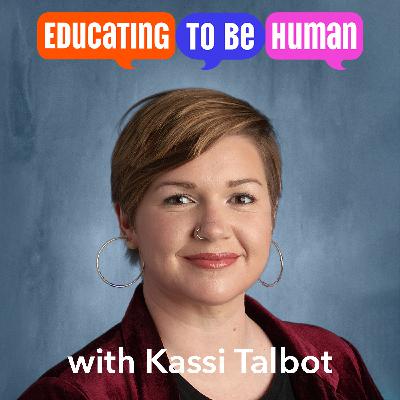
In the season finale of Educating to Be Human, we turn our attention to rural education and the transformative power of community-centered learning. Host Lisa Petrides is joined by Kassi Talbot, educator, social justice advocate, and principal of Pescadero Elementary School, a small rural school on California's coastside. Born and raised in the same community she now leads, Kassi shares how participatory and community-based education, and a deep commitment to equitable, open education can drive lasting positive outcomes — not just in remote or non-urban schools, but across all systems of learning. This episode explores what it means to center humanity, care, and connection in education, reminding us that the lessons from small schools and rural communities often hold the keys to building a more inclusive and transformative future for all learners. Kassandra "Kassi" Talbot, EdD, is an educator and principal dedicated to her local rural schools. With nearly a decade of classroom experience teaching middle school social studies and high school Spanish, Kassi centers her work on antiracist and equitable practices. Her doctoral research, "Reclaiming the Story: YPAR in the Rural Social Studies Classroom," explored how youth can (re)claim history and stories through participatory action research. Kassi serves her community through local leadership, human rights training, and youth mentorship. She lives on the California coast with her dogs, and extended family — where she's working to build the kind of community her students will one day lead. LinkedIN: www.linkedin.com/in/kassandratalbot https://www.lhpusd.com/
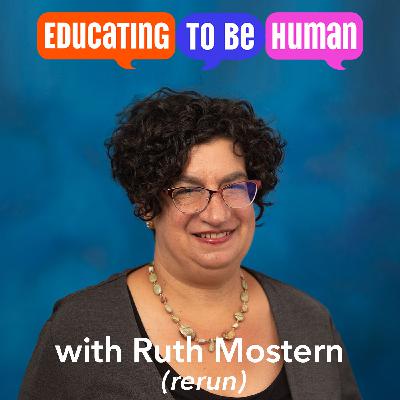
Today, we're revisiting one of our favorite conversations from Educating to Be Human — and much has changed since we first recorded it. Back in September 2024, Lisa sat down with Ruth Mostern, Professor of History and founder of the World Historical Gazetteer, to explore how our sense of place influences the way we understand our past and our identities. Through her groundbreaking project, the World Historical Gazetteer, Ruth enables historians and the public alike to visualize and contextualize historical events and relationships geographically, transforming static history into dynamic, place-based storytelling. Since that conversation, we've seen how place names and their meanings continue to shift - and spark debate - reminding us just how deeply history is woven into geography. This year, Ruth and her team also launched something brand new: the Institute for Spatial History Innovation, or ISHI, at the University of Pittsburgh. https://ishi.pitt.edu/ - now the new home for the World Historical Gazetteer. Resources: The Institute for Spatial History Innovation: ishi.pitt.edu Ruth Mostern at University of Pittsburgh: www.history.pitt.edu/people/ruth-mostern
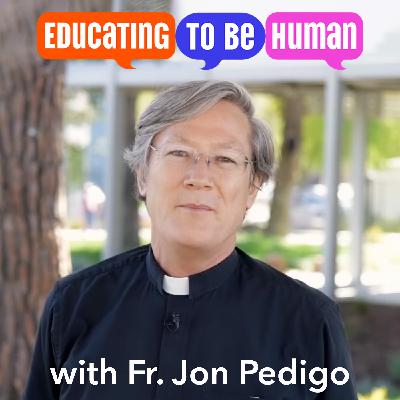
In this episode of Educating to be Human, Lisa is joined by Jon Pedigo, known by some as Father Jon. He is a longtime social justice advocate and activist, faith leader within the Catholic diocese of San Jose, and the new executive director of People Acting in Community Together, or PACT. In conversation, they explore what it means to rebuild connection in a time of deep division, how faith communities can act as ancient technologies for compassion and healing, and the power of grassroots organizing to help people claim their own agency and voice, particularly in difficult times. Fr. Jon Pedigo, a Bay Area native, has been active in civic affairs and social justice causes for over 35 years in the Bay Area. Working with the interfaith community of Silicon Valley, labor, community organizers, and civil rights activists, Fr. Jon was just named the Executive Director for PACT, People Acting In Community Together. In his previous position as the Director of Advocacy and Community Engagement for Catholic Charities of Santa Clara County, he developed a methodology of trauma-informed community organizing for people living in chronic poverty, refugees, and immigrant families. Fr. Jon has been acknowledged as a social justice advocate for immigrants and social change by many local organizations and received commendations from various public officials. Resources: https://www.cliniclegal.org/stories/grupo-de-solidaridad-brings-community-together https://www.americamagazine.org/faith/2020/06/11/what-church-san-jose-doing-prepare-post-covid-future https://www.pbssocal.org/shows/socal-connected/how-california-went-from-anti-immigration-to-sanctuary-state Transcript: 00:00:06 - 00:33:16 Jon Pedigo: The core of our humanity and what defines us isn't these separations, but it's our ability to care and heal. And through that kind of impulse religions kind of evolved as a technology to pull out of the best of humanity, our ability to connect to each other and to connect to the divine. 00:33:18 - 01:04:06 Lisa Petrides This is Educating to be Human. And I'm your host, Lisa Petridis, founder of the Institute for the Study of Knowledge Management in Education. In each episode, I sit down with ordinary people, creating extraordinary impact people who are challenging notions of how we learn, why we learn, and who controls what we learn. Thank you very much for listening. 01:04:08 - 01:45:23 Lisa Petrides I'm so delighted to be speaking with Jon Pedigo today. Also known by some as Father Jon and he is a longtime social justice advocate and faith leader within the Catholic Diocese of San Jose, California, and the new executive Director of People Acting in Community Together or PACT. Pact. And in our conversation, we explore what it means to rebuild connection in a time of deep division and how faith communities can act as ancient technologies for compassion and healing. 01:46:00 - 01:56:00 Lisa Petrides And the power of grassroots organizing to help people claim their own agency and voice. So welcome, Jon and thank you for being with us here today. 01:56:01 - 01:58:01 Jon Pedigo: Thanks, Lisa. 01:58:03 - 02:17:24 Lisa Petrides So we're living in a time of fragmentation, right? Deep polarization, ICE raids in cities, authoritarian impulses on the rise. I mean, even technology is threatening to replace human connection. What do you see as the defining challenges of this moment? 02:18:01 - 02:51:22 Jon Pedigo: What are defining challenges of this moment really are in just the profound loss of relationships that are in our community, the sort still profound separation, the divorce that happens in families because of ideology and politics. And in many cases, for good reason that people just simply aren't safe in their homes or in their families. They're not feeling safe in their churches and not feeling safe in their workplaces. 02:51:24 - 03:13:06 Jon Pedigo: They can't really speak their mind. They can't speak out of their heart. So it is not just policy and politics, but it is this very bizarre impulse of division that really is more like a divorce and not a disagreement. And that's kind of where we're coming from on this. 03:13:08 - 03:23:18 Lisa Petrides: So in the face of this fear and hostility and division, what role can faith communities and spiritual traditions play in bringing people together? 03:23:20 - 04:09:03 Jon Pedigo: Yeah, that's a great question. I was actually giving a talk the other day, and I brought this, I used religion as a kind of explaining it as, like an ancient technology that, is used to enhance, magnify, amplify our most human dimension, which is compassion and caretaking. Like Margaret Mead said, the sign that she found. And I think there's an old saying, but she just said that the the oldest sign, the oldest indication of human civilization is a healed femur, because that would indicate that the humanoid that was injured was cared for rather than left. 04:09:06 - 04:42:19 Jon Pedigo: And if you're kind of cutting one's losses that this member of this group of humanoids had felt that it was important that we need to kind of stay together and including this weak person this kind of this link that isn't the strongest. And so that indicated that there was, a decision of care. So that would indicate that at the core of our humanity and what defines us isn't these separations, but is our ability to care and heal. 04:42:21 - 05:13:00 Jon Pedigo: And through that kind of impulse. Religion's kind of evolved as a technology to pull out of the best of humanity, our ability to connect to each other and to connect to the divine. However, that was defined by early human groupings and societies to find a way to protect and to nurture each other, and especially to pay attention to the weakest among us. 05:13:02 - 05:37:23 Jon Pedigo: And so that religion, that dimension is dependent on three things. First is that we're connected to each other, that we are connecting out of concern that there is a there's a connection, a social bond, a connection that kind of a I don't know what you would call it, a kind of a covenant. Although that covenant with that concept evolved much, much later. 05:37:23 - 05:54:15 Jon Pedigo: But there is a a real bond of connectivity. The second thing that's important to recognize is that this bond is connected to actual everyday decisions, right? You know how we're going to actually do things, how we're going to run our how we're going to run our tribe, how we're going to run our our society are going to run this village. 05:54:21 - 06:25:06 Jon Pedigo: It's with that concern. And the third part is, of course, the divine is that, that that cover all overall sense of that. We stand before some kind of force that could be defined as a nature, could be defined as a spiritual contact, a certain existential dimension of us, that we're connecting to that. So those three pieces kind of bring together what what kind of early religions, religious systems. 06:25:08 - 07:13:21 Jon Pedigo: And so religion is that technology. The work that I do today, you know, hundreds of thousands of years later is, you know, it hasn't changed that much, especially in community organizing, that we spend the time to understand the impact of, of injuries caused by poverty, violence, lack of access to housing, the constant fear of lives being separated, destroyed by deportation, or just the trauma of having violent experiences, of having to leave one's own country, not out of one's own will, but out of necessity, working with people that have seen death, that have lost their children in a jungle, crossing a river, in the Darien Gap. 07:14:02 - 07:34:09 Jon Pedigo: People walking across countries. These are people that we know. These are people that are our base. And there's this trauma that's happened. And so our work is, first of all, understanding the human reality that we are broken by this. And so, you know, when we talk about human organizing, it's not just jumping into an issue like if, I'm snapping my fingers, ha. 07:34:11 - 08:07:08 Jon Pedigo: It's not like an issue of jumping into like, let's agitate people for change. Our work is doing trauma informed organizing, which is really addressing to understand the dynamic of broken realities, of broken dreams, of of separation and understanding that and and trying to pull out of that person their ability to see themselves not as a victim, but as a protagonist of their own destiny, which means that we we work and get people to move forward in that, in that place. 08:07:08 - 08:08:19 Jon Pedigo: So that's a starting point we go to. 08:08:19 - 08:30:01 Lisa Petrides Yeah. And I want to ask you about that. So I think what I've just heard you say is sort of talking about how faith is underlying this sort of driver, this very powerful driver of collective action and belonging. And I want you to speak a little bit more about community organizing, because I know that's really central to your work today. 08:30:03 - 08:45:07 Lisa Petrides So if you could tell us a little bit about the organization that you work with - PACT - and you've already described how that work intersects with your calling as a faith leader. But tell us a little bit more about that. And, and, and how you carry out this work. 08:45:08 - 09:18:01 Jon Pedigo: Okay. Before I do that, before too, I just want to kind of make, a kind of a little footnote that the word faith is not understood in the same way by different religious traditions. And faith, for some, it's a subscription to Creed-le statements. For others, it's an existential stance before the universe. So, like, we work with Buddhists that don't have, a particular, subscription to deity or anything like that. 09:18:06 - 09:51:09 Jon Pedigo: So, so. And we were the Unitarians that don't that really don't have a specific God to which they worship. And then we also work, obviously with traditional Christians, Jews, Muslims. But when we work in interreligio

Comments

Download from Google Play

Download from App Store
 United States