DiscoverNPI Sherpa Podcast Series: Operational Truth & Scaling for Ops, Engineering & Product Executives
NPI Sherpa Podcast Series: Operational Truth & Scaling for Ops, Engineering & Product Executives
Claim Ownership

NPI Sherpa Podcast Series: Operational Truth & Scaling for Ops, Engineering & Product Executives

Author: Robert L. Carl

Subscribed: 0Played: 1
Share

Description

Welcome to the NPI Sherpa Podcast Series

A masterclass in operational resilience and strategic execution produced by Global NPI Solvers.

This is not a show about theory; it is a tactical NPI survival manual for the most dangerous phase of any hardware company’s lifecycle: the "Brutal Middle" between a working prototype and high-volume profitability.

Who This Is For We designed this podcast for Product Developers, Manufacturing Engineers, Entrepreneurs, and Launch Executives who know that a beautiful CAD model is only 10% of the journey. The remaining 90% involves navigating rocky supply chain terrain, bridging cultural gaps between Western design and Eastern manufacturing, and ensuring your launch doesn't crash due to unscalable tolerances or yield loss.

Current Series: The Kilimanjaro Framework Our inaugural trilogy features Rob Carl, Founder & CEO of Global NPI Solvers. With 30+ years of NPI experience guiding over 500 products to market and driving $1 billion in sales, Rob frames the chaos of global production through the lens of high-altitude mountaineering.

Just as summiting Kilimanjaro requires navigating distinct ecological zones, launching a product requires navigating the shifting terrain of global supply chains, cultural gaps, and volatile market "weather."

Key Themes & Episodes Anchored by the "Kilimanjaro Trilogy," we dissect the biological and strategic parallels between an 8-day expedition and a 9-month product launch cycle.

· The Valley of Death: We analyze the "gap" where most hardware startups fail—between the excitement of R&D and the profitability of mass production—and how to survive yield loss and cost overruns.

· The Gear Check (DFM): Design for Manufacturability is not a checkbox; it is a survival discipline. We explain why "unscalable tolerances" are heavy rocks in your backpack that will kill your ascent, and how to strip out weak suppliers before you even board the plane.

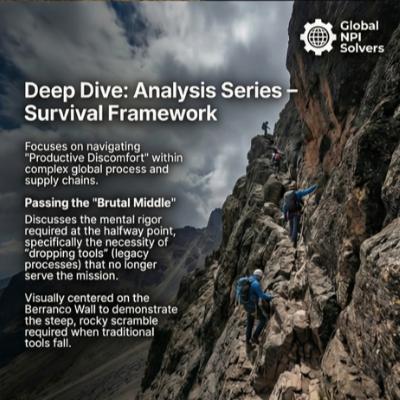
· Mindset Over Muscle: Leadership is physiology. We discuss using your body as a "data dashboard" to prevent burnout. We also explore the "Barranco Wall" moment: the terrifying point where you must drop the legacy tools and management styles that built your startup because they are now liabilities at scale.

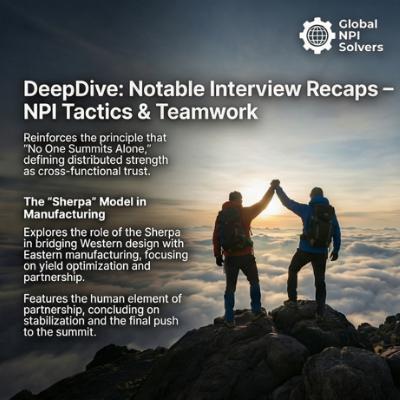
· Distributed Strength: No one summits alone. We break down the "Sherpa" model of cross-functional trust, humanizing the factory floor to reduce yield loss, and leveraging a guide who has "seen the movie and knows the ending."

· The True Summit: Success isn't the launch party; it’s Stabilization. The goal isn't making one perfect unit; it's ensuring unit #10,000 is just as perfect as unit #1, and descending safely without product recalls.

Why Listen? If you are standing at the trailhead of a massive launch, looking up at a summit shrouded in clouds, you need a guide. Whether you are dealing with "hypoxia" in the boardroom or a crisis on the factory floor in Vietnam, we provide the frameworks to turn "productive discomfort" into fuel for progress.

Coming Soon The climb continues. Subscribe now as we expand the NPI Sherpa series to cover advanced methodologies, including:

· The NPI Sherpa Pre-Ascent Protocol (A 4-part DFM Audit Masterclass)

· The Psychology of Cross-Functional Trust

Join us to ensure your next launch doesn't just reach the peak, but stays there.

"Keep climbing—you’re never too small to do something big."

5 Episodes
Reverse
The NPI Sherpa Pre‑Ascent Protocol — A 4‑Part MasterclassEpisode 2 — Fuel & Protection: Securing the Supply Chain Before the ClimbMost hardware programs don’t fail because the product doesn’t work — they fail because the organization wasn’t prepared to scale.Episode 2 of The NPI Sherpa Pre‑Ascent Protocol advances the journey from “route planning” into the executive gear check: determining whether a New Product Introduction (NPI) program can actually survive the production ramp. This episode aligns directly with Sections C & D of the Global NPI Solvers NPI Design for Manufacturing (DFM) Evaluation Protocol, which focus on supply chain readiness and regulatory protection. Using a high‑altitude expedition metaphor, host Sarah and Rob Carl, Founder & CEO of Global NPI Solvers, reframe two of the most underestimated NPI risk categories:Fuel — the Bill of Materials (BOM), examined not just for availability, but for lifecycle exposure, lead‑time volatility, sourcing fragility, and volume scalability. Protection — safety, regulatory, and certification readiness, reframed from perceived “red tape” into executive insurance that protects schedule, margin, and brand reputation. This episode explores how even experienced teams are caught off‑guard by:Single‑source component and tooling dependenciesHidden BOM lifecycle and end‑of‑life risks“99% kitted” builds that mask true readinessTooling supply chain constraints that stall production rampsCertification gaps across UL, FCC, IEC, and battery safety standards Real‑world examples are used to illustrate how small, late‑stage changes — such as a lithium‑ion battery supplier modification — can cascade into border holds, schedule slips, financial impact, and recall‑ or PR‑level threats when supply chain and regulatory risks are not surfaced early. The conversation also clarifies the role of the NPI Sherpa: an experienced, independent voice responsible for delivering operational truth early — even when it is uncomfortable — so leadership can make informed decisions before authorizing scale.This podcast series is intentionally free and open. It exists to provide product leaders, manufacturing engineers, and launch executives with practical context, real examples, and shared language to better navigate the Global NPI Solvers DFM Evaluation Protocol on their own programs. For organizations that require hands‑on execution, facilitation, and risk governance, Global NPI Solvers provides experienced Sherpas who lead and run the Pre‑Ascent Protocol with client teams.This episode is part of a four‑part masterclass designed to help hardware teams cross the “Valley of Death” between prototype and profitable mass production with confidence. This episode was produced by Global NPI Solvers with the assistance of AI voice technology—including a digital twin of my voice—to bring you these insights faster. While the delivery is automated to scale and speed our knowledge sharing, the expertise, strategies, and Sherpa methodology are 100% real. #NPI #Manufacturing #SupplyChain #ProductDevelopment #Leadership #Hardware #TheBrutalMiddle #GlobalNPISolvers #Engineering #TheNPISherpa
The NPI Sherpa Pre‑Ascent Protocol — A 4‑Part MasterclassEpisode 1 — Mapping the Route: Defining Product Intent & Risk Before the ClimbMost hardware teams believe they have a product once the prototype works on the bench. That belief is one of the most dangerous illusions in New Product Introduction.The NPI Sherpa Pre‑Ascent Protocol sets the foundation for the entire series by confronting the gap between a functional prototype and a product that can survive mass production. This episode aligns directly with Sections A & B of the Global NPI Solvers NPI Design for Manufacturing (DFM) Evaluation Protocol, which focus on Product Intent and Risk Management — the two areas that most often determine whether a program will scale or stall.Using a high‑altitude expedition metaphor, host Sarah and Rob Carl, Founder & CEO of Global NPI Solvers, explain why successful scale begins long before tooling is cut or volume forecasts are approved. A working prototype is not a map — it is a sketch. A real map requires defining the hostile terrain of manufacturing early, while changes are still survivable.The conversation walks through what Product Intent actually means at scale — including architecture freeze decisions around voltage rails, thermal envelopes, antenna placement, and mechanical interfaces — and why these are leadership decisions, not late‑stage engineering clean‑up.The episode then dives into Risk Management through the practical application of DFMEA and PFMEA, reframing them from paperwork exercises into early‑warning systems that expose failure modes before they become schedule, cost, or field‑return disasters. Real‑world examples illustrate how seemingly minor design details — such as a snap‑fit tolerance that is just 0.1mm too tight — can force unsafe workarounds on the factory floor and create latent defects that escape detection until customers experience failure.Listeners will learn why relying on detection instead of prevention at scale simply builds a graveyard of scrap — and why teams that “plan to learn at altitude” often discover risks when it is already too late to respond.This episode establishes the role of the NPI Sherpa: an independent, experienced guide responsible for delivering operational truth early, mapping risk honestly, and ensuring leadership understands what it is authorizing before committing to scale.If you are responsible for taking a hardware product from prototype to production, this episode will help you:Separate prototype success from manufacturable realityLock product intent before change becomes catastrophicUse DFMEA and PFMEA as decision tools, not checkboxesSurface scale‑killing risks while you still have room to maneuverThis podcast series is intentionally free and open. It exists to provide product leaders, manufacturing engineers, and launch executives with practical context, real examples, and shared language to better navigate the Global NPI Solvers DFM Evaluation Protocol on their own programs. For organizations that require hands‑on execution, facilitation, and risk governance, Global NPI Solvers provides experienced Sherpas who lead and run the Pre‑Ascent Protocol with client teams.This episode is part of a four‑part masterclass designed to help hardware teams cross the Brutal Middle between prototype and profitable mass production with confidence.This episode was produced by Global NPI Solvers with the assistance of AI voice technology—including a digital twin of my voice—to bring you these insights faster. While the delivery is automated to scale and speed our knowledge sharing, the expertise, strategies, and Sherpa methodology are 100% real.Copyright © 2026, Global NPI Solvers. All rights reserved.#GlobalNPISolvers #NPI
Executive Summary In this "Interview Recap" episode, the hosts analyze Rob Carl’s methodology, moving past the "motivational poster" cliché of mountain climbing to reveal a brutal survival manual for New Product Introduction (NPI). The core takeaway is that the biological and strategic demands of summiting Kilimanjaro are identical to surviving the "Valley of Death"—the fatal gap between a fun prototype and profitable mass production.1. Empty Your Backpack (The Gear Check) The most "sticky" metaphor for listeners is the "Backpack of Rocks." In hiking, carrying rocks is insanity; in business, companies do it daily by launching with unscalable tolerances.• The Insight: A design demanding 5-micron precision works in a lab but fails in a 20-micron factory. These "rocks" are invisible at the start but become dead weight that kills the project halfway up the mountain.• Action: Perform a ruthless Design for Manufacturability (DFM) review to strip out risks before boarding the plane.2. The Courage to Pivot (The Barranco Wall) The narrative peak is the Barranco Wall, where Rob had to fold up his trekking poles—his "safety net"—to survive a cliff climb.• The Business Parallel: "What got you here won't get you there." Tools that served a startup (e.g., gut-check management, local mom-and-pop vendors) become liabilities at scale. High performers must abandon legacy tools to survive the ascent.3. Yield Loss is "Creating Garbage" The hosts demystify Yield Loss as the silent killer in the Valley of Death. If 400 out of 1,000 watches fail, you have paid for materials and labor to create garbage. Success requires "Distributed Strength"—treating factory workers as partners (Ubuntu) rather than black-box vendors to ensure quality.4. The Summit is Stabilization Finally, the episode redefines success. The launch party is a trap; it is only the halfway point. The true summit is Stabilization—ensuring unit #10,000 is as perfect as unit #1. Hiring a "Solver" is framed not as a consulting expense, but as an insurance policy against the fatal descent of product recalls.Final Thought: "You don't have to be fearless; you just have to begin".This episode was produced by Global NPI Solvers with the assistance of AI voice technology—including a digital twin of my voice—to bring you these insights faster. While the delivery is automated to scale and speed our knowledge sharing, the expertise, strategies, and 'Sherpa' methodology are 100% real.
The NPI Sherpa: A Framework for Survival (Analysis Series)Executive Summary In this "Analysis Series" deep dive, the hosts deconstruct the philosophy of Rob Carl, CEO of Global NPI Solvers, moving beyond the "motivational poster" view of mountain climbing to reveal a technical survival manual for New Product Introduction (NPI). The core takeaway is that the "Brutal Middle" of summiting a 19,300-foot volcano is structurally identical to the "Valley of Death" in manufacturing—the gap where most products die between prototype and profitability,,.1. The Gear Check: Empty Your Backpack The most actionable metaphor is the "Backpack of Rocks." In hiking, carrying useless rocks ensures fatigue; in business, companies do this by launching with unscalable tolerances.• The Insight: A design demanding microscopic precision works in a California lab but fails in a mass-production factory in Vietnam. These "rocks" are invisible at the start but become dead weight that kills the project halfway up the mountain,.• Action: Perform a ruthless Design for Manufacturability (DFM) review to strip out weak suppliers and impossible specs before the climb begins.2. The Courage to Pivot (The Barranco Wall) The narrative peak is the Barranco Wall, a 900-foot cliff where Rob had to fold up his trekking poles—his "safety net"—to climb a sheer face.• The Business Parallel: "What got you here won't get you there." Tools that served a startup (e.g., gut-instinct management, mom-and-pop vendors) become liabilities at scale. High performers must abandon legacy tools to survive the ascent,.3. The Translator & The Summit Success requires a "Translator" to bridge Western design intent with Eastern manufacturing reality, preventing factories from making fatal assumptions (like swapping glues). Finally, the episode redefines success: The launch party is a trap. The true summit is Stabilization—ensuring unit #10,000 is as perfect as unit #1. Hiring a "Solver" is an insurance policy against the fatal descent of product recalls,.Final Thought: "You don't have to be fearless; you just have to begin"This episode was produced by Global NPI Solvers with the assistance of AI voice technology—including a digital twin of my voice—to bring you these insights faster. While the delivery is automated to scale and speed our knowledge sharing, the expertise, strategies, and 'Sherpa' methodology are 100% real.
Executive Summary This "DeepDive 1-on-1" episode features Rob Carl, CEO of Global NPI Solvers where he and our host discuss his framework for business leadership by mapping the biological and strategic demands of summiting Mount Kilimanjaro to the chaos of New Product Introduction (NPI). Drawing on 40 years of experience guiding 500+ new products to market, Carl shares how the "Brutal Middle" of a climb is structurally identical to the "Valley of Death" in manufacturing,,.The core takeaway is that success is not defined by the initial excitement or the launch party, but by the ability to survive hostile landscapes through radical self-awareness, the courage to drop legacy tools, and the humility to trust a guide.Executive Summary: The Kilimanjaro FrameworkRob Carl, CEO of Global NPI Solvers, parallels summiting Mount Kilimanjaro with the "Valley of Death" in New Product Introduction (NPI). Success requires surviving hostile landscapes through radical self-awareness and shedding legacy tools.1. Concept to CommitmentThe journey starts when alignment shifts to action. Real leadership begins when the "landscape turns hostile" and the finish line is no longer visible.2. DFM: Stripping the "Rocks"In NPI, unscalable tolerances are "rocks" in your pack. A part with 0.01mm precision may work in a lab but fail in mass production. You must strip these risks before scaling; unscalable designs are dead weight.3. The Body as a DashboardRob reframes burnout as biological data. Just as you cannot "spin" low oxygen on a mountain, leaders cannot ignore cognitive fatigue. Treating exhaustion as noise is a fatal operational error; self-regulation is a prerequisite for leadership.4. The Courage to PivotAt the Barranco Wall, Rob had to abandon his trekking poles—the very tools that provided stability for 22 miles—to climb with his hands. Similarly, gut-instinct management that builds a startup becomes a bottleneck for an enterprise. You must drop the tools that got you here to get there.5. Distributed StrengthNo one summits alone. Success requires a "Sherpa" who knows the supply chain's "ending." Following the Ubuntu philosophy—"I am because we are"—means treating factory operators as essential partners.6. The SummitThe struggle is "fuel for progress." When the middle gets brutal, focus only on the next foothold.Final Thought: Check your gear, drop the rocks, trust the guide, and begin.This episode was produced by Global NPI Solvers with the assistance of AI voice technology—including a digital twin of my voice—to bring you these insights faster. While the delivery is automated to scale and speed our knowledge sharing, the expertise, strategies, and 'Sherpa' methodology are 100% real.
Comments 
loading