


 Claim Ownership
The Future-Ready Podcast: Industry & Beyond
Subscribed: 0Played: 0
Subscribe

© Siemens AG
Description
A podcast series exploring the future of industry and the ideas, technologies, and transformations shaping what comes next.In each episode, industry leaders and experts discuss how they bridge the physical and digital worlds to accelerate change. The podcast explores how AI, software, and data are reshaping the design, production, and operation of complex products - and how organizations can turn complexity into opportunity and stay future-ready.
9 Episodes
Reverse
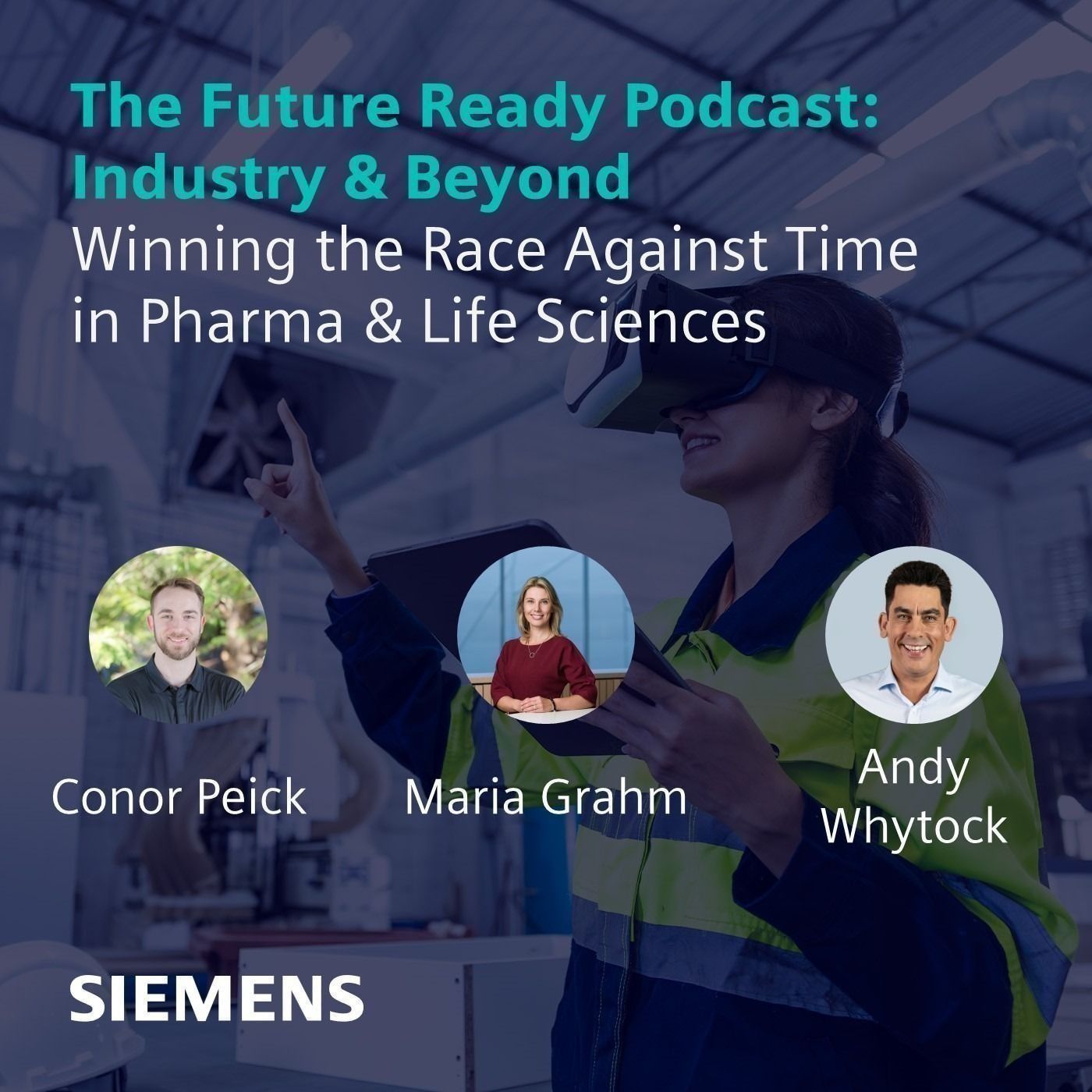
Pharmaceutical and Life Sciences companies are in a race against time in the development of new therapies. Pharmaceutical manufacturers must accelerate timelines while ensuring patient safety, maintaining data integrity and managing complexity across global supply networks.In this episode of the Future Ready Podcast from Siemens, hear experts discuss the realities and shortcomings of current development methods, explore how digitalization can deliver value and examine emerging production and distribution models.In this episode you’ll learn about: (00:00) Introduction(01:40) Pressures driving timeline acceleration(04:14) Friction in current development methods(07:51) Collaboration and the challenge of knowledge transfer(11:22) Precision medicine(15:44) Supply chain readiness for faster timelines(19:25) Distributed production modelsAbout the voices: Maria Grahm is the Global VP of Life Sciences for Siemens. Maria is responsible for managing how Siemens applies its full portfolio, including smart infrastructure, digital industries, and software, to lead digital transformation from molecule to market.Andy Whytock is the Head of Market Strategy and Thought Leadership of Life Sciences at Siemens. Andy is responsible for driving digital transformation initiatives and thought leadership activities in the pharmaceutical and life sciences sector and specializes in helping life sciences manufacturers embrace digital transformation, adopt cutting-edge technologies and evolve into fully connected, data-driven and sustainable enterprises.Conor Peick is a Marketing Professional creating forward-looking content for the Thought Leadership team at Siemens Digital Industries Software. Conor collaborates with industry experts and executives to produce impactful content exploring the challenges companies face and the technologies that can provide solutions.
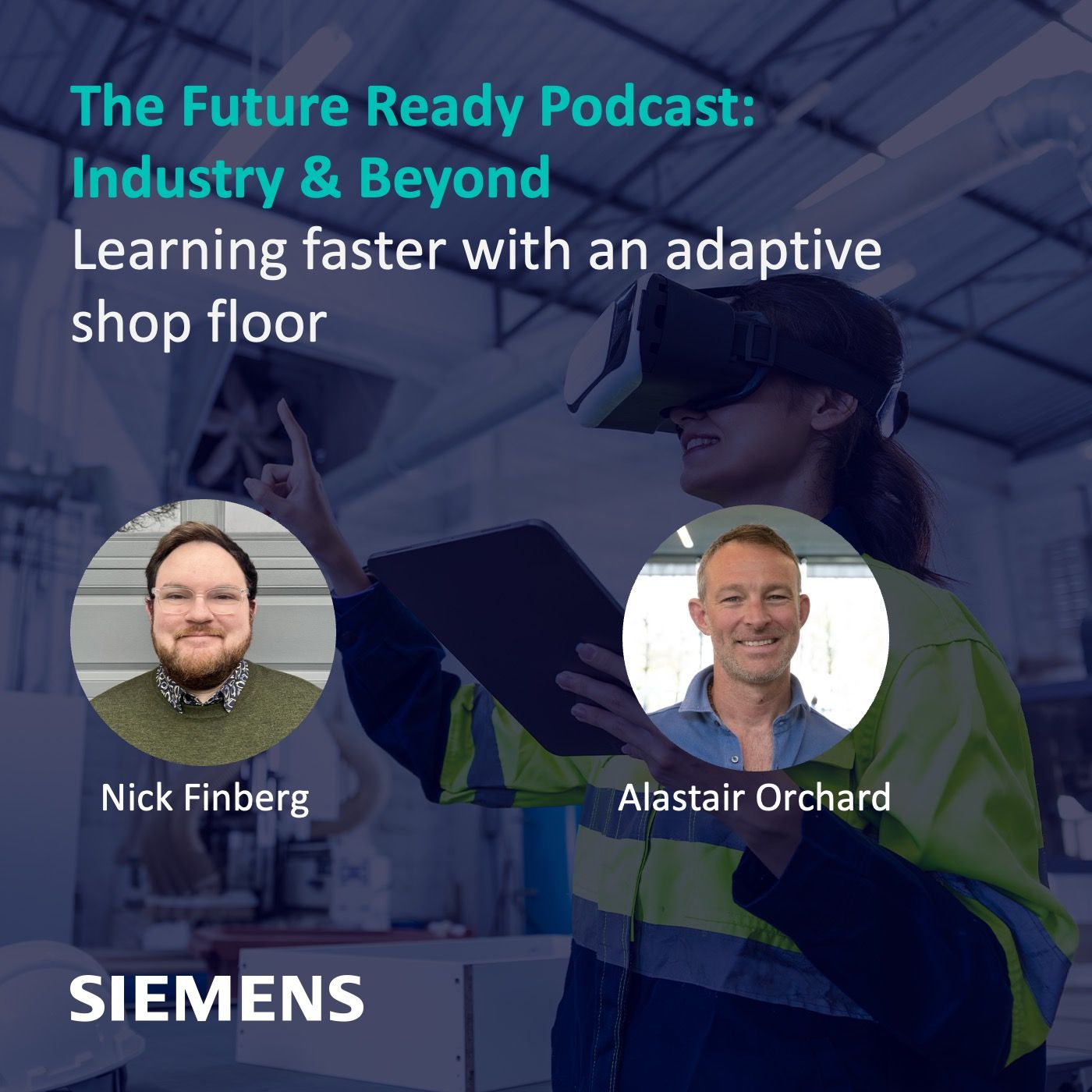
Automation is adapting and learning to use new tools, much like we and a handful of other creatures have, to get better faster than evolution would normally allow. Machines don’t have to chug along doing the same thing until decommissioning. Soon they’ll be changing with the demands of the industry they serve.For the shop floor, this advantage is built on digitalization – making variability the new status quo and ensuring it remains reliable through comprehensive validation in the digital world. To talk about this evolution and the niches businesses will be able to occupy, we brought Alastair Orchard on the show.In this episode you’ll learn about:(00:00) Introduction(01:13) Automation is adapting, not evolving (05:53) Digital twins are not mirrors(08:03) Perfecting the last twenty percent(13:05) Applying an in-depth understandingAbout the voices:Alastair Orchard runs Digital Enterprise Thought Leadership for Siemens Digital Industries, working with customers to become more flexible, cost effective, transparent and collaborative organizations. All while bringing their world-class products to market faster than their competitors. He is also the co-founder and CTO of dimax cloud – a distributed manufacturing platform cutting costs, carbon and complexity from supply chains.Nick Finberg is a technical marketing writer and coordinator for Software-Defined Everything, with a background in Nuclear Engineering. He has worked with experts to cover many industries and topics including Automotive, Battery, sustainability, and systems engineering.
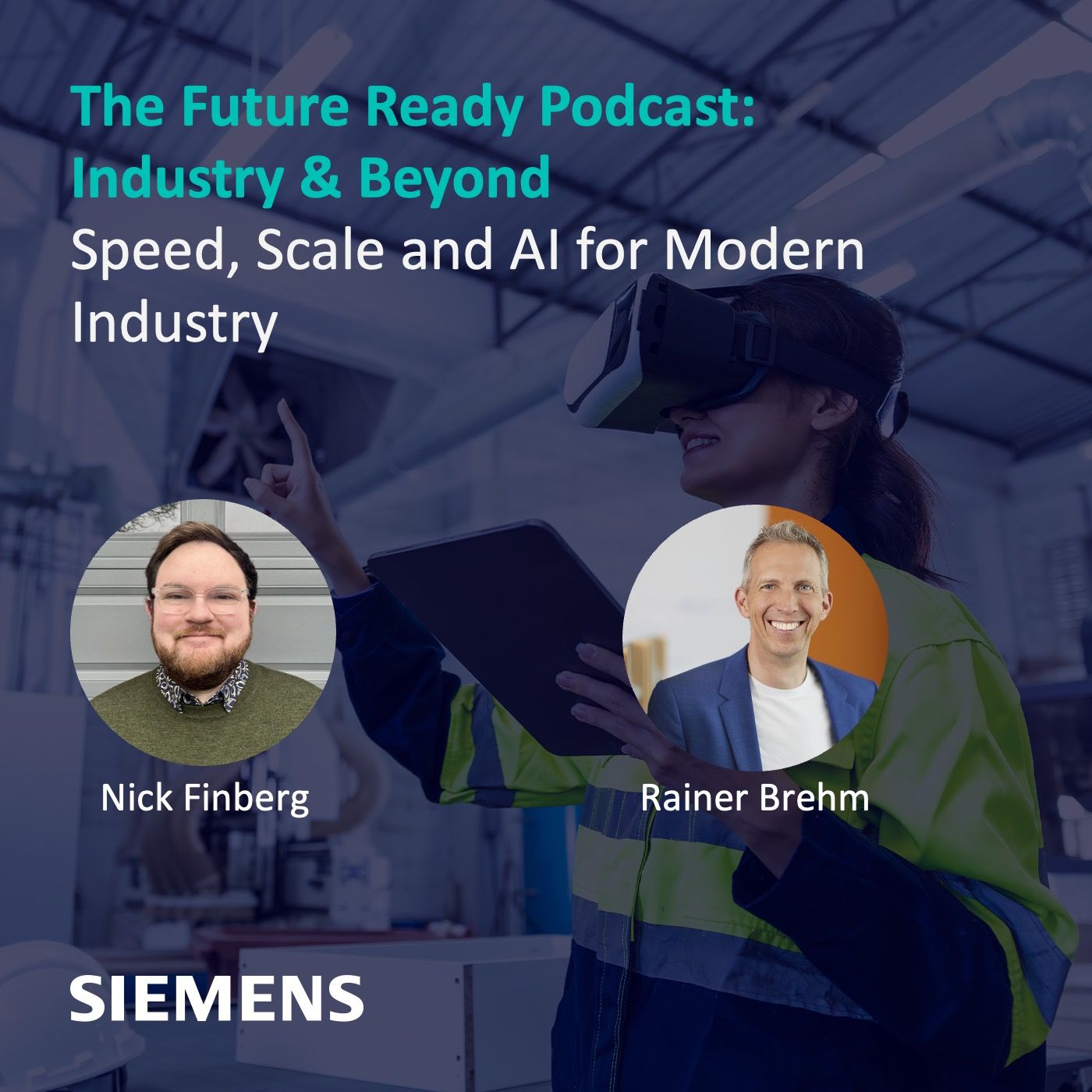
AI is moving from theory to practice on the shop floor. And it is only possible because of an accelerated workflow built on software. Whether it is generative AI powered assistants, smarter data integration or efficient deployment across both greenfield and brownfield deployments, the future of industry starts with digitalization and software. And we have Rainer Brehm to explore the topic.The flexibility of this transition, highlighted in parts one and two, extend to the how as well. Your facility can be large and stationary or remote microfactories, deployed at a moment’s notice, flexibility in a software-defined system is about understanding what works and applying it to every relevant use case as a business grows. Automation is transitioning from rule-based to goal-based, enabling systems that can adapt, optimize and execute in dynamic conditions.In this episode you’ll learn about:(00:00) When is this transformation happening?(04:30) Scaling across industries(08:05) Rule-based to goal-basedAbout the voices:Rainer Brehm is the Chief Operations Officer (COO) for the automation business and Chief Technology Officer (CTO) at Siemens Digital Industries. In these roles, he drives the strategic advancement of Siemens’ automation portfolio and leads the development of technologies such as Industrial AI and Software-Defined Automation to unlock the full potential of automation. His focus is on making production more adaptive, resilient, and sustainable. His vision is an automated automation that solves unknown tasks independently.Nick Finberg is a technical marketing writer and coordinator for Software-Defined Everything, with a background in Nuclear Engineering. He has worked with experts to cover many industries and topics including Automotive, Battery, sustainability, and systems engineering.
Connecting enterprise data is a necessary, yet challenging, step in the process of developing Industrial AI solutions to their fullest potential. Data fabrics are a key way to address this challenge, offering connection and context to enterprise data and credibility to AI-generated results. These three elements will, together, be necessary building blocks for developing highly autonomous AI agents in the future, paving the way for users to orchestrate complex workflows across multiple domains.In this episode, host Spencer Acain is joined by Tobias Malbretcht, Head of Product Management, Data & AI at Siemens Digital Industries to explore the future role of tools like RapidMiner in supporting complex agentic AI solutions for industry and what that will mean for product design and production going forward.In the episode you’ll learn about:(00:00) How data fabrics are applied to agentic AI(03:03) Building secure and trusted AI systems with data fabrics(07:00) What the future holds for RapidMinerAbout the voices:Tobias Malbretcht is the Head of Product Management for Data and AI at Siemens Digital Industries leading development for the RapidMiner AI Platform.Spencer Acain Is a technical marketing writer for AI thought leadership at Siemens Digital Industries with a background in Applied Mathematics and Mechanical Engineering.
The ChatGPT moment for robotics is here,” Nvidia boss Jensen Huang said. And nowhere is that more obvious than on the factory floor, where machines aren’t just becoming more agile, but smarter, too. Last November, Money Talks took a trip to Siemens in Germany, to tour the factories of the future.© The Economist Newspaper Limited, London 2026This is a special episode, first recorded by The Economist, to uncover the future of factories. Their crew interviewed a handful of guests including Cedrik Neike, Rainer Brehm and Stephan Schlauss.
Computers and software are becoming paramount to the future of industry, whether to automate automation engineering or expand the available design space for operational needs. Co-host Mark Hindsbo sat down to talk to the later and explain the transition happening in the world of production and manufacturing.There are so many interesting topics in the realm of operations software, but to start off it’d be best to understand exactly what that encompasses as well as some of the advantages to deploying a software-first plan. Going virtual first, means more trials with fewer costs and less capital investment – just like the gains automotive companies have made with virtual crash-testing.In this episode you’ll learn about:(00:00) Who is Mark Hindsbo(04:41) Integrating automation and operations(08:58) Defining operations softwareAbout the voices:Mark Hindsbo joined Siemens in 2025 as Head of Operations Software. He is leading a team to build an integrated and modular industrial operations software suite that allows customers to design, engineer, and operate their factories, data centers, or plants – powered by agentic AI and digital twins. His extensive career includes leadership roles at Ansys, Parallels, and Microsoft, alongside experiences at The Boston Consulting Group, Novo Nordisk, and CERN. Mark is also an Adjunct Professor at Carnegie Mellon University. Born and educated in Denmark, he holds an M.S. in Applied Physics & Mathematics from the Technical University of Denmark.Nick Finberg is a technical marketing writer and coordinator for Software-Defined Everything, with a background in Nuclear Engineering. He has worked with experts to cover many industries and topics including Automotive, Battery, sustainability, and systems engineering.
Data is the core of a good AI solution and, while data is plentiful in enterprise and industrial settings, accessing and utilizing that data for AI training isn’t so easy. In industry, data sources are often fragmented and, even if they can be easily accessed, lack the critical context needed to support robust AI usage. This is where data fabrics shine, offering a single, unified way of accessing and contextualizing all types of enterprise data.In this episode, host Spencer Acain is joined by Tobias Malbretcht, Head of Product Management, Data & AI at Siemens Digital Industries to examine the importance of data fabrics in the expanding role of AI in industry.In the episode you’ll learn about:(00:00) Introduction(02:47) What is RapidMiner?(05:14) The benefits of a data fabric for AI(08:06) Bringing context to AI training data(11:36) How data is connected to RapidMinerAbout the voices:Tobias Malbretcht is the Head of Product Management for Data and AI at Siemens Digital Industries leading development for the RapidMiner AI Platform.Spencer Acain Is a technical marketing writer for AI thought leadership at Siemens Digital Industries with a background in Applied Mathematics and Mechanical Engineering.
Digitalization is important for the future of automation, but how businesses get there is the critical discussion. It’s not about solving all problems by day one of production. Instead it is pinpointing pain points today and incrementally adopting it across the organization. Our co-host Rainer Brehm chatted with us about his perspective and the ways businesses are already adopting the technological side of digitalization.But the real gains to be made are in the changing mindset and understanding where digitalization can be deployed to bring the best returns on investment. While digitalization is partly a technological transformation, it is just as much a social one – as we’ll see with his example from Audi where engineers and operators were gaining inspiration from their peers.In this episode you’ll learn about:(00:00) How to start with SDA(09:27) Fundamental changes in production systems(13:33) Empowering operators with intelligent systemsLearn more about Docker and KubernetesAbout the voices:Rainer Brehm is the Chief Operations Officer (COO) for the automation business and Chief Technology Officer (CTO) at Siemens Digital Industries. In these roles, he drives the strategic advancement of Siemens’ automation portfolio and leads the development of technologies such as Industrial AI and Software-Defined Automation to unlock the full potential of automation. His focus is on making production more adaptive, resilient, and sustainable. His vision is an automated automation that solves unknown tasks independently.Nick Finberg is a technical marketing writer and coordinator for Software-Defined Everything, with a background in Nuclear Engineering. He has worked with experts to cover many industries and topics including Automotive, Battery, sustainability, and systems engineering.
In this first episode of the Future Ready Podcast from Siemens, we are bringing you a conversation with Rainer Brehm – the CTO and the COO of our automation business at Siemens Digital Industries. His experience and understanding of automation technologies makes him a perfect co-host for our discussions on Software-Defined Everything.This first episode aims to define that exact term so that we can continue to dive into how software-defined everything creates a foundation for the rapidly changing industrial world. We’ve got a lot to talk about in the realms of data, software, and AI, so make sure to subscribe so you don’t miss future conversations with experts from Siemens, our co-host Mark Hindsbo – Head of Operations Software at Siemens Digital Industries – and beyond.In this episode you’ll learn about:(00:00) Introduction(01:37) Automating automation(03:56) Software-defined approaches(06:10) A limit to software-defined everything(08:59) Software-defined for automationAbout the voices:Rainer Brehm is the Chief Operations Officer (COO) for the automation business and Chief Technology Officer (CTO) at Siemens Digital Industries. In these roles, he drives the strategic advancement of Siemens’ automation portfolio and leads the development of technologies such as Industrial AI and Software-Defined Automation to unlock the full potential of automation. His focus is on making production more adaptive, resilient, and sustainable. His vision is an automated automation that solves unknown tasks independently.Nick Finberg is a technical marketing writer and coordinator for Software-Defined Everything, with a background in Nuclear Engineering. He has worked with experts to cover many industries and topics including Automotive, Battery, sustainability, and systems engineering.
Comments

Download from Google Play

Download from App Store
 United States