


 Claim Ownership
Commercial Excellence with Jesse Hopps
Subscribed: 1Played: 7
Subscribe

© Copyright 2025 All rights reserved.
Description
Learn how to achieve commercial excellence from senior executives at the world’s best companies.
7 Episodes
Reverse
Summary of "The Strategy Gap"
1. The Strategy Gap Defined:
There is a disconnect in large enterprises between the high-level strategy created by elite consultants (like McKinsey or Bain) and the actual execution at the business unit level. While CEOs hire top firms to create grand strategies, those plans often fail to trickle down into actionable, practical guidance for the people responsible for delivering results.
2. The Reality of Corporate Strategy:
These high-level strategies are often generic, involving cost-cutting, restructuring, and growth targets like “12% this year.” However, business unit leaders face real-world challenges (market conditions, internal capabilities, competition) that make such goals unrealistic without clear, grounded strategic direction.
3. Fake vs. Real Strategy:
Many companies operate on what the speaker calls “fake strategy” – lists of projects or vague goals without logical, causal connections to desired outcomes. True strategy is about solving problems with a clear guiding policy and a coherent set of actions that are logically linked to results.
4. Dysfunction is the Norm:
Most large enterprises are inherently dysfunctional. They operate with matrix structures, centralized functions, and misalignment between departments like product, sales, and marketing. This dysfunction makes it harder to execute on strategic plans.
5. Solution – Collaborative Strategy Development:
Effective strategy comes from bringing together the smartest people across functions (not just the strategy department) to think critically, debate, and co-create hypotheses. This approach builds alignment and leads to more realistic and testable strategies.
6. Scientific, Root-Cause Thinking:
Good strategy is rooted in identifying the real problem, forming a guiding policy to address it, and designing actions that logically lead to the desired outcome. Like in medicine, treating symptoms (rather than root causes) leads to recurring issues.
7. Strategy Should Be Simple:
A good strategy can and should be expressed simply—ideally in one page. The analysis and data supporting it go in the appendix. If a company can’t hit its numbers, its strategy isn’t working, regardless of how elaborate the planning process is.
8. Teaching Strategy to Companies:
The goal is to teach high-potential individuals inside companies to do real strategic thinking—better than McKinsey—so that the organization can continue developing strategy independently and effectively in the future.
The discussion revolved around unlocking growth through learning, focusing on how to equip employees with the right mindset, skill set, and tool set to drive meaningful business impact. Topics included corporate transformation, resilience (AQ), grit, learning effectiveness, and motivation.
Watch the video version:
The discussion revolved around unlocking growth through learning, focusing on how to equip employees with the right mindset, skill set, and tool set to drive meaningful business impact. Topics included corporate transformation, resilience (AQ), grit, learning effectiveness, and motivation.
🎤 Summary of Points by Each Speaker
Ron Denoo
Former Chief Strategy Officer, Mitsubishi Chemical Advanced Materials
30+ years in chemicals, plastics, and composites—ranging from project engineer to CEO
Specialized in business turnarounds and corporate transformation
Led global transformation for a chemical company with 70,000 employees across 32 countries
Now runs a portfolio of musical instrument companies, merging business strategy with passion
Key Discussion Points
Corporate Transformation Failure
70–80% of transformations fail due to:
Superficial strategy (e.g., bonuses without structural change)
A sprint mindset—short-term focus instead of long-term capability building
Ignoring people—transformation is behavioral, not just procedural
Best Practices
Put employee growth first, not just business metrics
Support change with intrinsic motivation, structured learning, and behavior design
Dr. Paul Stoltz
Resilience & AQ Expert, Founder of Peak Learning
38+ years studying Adversity Quotient (AQ)
Trained 5M+ people in 137 countries, including the U.S. Olympic team
Faculty at Harvard, Stanford, INSEAD, Cornell, Carnegie Mellon, and Princeton
Key Discussion Points
Why Transformations Fail
Change is framed as resistance, rather than opportunity
Traditional models falsely assume performance dips before recovery
Employees must be trained to thrive in change, not just react to it
Power of AQ
AQ predicts:
Resilience
Innovation
Leadership
Problem-solving
Employees with high AQ:
Are more adaptable and productive
Overcome adversity faster
Show lower attrition and higher engagement
AQ > IQ or EQ in adversity
AQ enables EQ—especially in emotional regulation and trust under stress
Kurt Friedman
Strategic Sales & Coaching Expert
20+ years in revenue growth, learning, and customer experience
Co-founded 6 startups—4 successfully acquired
Advised 500+ founders and students
Key Discussion Points
The Forgetting Curve
90% of learning is forgotten in 1 week without reinforcement
Traditional methods (e.g., lectures, e-learning) are not sticky
Retention Strategies
Learning by doing: 75% retention
Teaching others: 90% retention
Use spaced learning, coaching, and real application
Guided Discovery
Ask questions instead of prescribing answers
Encourages ownership and reflects real-world decision making
Jesse Hopps
Founder of Demand Metric, Behavioral Science Advocate
Background in psychology, learning science, and motivation
Partnered with Dr. Stoltz to apply AQ and grit to growth strategies
Key Discussion Points
Traditional Training Falls Short
The issue isn’t lack of tools—it’s lack of motivation
Most training ignores intrinsic drivers
Self-Determination Theory (SDT)
People learn best when they feel:
Autonomy – freedom to choose their path
Competence – confidence and ability
Relatedness – personal relevance and connection
Real-World Learning Models
Inspired by Montessori and Fontan methods
Emphasizes project-based, self-driven learning over rote memorization
Businesses should adopt guided discovery and problem-solving approaches
🔑 Key Takeaways
Corporate transformations fail when they ignore mindset and motivation
Resilience (AQ) is the most powerful predictor of innovation and performance
Interactive, applied, and reinforced learning methods outperform traditional training
Guided discovery and intrinsic motivation create deeper engagement
Organizations must shift from “change management” to “harnessing adversity”
“This fireside chat offered a fresh perspective on growth, transformation, and learning—placing resilience and intrinsic motivation at the center of employee development.”
Hear how Demand Metric got started and how we've evolved since 2006.
Listen to Jesse Hopps as he shares his POV on why the traditional strategy consulting paradigm, dominated by the big 4, is broken.
In this episode, Jesse discusses the challenges related to building commercial capabilities at scale, and shares 6 best practices to up-skill your people.
Watch the video version below:
Listen to this interview with Dr. Paul Stoltz, the world's leading expert on human resilience and GRIT. Dr. Paul is a master coach for the US Olympic team and his Adversity Quotient (AQ) method for assessing and permanently improving how people respond to adversity is used by Harvard's MBA program, MIT's entrepreneurship program, INSEAD, Stanford, Cornell, Princeton, and Fortune 500s like Apple, Amazon, AT&T, Fedex, and many more.
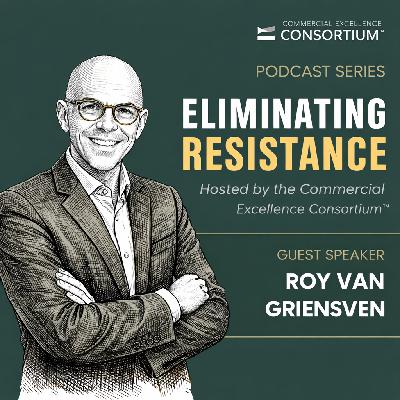
Roy Van Griensven, Head of Commercial Excellence at LANXESS, discusses his innovative approach to organizational transformation that challenges traditional change management methodologies. He explains how conventional consulting-led transformations often fail because they rely on top-down mandates and extrinsic motivation, leading to passive resistance from employees.
Instead, Roy advocates for a servant leadership approach that focuses on intrinsic motivation through structured autonomy, psychological safety, and bottom-up engagement. His method involves inspiring people with possibilities, creating safe environments for reflection on challenges, and then supporting employee-driven projects that align with business objectives.
The conversation covers the importance of adaptive capacity as a leading indicator, the shift from managing change to changing management approaches, and how to create sustainable behavioral change by involving people in designing solutions rather than imposing them.
Roy emphasizes that people don't resist change itself, but rather the feeling of being changed by others, and argues that leaders should take accountability for transformation failures rather than blaming employee resistance.
Comments

Download from Google Play

Download from App Store
 United States