DiscoverThe Academy Now
The Academy Now
Claim Ownership

The Academy Now

Author: Adewale Babalola

Subscribed: 0Played: 0
Share

Description

The ancient Philosopher, Plato, was a tool that helped navigate the ancient, and his timeless philosophy will help do that better now! Because he was to know: how could a society get better at producing not military power but eudaimonia? Applied to our age: how could the world get better at generating not compute mastery but delighted industrial revolution? How could digital technologies reliably help us to flourish?


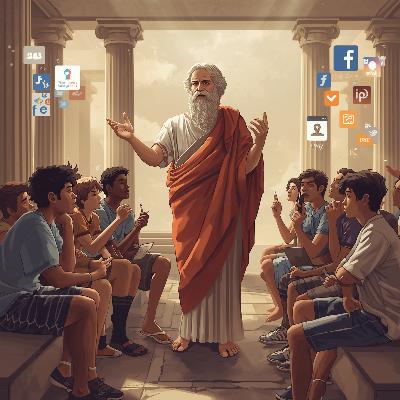
By positioning ourselves at the intersection of the ancient and the digital age, the podcast draw on Plato to address key questions concerning the nature of a flourishing enterprise and community, education and development, healthcare and wellness, love and friendship, reality, and art.


Hence , drawing from Plato Philosophy, this podcast makes clear that issues exacerbate in the digital age with inherently dramatic form, to pour forth profound elucidation about digital innovation and investment, regulation, and policy making of the socio-technical system, and tech subscriptions and user experience.


Contact or/and follows: 


Mail: theacademy.now01@gmail.com


WhatsApp: +2347064920564


Facebook: The Academy Now


Instagram: @the_academy_now


Tiktok: @the.academy. now


YouTube: @TheAcademyNow

5 Episodes
Reverse
Using Plato’s Laws as a mirror, this episode argues that organizing society around rivalry and victory—now translated into AI supremacy—reshapes law, education, and everyday life in worrying ways. AI amplifies both strengths and weaknesses, turning surveillance, manipulation, and disinformation into routine tools and intensifying internal civil strife fought through information systems. The antidote, Plato suggests, isn’t purely technical but moral and political: wisdom-shaped education, transparent law, and responsible “guardians” who pair competence with character. The episode asks who will steer powerful AI—appetite or wisdom—and what governance choices can protect freedom and civic trust.
We translate Plato’s Lysis into the world of apps, followers, and DMs to ask: what is friendship when platforms shape how we connect? Socrates interrogates familiar answers—likeness, need, usefulness, loving the good—and shows why none fully capture friendship’s depth. This episode traces how algorithms, parasociality, and subscription-like incentives warp relationships, then offers practical questions and virtues to rebuild real, durable friendships online.
What Is Data?

What Is Data?

2026-02-1811:18

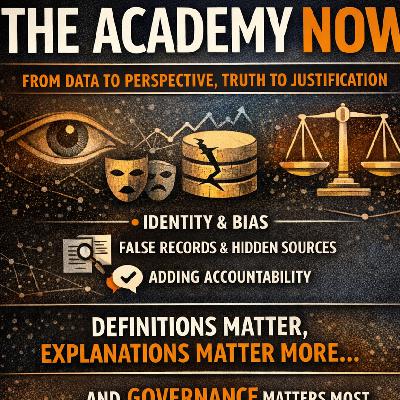
We take Plato’s Theaetetus into the age of AI and ask a simple question with complicated consequences: what is data? Walking through three Socratic attempts—cataloguing examples, calling data “perception,” and treating data as true belief—we expose how each definition breaks and what that reveals about measurement, error, and authority in modern systems. The episode shows how perception ties data to perspective, how “true judgment” fails when identity, proxies, stale records, or inaccessible sources produce false conclusions, and how adding an “account” (explanation) raises standards—and political questions—about who can justify decisions. Concise and provocative, this conversation turns a philosophical knot into a practical checklist for builders, policymakers, and everyday users: definitions matter, explanations matter more, and governance matters most. Share your one‑sentence definition of data and join the next episode where we interrogate what counts as an adequate account in AI, regulation, and product design.
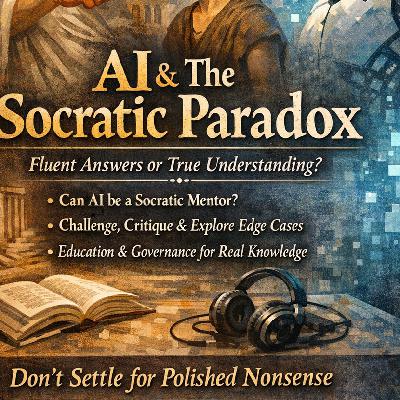
This episode uses Plato’s Meno and Socrates’ questioning of a slave boy to probe a modern paradox: generative AI can produce fluent answers, but without internal standards and judgment users may accept wrong or shallow outputs and lose the struggle that builds real understanding. We argue AI is most useful as a Socratic partner—ask it for critiques, edge cases, and alternative views—while still practicing skills unaided; and we call for education, governance, and professional norms so society can tell true knowledge from polished nonsense.
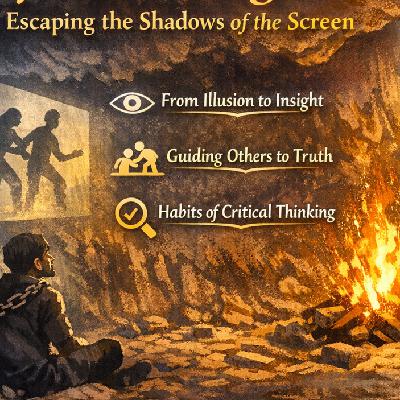
This episode reimagines Plato’s allegory of the cave for our digital age, arguing that screens, feeds, and AI-generated content often function as convincing shadows that distort reality. It explains how representation, incentives, and design can keep us mistaking curated projections for truth, and why genuine understanding requires turning from appearances toward causes. More than critique, the episode calls for a philosophically informed approach to technology: education as reorientation, responsibility to guide others toward clearer sight, and practical habits for testing what we see online. It ends with a challenge to step closer to the fire—and then beyond it.
Comments 
loading