


 Claim Ownership
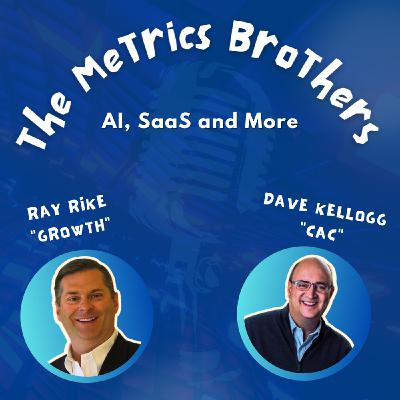
The Metrics Brothers
Subscribed: 68Played: 742
Subscribe

Description
The Metrics Brothers is hosted by Dave "CAC" Kellogg and Ray "Growth" Rike. The Metrics Brothers provides unique insights, strategies, tactics, and metrics that are relevant to AI-Native software and SaaS companies.
Each 25-30 minute episode will cover a topic critical to leading a B2B software company, and chock-full of practical advice that can be introduced and applied in most Native-AI, Agentic AI, and B2B software and SaaS companies.
116 Episodes
Reverse
One word can reveal a lot about someone's analytical depth, and on this episode of The Metrics Brothers, Dave "CAC" Kellogg and Ray "Growth" Rike break down one of the most commonly misused pair of terms in metrics analysis: segments and cohorts.Dave shares what sparked this topic, a Norwest benchmark report that used the word "cohort" when it clearly meant "segment," and explains why the mix-up matters far more than a simple vocabulary error. In this episode, Ray and Dave cover:Segments vs. Cohorts Defined: A segment is a slice of data defined by a shared attribute such as company size, vertical, or deal size. A cohort is a group anchored to a shared event and tracked over time, such as all opportunities created in Q1 or all customers acquired in a given year. The two are orthogonal concepts, not synonyms, and confusing them can signal a lack of the numerical fluency that sharp operators and investors expectSnapshot vs. Cohort Analysis: Standard dashboard win rates are fast and stable, but they only capture what crossed the finish line in a given period with no visibility into where those deals came from or how long they were in the pipeline. Cohort analysis rides along with a group of opportunities from creation to resolution, revealing how process and personnel changes actually affect outcomes over timeWin Rates and Pipeline Coverage: Ray walks through a real example where cohort-based win rate analysis exposed a breakdown in discovery quality after a Q3 process change, something a standard dashboard completely masked. Dave explains why pipeline coverage goals should not simply be calculated as the inverse of a snapshot-based win rate, and how close rate (a cohort-based metric) gives a more accurate picture of both yield and timingNRR, GRR, and Customer Expansion: Dave makes the case that tracking ARR by customer acquisition cohort over time is far more predictive of long-term retention and expansion behavior than NRR alone, which only looks back one year. Ray adds how cohort analysis helped him identify a high-value expansion window between months 18 and 30 of the customer lifecycle, enabling smarter allocation of sales resources towards existing customersCombining Both for Maximum Insight: The most powerful approach is a segmented cohort analysis, tracking time-based behavior across meaningful attribute-based cuts of your customer or pipeline data. Segments tell you what kind of customer. Cohorts tell you what happened over time. Together, they tell the full story.If you use metrics to help inform decisions in your company, and have a goal to help build a culture of numeracy in your company, this is a great listen!See Privacy Policy at https://art19.com/privacy and California Privacy Notice at https://art19.com/privacy#do-not-sell-my-info.
The Metrics Brothers, Dave Kellogg and Ray Rike open with their introductory bit, which this week included Statler and Waldorf, the grumpy old men in the balcony from the Muppets, before diving into a thorough review of the Norwest B2B Sales and Marketing Benchmark Report, a102-page study published in November 2025, that included 177 participants (77 Norwest portfolio, 100 third-party VC/PE-backed).Key Topics Covered:Overall Report Assessment: Praised for its breadth, year-over-year trend data, and even split of marketing (40%), sales (42%), and combined (18%) respondentsMarketing Budgets: Smaller companies ($5M–$15M ARR) saw dramatic budget cuts — down from $3.3M to $825K, nearly a 75% decreaseTop GTM Challenges in 2025: #1: Positioning product as a "must have" — 44%, up 6% YoYRevenue Re-Forecasting: 66% of respondents changed their revenue plan mid-year; 43% increased it (down from 48% prior year), while 23% decreased (up from 18%)Renewals Ownership Shift: Customer Success owned renewals 56% of the time in 2023 — now just 29% in 2025MQL Scoring Model Collapse: Use of formal scoring models (demographic fit + engagement)Top Marketing KPIs: #1: Dollar value of opportunities (pipeline) was number one metric at 56%CAC & Cost-Per-Lead Awareness - The "Bonus" Topic: 45% of respondents didn't know their CAC; 41% didn't know their cost per leadClosing Recommendations: Both hosts recommend reading the report, including pages 80–98 covering AI adoption in sales and marketing, that they were not able to cover in this episodeIf you are a GTM executive leading a software company or the CFO responsible for driving revenue growth and profitability - this episode and the associated report is a great source of insights!See Privacy Policy at https://art19.com/privacy and California Privacy Notice at https://art19.com/privacy#do-not-sell-my-info.
For more than a decade, the Rule of 40 has been the gold standard for measuring SaaS performance:Growth Rate + Profit Margin ≥ 40But in today’s environment of higher interest rates, multiple compression, private equity leverage, and AI-driven cost pressures, that benchmark may no longer be enough.In this episode of the Metrics Brothers, Ray “Growth” Rike and Dave “CAC” Kellogg explore why many investors and operators are now targeting something far more ambitious:The Rule of 60.Dave walks through the history of SaaS economics, from the growth-at-all-costs era, to the rise of balanced metrics after 2015, to the capital reset that began in 2022. The discussion then shifts to the math driving today’s expectations: if private equity firms buy companies at high multiples but must sell them later at lower multiples, Rule-of-40 performance simply doesn’t always generate acceptable returns.In many leveraged SaaS deals today, hitting Rule of 60 can be the difference between a 1.1x return and a 3x outcome.Ray and Dave also dig into how the Rule of 40 is evolving in practice, including:Why growth still matters far more than margin in valuation modelsHow companies organically converged on the “20/20” Rule-of-40 profileWhy PE investors increasingly expect Rule-of-60 performanceThe impact of debt service, CAC inflation, and AI cost structuresWhy achieving Rule of 60 often requires radical operational changesThe takeaway: this isn’t a temporary metric trend.For many SaaS companies, the math of modern software investing now demands it.One interesting comment that reflects the reality of the Rule of 60, especially for companies that have been funded with leverage debt is: “This isn’t a fad. The math of the deal breaks without it.”See Privacy Policy at https://art19.com/privacy and California Privacy Notice at https://art19.com/privacy#do-not-sell-my-info.
In this episode, Dave "CAC" Kellogg and Ray "Growth" Rike go point-counterpoint on two high-profile articles making waves across Wall Street and Silicon Valley: Citrini's provocative February 2025 report, The 2028 Global Intelligence Crisis, and Citadel's rebuttal, The 2026 Global Intelligence Crisis.Dave and Ray unpack whether AI is truly triggering an unprecedented economic collapse or whether Citrini's dark simulation is, as one economist put it, just "a scary bedtime story." They dig into the SaaS private credit contagion theory, the historic parallels of labor displacement, the role of government regulation, and why this particular AI scare hits closer to home than any previous tech disruption. As always, the brothers bring the receipts, including nearly 20 sources and 20 hours of research - so you don't have to.Full Episode Summary:Dave Kellogg and Ray Rike open by framing the episode as a tale of two AI futures: Citrini's alarming speculative simulation versus Citadel's data-driven rebuttal.The Citrini Case (Bear Case): Published February 22nd, Citrini's report simulates a scenario in which rapid AI agent adoption triggers a global intelligence crisis by mid-2028 featuring 10.2% unemployment and a 38% drop in the S&P 500. The report argues AI is categorically different from prior technology waves because it displaces cognitive workers, who represent roughly 75% of U.S. labor income.Citrini further warns that SaaS, already accounting for 23% - 25% of the $3 trillion U.S. private credit market could become the chip in the windshield that cracks the broader financial system, with ripple effects into insurance and the broader economy. Dave and Ray note that Citrini's word choices ran 3.4-to-1 negative, and flag that the firm may hold short positions — characterizing the piece as well-crafted "bear porn."The Citadel Rebuttal (Bull Case): Two days later, Citadel, a $65B AUM asset manager with 35 years of credibility responded with a data-driven defense. Software engineering jobs are up since January 2024, AI CapEx is 2% of GDP and AI-adjacent commodity pricing is up 65%. Citadel argues AI follows historical S-curve adoption patterns, that "recursive capability doesn't equal recursive adoption," and that technology has always complemented rather than replaced labor - pointing to Microsoft Office as a historical analogue.Dave and Ray's Take: Both hosts find Citadel more credible, but acknowledge real displacement risks ahead. Their key insight: the reason this particular AI scare is generating 10x more fear than past labor disruptions (auto workers, telephone operators, elevator operators) is that this time it's us — white-collar knowledge workers facing displacement. Ray adds that blue-collar jobs (truck drivers, Uber drivers, warehouse workers) face equal or greater long-term risk from AI plus robotics, but those disruptions don't generate the same visceral fear in the media and investor class. Both agree the timing of adoption is the biggest unknown. Long-term, history favors the Citadel view. Short-term, the transition could be painful.On Government Response: Dave and Ray agree that political and regulatory intervention is inevitable if unemployment spikes materially, whether through labor protections, AI regulation, or fiscal stimulus.On Economists' Reactions: Real economists, including Noah Smith (Noahpinion) and Wharton's Jeremy Siegel, largely dismissed the Citrini piece, wi Siegel arguing that productivity gains generate new income and demand, Smith calling it a "scary bedtime story." Dave's takeaway for operators: let the Metrics Brothers do the 20 hours of reading so you don't have to.See Privacy Policy at https://art19.com/privacy and California Privacy Notice at https://art19.com/privacy#do-not-sell-my-info.
In this episode, the Metrics Brothers, Dave "CAC" Kellogg and Ray "Growth" Rike dive deep into the ICONIQ State of AI: Bi-Annual Snapshot Report. Published in January 2026, this 44-page report summarizes insights from ~300 software executives on the front lines of building and scaling AI products.Ray and Dave explore a market transition from experimental model races to the challenge of building durable, economically sound products. Key discussions in this episode include:Differentiation Beyond the Model: Why 69% of builders are focusing on vertical AI applications and why 49% cite the application layer (UX and workflows) as their primary competitive edge over the underlying model.The Gross Margin "U-Curve": A look at the shifting economics of AI, where aggregated gross margins are projected to climb to 52% by 2026, even as inference and infrastructure costs remain significant hurdles.Pricing Evolution: The rise of outcome and usage-based pricing, with only 23% of companies still relying on seat-based models as customer demand shifts toward value-aligned monetization.AI as an Internal Force Multiplier: How R&D teams are leading internal adoption, with 83% of companies now measuring success through productivity gains and 59% through direct cost savings.Whether you are a CEO or CFO navigating AI product gross margin concerns or a GTM leader rethinking your proof-of-concept strategy, this episode provides the benchmarks you need to understand the "new phase of maturity" in the AI market.See Privacy Policy at https://art19.com/privacy and California Privacy Notice at https://art19.com/privacy#do-not-sell-my-info.
In this extended episode, the Metrics Brothers tackle the "elephant in the room" - the SaaSpocalypse. With nearly $1 trillion in market value wiped out recently, Ray and Dave go beyond the stock market headlines to analyze the structural shifts hitting the industry.The duo breaks down the three primary drivers of the current market "carnage", including the AI Fear of Being Obsolete (FOBO), Regression to the Mean for SaaS stocks and Changing Valuation Methodologies, before diving into the newly released Aviner report, The Future of SaaS: A Fork in the Road. Using Aviner’s "Red Pill vs. Blue Pill" metaphor, they debate whether SaaS companies must fundamentally pivot to "agentic" systems or accept maturity and financialize by focusing on profitability.Covered in This Episode:The SaaSpocalypse Explained: Why the stock market is currently a "rugby scrum of information" and why stock price is a measure of future expectations rather than current healthServiceNow as a Bellwether: An analysis of how a "Rule of 56" company can beat expectations and still see a 30% stock drop in a single month.FOBO (Fear of Being Obsolete): How the "revenge of build vs. buy" and the collapsing cost of coding are demoting traditional SaaS apps to mere systems of record.The Aviner Report Breakdown:Part 1: The hard data on slowing revenue growth (cut from 40% to 20%) and the "aberration" of 2019–2021 multiples.Part 2: The binary choice between embracing AI "Systems of Context" or financializing for net income.The "Architect Strategy": Ray’s argument for a third path where SaaS companies coexist with AI by providing the governance and orchestration layerBuyer Sentiment vs. Market Narrative: Why 63% of software buyers believe existing vendors will be the beneficiaries of AI, contradicting the current "SaaS is dead" stock market trend.Key Metrics & Concepts MentionedRule of 40 vs. Rule of 60: How the standard for SaaS health is shiftingStock-Based Compensation (SBC): Why excluding this from profitability metrics is no longer passing the "financialization" testThe Three-Layer Taxonomy: Systems of Record, Systems of Engagement, and Systems of ContextMultiple Compression: The shift from 15x revenue multiples back to the historical 5x meanResources MentionedReport: The Future of SaaS: A Fork in the Road by Aviner Growth (Jan 2026).Book: The Reckoning by David Halberstam.Book: Profit Pools by Orit Gadiesh and James L. Gilbert.See Privacy Policy at https://art19.com/privacy and California Privacy Notice at https://art19.com/privacy#do-not-sell-my-info.
In this episode of the Metrics Brothers podcast, Ray Rike and Dave Kellogg tackle one of the most critical yet misunderstood metrics in the U.S. economy: Labor Productivity. Amidst the rapid rise of Artificial Intelligence, the "Metrics Brothers" break down how productivity is officially measured by the Bureau of Labor Statistics and why historical technology booms, from SaaS to Cloud, haven't always moved productivity growth as much as expected.Key Takeaways: A deep dive into the ratio of economic output per hour worked, including what the BLS excludes (farms and government) and the nuances of white-collar labor tracking.Historical Trends: A comparison of the post-war boom versus the "SaaS era," exploring why the last 20 years have seen a 66% relative decrease in productivity growth despite trillions in tech investment.The AI Impact: Three potential scenarios for the future of work, from "exploding output" to "labor displacement," and why AI might fundamentally remake work in ways the Cloud never did.Global Benchmarking: How the U.S. stacks up against leaders like Ireland and Norway in output per hour.Why Listen? Whether you are a SaaS leader, investor, or white-collar professional, this episode provides a roadmap for staying on the "right side of the divide" in the upcoming AI-driven economic shift.See Privacy Policy at https://art19.com/privacy and California Privacy Notice at https://art19.com/privacy#do-not-sell-my-info.
Brand is one of the most powerful assets a company can build and one of the hardest to measure. In this episode of The Metrics Brothers, Dave “CAC” Kellogg, and Ray "Growth" Rike take on one of marketing’s most persistent challenges: how to measure brand in a world obsessed with direct attribution and near-term ROI.The conversation starts with what a brand really is, originating from literal marks of ownership and evolving into a promise of quality, trust, and differentiation. From there, Ray and Dave explore why strong brands create pricing power, customer loyalty, category leadership, and long-term defensibility, even if those benefits do not always show up cleanly in dashboards.They then break down practical ways to measure brand that align marketing and finance perspectives, including indirect valuation approaches such as brand value and goodwill frameworks, along with comparative metrics like direct and branded web traffic, share of voice, share of search, and inbound pipeline contribution. The episode also covers market research fundamentals including awareness, consideration, trial, and repurchase, and why dedicating a portion of your marketing budget to measurement is essential to sustaining brand investment.Finally, the Metrics Brothers dig into brand measurement techniques that work in practice, including self-reported attribution, lift experiments, and analyzing sales conversations to see how brand shows up late in the buying process, often at the exact moment a deal is won.If you have ever struggled to align brand investment with measurable outcomes, justify brand spend alongside demand generation, or connect long-term brand building to real business results, this episode provides a grounded, metrics-driven framework for doing exactly that.See Privacy Policy at https://art19.com/privacy and California Privacy Notice at https://art19.com/privacy#do-not-sell-my-info.
The State of Generative AI in the Enterprise 2025In this episode of The Metrics Brothers, Ray Rike and Dave Kellogg break down the 2025 State of Generative AI in the Enterprise report from Menlo Ventures and explain what the data really says about where enterprise AI adoption is accelerating and where the market is consolidating.The headline takeaway: AI software is scaling faster than any software category in history. Enterprise AI spend has exploded from roughly $1.7B in 2023 to nearly $37B in 2025, reaching scale in just three years. This revenue milestone took SaaS more than 15 years to achieve. Foundational models now represent the single largest area of spend, highlighting how infrastructure and model access remain core to enterprise AI strategies.Ray and Dave also explore a major strategic shift inside the enterprise: buy is decisively beating build. In 2025, 76% of enterprise AI solutions are purchased rather than built internally, up sharply from 53% the year prior. Rapid model evolution, ongoing retraining costs, and model drift are making internal AI development far more expensive to maintain than many teams originally expected.One of the most surprising findings is on go-to-market efficiency. AI software pilots convert to production at nearly twice the rate of traditional software, with roughly 47% of AI pilots reaching production versus about 25% for conventional enterprise software. This runs counter to recent narratives suggesting enterprise AI pilots are stalling and points to clearer ROI and faster time-to-value.The episode also dives into what Menlo calls the first true “AI killer app”: AI-assisted coding. Coding tools now account for more than half of departmental AI spend, with over 50% of developers already using AI coding assistants and adoption exceeding 65% among top-quartile teams. Real-world examples show meaningful productivity gains, including double-digit increases in development velocity and significant time savings during legacy system upgrades.Industry-wise, healthcare emerges as the largest buyer of vertical AI, representing 43% of vertical AI spend. This is notable given healthcare’s historically lower IT spend as a percentage of revenue. Much of the value is coming from administrative automation such as medical scribing, where AI directly reduces non-clinical workload and unlocks meaningful productivity gains for care providers.Finally, Ray and Dave examine the shifting competitive landscape among foundation model providers. Anthropic has surged to roughly 40% share of enterprise AI usage, up dramatically from prior years, while OpenAI’s share has declined as Google continues to gain traction. The discussion centers on focus versus breadth and why enterprise positioning and reliability may matter more than consumer mindshare.Key takeaways from the episode:AI software is the fastest-scaling software category everEnterprises are rapidly moving from build to buyAI pilots convert to production at nearly 2x traditional softwareAI coding is emerging as the first true enterprise AI killer appAnthropic’s enterprise focus is translating into meaningful market share gainsIf you care about how AI adoption actually translates into spend, productivity, and competitive advantage inside large organizations, this episode is a must-listen.See Privacy Policy at https://art19.com/privacy and California Privacy Notice at https://art19.com/privacy#do-not-sell-my-info.
The claim that “95% of AI projects fail” has become one of the most repeated talking points in enterprise AI. But where did it come from, and does it actually hold up?In this episode, Dave "CAC" Kellogg and Ray "Growth" Rike take a detailed, data-driven look at the MIT NANDA report, titled The GenAI Divide: State of AI in Business 2025. They break down how the "95% fail rate" statistic went viral, why it stuck, and why the underlying evidence does not support such a sweeping conclusion.What Ray and Dave cover:Why the NANDA report is often mistaken for a peer-reviewed academic study when it is notHow ambiguous definitions of “failure” turn partial adoption into sensational headlinesData inconsistencies and methodological gaps that undermine the 95% claimThe difference between failed AI initiatives and early-stage pilots or experimentsWhy measuring AI success by the percent of projects is misleading compared to the business value createdThe rise of Shadow AI and employee-driven adoption, and why that may be a feature, not a flawHow the report’s conclusions conveniently align with the authors’ proposed NANDA architectureThe real issues enterprises face with AI: workflow integration, governance, and change managementThe episode also discusses why personal productivity gains still matter to the P&L, even if they do not appear as a clear line item, and why fear-driven AI narratives can do real damage within organizations.Key takeaway: The NANDA report raises some legitimate concerns about scaling AI from pilot to production, but the infamous “95% of AI projects fail” claim does not survive close inspection. Leaders should read the report skeptically and push back when flawed statistics begin to drive decisions and strategy.Recommended for: CFOs, operators, AI leaders, and anyone tired of scary AI statistics that fall apart under scrutiny.See Privacy Policy at https://art19.com/privacy and California Privacy Notice at https://art19.com/privacy#do-not-sell-my-info.
Brand vs Demand: Why B2B Marketing Is Stuck in a Measurement TrapIn this episode of The Metrics Brothers, Dave "CAC" Kellogg and Ray "Growth" Rike tackle one of the most persistent and controversial questions in B2B marketing: Brand vs. Demand.The discussion is grounded in new data from the 2026 B2B Brand vs Demand Benchmark Report. While most marketing teams say they believe brand and demand are complementary, the numbers tell a more complicated story.Today’s reality?Marketing budgets are still heavily skewed toward short-term demand generation, with roughly 70% of spend allocated to demand and only ~25% to brand. Yet when asked how they want to invest, marketing leaders overwhelmingly say they’d prefer a much more balanced future, closer to 50% demand and 40% brand.So why the disconnect?Ray and Dave dig into the root cause: measurement.Demand generation is tied to metrics CFOs understand like pipeline dollars, opportunities, and ARR. Brand, on the other hand, is still largely measured using proxy metrics like website traffic and awareness, leaving many executives unable to confidently link brand investments to revenue outcomes. Only 28% of companies say they can directly tie brand activity to pipeline, and when budgets are cut, brand is sacrificed five times more often than demand.The episode also explores:Why performance marketing struggles are pushing CMOs back toward brandThe growing inefficiency of demand spend aimed at “future buyers”How much of the “demand” budget is effectively unmeasured brand spendThe dangerous gap between belief in brand and proof of impactWhy AEO, AI search, and LLM visibility will make brand ROI even harder and more urgent to measureRay and Dave don’t just highlight the findings, they discuss the reality of Chief Marketing Officers making the Brand vs Demand budget allocation trade-offs.One key takeaway? Until brand investments can be credibly connected to pipeline efficiency, win rates, and ARR, it will remain more a faith-based investment instead of a financial one the CFOs understand.If you’re a CMO trying to defend brand spend, or a CFO trying to understand where marketing dollars truly drive growth, this episode is required listening.See Privacy Policy at https://art19.com/privacy and California Privacy Notice at https://art19.com/privacy#do-not-sell-my-info.
In this episode of The Metrics Brothers, Dave "CAC" Kellogg and Ray "Growth" Rike break down the 2025 Tidemark Vertical & SMB SaaS Benchmark Report. Drawing from data across 200+ companies, the report explores control points, multi-product expansion, fintech monetization, and AI adoption, but not all conclusions hold up under scrutiny as they are sometimes take on the tone of a narrative summary rather than insights purely from data-backed research.Ray and Dave dig into what the data actually supports versus where narrative may be running ahead of evidence. They unpack the concept of “control points,” examine why fintech (especially payments) continues to dominate expansion strategies, and challenge whether multi-product really delivers the retention and growth advantages many assume. Along the way, they highlight where benchmarks are useful, where definitions blur, and why context matters more than ever.The episode also explores the rapid rise of AI inside Vertical SaaS, from attach rates to monetization models and asks the hard question: "Does AI actually drive better performance, or is it simply becoming table stakes?" If you’re building, investing in, or operating a vertical SaaS business, this episode helps separate signal from story.See Privacy Policy at https://art19.com/privacy and California Privacy Notice at https://art19.com/privacy#do-not-sell-my-info.
In this episode of The Metrics Brothers, Ray Rike and Dave Kellogg unpack Benedict Evans’ latest landmark presentation, AI Eats the World, and explore why this moment may rival or even surpass the original “software is eating the world” era. Drawing parallels to Marc Andreessen’s 2011 thesis, they examine how AI is no longer just another platform shift, but a force capable of reshaping labor, capital allocation, and entire industries at once.The conversation spans the explosive rise in AI infrastructure spending, from hyperscaler capex surging past $400B to the growing strain on power, compute, and supply chains. Ray and Dave discuss why this moment feels different from past tech cycles, not just because of scale, but because AI directly targets labor, which represents more than half of global GDP. They explore whether AI is creating real moats or accelerating commoditization, and why many enterprises are still stuck in experimentation rather than true deployment.The episode also dives into historical parallels from elevators and telephone operators to cloud computing highlighting how software enabled automation always feels threatening before it quietly becomes invisible. Along the way, they unpack the strategic tension facing AI leaders: go down the stack for scale or up the stack for value capture. With insights on hyperscalers, OpenAI, Oracle, and the economics of AI adoption, this episode challenges leaders to rethink how value will actually be created and captured in the age of AI.If you want to understand what’s hype, what’s durable, and why “AI eating the world” may be the most consequential shift since the internet itself, this episode is a must-listen.See Privacy Policy at https://art19.com/privacy and California Privacy Notice at https://art19.com/privacy#do-not-sell-my-info.
In this episode of The Metrics Brothers, hosts Ray “Growth” Rike and Dave “CAC” Kellogg provide a critical deep dive into the 2025 SaaS Benchmark Report published by High Alpha. Known for their analytical, and sometimes "crusty" approach, the metrics brothers dissect the data behind 800+ SaaS companies to separate real market trends from report commentary.Key Highlights & BenchmarksThe brothers break down the report’s most significant findings with their signature skepticism regarding "correlation vs. causation."The AI Growth Premium: Companies with AI at their core are growing significantly faster than those using AI as a supporting feature. For instance, in the $1–5M ARR band, AI-core companies achieved a median growth of 110%, compared to 40% for their peersThe "Lean Team" Era: Efficiency is surging as headcount falls. Median revenue per employee has jumped to $129K–$173K, with top-tier public companies hitting over $283K. The hosts note that engineering and support have seen the largest headcount reductions due to AI automationVenture Rebound (with a Caveat): While quarterly VC deal value has returned to near 2021 levels (~$80B), the capital is highly concentrated. Over half of all VC funding is currently flowing into AI startups, often in massive "mega-rounds."In-Office vs. Remote: For the second consecutive year, the data suggests that in-office or hybrid teams are growing faster (42% median) than fully remote teams (31% median).As always, Ray and Dave offer practical advice for founders and GTM leaders:"Read the data, but watch out for the commentary." While the data is good, some commentary and conclusions in the report imply causation where there is at best some level of correlation, such as why companies stay private longer or how AI "drives" growth.Retention is King: The strongest growth outcomes are found where high Net Revenue Retention (NRR) meets short CAC payback periods.Outcome-Based Pricing: The brothers highlight the shift toward outcome-based and hybrid pricing models as a primary driver for best-in-class NRR in 2025.See Privacy Policy at https://art19.com/privacy and California Privacy Notice at https://art19.com/privacy#do-not-sell-my-info.
In this episode of The Metrics Brothers, Ray “Growth” Rike and Dave “CAC” Kellogg take on one of the biggest challenges facing modern SaaS and AI-Native companies: how to measure NRR and expansion when pricing isn’t fixed anymore.With the rise of usage-based, user-based-but-variable, and outcome-based pricing, the traditional world of ARR - long the backbone of SaaS metrics has been turned on its head. Contracts no longer tell the story. Spend does.Dave breaks down how to rethink ARR proxies using quarterly or monthly revenue (“implied ARR”) and why longer intervals help smooth volatility, especially for “humpback” or highly seasonal customers whose spend fluctuates dramatically month-to-month.Ray digs into what NRR was originally designed to measure and why many teams misinterpret it—especially in variable-pricing environments where a backward-looking metric can’t serve as a forward-looking forecast. The brothers explain why sequential expansion, usage behavior, and real spend patterns now matter far more than traditional ARR bridges.Key topics include:Why ARR no longer maps cleanly to revenue in a variable pricing worldHow to calculate implied ARR using quarterly or monthly software revenueWhy NRR must be interpreted differently—and why survivor bias still mattersHow volatility and seasonality distort short-interval metricsWhy usage is the real leading indicator, not invoicesHow to rethink “expansion ARR” when base + variable spend changes continuouslyPacked with examples, including sinusoidal customers, misleading GRR math, and the dangers of splitting base versus variable revenue, this episode gives operators and investors a practical framework for measuring customer growth when pricing is anything but predictable.A must-listen for CFOs, RevOps leaders, and anyone trying to modernize SaaS metrics for the AI era.See Privacy Policy at https://art19.com/privacy and California Privacy Notice at https://art19.com/privacy#do-not-sell-my-info.
In this episode, "The Metrics Brothers," Growth (Ray Rike) and CAC (Dave Kellogg), dive into a critical challenge for modern SaaS and AI-Native companies: accurately calculating Net Revenue Retention (NRR) in environments that utilize variable pricing models (usage-based, outcome-based, etc.).They begin by defining NRR, emphasizing its importance as a key metric and its high correlation with Enterprise Value-to-Revenue multiples.The brothers then dissect the primary challenge: the absence of traditional Annual Recurring Revenue (ARR) in non-annual contract models. They explore different proxies for ARR, including MRR x 12 and Implied ARR (Quarterly Revenue x 4), and discuss the pitfalls of each, particularly the risk of overstating annual revenue due to seasonality or significant one-time deals.Finally, they offer their preferred, cohort-based method for calculating NRR—the "Snowflake Method" or "Two-Year Look Back"—which compares the current revenue of a specific group of customers (cohort) to their revenue from a year ago. They conclude with a discussion on how this method helps dampen the "noise" and variability inherent in usage-based data when trying to measure expansion and contraction.📊 Key Takeaways & Discussion PointsNRR Definition & Importance: NRR measures how much recurring revenue you retain and expand from your existing customer base over a period, factoring in upsells, cross-sells, downgrades, and churn. It's a top-tier metric for investors, correlating highly with enterprise valuation.The ARR Proxy Problem: In usage-based and outcome-based models, true ARR (based on annual contracts) doesn't exist, requiring the use of proxiesMRR x 12 and Implied ARR (Q4 Revenue x 4) are common but suffer from issues like seasonality or the timing of large deals, often leading to an overstatement of forward-looking revenue.Trailing Spend is presented as the most reliable underlying truth, as it reflects the actual usage and revenue generated by the customer.Best Practice: The Cohort Method for NRR:The recommended approach is a cohort-based calculation that eliminates the need to rely on potentially flawed ARR proxies.The Calculation: Take a specific cohort of customers who existed one year ago (e.g., all customers as of December 31, 2024). Divide their revenue today (December 31, 2025) by their revenue one year ago.The Two-Year Look Back Method (Snowflake): This method is "self-correcting" as it naturally excludes new customer revenue, ensuring the NRR accurately reflects only the existing customer base.Dealing with Usage-Based Variability (Noise): Variable usage can lead to "noise" in quarterly expansion/contraction metrics. Using a trailing 12-month period (year-over-year) for the NRR calculation is safer than a quarterly view, as it dampens this volatility and provides a clearer signal of long-term customer value.If you are responsible or measured on NRR in a variable pricing model environment, this episode is a great listen to understand the pitfalls and best practices of calculating Net Revenue Retenion.See Privacy Policy at https://art19.com/privacy and California Privacy Notice at https://art19.com/privacy#do-not-sell-my-info.
For their 100th episode, Ray "Growth" Rike and Dave "CAC" Kellogg get philosophical, inspired by the notion that many hold, which is "nothing works" in B2B GTM anymore - especially in regards to pipeline development.They dive into the 2025 State of B2B GTM Report by Kyle Poyar and Maja Voijc to challenge this idea and find out what GTM leaders are actually prioritizing.In this episode, The Metrics Brothers break down:The State of the Market: Analyzing a survey of 195 GTM leaders, including data on small companies, growth rates, and the surprising lack of correlation between GTM motion and growth.The "Pipeline Crisis": Discussing why scaling existing GTM motions is the number one priority, even when many GTM leaders feel their current efforts aren't effective.Too Much Noise: A look at the "distraction chart" [slide 12] showing the staggering number of channels and strategies B2B companies are trying, and why the report suggests this is "too much".The Tried and True GTM Quadrant: Highlighting the activities with the biggest likelihood of impact, including Intimate Events, Intent-Based Inbound, and LinkedIn [slide 13].The Winner Take All Future: Exploring the massive trend of investing in Answer Engine Optimization (AEO) [slide 18] and breaking down tactical recommendations for optimizing for ChatGPT and other answer engines, emphasizing the importance of facts and platforms like Reddit and G2 [slide 19].Must Try GTM Tools: Reviewing the next generation of GTM tools, with a focus on cutting-edge platforms like Clay, Lovable, Sora, and Replit for data automation, outbound, and video generation [slide 29].Whether you're a Founder, CMO, CRO or GTM leader, this episode offers a data-driven look at where to focus your budget and attention in the year ahead.See Privacy Policy at https://art19.com/privacy and California Privacy Notice at https://art19.com/privacy#do-not-sell-my-info.
In this episode of The Metrics Brothers, Ray “Growth” Rike and Dave “CAC” Kellogg break down one of the emerging metrics in the Agentic AI era: Containment Rate - the percentage of tasks an AI agent completes (resolves) end-to-end without human intervention.They explore multiple aspects of the Containment Rate Metric including:How containment rate differs from classic chatbot metric - deflection rateWhy defining “resolved” and/or "completed" is essential to calculating containment rateHow the metric connects directly to ROIWhy ROI needs to include both the benefit (cost-savings) and the investment (expense) for the AI AgentRay and Dave also trace the history of containment from IVR to Chatbots to LLM-powered agents, debate common misconceptions, and outline benchmarks across customer support, IT, HR, and back-office agentic AI workflows.If you’re building, buying, or benchmarking AI agents - or trying to turn AI investments into measurable ROI — this episode delivers the context, clarity, and humor only The Metrics Brothers can provide.See Privacy Policy at https://art19.com/privacy and California Privacy Notice at https://art19.com/privacy#do-not-sell-my-info.
Air Street Capital’s Nathan Benaich just dropped the 2025 State of AI Report — a 313-page tour de force on where artificial intelligence is today and where it’s headed next. In this episode, Dave “CAC” Kellogg and Ray “Growth” Rike break down the highlights, surprises, and bold predictions shaping the future of AI, software, and the global economy.They explore:Why this report is becoming the “Mary Meeker Internet Report” of the AI eraKey insights across research breakthroughs, model performance, geopolitics, enterprise adoption, and market maturityThe Top 10 Predictions that could define the next 12 months — from AI agents running $5B in ad spend to the first UN emergency debate on AI securityPredictions discussed include:Retailers generating 5%+ of online sales via agentic checkoutOpen-sourcing frontier models to win government favorAI-driven scientific discoveries completed end-to-end by autonomous agentsDeepfake or agent-led cyberattacks prompting NATO-level actionA real-time generative video game dominating Twitch“AI neutrality” emerging as a new foreign policy doctrineAI-produced films earning major audience praise (and backlash)A Chinese lab surpassing U.S. AI leadershipDatacenter NIMBYism shaping local electionsAnd even AI entering U.S. presidential politics through executive orders and court battlesIf you work in B2B software, this episode is your roadmap to how AI is transforming not just technology — but business models, economics, and the balance of global power.See Privacy Policy at https://art19.com/privacy and California Privacy Notice at https://art19.com/privacy#do-not-sell-my-info.
AI Agents (also known as Agentic AI) are quickly becoming one of the most talked-about ways for enterprises to operationalize generative AI. G2 recently released a new research report — “A Leap of Trust: AI Agents Are Winning Hearts and Wallets” — highlighting where adoption is happening and why.In this episode, Dave “CAC” Kellogg and Ray “Growth” Rike break down the report’s findings and what they mean for business leaders evaluating AI strategies today, including:How efficiency and effectiveness gains translate into real business outcomesThe connection between Parkinson’s Law and AI Agent scalingWhich industries are leading AI Agent adoptionThe top use cases emerging across the enterpriseWhy Time to Value may be faster than expectedContainment Rate — the new metric that mattersAnd whether AI Agents accelerate a return to IT-centric projectsIf you're evaluating how to bring Generative AI into your organization — including whether to deploy packaged AI applications or pursue an agentic approach — this conversation is full of practical insights and thought-provoking perspectives you won’t want to miss.See Privacy Policy at https://art19.com/privacy and California Privacy Notice at https://art19.com/privacy#do-not-sell-my-info.

Comments

Download from Google Play

Download from App Store
 United States