


 Claim Ownership
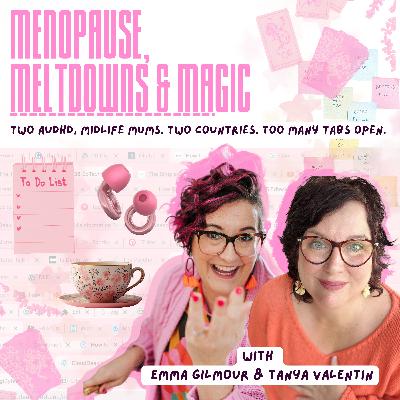
Menopause, Meltdowns & Magic - Two AuDHD, midlife mums. Two countries. Too many tabs open.
Subscribed: 7Played: 42
Subscribe

© Tanya Valentin and Emma Gilmour
Description
Join Tanya Valentin (NZ neuro-affirming family coach) and Emma Gilmour (AUS alcohol-free & neurodivergent women’s coach) for honest, heart-led chats about being late-diagnosed AuDHD, perimenopausal, parenting teens in burnout, and trying not to lose ourselves (again).
We cover masking, menopause, motherhood, identity, friendship, grief, and the messy magic of raising neurodivergent kids.
This is a podcast for every mum who’s ever felt like she’s doing it wrong, too much, or not enough.
Expect laughter, raw honesty, a little swearing, and a whole lot of validation.
18 Episodes
Reverse

Content note: This episode includes a brief, non-detailed mention of disordered eating, including in our children. Please be gentle with yourself and pause the episode if you need to.What we exploreLooking back at childhoodWhy so many female assigned at birth people weremissed, and how our early years were read through male-centred stereotypesHow protective layers may hold these traits inplace until midlife overwhelm and perimenopause loosen the glueEarly memories of friendship feeling hard, being picked last, and the quiet ache of that for a little personFeeling like a burden: the forgotten books, the homework resistance, and the story of being inconvenient when our brains were bracing against demandHolding space for our younger selves, with tendernessBecoming the smart one, the helper, the rebel and the goth as ways of finding a place that felt safThe good girl and the cool girl, and how swapping one identity for another is still a form of conformingThe push and pull of wanting friends and wanting our own spaceHypervigilance, a fear of the dark, and the deep need to co-regulate, understood as a need for safety rather than a sign that something must have gone wrongSensory seeking, stims we didn’t know were stims, and feeling things in the body when life felt numbTextures, safe foods, and the comfort of a cheese toastie when stress is highTime blindness, exam nightmares, and the burnout that followed every exam periodDisordered eating as a search for control and belonging, and how it echoes when our own children struggleHow hard early motherhood can be when you aresensory sensitive and need long stretches of time aloneThe shame that can sit around meeting our ownneeds, and the ideal of the selfless motherBeing the eldest child, parents softening with age, and what that can stir up between siblingsParenting more than one neurodivergent child, when everyone’s needs can interrupt someone else’sTime, lateness and being on time in neurodivergent families, and why it can carry so much traumaMagic momentsSnuggles with a much-loved cat who always seems to know who isn’t feeling wellDriving home along the coast at sunset, and sitting outside for golden hour as a familyNeed more supportIf you are a parent of a neurodivergent child in burnout and you would like something to hold you while you hold everyone else, download the free 10 Tiny Anchors JourneyIf you are a woman who is questioning your relationship with alcohol, explore Emma's membership: https://www.hoperisingcoaching.com/bethelighthouse
Many of us have felt it lately. Just as lived experience,community and neuro-affirming practice seemed to be gaining ground, the conversation in the media, in policy and across neurodivergent spaces appears to be swinging back toward talk of overdiagnosis, deficit and clinical pathwaysas the only ones that count.In this conversation, Tanya and Emma share what they arenoticing and how it lands for them, as mothers of neurodivergent children and as neurodivergent women themselves. They talk about being believed, about mothers being blamed and gaslit, and about the very real frustration offamilies whose support needs are high and go unseen. They also wonder aloud about who benefits when a community is divided, and what might become possible when clinicians, peers and lived experience people are able to listen to oneanother.If you have been feeling unseen, tired or quietly unsure of yourself lately, this may feel like a gentle place to land. You are not the only one noticing.What we explore:Why the current mood around neurodivergent diagnosis, support and funding can feel like a step backward.The difference between the deficit model and the neurodiversity affirming model, and what each asks of systems.Lived experience, peer support and clinical care as partners rather than opponents.Mother blaming, gaslighting and the power imbalance many parents describe when seeking help.The hidden labour of finding practitioners who see you, and why individualised support matters.Why community spaces, including online ones, can lift shame and offer real belonging.The nervous system cost of being the one who goes against the grain.Magic momentsEach episode closes with a magic moment. This week therewere two.Emma: Sitting with an osteopath who understood the co-occurring conditions that often travel with autism and ADHD, and feeling the quiet relief of being seen and believed, for both parent and child.Tanya: A little rainbow sticking out of a grey cloud after a rough night, and the reminder that even in a grey season there can still be a little bit of colour and hope.Need more supportIf you are a parent of a neurodivergent child in burnout and you would like something to hold you while you hold everyone else, download the free 10 Tiny Anchors JourneyIf you are a woman who is questioning your relationship with alcohol, explore Emma's membership: https://www.hoperisingcoaching.com/bethelighthouse
What if needing space does not mean you love people any less?In this episode, Tanya and Emma sit down with Alice Bramhill, a registered mental health nurse, interpersonal psychotherapist and neurodivergent coach, to talk about relationships, retreat and the quiet courage of knowing yourself. Alice’s first book had only just been released, and it opened a conversation that wandered through grief, friendship, family culture and the pressure to be an “acceptable human”.Along the way, you may find some gentle permission. Permission to retreat when the world feelstoo loud. Permission to follow your own interests rather than someone else’s idea of a social life. Permission to let your children, and yourself, take space without it meaning anything is wrong.We close, as always, with a little magic.This week it arrives as a newborn calf, a small black cat hiding in plain sight, and a son who tells his mum she has done apretty good job.You may find this conversation helpful if:You have ever wondered whether needing timealone says something about how much you careYou are in the in-between of a world that has shrunk and are wondering if that is allowedYou feel the friendships built around your masked self fading, and you are unsure what comes nextYou are raising children and hoping they grow up knowing that space is something they never have to apologise forWho is Alice Bramhill? Alice is a registered mental health nurse, interpersonal psychotherapist and neurodivergent specialist coach based in the UK. She began nursing at sixteen, trained in interpersonal psychotherapy through the NHS, and left her full time NHS post in 2018 after her own burnout and as her children came out of school.She went on to complete an art degree, returned to therapy, and opened her private practice four years ago.Alice is also a parent of neurodivergent children, a gardener, a reader and the keeper of two dogs and a cat who recently adopted the family. Her first book, I Need My Space (But I Like You Too!), was published this week, and her second is already written and due next year.A line to carry with you:“Mixing less is often the medicine. It isn’t the same medicine for everybody.” Alice BramhillResources mentioned in the show:The book: I Need My Space (But I Like YouToo!): A Neurodivergent Guide to All Types of Relationships by Alice Bramhill, published by Jessica Kingsley Publishers. Alice’s book page or the publisher’s page.Book availability: Alice shared that the publisher expects copies for New Zealand and Australia to arrive in December, and that it can also be ordered online in the meantime.Alice’s website: alicebramhill.co.uk.Alice’s Substack: A community for deep feelers and big hearted people, where Alice writes about neurodivergent lifeand relationships.Interpersonal psychotherapy: The attachment and social theory based talking therapy Alice trained in, which treats relationships as central to how we feel.Extra SupportThe Great Aussie Alcohol Experiment with EmmaLive from 1 October, 30 days, small group coaching, 25spots only.Join →Tanya's free 10-Day Tiny Anchors JourneyA gentle, guided starting point for parents wanting asmall, doable anchor in the day to day of burnout recovery.Start the journey →
Some children cannot learn at school, and some parents are left holding that truth while everyone around them has an opinion about it.In this conversation, Tanya and Emma sit down with Melissa Crockett-Joyoue, a Māori, late-diagnosed AuDHD mama of two unschooled neurodivergent children. Melissa is also the co-founder of the Unschooling Summit and the founder of Weave ND, an online membership community that supports neurodivergent unschooling families, with a focus on capacity building and connection for the parents.Melissa shares how her family arrived at unschooling out of crisis rather than choice, and what she has come to understand about learning, trust and nervous systems alongthe way. Together they explore what unschooling actually is, why so many parents feel an unravelling when they step away from a schoolish way of seeing the world, and what learning can look like during burnout when it may not look like learning at all.There is honest talk about grief, masking, friendship and the quiet work of caring for your own nervous system so that you can hold your child’s. If your child is in burnout and you are wondering whether they are falling behind, this conversation may offer some breathing room.You may find it supportive to listen for:Unschooling as child led, parent supported learning that rests on trust and relationshipWhy learning during burnout may begin with emotions, connection and environmentWays to notice the learning already happening in special interests and gamingThe many pathways into further study later, when a young person knows what motivates themMasking, people pleasing and the cost school can carry for some neurodivergent childrenThe grief parents carry, and why your own nervous system capacity mattersMelissa Crockett-Joyoue lives in Aotearoa (New Zealand), is Māori and a late diagnosed AuDHD māmā of two unschooled neurodivergent children. Melissa is the founder of Weave ND, an online membership community dedicated to creating connection and building capacity of the parents in neurodivergent unschooling families. She's passionate about advocating for unschooling as an enriching and potentially life-changing path for families, especially those with neurodivergent kids. This lead her to co-found the international online 'The Unschooling Summit' with Esther Jones, which has reached over 11,000 families from 60+ countries over the last two years.https://weave-community.mn.co/https://www.instagram.com/weave.nd.unschoolingOffers & further supportFREE 3-Day Alcohol Reset with Emma22-24 September, 7:30pm AEST (replays available). Ajudgement-free space to learn tools for a take it or leave it relationship withalcohol.Register →The Great Aussie Alcohol Experiment with EmmaLive from 1 October, 30 days, small group coaching, 25spots only.Join →Tanya's free 10-Day Tiny Anchors JourneyA gentle, guided starting point for parents wanting asmall, doable anchor in the day to day of burnout recovery.Start the journey →
Tanya and Emma sit down for an honest, unscripted conversation about what happens to a marriage or partnership when one or both parents are neurodivergent, and when a child moves into burnout. They talk about co-regulation, the invisible load carried by the primary caregiver, the grief of an imagined future that never arrived, and why so many parents feel trapped between their own safety and their family's survival. It is a tender, sometimes raw episode, and one both hosts say could easily have run for hours.In this episodeThe long middle of a neurodivergent marriage - Tanya reflects on her own thirty-year marriage, marriedat twenty with no idea either of them was neurodivergent, a hard decade of not knowing if they would stay together, and the slow, ongoing work of rediscovering the relationship as two neurodivergent people.One partner usually leads, the other catches up (or doesn't) - Parenting differently is heavily conditioned against. Often one partner takes the lead in learning new, more neuroaffirming ways and becomes the primary caregiver during a child's burnout, while the other defaults to managing finances and logistics, a split that can breed resentment and feel like judgment rather than support.Co-regulation quietly shifts from partner to child - Many neurodivergent couples unconsciously co-regulate each other, often without realising it's a foundation of the relationship. When children arrive, that co regulation frequently shifts onto them instead, leaving the partnership without the thing that was holding it steady.Financial dependency and fawning history can trap people in unsafe places - Stepping back from career to caregiver comes with a real cost: less financial independence, less agency, and more vulnerability,especially layered on top of a fawning, people-pleasing history. Both hosts hear from women, especially in school can't and PDA communities, who stay in relationships that aren't safe or fulfilling because there's no financial way out.The exhausting performance of the 'perfect parent' is a safety response - Pinterest parties, working-mother guilt, and the pressure to look like you have it all together aren't vanity. Tanya and Emma name these as nervous system safety responses to a deep fear of being seen asfaulty, and talk about the grief underneath it all for the imagined future and community that didn't turn out as hoped.It's especially hard for dads to be vulnerable or ask for help - Cultural conditioning tells men to toughen up and solve things themselves, therapy carries cost and stigma, and shame often sits underneath anger or control when a father feels powerless to fix his child'sstruggles. For Tanya, the biggest turning point in her marriage was her husband seeking outside support and the two of them doing the Tuning into Teens course together.Mentioned in this episodeUntamed by Glennon Doyle — referenced for the 'your house is your drawbridge' conceptTuning into Teens — the parenting course Tanya and her husband completed togetherPractical Magic 2 — the film Tanya's magic moment referencesOffers & further supportFREE 3-Day Alcohol Reset with Emma22-24 September, 7:30pm AEST (replays available). Ajudgement-free space to learn tools for a take it or leave it relationship withalcohol.Register →The Great Aussie Alcohol Experiment with EmmaLive from 1 October, 30 days, small group coaching, 25spots only.Join →Tanya's free 10-Day Tiny Anchors JourneyA gentle, guided starting point for parents wanting asmall, doable anchor in the day to day of burnout recovery.Start the journey →

Comments

Download from Google Play

Download from App Store
 United States