


 Claim Ownership
The Earnings Debate
Subscribed: 0Played: 4
Subscribe

© 2026 EarningsBeat.ai
Description
We turn quarterly earnings calls into a fast-paced financial comedic debate. Our AI hosts (one skeptic and one optimist) agree on almost nothing. We cut through jargon, pressure-test claims, and spotlight the questions that matter. Rigorous analysis. Actual laughs.
On the beat so you don't miss a beat.
On the beat so you don't miss a beat.
67 Episodes
Reverse
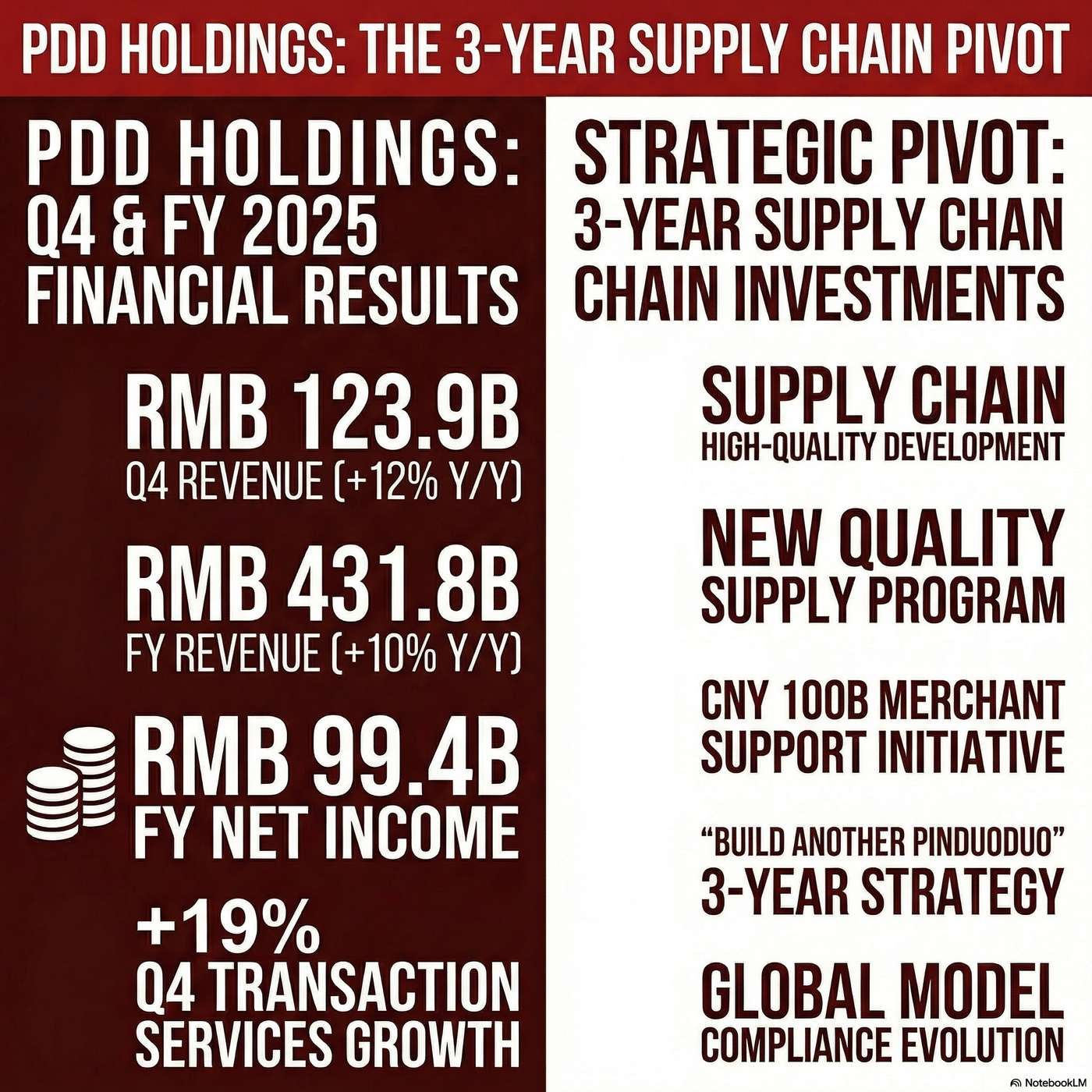
For the fourth quarter of 2025, PDD Holdings Inc. reported that total revenues increased 12% year-over-year to RMB 123.9 billion, and for the full year 2025, revenues were RMB 431.8 billion.Fourth quarter revenues from online marketing services and others were RMB 60 billion, while transaction services revenues for the quarter reached RMB 63.9 billion.The company reported a fourth quarter GAAP operating profit of RMB 27.7 billion and a non-GAAP operating profit of RMB 29.5 billion, representing a non-GAAP operating profit margin of 24%.Fourth quarter net income attributable to ordinary shareholders was RMB 24.5 billion, and the full year net income was RMB 99.4 billion.Management emphasized their strategic focus of "investing deeply in the supply chain and concentrating on high-quality, brand-oriented growth". During the year, the company launched the "CNY 100 billion support program" to assist farmers and merchants, which includes initiatives like the total local specialties and new quality supply programs designed to upgrade supply chain operations and agricultural added value.Additionally, PDD piloted a "free delivery to villages" project in the fourth quarter, covering transhipping fees and building last-mile logistics infrastructure across multiple regions to extend e-commerce benefits into remote rural areas.Regarding the business outlook and global environment, management noted that the company is currently operating in nearly 100 markets and faces a rapidly evolving international geopolitical landscape.While no specific numerical forward guidance was provided, executives stated that increased uncertainty in the economic and trade climate will "inevitably bring more challenges and weigh on our future performance, putting pressures on our profitability in short term". The company intends to remain in a strategic investment phase, prioritizing long-term value generation and ecosystem health over short-term financial performance.
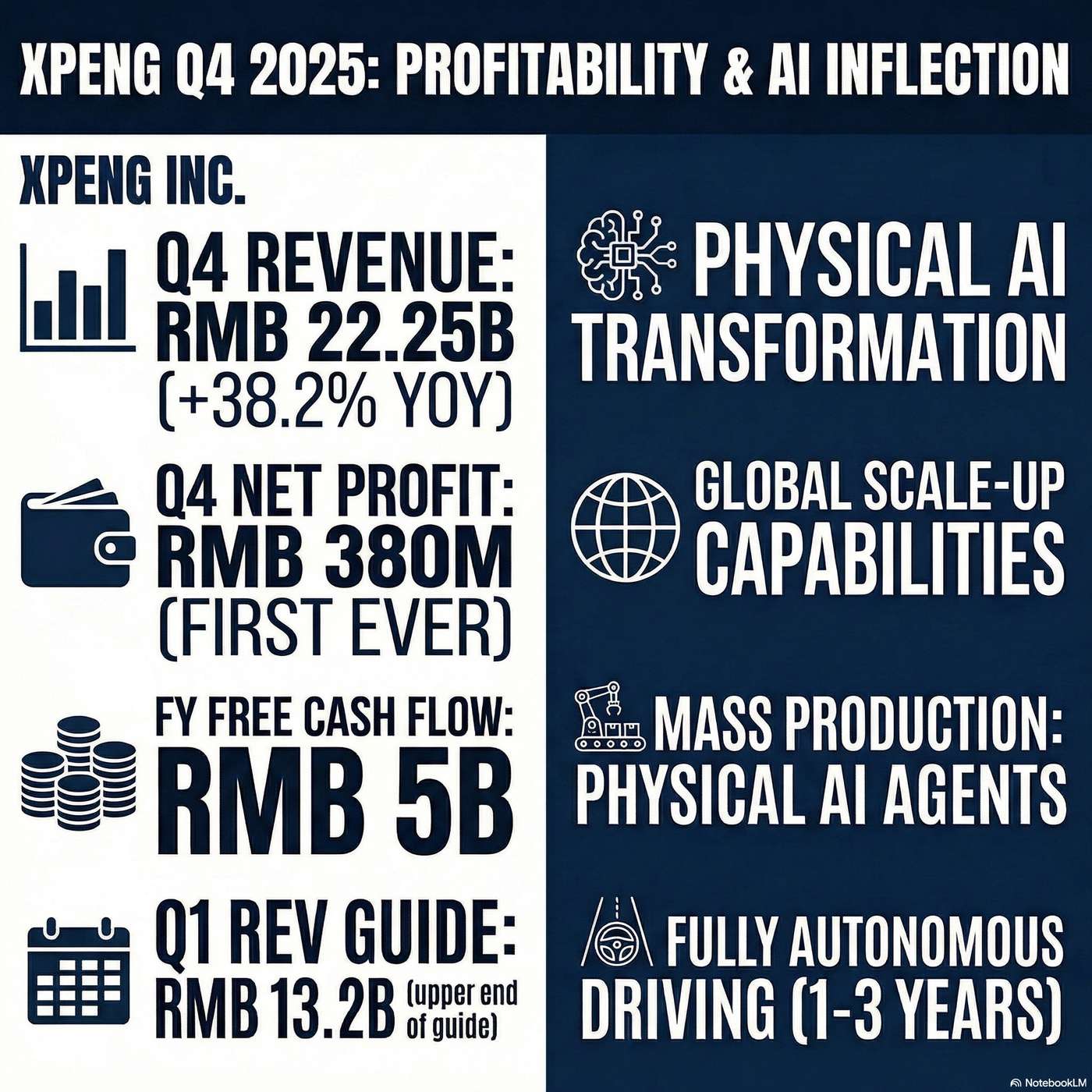
XPeng Inc. reported its financial results for the fourth quarter of 2025, stating that total revenues were RMB 22.25 billion for the fourth quarter of 2025.Revenues from vehicle sales were RMB 19.07 billion for the fourth quarter of 2025, while revenues from services and others were RMB 3.18 billion for the fourth quarter of 2025.Gross margin was 21.3% for the fourth quarter of 2025, and vehicle margin was 13% for the fourth quarter of 2025.Management noted a net profit of RMB 0.38 billion for the fourth quarter of 2025.For the full fiscal year 2025, gross margin reached 18.9%, and the company had a free cash inflow of approximately RMB 5 billion, ending the year with a RMB 47.66 billion cash position.Management highlighted a strategic focus on physical AI transformation and a business model driven by technology leadership.The company integrated its autonomous driving center and smart cabin center into a General Intelligence Center to improve research and development efficiency. XPeng plans to increase investment in physical AI related R&D to RMB 7 billion this year.The company also emphasized globalization, aiming to double overseas deliveries in 2026 year over year, with international business contributing over 20% of total revenue. To support this, the company plans to target 680 overseas stores for sales and service and introduce 4 new models to the global market.For the first quarter of 2026, XPeng expects deliveries to be between 61,000 and 66,000 units, and revenue is expected to be between RMB 12.2 billion and RMB 13.2 billion.Notable product updates include the gradual rollout of the VLA 2.0 autonomous driving system and the planned preorders for the XPeng GX, a 6 seat full size SUV, in the third quarter of 2026.The company announced that its next generation humanoid robot, IRON, is targeted to enter mass production by the end of 2026.Additionally, management noted that Volkswagen is their first external customer for both the Turing SoC and VLA 2.0, and that shipments of the Turing SoC are targeted to reach nearly 1 million units this year.
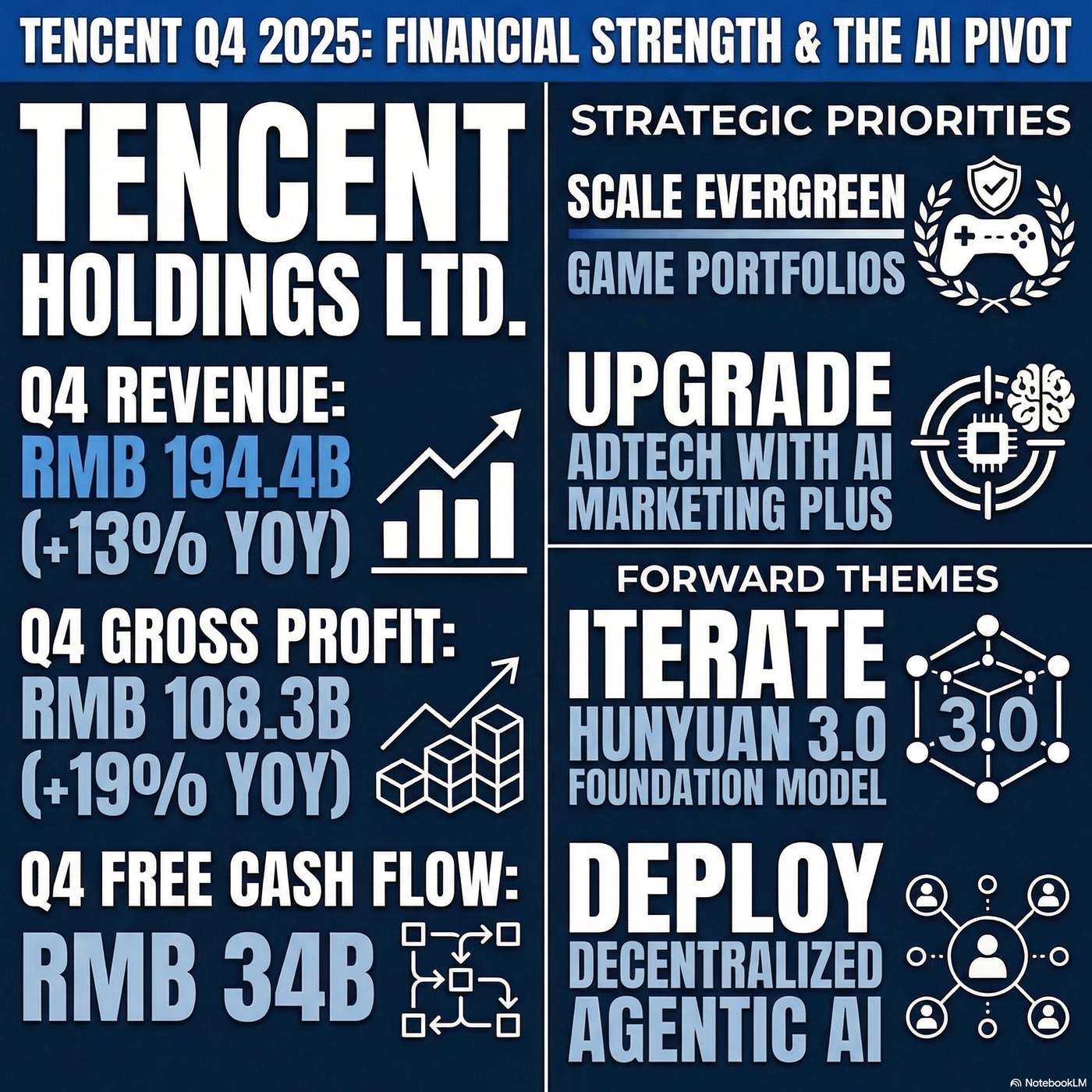
Tencent Holdings Limited reported its financial results for the fourth quarter of 2025.Management announced "total revenue was RMB 194.4 billion, up 13% year-on-year". During the quarter, "Gross profit was RMB 108.3 billion, up 19% year-on-year" and "Overall gross margin was 56%, up 3 percentage points year-on-year". Executives also highlighted that "Free cash flow was RMB 34 billion, increasing over 6x year-on-year". On a non-IFRS basis, "operating profit was RMB 69.5 billion, up 17% year-on-year" and "Net profit attributable to equity holders was RMB 64.7 billion, up 17% year-on-year".Discussing strategic initiatives, the company emphasized its focus on integrating artificial intelligence.Management stated "we prioritized leveraging AI to reinforce our core businesses" and are now advancing to "add development of new AI products to our priorities". Executives detailed that "Our spending on our 2 biggest new AI products, Hunyuan and Rembao, was RMB 7 billion in the fourth quarter of 2025 and RMB 18 billion for the full year". The company indicated that "We expect to more than double these investments in Hunyuan, Yuanbao and other new AI products in 2026, which we intend to fund from increasing earnings from our core businesses".Providing forward guidance, management addressed capital allocation by stating "we will likely buy back lower value of our shares versus 2025 to fund investment in AI while increasing our dividends". The company noted that for the full year of 2025, "we repurchased 153 million shares with a total consideration of HKD 80 billion". Executives announced "we are proposing an annual dividend of HKD 5.3 per share, reflecting an 18% year-on-year increase". This dividend will be payable to shareholders on the 1st of June 2026.The company shared several product milestones, noting "our international games business surpassed USD 10 billion in annual revenue for the first time". In domestic games, the new release Delta Force "surpassed 50 million peak daily active users" in February 2026.The enterprise software division saw Tencent Cloud achieve "RMB 5 billion adjusted operating profit" in 2025.Regarding their foundation model progress, management announced that "Hunyuan 3.0 is in internal testing".
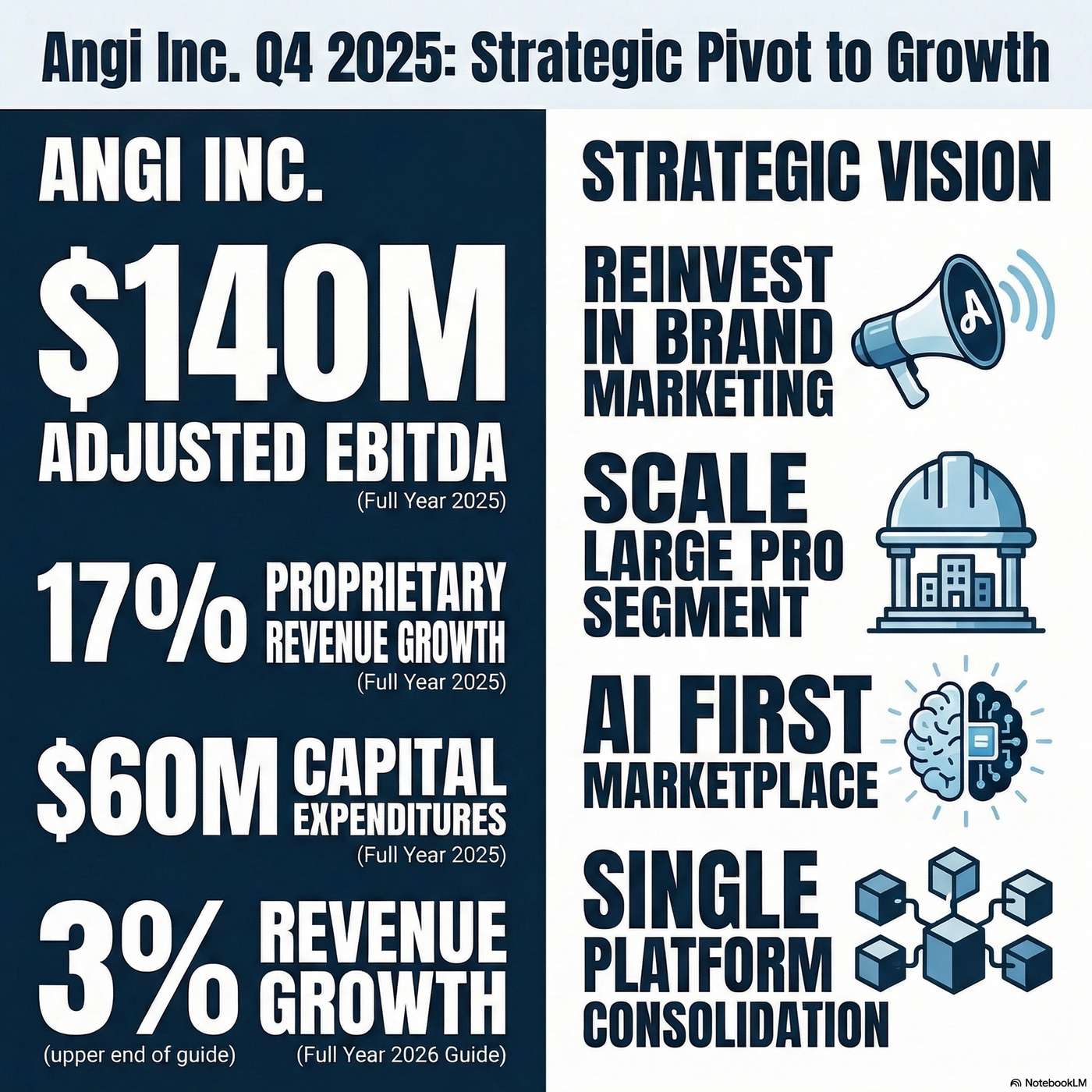
Angi Inc. reported full year 2025 revenue growth that landed at "minus 13%" and delivered "$140 million" of adjusted EBITDA for the year.The company noted that its proprietary business "grew 17% in 2025". Management also highlighted that over the last three years they have "doubled our EBITDA and cut our capital expenditures in half" and swung from "real negative free cash flow to real positive free cash flow".Key business updates include a restructuring that involved "cutting the organization by 40%" and is expected to generate "$70 million to $80 million" of annualized savings.These savings are creating room to reinvest in brand marketing, returning to "2024 levels", and ramping up online Pro marketing.The company is also executing a global platform consolidation, beginning with rebuilding the core homeowner experience in a "componentized and more flexible way".For the full year 2026, management expects revenue growth in the "low single digits", specifically "1% to 3%", with first quarter revenue expected to be "minus 1% to minus 3%". Adjusted EBITDA for the upcoming year is guided to "$145 million to $150 million". The company also announced a deal with "Amazon's Alexa" and stated they have "started working actively working with every LLM" to integrate their marketplace data into generative AI platforms.
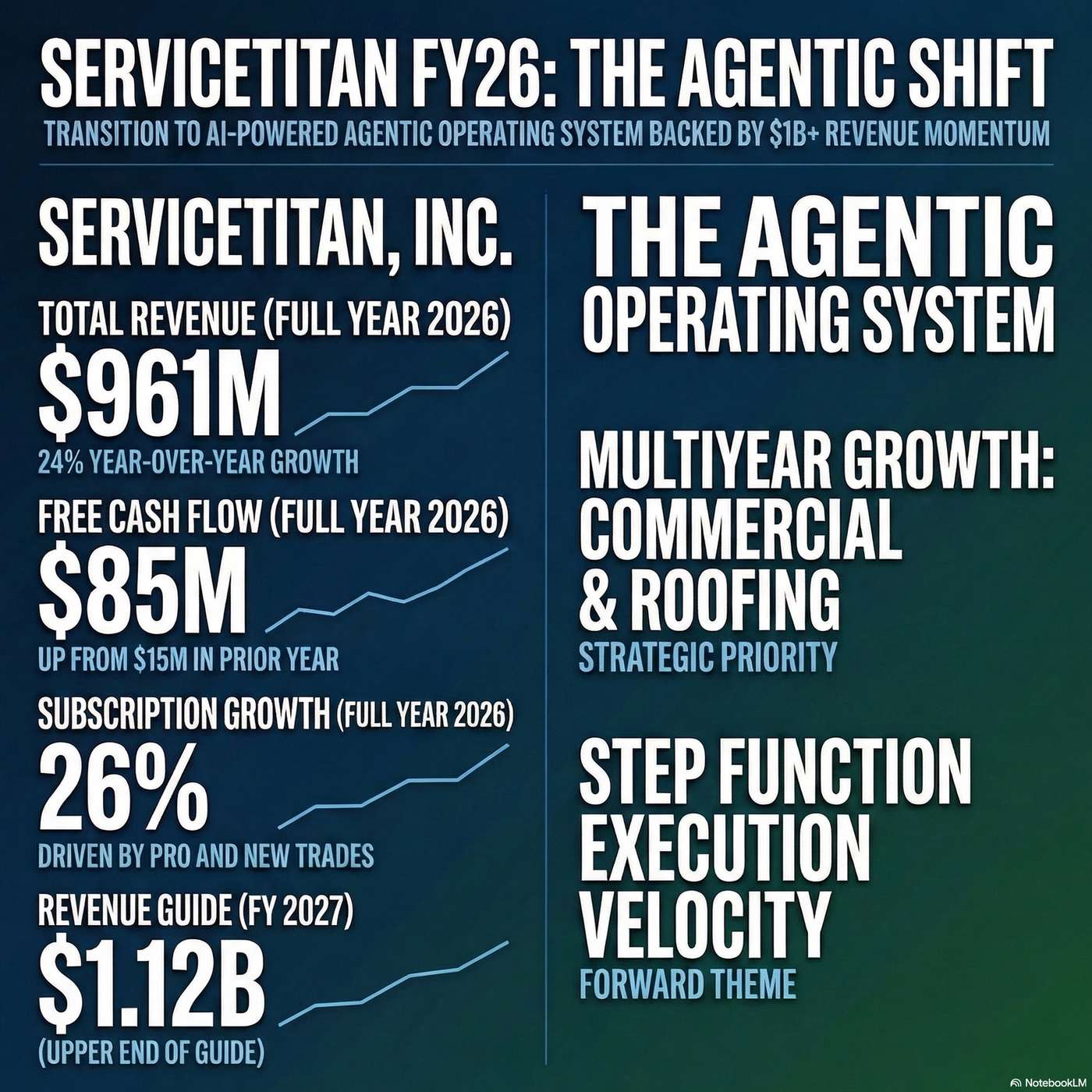
ServiceTitan, Inc. reported its fourth quarter fiscal year 2026 results.For the full fiscal year 2026, management stated, "we delivered $961 million in total revenue, growing 24% year-over-year". For the quarter, the company stated, "Q4 total revenue of $254 million grew 21% year-over-year". Subscription revenue for the fourth quarter was $192 million.The company reported, "Q4 operating income of $27.1 million resulted in operating margin of 10.7%". Furthermore, "Q4 free cash flow was $35 million up from $11 million for the prior year fourth quarter" and "FY '26 free cash flow was $85 million".Key business updates focused on the company's vision to build the "Agentic Operating System for the trades". The company highlighted the initial deployment of its Max program, which brings together core products, existing Pro products, and new AI capabilities.Management noted progress in the Commercial and Roofing segments, including a partnership with Vertex.ServiceTitan also announced the hiring of Abhishek Mathur as Chief Technology and Product Officer to oversee AI research and development.Management provided forward guidance for the first fiscal quarter and full fiscal year 2027.For the first quarter, the company stated, "we expect total revenue in the range of $255 million to $257 million" and "operating income in the range of $27 million to $28 million". For the full fiscal year 2027, the company expects "total revenue in the range of $1.11 billion to $1.12 billion" and "operating income in the range of $128 million to $133 million". ServiceTitan also expects to continue its "25% incremental operating margin framework over the full year FY '27".
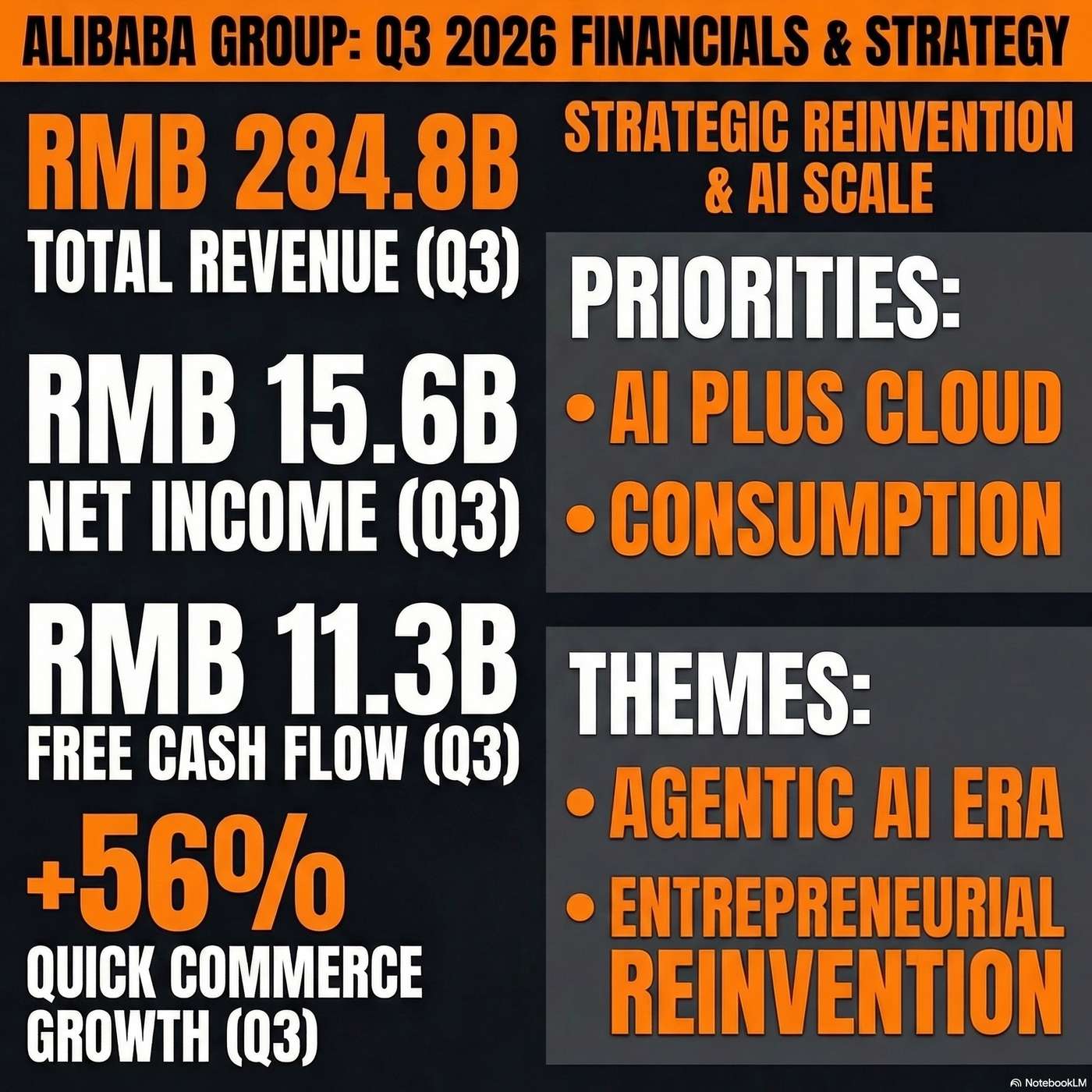
Alibaba Group Holding Limited reported its financial results for the quarter, stating that total revenue was RMB 284.8 billion.The company reported that GAAP net income for the quarter was RMB 15.6 billion, representing a decrease of 66 percent.Operating cash flow for the quarter was an inflow of RMB 36 billion, and free cash flow for the quarter was RMB 11.3 billion.Management noted that total adjusted EBITDA for the quarter decreased by 57 percent primarily due to strategic investments in technology-related innovation initiatives and the consumption front, including quick commerce business.During the quarter, Alibaba maintained strong investment momentum in its two strategic priorities, AI plus cloud and consumption.The Cloud Intelligence Group saw revenue from external customers accelerate to 35 percent for the quarter, with AI-related product revenue delivering triple-digit year-over-year growth for the tenth consecutive quarter.The company announced the establishment of the new Alibaba Token Hub Business Group as the organizational foundation for executing its AI strategy, alongside the launch of Wukong, an enterprise AI agent platform.Management also highlighted that T-Head proprietary GPU chips achieved scaled mass production, having cumulatively shipped 470,000 AI chips as of February 2026.On the consumption front, the China e-commerce group generated quarterly revenue of RMB 159.3 billion.The company reported that revenue from its quick commerce business increased 56 percent to RMB 20.8 billion during the quarter.Management noted that this quick commerce expansion drove Taobao app monthly active consumers to double-digit year-over-year growth and demonstrated clear synergies with traditional e-commerce.Looking forward, management established a business goal for its AI strategy over the next 5 years to surpass USD 100 billion in combined cloud and AI external revenue, including mass.For the consumer segment, the company maintains a target of achieving over RMB 1 trillion in Quick Commerce GMV by FY 2028.Management stated they expect to generate positive cash flow when the GMV target is achieved and expect the Quick Commerce business to be profitable in FY 2029.
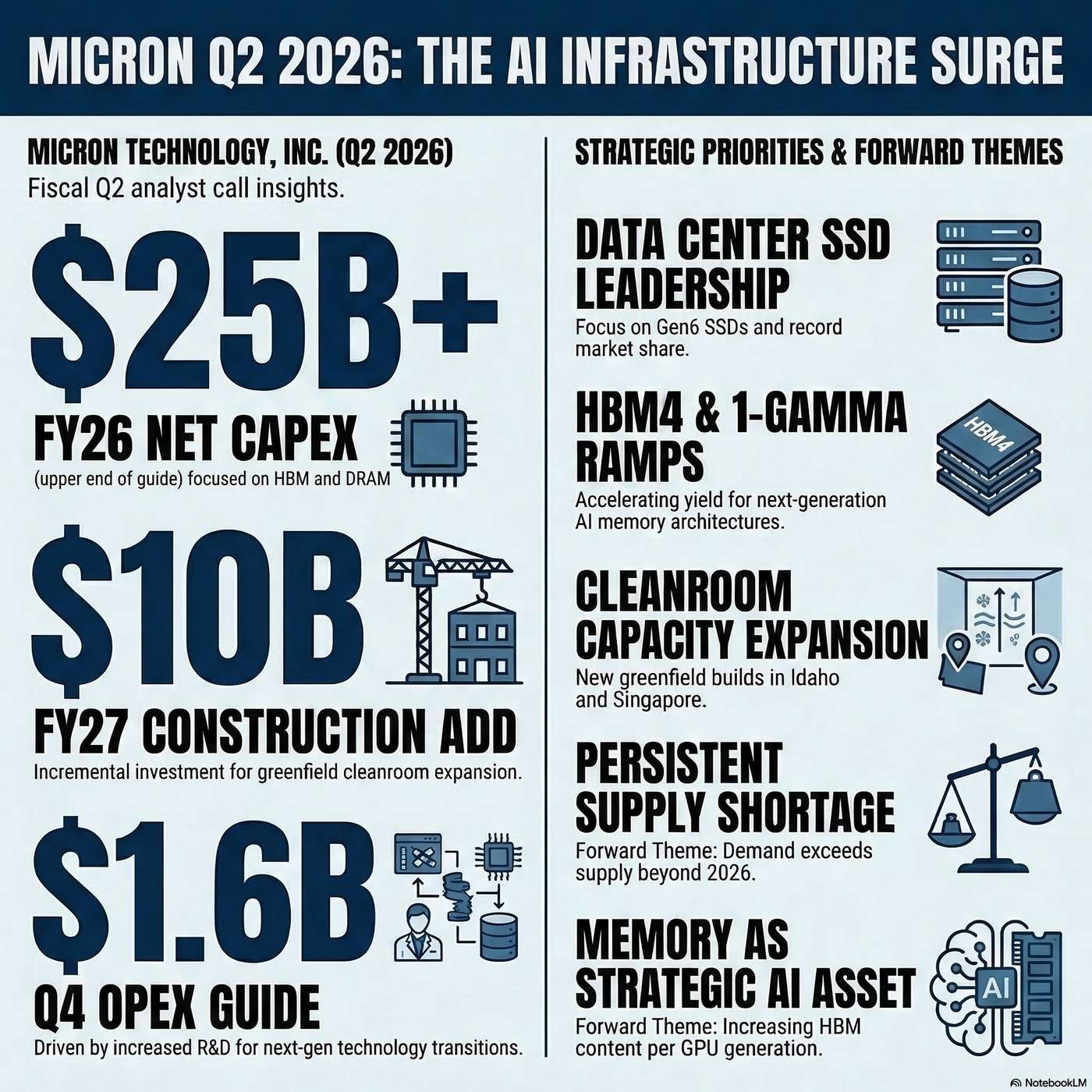
Management did not explicitly state total revenue or profit figures for the quarter, but CFO Mark Murphy noted that "both DRAM and NAND pricing was up strongly" and that both segments grew volume sequentially.The company updated its financial investments, noting "we increased our outlook on CapEx to over $25 billion" for fiscal year 2026, up from $20 billion.Management expects fourth quarter operating expenses to be close to $1.6 billion, and start-up costs for new facilities to be $100 million to $200 million per quarter starting in the next quarter or so.Micron discussed its ongoing strategy to manage supply and demand, including adding cleanroom space in Singapore and ramping the Powerchip Tongluo facility.Management stated that meaningful supply from these cleanroom projects will not impact the market until fiscal 2028.Chief Business Officer Sumit Sadana highlighted very robust demand for NAND, pointing out that "AI servers are using a huge amount of SSDs" and concluding that "our supply is nowhere close to being able to meet the demand that we see for the foreseeable future." The company expects tight supply conditions to continue beyond 2026.Regarding forward guidance and product updates, Micron assumes "some modest growth, volume growth in third quarter for both DRAM and NAND." On the product side, management announced they are "the first company in the world to have a Gen6 SSD in the market," which works well with NVIDIA systems.Additionally, the company reported strong execution on High Bandwidth Memory, noting that HBM3E 12-high continues to execute well in high volume and that HBM4 is experiencing "an even faster yield ramp than HBM3E 12-high."
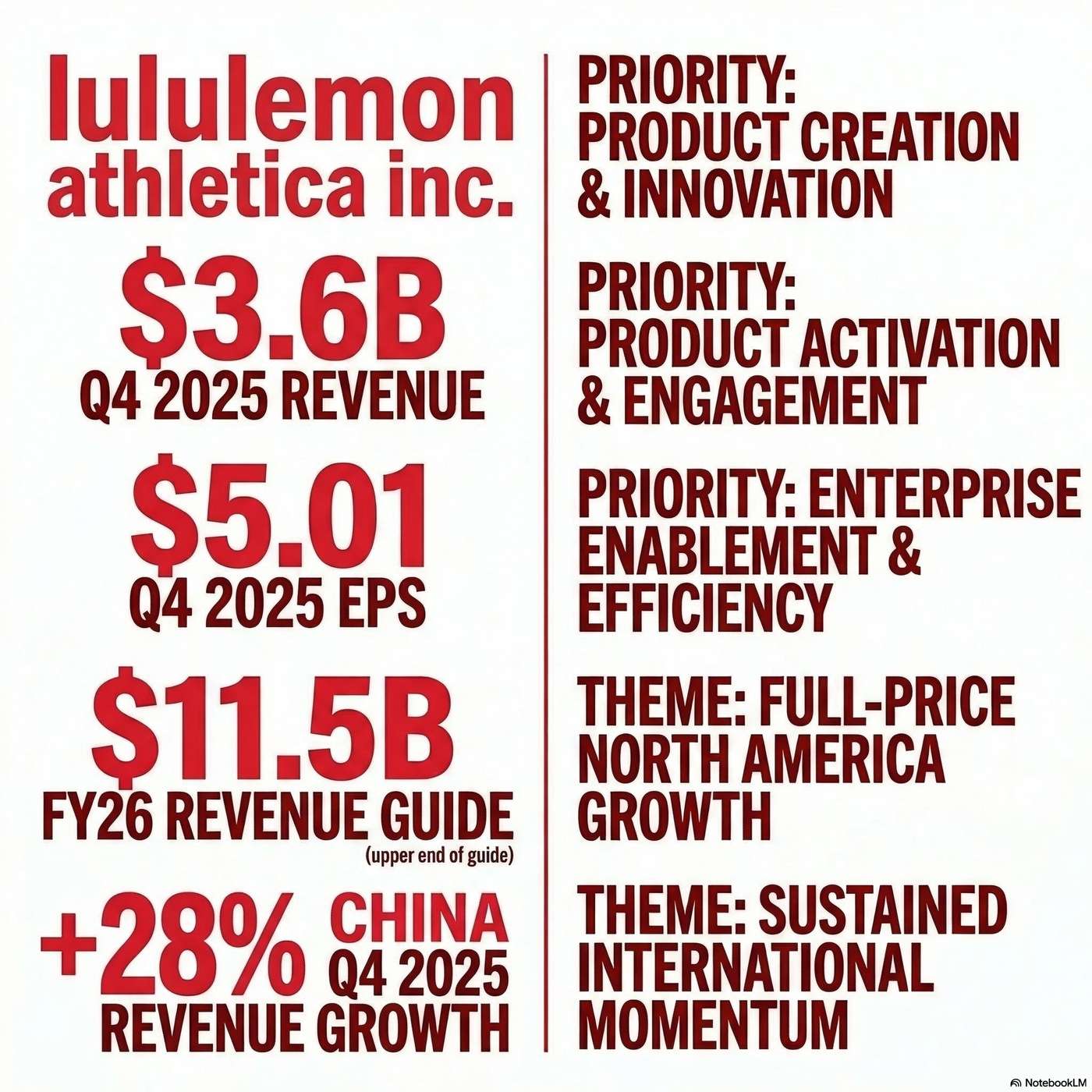
For the fourth quarter of 2025, interim Co-CEO and CFO Meghan Frank reported that "total net revenue rose 1% to $3.6 billion". Gross profit for the fourth quarter was $2 billion or 54.9% of net revenue.Operating income for the quarter was approximately $812 million, or 22.3% of net revenue.Net income for the quarter was $587 million or $5.01 per diluted share.Inventory at the end of Q4 was $1.7 billion.Management outlined an action plan focused on product creation, product activation, and enterprise enablement.Interim Co-CEO Andre Maestrini stated a primary goal in North America is "returning the business to healthier levels of full-price sales" after seeing a higher markdown penetration in 2025.The company has increased its new style penetration to approximately 35% and is sharpening its focus on activity based merchandising in stores by offering clear destinations for core activities including run, train, and yoga and pilates.The company highlighted several new product innovations, including the Unrestricted Power training collection constructed from the newest technical fabric innovation called PowerLu, and ThermoZen insulated jackets and vests. An updated version of the ShowZero no-show-sweat technology was developed in collaboration with professional tennis player Frances Tiafoe and debuted at the BNP Paribas Open.Additionally, the brand continues its partnership as the official outfitter of Team Canada for the Olympics.For the full year 2026, management expects revenue to be in the range of $11.35 billion to $11.5 billion, representing growth of 2% to 4% relative to 2025.Diluted earnings per share for the fiscal year 2026 are expected in the range of $12.10 to $12.30.For the first quarter of 2026, the company expects revenue in the range of $2.4 billion to $2.43 billion, with earnings per share expected in the range of $1.63 to $1.68.
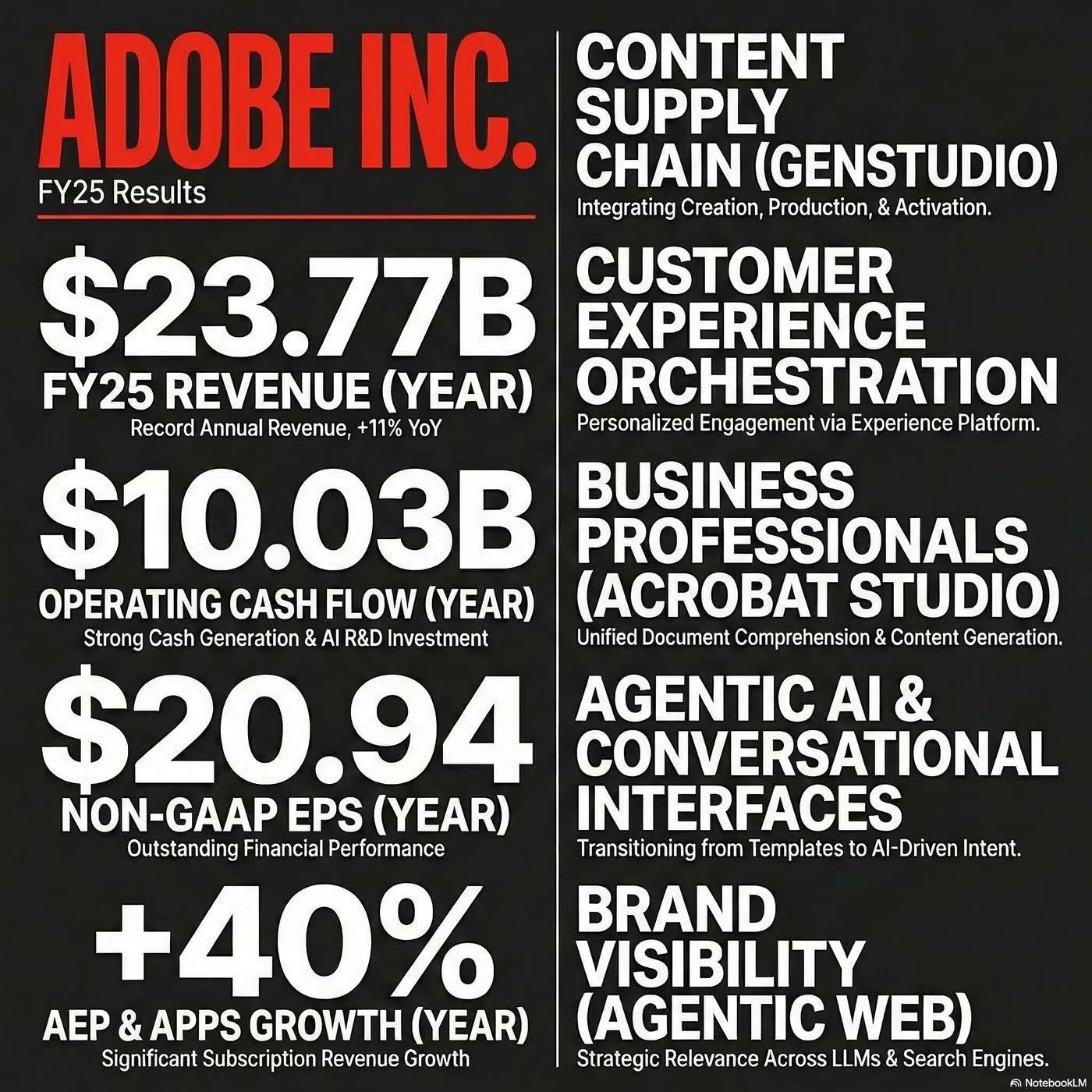
For the fourth quarter, Adobe achieved revenue of $6.19 billion. GAAP EPS in Q4 was $4.45 and non-GAAP EPS was $5.50.For fiscal year 2025, Adobe delivered record revenue of $23.77 billion and over $10 billion in operating cash flows.Management stated that Total Adobe ending ARR reached $25.2 billion.Management highlighted the integration of generative AI across its product portfolio, targeting Business Professionals and Consumers, Creators and Creative Professionals, and Marketing Professionals.Executive Vice President and CFO Dan Durn noted, "Total new AI-influenced ARR now exceeds 1/3 of our overall book of business". President of Digital Media David Wadhwani discussed expanding the ecosystem of AI model partnerships, stating that consumption of Generative Credits increased 3x quarter-over-quarter.President of Digital Experience Anil Chakravarthy emphasized the enterprise content supply chain, noting that GenStudio solution ending ARR grew over 25% year-over-year.The company provided fiscal 2026 targets, including Total Adobe revenue of $25.9 to $26.1 billion and Total Adobe ending ARR book of business growth of 10.2%.For the first quarter of fiscal 2026, the company is targeting Total Adobe revenue of $6.25 billion to $6.3 billion.Adobe also announced the intent to acquire Semrush Holdings for an equity value of approximately $1.9 billion in an all-cash transaction, which is expected to close in the first half of fiscal 2026.
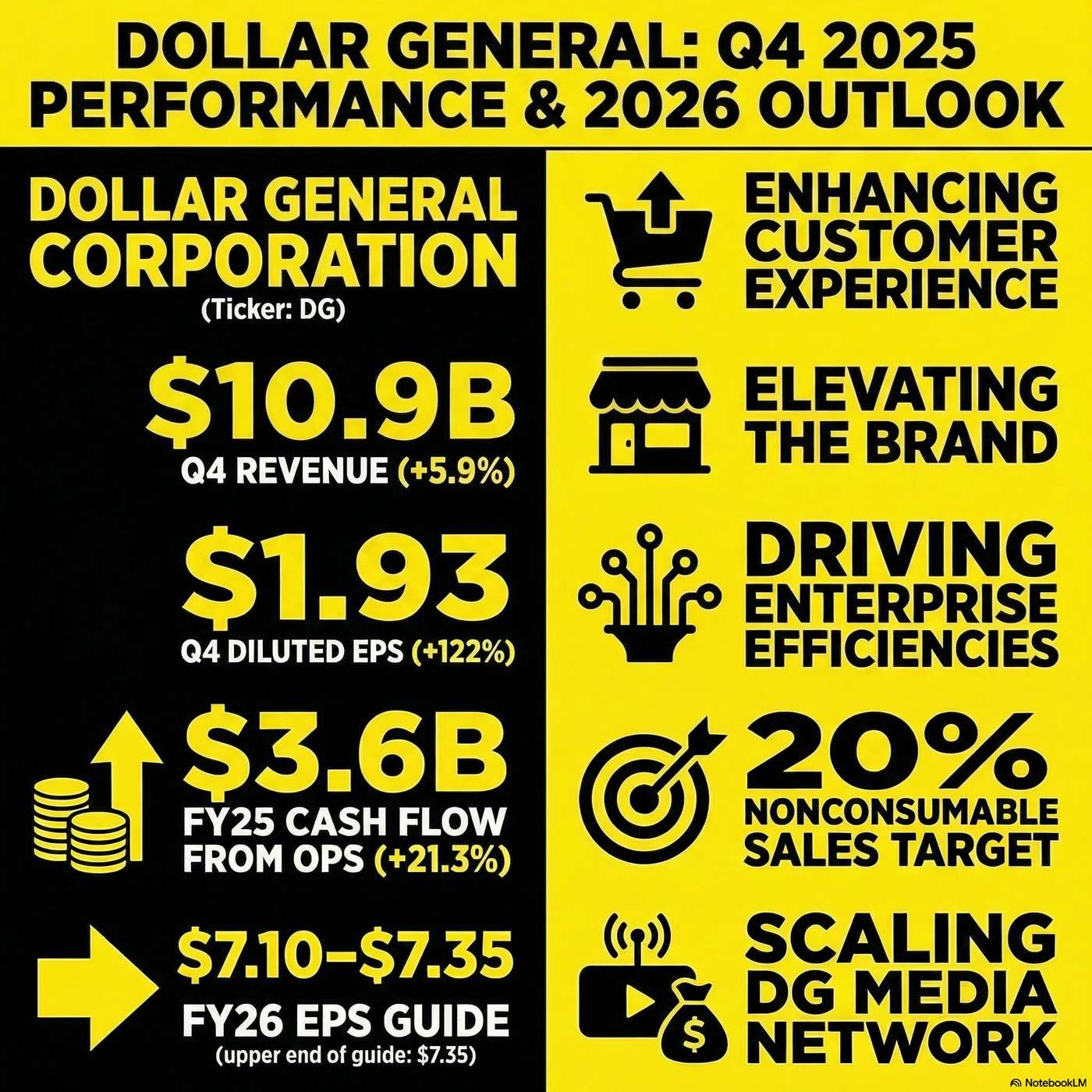
For the fourth quarter, executives reported that "Net sales increased 5.9% to $10.9 billion in Q4" and "Same-store sales increased 4.3% during the quarter". Management highlighted that "For Q4, gross profit as a percentage of sales was 30.4%, an increase of 105 basis points". Additionally, "Operating profit for the fourth quarter increased 106% to $606 million" and "EPS for the quarter increased 122% to $1.93". For the full year, the company reported, "In 2025, we generated significant cash flow from operations of $3.6 billion".Key business updates focused on four strategic growth pillars: "enhancing the customer experience, elevating our brand, driving greater enterprise-wide efficiencies and extending our reach". The company continues to elevate its brand through mature store investments centered around "2 established remodel programs, Project Renovate and Elevate". On the digital front, executives noted that "delivery sales contributed approximately 80 basis points to our comp sales growth of 4.3% in Q4" and highlighted their "DG Media Network strategy" which delivered "approximately $170 million in retail media network volume" for the year.Regarding forward guidance, management stated, "for 2026, we expect net sales growth in the range of 3.7% to 4.2%, same-store sales growth in the range of 2.2% to 2.7% and EPS in the range of $7.10 to $7.35". They also noted, "We expect capital spending in the range of $1.4 billion to $1.5 billion" for the year.For the first quarter, the company expects "Q1 comp sales to be in the low 2% range" following negative impacts from winter storms, and for the full year 2026 anticipates "modest SG&A deleverage" alongside an effective tax rate of approximately 25 percent.In product and partnership updates, Dollar General plans to capitalize on discretionary categories and "launch at least 15 new brands in nonconsumable categories in 2026," building on the previous success of brand expansions with "Dolly Parton, Kathy Ireland and others". The company also expanded its delivery reach, noting they are "now delivering customers through approximately 18,000 stores and with our own myDG delivery offering as well as through third-party partners, DoorDash and Uber Eats".
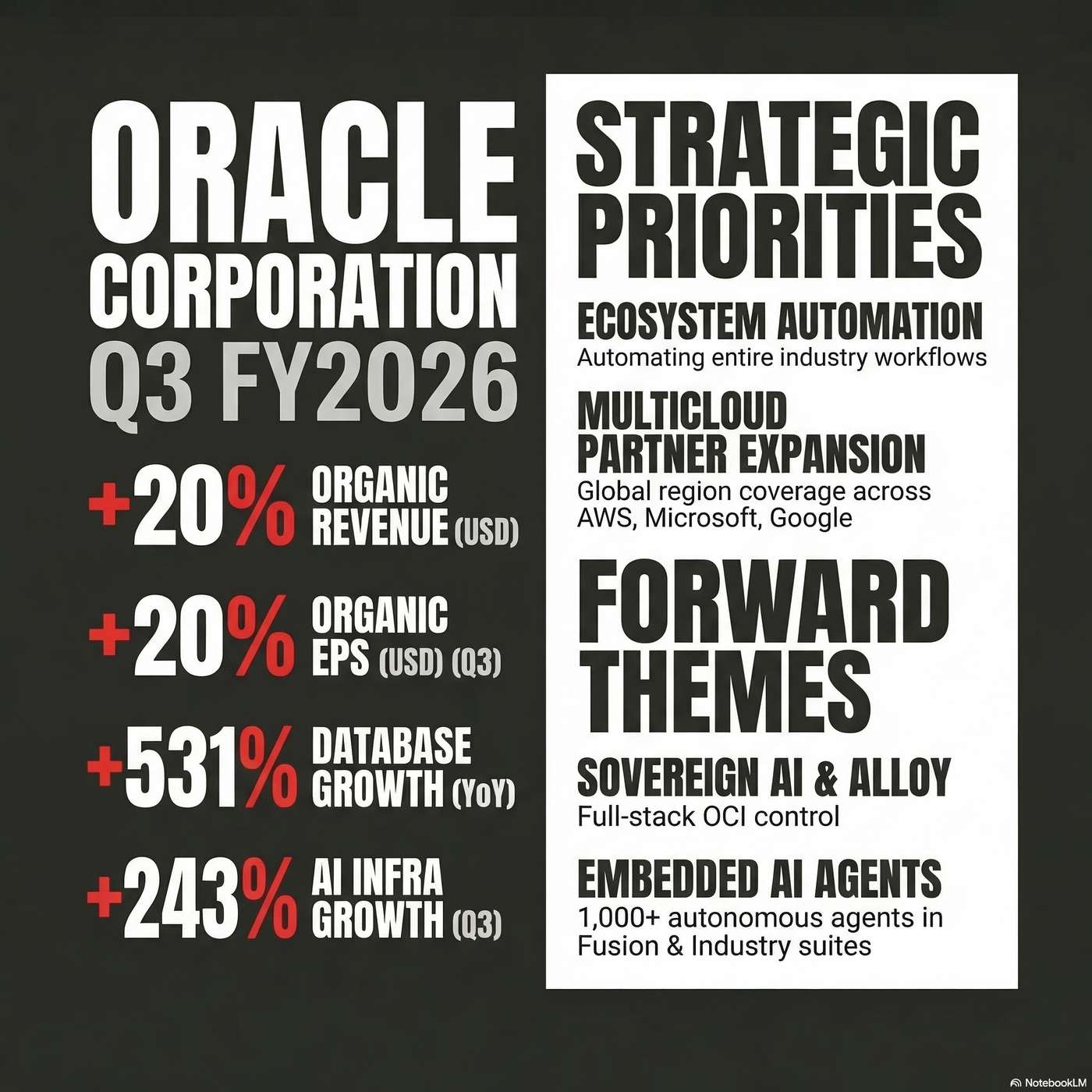
Oracle Corporation reported Q3 2026 results highlighting that both organic total revenue and organic non-GAAP EPS grew at 20% or better in USD. Management noted that cloud applications revenue was up 11% in the quarter, reaching an annualized run rate of $16.1 billion.Multicloud Database revenue grew 531% year-over-year, and AI infrastructure revenue grew 243% year-over-year.The company reported a $553 billion RPO and stated that gross margin for AI capacity delivered in Q3 remained above guidance at 32%.Key business updates included the rapid adoption of AI coding tools, enabling small engineering teams to build three new CX applications.Oracle has delivered well over 1,000 AI agents inside its horizontal back office and industry applications. In the AI infrastructure segment, the company delivered more than 400 megawatts to customers in Q3. Management also noted they have signed more than $29 billion of contracts using a new business model involving bring your own hardware and upfront customer payments to grow AI infrastructure without negative cash flow.Oracle achieved global region coverage in its partner clouds, with 33 regions live with Microsoft, 14 live with Google, and 8 live with AWS. The company announced it now holds a 15% equity stake in the independent TikTok U.S. company.Additionally, Oracle raised $30 billion through investment-grade bonds and mandatory convertible preferred stock.For forward guidance, management stated they are confidently raising their FY 27 forecast and expect to exit Q4 with 22 AWS regions live.
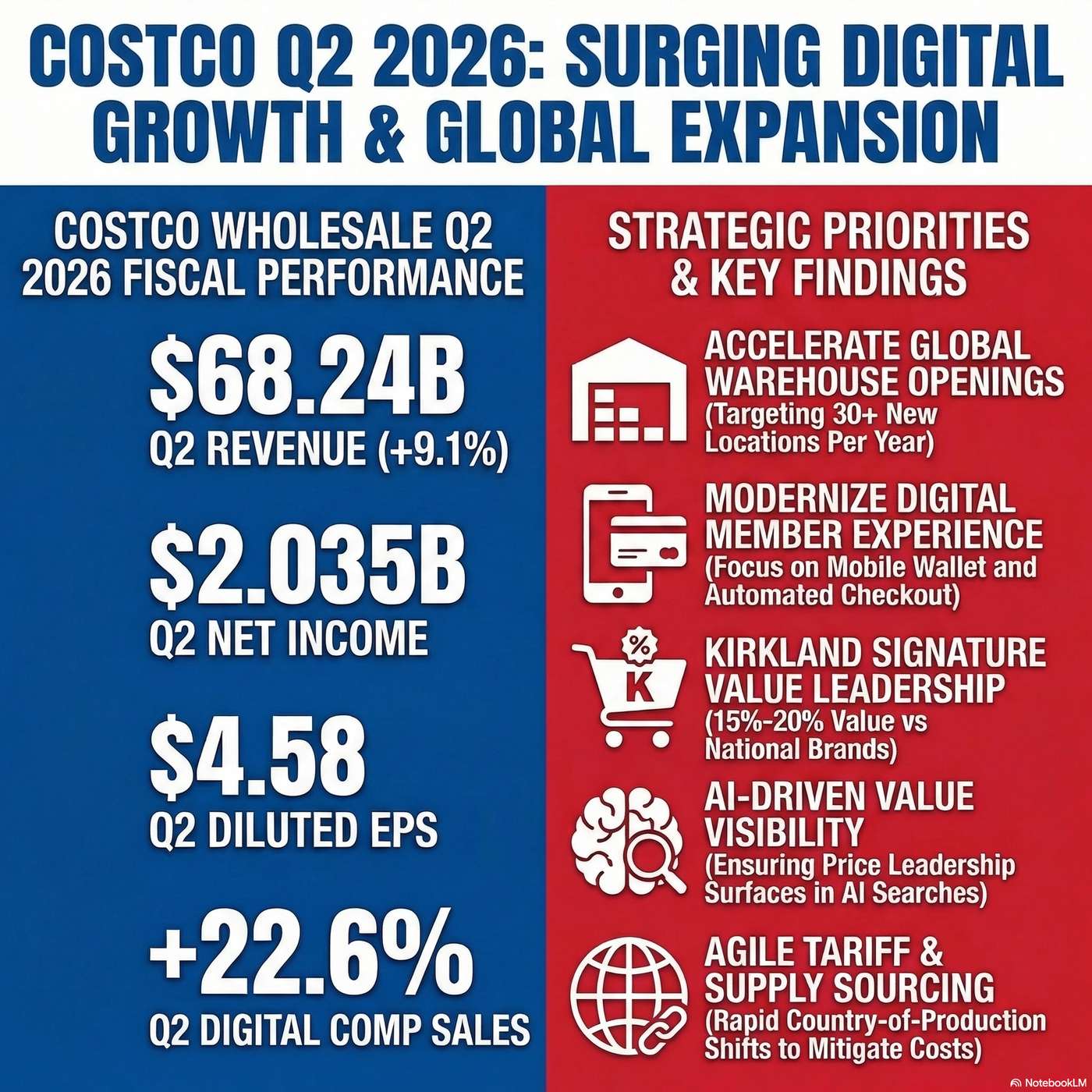
Costco Wholesale Corporation reported net income for the second quarter of 2026 at $2.035 billion, or $4.58 per diluted share.Net sales for the second quarter were $68.24 billion, which represents an increase of 9.1 percent from the second quarter of 2025.Comparable sales were up 7.4 percent.The company reported membership fee income of $1.355 billion, an increase of 13.6 percent year-over-year.The quarter ended with 82.1 million total paid members and 4.4 million paid executive memberships.Management highlighted several key business priorities, including increasing the pipeline of new warehouses domestically and internationally.The company expects to have 28 net new openings in fiscal year 2026 and is targeting 30-plus new openings per year in the coming years. In digital and warehouse operations, the company is piloting automated pay stations that allow members to pay seamlessly, with an average transaction time of around 8 seconds.Additionally, personalized product recommendation carousels drove over $470 million of e-commerce sales in the second quarter.Looking ahead, the company estimates full-year capital expenditure will be approximately $6.5 billion to support a larger pipeline of new warehouses, remodeling existing locations, expanding the depot network, and enhancing the digital experience.Management noted that egg price deflation is expected to continue to be a headwind to sales in food and sundries for the foreseeable future.Furthermore, they indicated that the situation in the Middle East could impact fuel costs and shipping schedules if there is instability in the region for a sustained period of time.During the quarter, Costco lowered prices on several Kirkland Signature items, including butter, organic coconut water, and olive oil.The company also launched approximately 30 new Kirkland Signature items, such as crispy wings and blackened salmon.The pharmacy and food court businesses experienced double-digit comparable sales growth.Same-day delivery services offered through Instacart, Uber Eats, and DoorDash continued to grow at a faster pace than overall digital sales.
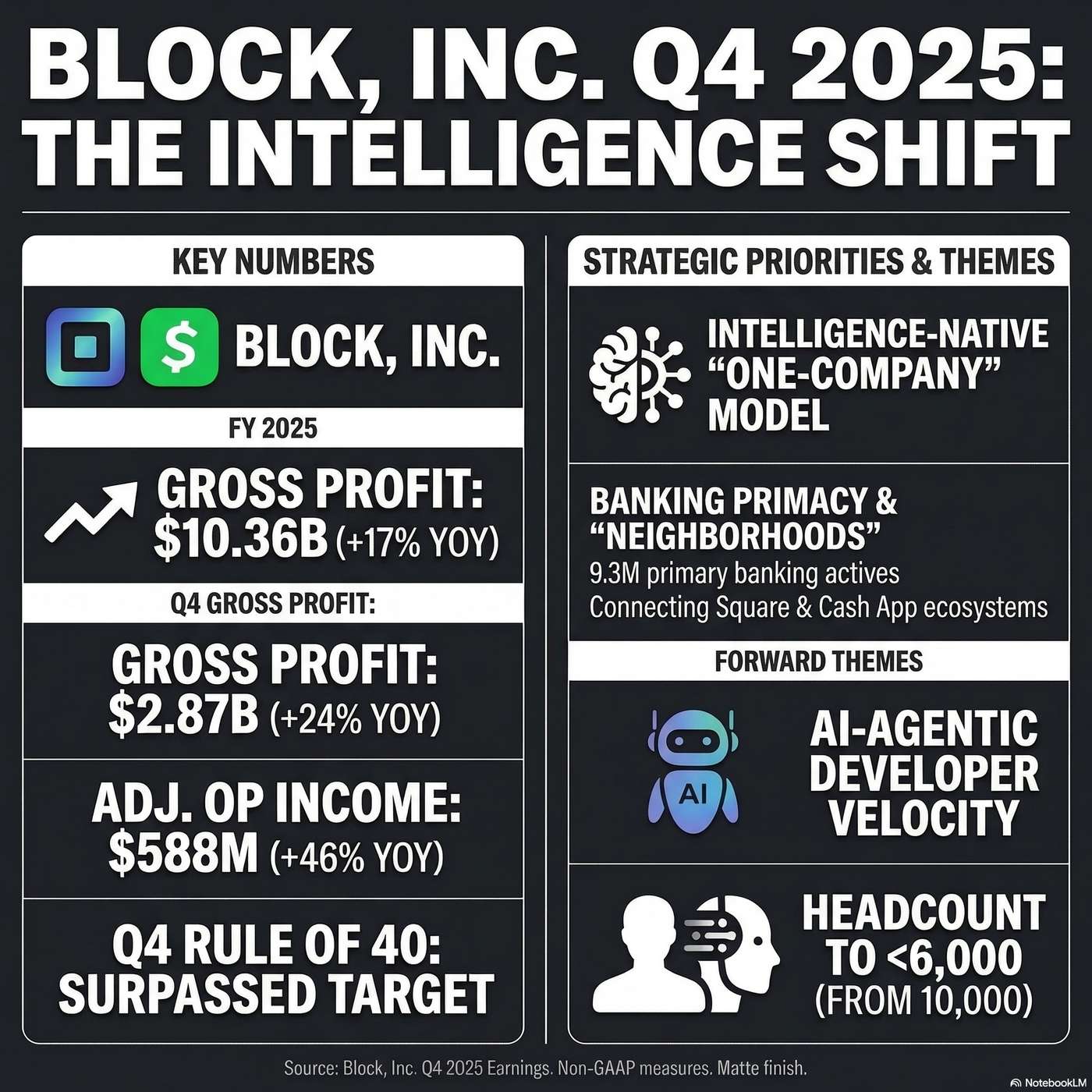
Block reported fourth quarter 2025 results with $2.87 billion in gross profit, representing 24% year-over-year growth.For the full year 2025, the company reported $10.36 billion in gross profit and growth of 17% year-over-year.Block grew adjusted operating income 46% year-over-year to $588 million in the fourth quarter. On a per share basis, adjusted diluted EPS grew 38% year-over-year in the quarter.Executives announced an organizational restructuring, reducing the workforce from over 10,000 people to just under 6,000.This structural change is designed to increase velocity and leverage intelligence tools across the company. In terms of network growth, Cash App monthly actives reached 59 million in December, with primary banking actives growing 22% year-over-year to 9.3 million.Meanwhile, Square accelerated its gross payment volume growth to 10% in 2025.Block provided strong forward guidance for 2026, expecting year-over-year gross profit growth of 18% to $12.2 billion.The company increased its guidance for 2026 adjusted operating income to $3.2 billion and adjusted diluted EPS to $3.66.For the first quarter of 2026, Block expects year-over-year gross profit growth of 22% to $2.8 billion, adjusted operating income of $600 million, and adjusted diluted EPS of $0.67.The company highlighted notable momentum with Cash App Borrow, which saw origination volume grow more than 3x year-over-year in the fourth quarter.Block also launched Afterpay pre-purchase functionality on the Cash App Card in February and introduced Pay in 4 functionality for peer-to-peer transactions.Looking ahead, Block is focused on scaling new intelligence products, including Moneybot, Managerbot, and Square AI for sellers.
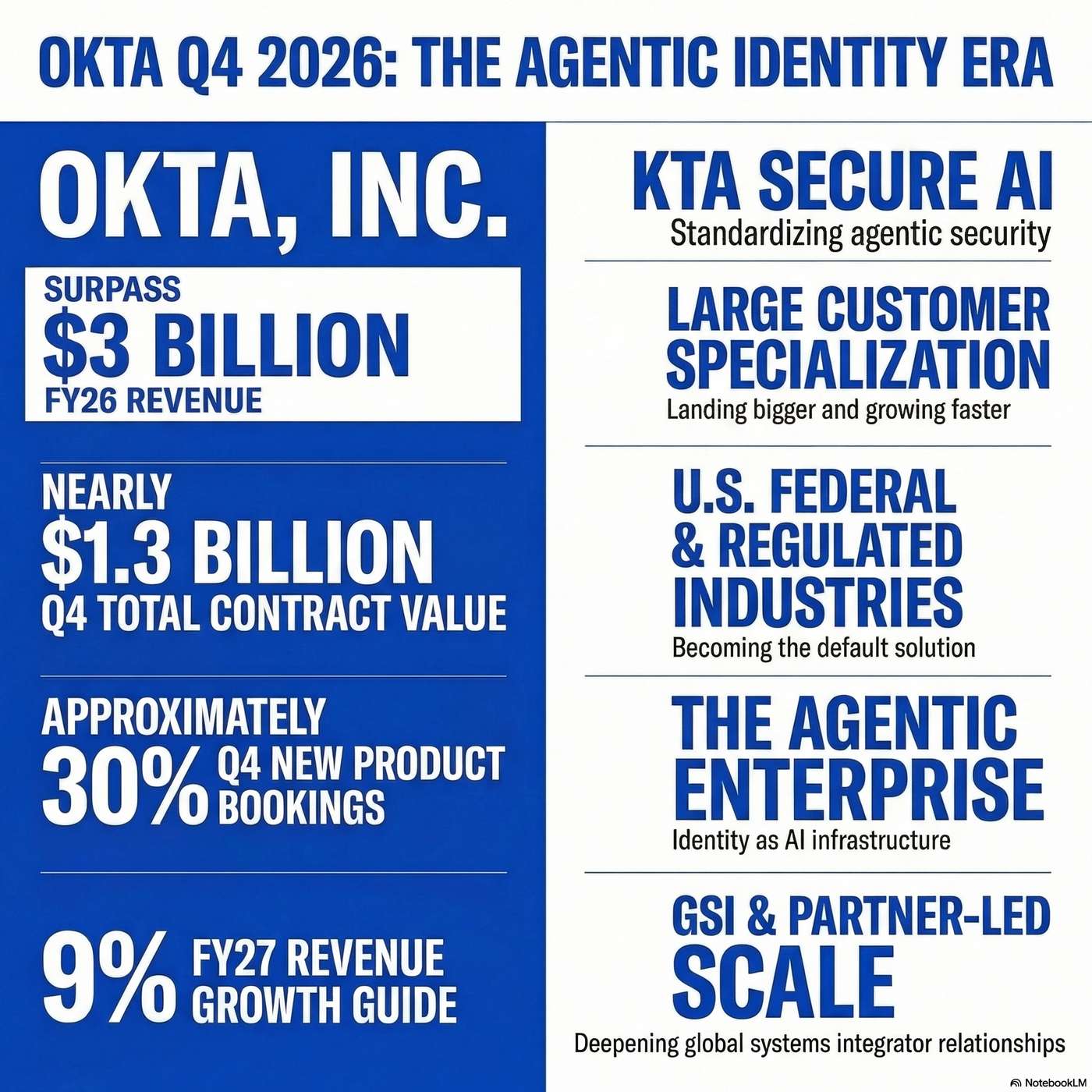
In Q4, Okta closed a record amount of total contract value of nearly $1.3 billion and surpassed a major milestone of $3 billion in annual contract value.The company ended the quarter with over $2.5 billion in cash, cash equivalents, and short-term investments.Additionally, total contract value generated through AWS Marketplace grew over 45 percent in fiscal year 2026 to approximately $750 million. In January, the company repurchased and retired over 875,000 shares for a total cost of $79 million under a $1 billion share repurchase program.Management highlighted strong performance from their portfolio of new products, which represented approximately 30 percent of Q4 bookings.When these new products are included in a deal, the average contract uplift is approximately 40 percent.Okta Identity Governance now has over 2,000 customers.The company outlined its top priorities for fiscal year 2027, including securing agentic AI, increasing focus on large customers, and becoming the default identity security solution for the U.S. federal vertical and highly regulated industries.The company introduced its newest products, Auth0 for AI Agents and Okta for AI Agents, designed to secure and govern the life cycle of AI agents.Management emphasized that their neutral and independent identity solution is uniquely positioned to address the growing security threat represented by nonhuman identities.Okta also announced a strategic decision to shift more professional services business to global system integrators to deepen partner relationships and increase business with large enterprises.For the first quarter of fiscal year 2027, Okta expects total revenue growth of 9 percent, current RPO growth of 10 percent, non-GAAP operating margin of 23 percent to 24 percent, and free cash flow margin of 33 percent to 35 percent.For the full year fiscal 2027, the company expects total revenue growth of 9 percent, non-GAAP operating margin of 25 percent to 26 percent, and a free cash flow margin of 27 percent to 28 percent.
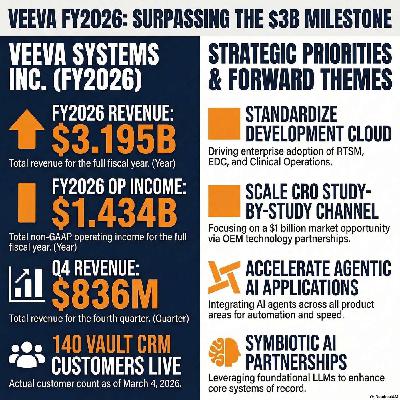
Veeva Systems Inc. reported fiscal 2026 fourth quarter and full year financial results.For the quarter, management stated that total revenue was $836 million with non-GAAP operating income of $366 million.For the full year, total revenue reached $3.195 billion and non-GAAP operating income was $1.434 billion.The company also announced it surpassed its $3 billion revenue run rate goal.During the call, management provided updates on several key business initiatives, highlighting significant momentum with Vault CRM, noting that close to 140 customers are now live.The company also announced a milestone deal with a top 20 life sciences company standardizing on its RTSM product.Additionally, Veeva discussed its ongoing AI strategy, revealing plans to roll out agents across all product areas this year and introducing a token-based pricing model for these offerings.Looking ahead, the company discussed its fiscal 2027 guidance, which incorporates a 13 percent total revenue growth starting point and anticipates continued healthy growth from the Crossix business.Management also noted that CRM represents roughly 20 percent of total revenue today and is projected to account for about 10 percent by the 2030 time frame, while pulling the Veeva CRM end of support date into December 2029 to ensure no stragglers remain in 2
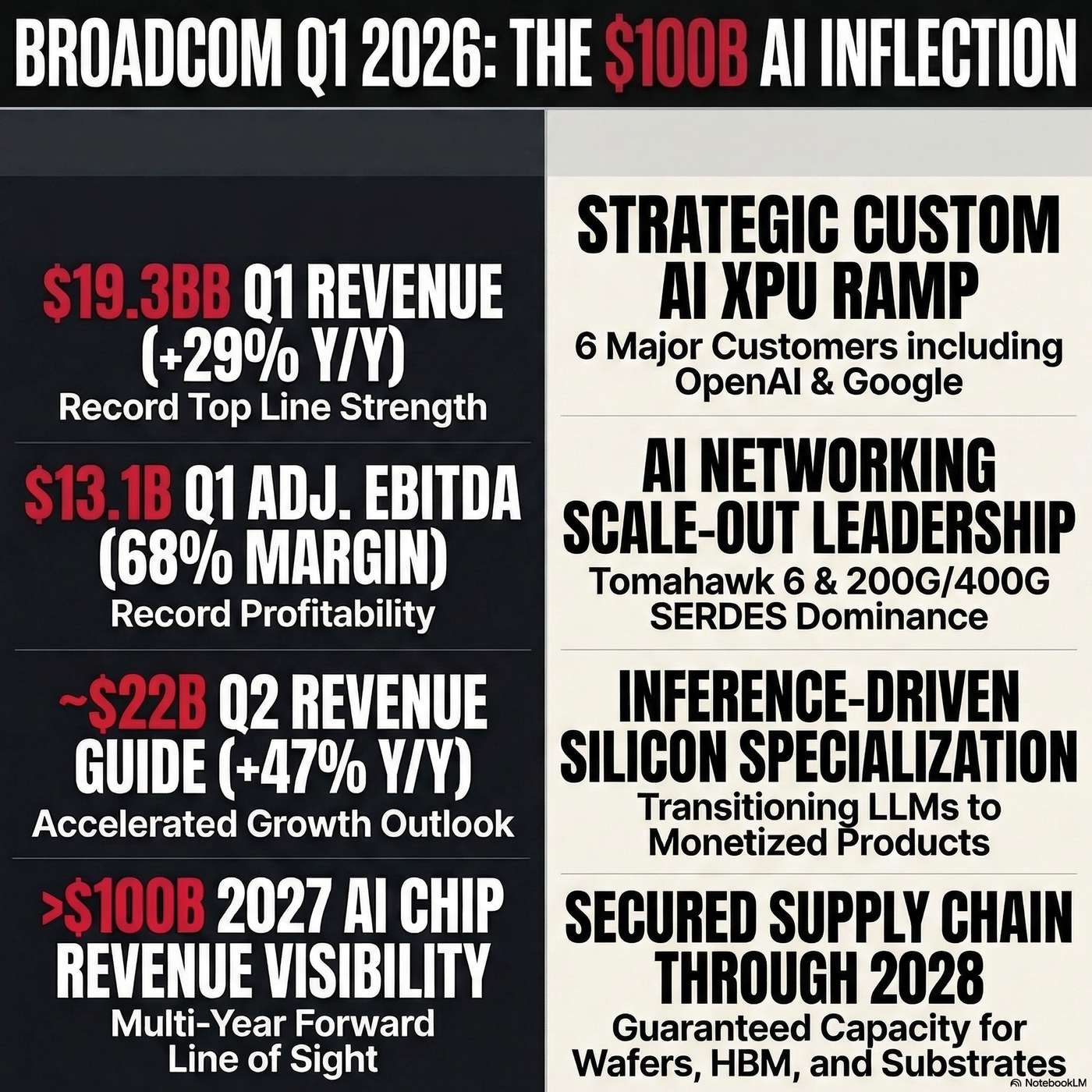
In Q1 2026, Broadcom reported consolidated revenue of a record $19.3 billion, up 29 percent year-on-year.Gross margin was 77 percent of revenue. Q1 operating income reached a record $12.8 billion.Adjusted EBITDA was a record $13.1 billion, representing 68 percent of revenue.Free cash flow for the quarter was $8 billion, which represented 41 percent of revenue.The Semiconductor Solutions segment generated a record $12.5 billion in revenue, while infrastructure software revenue was $6.8 billion.During the call, management highlighted that the ramp of custom AI accelerators across their customers is progressing very well.Broadcom now has six customers for custom AI XPUs, including Google, Anthropic, Meta, and OpenAI. AI networking revenue grew 60 percent year-on-year and represented one-third of total AI revenue, driven by demand for the Tomahawk 6 switch and 200G SERDES. Additionally, VMware Cloud Foundation was emphasized as the essential software layer in data centers.The company has fully secured capacity for leading-edge wafers, high-bandwidth memory, and substrates for 2026 through 2028.For Q2 2026, Broadcom issued guidance for consolidated revenue of approximately $22 billion, up 47 percent year-on-year, with adjusted EBITDA expected to be approximately 68 percent of revenue.Second-quarter semiconductor revenue is forecast at approximately $14.8 billion, with AI semiconductor revenue expected to be $10.7 billion.Looking further ahead, management stated they have line of sight to achieve AI revenue from chips in excess of $100 billion in 2
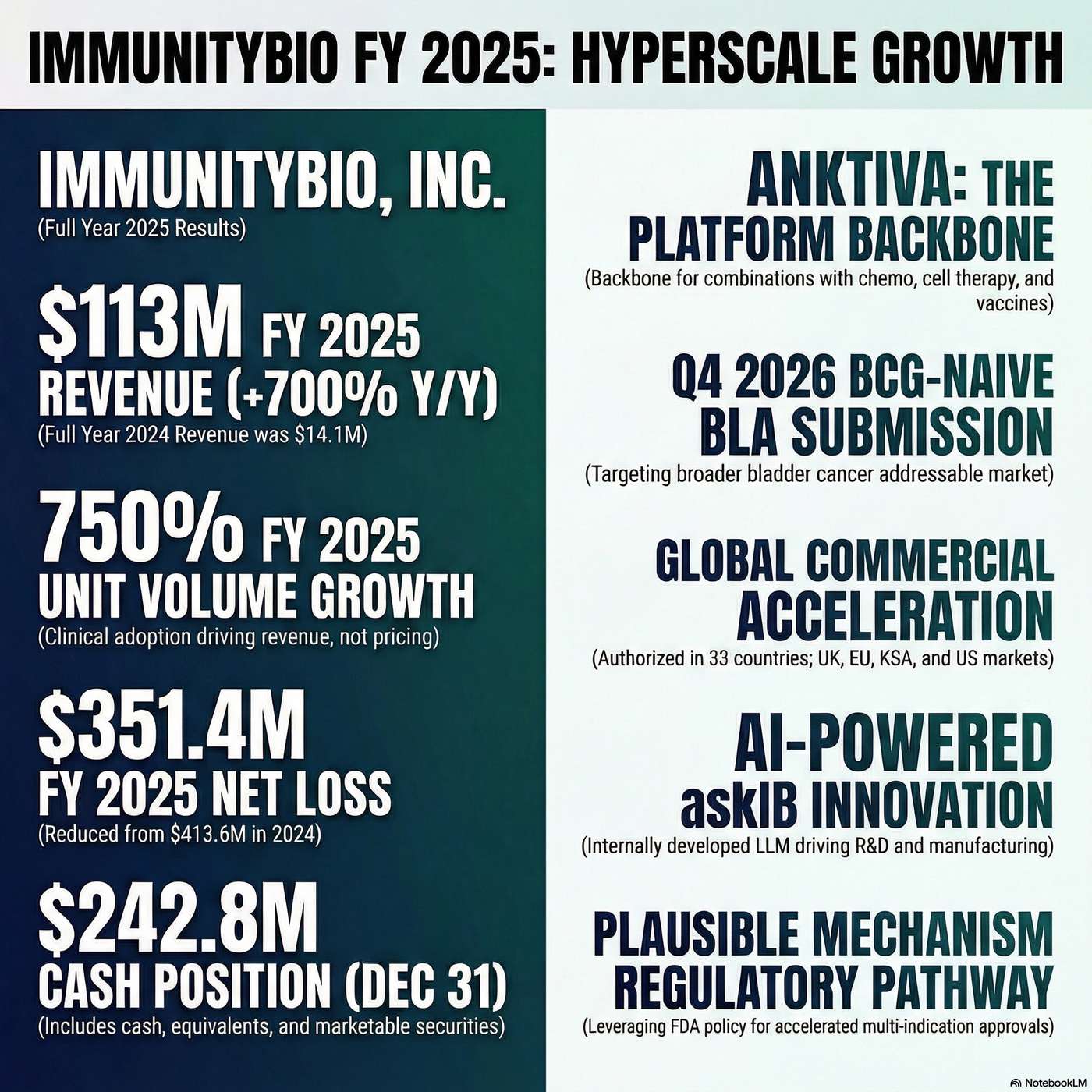
ImmunityBio, Inc. reported full year net product revenue for ANKTIVA of $113 million, representing a 700% year-over-year increase compared to $14.1 million in 2024. In the fourth quarter, net product revenue increased from $31.1 million to $38.3 million.Full year research and development expenses were $218.6 million, and selling, general, and administrative expenses decreased to $150 million.Full year net loss attributable to ImmunityBio common stockholders was $351.4 million.The company reported consolidated cash, cash equivalent, and marketable securities of $242.8 million as of December 31, 2025.The company highlighted the commercial momentum of ANKTIVA, which is now authorized across 33 countries.Management introduced askIB, an internally developed artificial intelligence solution utilizing advanced large language models to integrate with the global enterprise application suite.The company also discussed the NANT Leonardo platform for automated cellular manufacturing using artificial intelligence and machine vision.The company stated it will not be providing forward financial guidance on the call.However, management intends to submit a biologics licensing application for the BCG-naive indication in the fourth quarter of 2026.ImmunityBio partnered with Accord Healthcare to support commercial launch across 31 countries in Europe, including the United Kingdom and all 27 European Union member states.The company also announced partnerships with Biopharma and Cigalah to expand access across the Middle East and North Africa region following the Saudi FDA approvals of ANKTIVA for nonmuscle-invasive bladder cancer and metastatic nonsmall cell lung cancer.
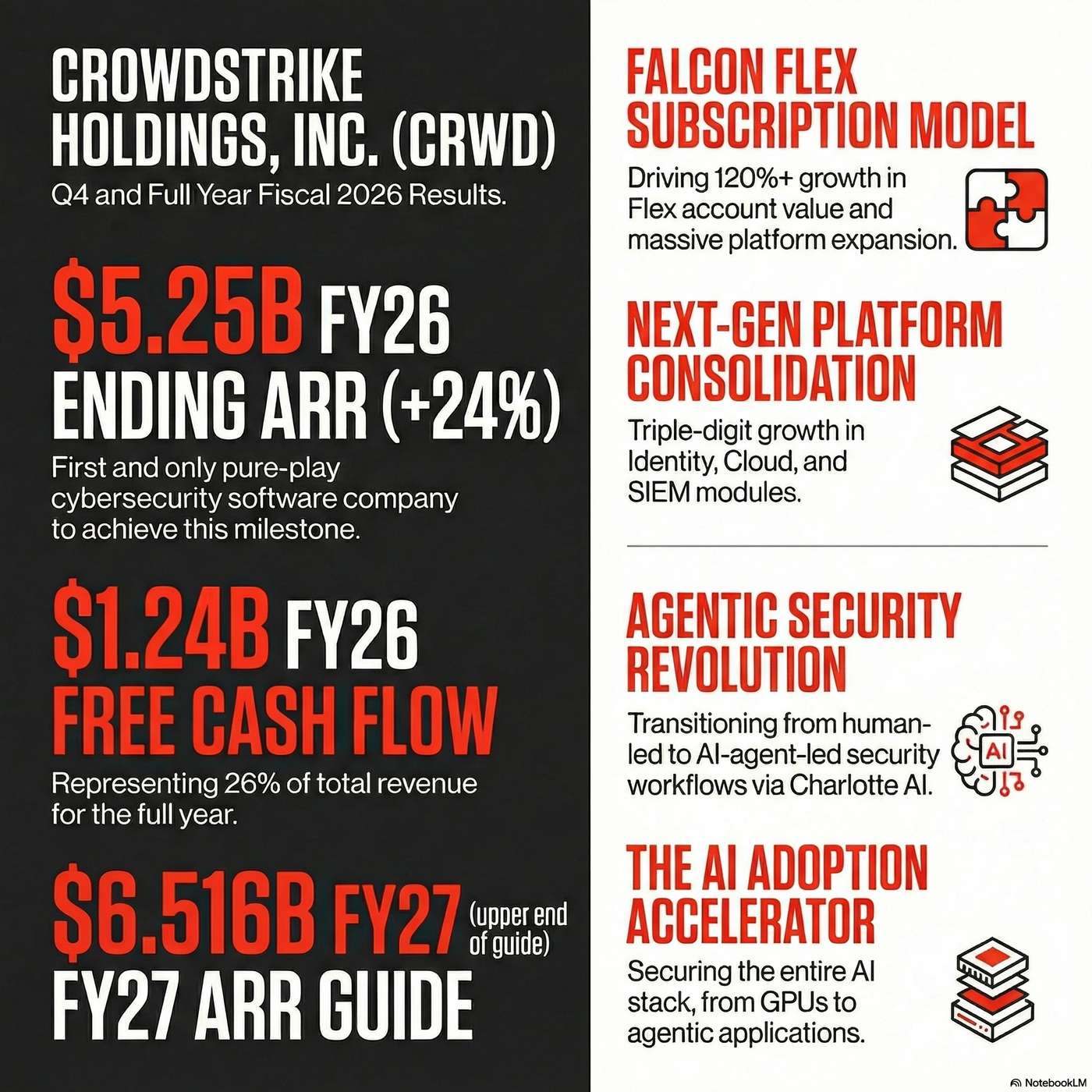
CrowdStrike Holdings, Inc. reported fourth quarter fiscal 2026 total revenue of $1.31 billion, an increase of 23% over Q4 of last year.The company posted record net new ARR of $330.7 million, bringing ending ARR to $5.25 billion.Fourth quarter non-GAAP operating income reached a record $325.8 million, representing 25% of revenue.Additionally, the company generated record free cash flow of $376.4 million, or 29% of revenue, for the quarter.Full fiscal year 2026 non-GAAP operating income reached a record $1.05 billion.Management emphasized the success of the Falcon Flex subscription model, noting the addition of more than 350 Flex customers in the fourth quarter to reach a total of over 1,600.The company stated that 50% of subscription customers are now using 6 or more modules.Chief Executive Officer George Kurtz highlighted that the company's endpoint business accelerated for the second consecutive quarter, driven by elevated demand for the Falcon platform amidst accelerating AI adoption.For the first quarter of fiscal 2027, CrowdStrike expects total revenue between $1.360 billion and $1.364 billion, with non-GAAP income from operations in the range of $308 million to $310 million.Full fiscal year 2027 guidance anticipates total revenue between $5.868 billion and $5.928 billion, and non-GAAP income from operations between $1.422 billion and $1.462 billion.Management also indicated a change in the sales commission amortization expense period from 4 to 5 years starting in Q1, which is expected to benefit non-GAAP operating income by $85 million to $95 million for the full year.The company shared details on its recent acquisitions of SGNL AI to provide zero standing privilege for all identities, and Seraphic to bring secure enterprise browser capabilities to the Falcon platform.CrowdStrike also launched a new AIDR offering designed to give customers immediate visibility into employee usage of AI tools.Regarding partnerships, management announced that CrowdStrike is now open for business on the Microsoft marketplace, allowing customers to utilize their Microsoft Azure consumption commitment dollars on Falcon.
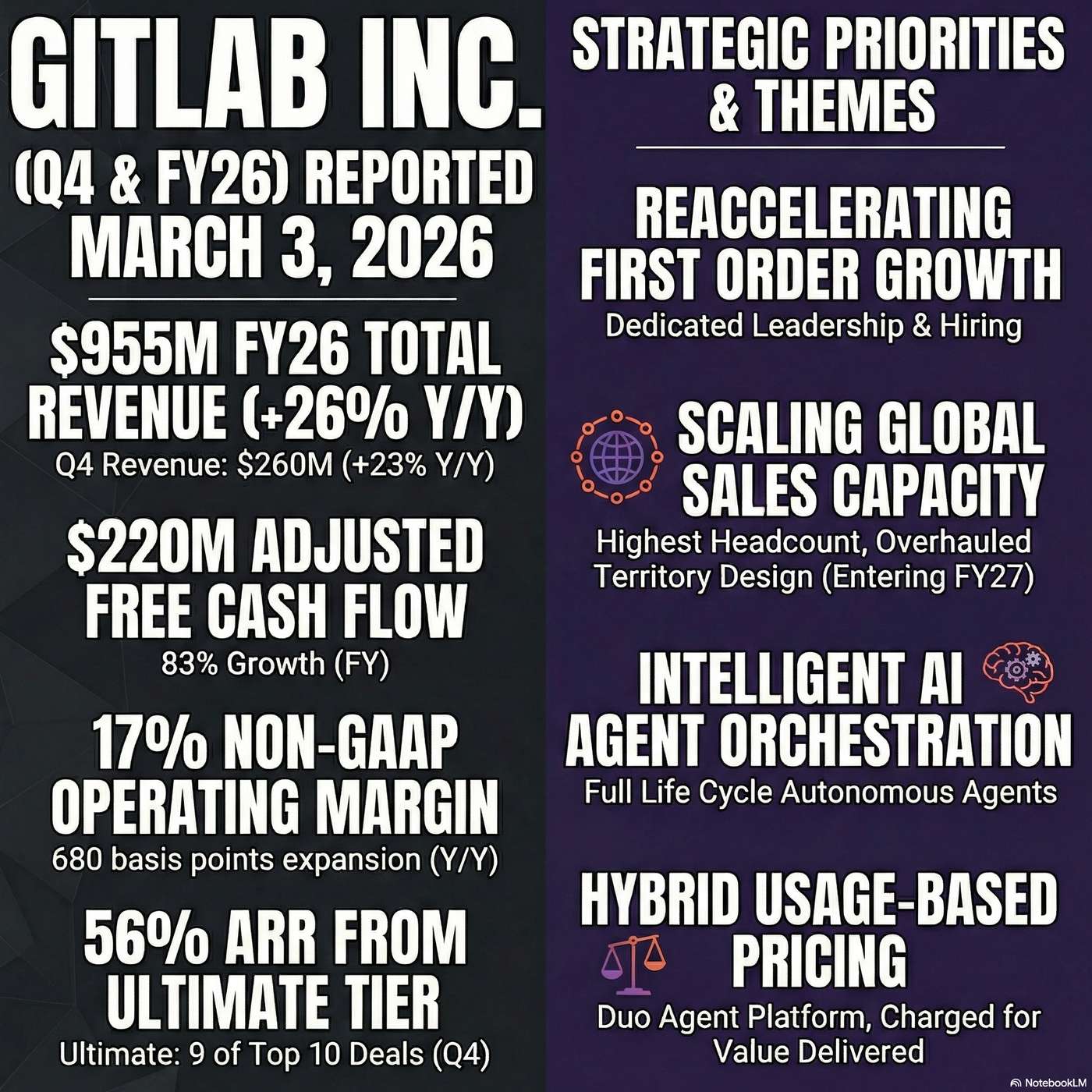
GitLab Inc. reported its fourth quarter and fiscal year 2026 financial results, with management noting that Q4 revenue was $260 million, up 23% year-over-year.For the full fiscal year 2026, revenue grew 26% to $955 million, and adjusted free cash flow grew 83% to $220 million.Fourth quarter non-GAAP operating income was $53.4 million, representing an operating margin of 20.5%.The company's Board also authorized a first-time share repurchase program of $400 million.Management outlined five specific strategies to improve growth at scale for fiscal year 2027, which include reaccelerating first orders, scaling sales capacity, expanding product packaging, engaging price-sensitive customers, and executing an AI strategy.The company is entering the new fiscal year with its highest sales capacity ever and has overhauled territory design. On the product front, the company launched the GitLab Duo agent platform in mid-January, which introduces usage-based pricing alongside the company's seat model.For forward guidance, management expects first quarter fiscal year 2027 total revenue of $253 million to $255 million, representing approximately 18% to 19% year-over-year growth.The company also expects first quarter non-GAAP operating income of $32 million to $34 million and non-GAAP net income per share of $0.20 to $0.21.Management noted they are assuming minimal revenue contribution from the GitLab Duo agent platform in fiscal year 2027 as they allow time to convert pilots into production deployments.
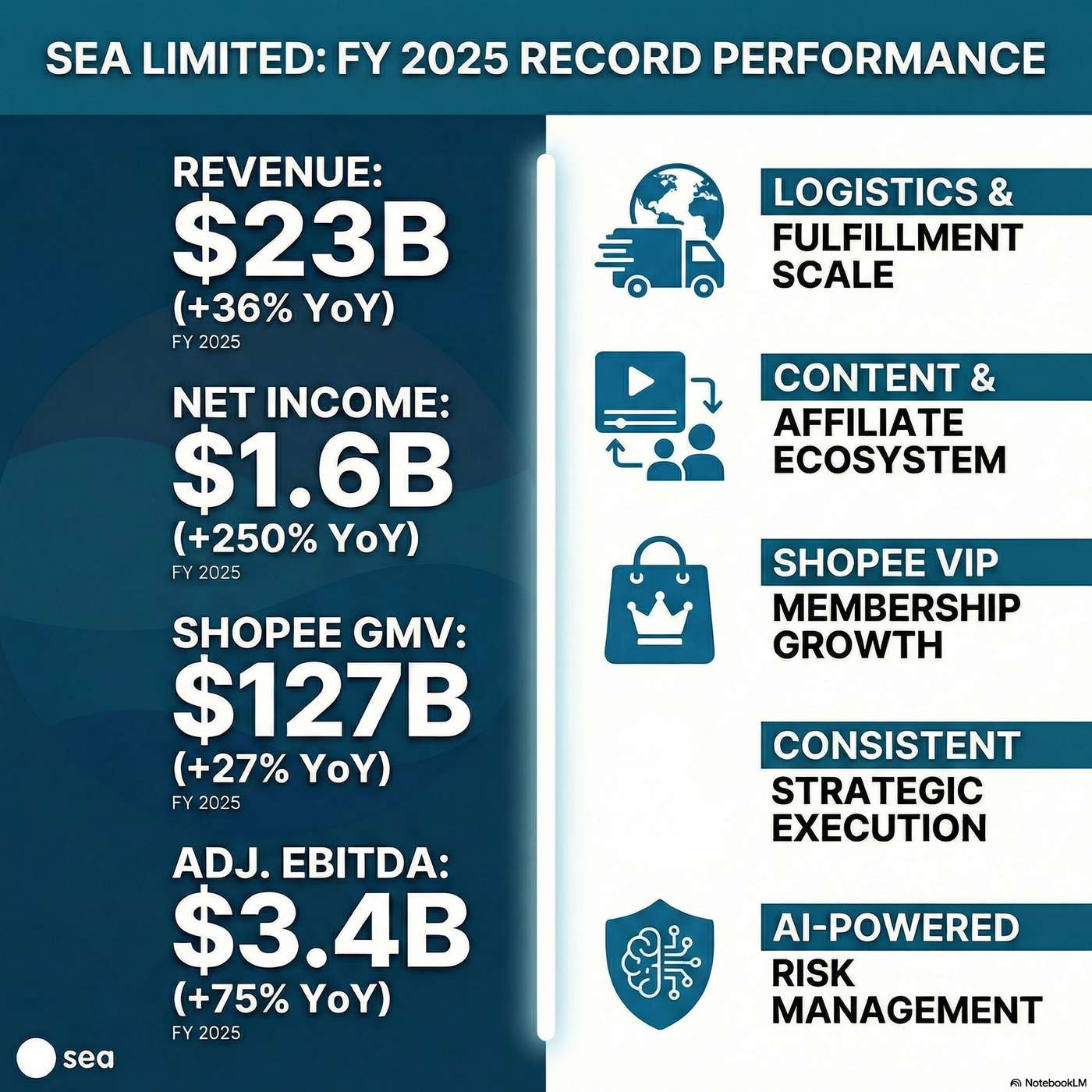
For the fourth quarter of 2025, Sea Limited reported total GAAP revenue of 6.9 billion dollars, representing a 38 percent increase year-on-year, and total adjusted EBITDA of 787 million dollars.For the full year of 2025, the company generated 22.9 billion dollars in total GAAP revenue, a 36 percent year-on-year increase, and full year net income reached 1.6 billion dollars.Shopee achieved full year GMV of 127 billion dollars with an adjusted EBITDA of 881 million dollars.The Money segment reported a full year revenue of 3.8 billion dollars, while Garena generated full year bookings of 2.9 billion dollars.Management highlighted operational improvements across all three core businesses.Shopee expanded its logistics and fulfillment capabilities, with its SPX Express processing over 30 million deliveries daily on average.The Shopee VIP membership program was rolled out across all Asian markets, reaching over 7 million subscribers by year-end, and the company plans to launch the program in Brazil.Shopee also deepened its content ecosystem through partnerships with YouTube and Meta, noting that orders driven by YouTube content more than tripled year-on-year in the fourth quarter.The credit business grew to 9.2 billion dollars in consumer and SME loans principal outstanding while maintaining a 90-day nonperforming loan ratio of 1.1 percent.For 2026, Sea Limited provided forward guidance for its e-commerce and digital entertainment segments.Management stated they aim to grow Shopee GMV by about 25 percent year-on-year, with its full year adjusted EBITDA expected to be no lower than 2025 in absolute dollars.For Garena, the company expects double-digit growth for 2026 and plans to extend its intellectual property collaborations, including a new Naruto release anticipated in the third quarter.

Comments

Download from Google Play

Download from App Store
 United States