


 Claim Ownership
SpeakSmart English
Subscribed: 27Played: 200
Subscribe

© Copyright Norse Studio
Description
Welcome to SpeakSmart English, your go-to podcast for learning English in a smart, practical, and fun way. Each episode is packed with tips, real-life examples, and strategies to help you speak confidently and naturally. Whether you’re a beginner or looking to polish your skills, we break down tricky grammar, vocabulary, and pronunciation into easy-to-follow lessons. Join us and discover how learning English can be engaging, motivating, and perfectly suited to your lifestyle. Start speaking smarter today!
Become a supporter of this podcast: https://www.spreaker.com/podcast/speaksmart-english--6886546/support.
Become a supporter of this podcast: https://www.spreaker.com/podcast/speaksmart-english--6886546/support.
92 Episodes
Reverse

This structured approach to language learning is designed to enhance English proficiency through a four-part methodology that targets listening, vocabulary, and active speaking. By integrating these components, learners can transition from passive understanding to confident communication.Stage One: Immersive ListeningThe process begins with natural listening practice. Learners listen to conversations between native speakers that mirror real-life situations, such as a professional discussing their transition into a new job. This stage focuses on understanding the overall meaning of a dialogue, covering topics like meeting a new team, managing workloads, and learning new software systems.Stage Two: Practical VocabularyTo help learners sound more natural, the method emphasizes mastering idiomatic expressions rather than just individual words. Key phrases covered include:"To sum up": Used to provide a brief summary."In a nutshell": An idiom used to describe something very briefly and concisely."Getting the hang of it": A phrase used when someone starts to understand or become good at a specific task.Stage Three: Interactive Question and AnswerThis stage transforms the learner into an active participant through listen and answer drills. Learners are asked questions about the dialogue—such as whether a character is enjoying their new role or if they have met their new team—and are encouraged to answer out loud. This interactive practice is essential for boosting speaking confidence and building the ability to formulate responses quickly.Stage Three: Shadowing PracticeThe final part of the training utilizes the shadowing technique. Learners repeat lines out loud immediately after the speakers, focusing specifically on rhythm, stress, and intonation. This exercise is designed to sharpen pronunciation and improve overall speaking abilities by mimicking the natural flow of English speech.Consistency for SuccessFor significant improvement, it is recommended to engage with these exercises daily for at least one week. This repetitive approach ensures that the new vocabulary and sentence structures are fully internalized, allowing learners to see a marked difference in their communication skills.Become a supporter of this podcast: https://www.spreaker.com/podcast/speaksmart-english--6886546/support.

This educational material is designed to help English learners enhance their speaking, listening, and pronunciation skills through a structured four-part exercise. The primary goal is to train the brain for fluency by engaging with real-life conversational scenarios and interactive practice techniques.The first section focuses on listening comprehension. It features a dialogue between two individuals discussing the completion of a project. One person expresses relief that the work is finished, despite it being submitted later than expected. They discuss the common challenges of modern life, specifically how technology can be unpredictable and "tricky," leading to unforeseen delays. This part of the exercise encourages learners to focus on the overall meaning of a conversation to better understand real-life interactions.The second part dives into essential vocabulary and idiomatic expressions used in the opening conversation. Key phrases include:"Better late than never," which emphasizes that completing a task behind schedule is preferable to not doing it at all."What took you so long," a common way to inquire about the cause of a delay."It took more time than I thought," which is used to describe situations where a task proves more demanding than originally anticipated. Each phrase is explained clearly and accompanied by practical examples to ensure learners understand how to apply them in different contexts.The third section is an interactive "listen and answer" practice. Learners are prompted to answer specific questions about the previous dialogue out loud before the correct answers are revealed. This method is intended to boost confidence and speed in verbal responses. By answering questions about the timeline of the project or the specific problems encountered, students reinforce their understanding of the narrative while practicing their sentence structure.The final phase of the lesson involves shadowing practice. This technique requires learners to read and speak their lines out loud immediately after the speakers in the conversation. The focus here is on the rhythm and intonation of English expressions. By mimicking the speakers, learners can sharpen their pronunciation and develop a more natural flow in their speech.Overall, the material emphasizes the importance of consistent, daily practice. It encourages learners to revisit these exercises for at least a week to see significant improvements in their ability to communicate effectively. The lesson concludes with the idea that once hard work is finished, it is important to take a moment to relax and appreciate the progress made in the learning journey.Become a supporter of this podcast: https://www.spreaker.com/podcast/speaksmart-english--6886546/support.

Learning English effectively requires a multifaceted approach that focuses on listening, vocabulary acquisition, and active speaking practice. This comprehensive method is divided into four distinct stages to ensure learners can process the language naturally and build confidence.The first stage focuses on listening comprehension through realistic dialogues. By listening to native speakers interact, students can grasp the overall meaning and context of a conversation without getting bogged down by every individual word. For example, a conversation about a project deadline illustrates how to manage stress and avoid mistakes by working carefully.,In the second stage, learners explore specific vocabulary and idiomatic expressions used in the dialogue. Important phrases like "easy does it" are explained as doing something slowly and carefully to avoid errors. Another useful expression, "one step at a time," teaches the value of focusing on a single task before moving to the next, which is particularly helpful when dealing with complex projects. Understanding these nuances allows for more natural communication in professional and social settings.The third stage is an interactive "listen and answer" exercise. Learners are asked questions about the previous dialogue and are encouraged to answer out loud as quickly as possible. This practice trains the brain to retrieve English vocabulary and grammar structures spontaneously, which is essential for real-time conversation., Repeating this exercise daily helps in building the speed and confidence needed to speak fluently.The final stage involves shadowing practice, a technique where the learner repeats sentences immediately after a speaker. This part of the exercise is crucial for developing proper rhythm, intonation, and pronunciation. By mimicking the natural flow of English speech, learners can sound more authentic and improve their overall speaking abilities.Consistent practice is key to mastering these skills. Engaging with these exercises every day for at least a week can lead to significant improvements in both comprehension and verbal expression. This structured system provides a clear path for anyone looking to transition from passive listening to active, fluent speaking.,Become a supporter of this podcast: https://www.spreaker.com/podcast/speaksmart-english--6886546/support.

This interactive English-speaking practice is designed to enhance vocabulary, listening comprehension, and pronunciation through a structured four-part method. The approach focuses on real-life communication and training the brain for fluency by immersing the learner in practical scenarios.Part One: Listening Practice Learners begin by listening to a natural conversation between native speakers to focus on understanding overall meaning in a real-life context. In this exercise, the dialogue centers on a daily update where one person describes cooking a new recipe—a homemade pizza. The exchange highlights that the process was easier than expected and resulted in a delicious meal topped with cheese and vegetables.Part Two: Vocabulary Development The method introduces and explains specific terms used in the dialogue to help learners grasp their meanings through examples. Key vocabulary includes:Recipe: A set of instructions for preparing a dish, including necessary ingredients.It turns out: A phrase used to indicate that something was discovered or became known unexpectedly.Leftovers: Food that remains after a meal has been finished.Part Three: Listen and Answer Practice This interactive segment requires learners to answer questions out loud based on the conversation they just heard. By responding before the correct answer is revealed, students can boost their speaking and listening skills. The questions test comprehension of specific details, such as whether certain toppings were used or when the food will be shared with others.Part Four: Shadowing Practice The final stage utilizes the shadowing technique, where learners read lines out loud immediately after the speakers. This specific exercise is intended to help students focus on the rhythm and intonation of English expressions. Regularly practicing shadowing helps sharpen pronunciation and overall speaking abilities.Recommendations for Success To achieve significant improvements in English skills, it is suggested to repeat these exercises every day for at least one week. Consistent repetition helps the learner provide answers more quickly and builds the confidence needed for real-world interactions.Become a supporter of this podcast: https://www.spreaker.com/podcast/speaksmart-english--6886546/support.

Improving English speaking skills is effectively achieved through a structured approach involving listening to natural conversations, expanding vocabulary with idiomatic expressions, and engaging in active speaking practice. This method allows learners to hear how native speakers interact in informal settings while gradually building the confidence to respond to questions in real-time.A central part of this learning process involves a humorous story about a group of friends. In the story, a character named Jake decided to pull a prank on his friend Tom by hiding a fake spider in his bag. When Tom eventually discovered the spider, his reaction was so extreme that he screamed at the top of his lungs. This sudden outburst cracked everyone up, causing the entire room to burst into laughter. Another friend, Mark, missed the event but heard the details later, remarking that he wished he could have seen it himself.The conversation highlights several useful English idioms that are common in daily life:• To pull a prank on someone: This means to play a trick or a joke on another person, typically to surprise them or make others laugh.• To crack someone up: This expression is used when someone is made to laugh very hard.• Priceless: In this context, it describes a reaction or a moment that is extremely funny or highly amusing, often because it is so unique that it cannot be bought.• To hang out with someone: This is a very common way to describe spending time with people in a relaxed, informal manner.Because Jake is such a fun person who knows how to make everyone laugh, his friends Emily and Mark agree that they should hang out with him more often. They even begin planning their next meeting because they believe his presence makes every situation more enjoyable.To truly master these concepts, it is important to participate in interactive exercises. By listening to questions about the story and attempting to answer them out loud within a short timeframe, learners can improve their reaction speed and pronunciation. Consistency is vital for progress, and repeating these types of exercises for several days helps to solidify the new vocabulary and sentence structures in the learner's memory. The more one practices speaking in a controlled yet conversational way, the more natural their English becomes.Become a supporter of this podcast: https://www.spreaker.com/podcast/speaksmart-english--6886546/support.

John and Emma recently shared details about their respective weekends, highlighting a mix of social outings, relaxation, and shared interests,. John spent part of his time exploring a new Italian restaurant located downtown. He was highly impressed by the meal, specifically noting that the pizza and pasta were excellent,. While the restaurant was slightly more expensive than his usual spots, he concluded that the high quality of the food made the experience entirely worth the price,. He also mentioned that the reviews he had seen prior to his visit were "spot on," meaning they were perfectly accurate in their praise,.In addition to dining out, John enjoyed a peaceful afternoon at a park. He spent his time there reading, which he found to be a relaxing way to enjoy being outside,. In contrast, Emma opted for a quieter weekend. She stayed home to watch movies and focus on resting, noting that it is sometimes necessary to simply take a break,. Upon hearing John’s positive report about the restaurant, she expressed an interest in visiting it herself the following weekend,.The conversation also touched upon a book that Emma had previously recommended to John,. John thanked her for the suggestion, noting that her intuition was "spot on" because he thoroughly enjoyed the read,. He was particularly impressed by the "engaging" nature of the story, which held his attention throughout, and he remarked that the characters felt very real to him,.Several useful expressions are illustrated through their exchange. For instance, the term "spot on" is used to describe something that is exactly right or accurate. The word "worth" is used to indicate that something has enough value or importance to justify the effort or money spent on it. Finally, "engaging" is used to describe something, like a book or a lesson, that is very interesting and successfully holds a person's focus. Through this dialogue, the two friends demonstrate how to discuss personal experiences, evaluate services, and provide feedback on recommendations,,.Become a supporter of this podcast: https://www.spreaker.com/podcast/speaksmart-english--6886546/support.

This educational session is designed to help learners improve their English speaking and listening skills through a structured three-part approach. The practice begins with a natural dialogue between two friends discussing their recent achievements and weekend activities. One friend shares news about a successful football game where they scored the winning goal, while the other describes a piano recital where, despite initial nerves, they performed their piece perfectly.A key element of the session is the explanation of specific idioms and terms used in the conversation. For instance, the phrase "to nail it" is highlighted as an expression meaning to complete a task perfectly or successfully. Other important words include "recital," referring to a performance by students to show their skills, and "encouragement," which describes the support and confidence given to someone to help them succeed.The dialogue also covers future plans, such as preparing for a significant exam. When one friend mentions having a big test on Friday, the other offers support, illustrating how to use encouraging language in a real-world context. To reinforce learning, the session features an interactive segment where learners are asked a series of straightforward questions based on the conversation. These questions, such as whether a game was won or what instrument was played at a performance, require the learner to respond out loud to build speaking confidence.The method emphasizes that consistent practice and repetition are essential for language improvement. By listening to the dialogue, learning new vocabulary, and answering questions, students can develop a better understanding of how to describe their own lives and support others in English. The session concludes by encouraging learners to revisit the material regularly to achieve the best results in their language journey.Become a supporter of this podcast: https://www.spreaker.com/podcast/speaksmart-english--6886546/support.

The following lesson overview of the key concepts discussed in the sources regarding personal transformation and language learning.The Philosophy of Incremental ChangeCenters on the idea that life-changing transformations do not happen overnight through massive decisions, but rather through small, daily changes and habits. A core principle mentioned is the 1% rule: by improving just 1% every day, an individual becomes 37 times better over the course of a year. This concept is linked to the book Atomic Habits, which posits that these small efforts eventually compound to redefine one’s identity.Overcoming Psychological BarriersThe sources identify several reasons why people feel "stuck" and fail to make progress:• Fear of Failure: Many avoid trying because they fear the outcome, forgetting that success often requires failing along the way.• Lack of Direction: People often wait for a "perfect plan" before taking any action.• Negative Self-Talk: Beliefs such as "I’m just not a language person" stop progress before it begins.• The Motivation Trap: A common mistake is waiting to "feel ready" or motivated. However, the hosts explain that motivation follows action, meaning one must start before the feeling of readiness arrives.Mindset and Brain ScienceThe podcast emphasizes the difference between a Growth Mindset (the belief that one can improve) and a Fixed Mindset (the belief that abilities are static). This is supported by the function of the Reticular Activating System (RAS) in the brain, which filters information based on what a person focuses on. If you focus on progress, your brain will find evidence of it. Tools recommended to "reprogram" the mind include:• Positive Affirmations: Using talk like "I am getting better every day".• Visualization: Seeing oneself succeed to trick the brain into believing it is possible.• Gratitude: Training the brain to see opportunities instead of obstacles.The Power of Action and EnvironmentA major takeaway is that "done is better than perfect". Waiting for perfection leads to stagnation, whereas imperfect action builds the momentum necessary for confidence.Furthermore, the sources highlight that individuals are the "average of the five people" they spend the most time with. To support growth, one must:1. Surround themselves with positive, goal-driven individuals who inspire them.2. Join learning communities to share struggles and celebrate progress.3. Reduce exposure to negativity, such as people who complain or draining social media content.Ultimately, the podcast argues that individuals have more control over their lives than they think, provided they maintain the right mindset and a supportive environment.Become a supporter of this podcast: https://www.spreaker.com/podcast/speaksmart-english--6886546/support.

Mastering English for travel involves understanding specific airport vocabulary and the chronological steps of a flight journey. To improve fluency, learners benefit from a multi-part approach that includes listening comprehension, vocabulary building, and active speaking practice.The journey typically begins with arriving at the terminal approximately two hours before departure to ensure there is enough time for all procedures. The first objective is to find the check-in desk, where passengers drop off their luggage and receive their boarding pass. This document is essential as it provides permission to enter restricted areas and indicates the specific gate from which the plane will depart. During check-in, passengers often choose between a window seat, which offers a view, or an aisle seat, which allows for more freedom of movement.The next stage is the security check, a process where travelers and their carry-on bags are screened for prohibited items. It is standard procedure to place items like laptops separately on the conveyor belt. After clearing security, passengers may relax until it is time to board the plane, which is the formal process of entering the aircraft.Once on board, the cabin crew, also known as flight attendants, are available to assist passengers and ensure their comfort throughout the flight. Travelers generally hope for a timely departure and an absence of delays so they can reach their destination on schedule.Upon landing—the moment the aircraft touches the ground at the end of the flight—passengers proceed to the baggage claim area to retrieve their checked suitcases from the rotating belts. For international travel, the final step is passing through passport control, where officials verify travel documents before passengers can officially begin their vacation.To effectively retain this information, several interactive techniques are highly recommended:• Vocabulary Acquisition: Learning terms such as departure (the act of leaving), depart (to leave for a journey), and boarding (the process of getting on the plane).• Listen and Answer: Challenging oneself to answer questions about a conversation out loud to boost confidence and processing speed.• Shadowing Practice: Repeating sentences immediately after a speaker to mimic the rhythm and intonation of natural English.Consistent daily practice of these exercises is key to seeing significant improvements in speaking and listening abilities.Become a supporter of this podcast: https://www.spreaker.com/podcast/speaksmart-english--6886546/support.

The story follows a woman who found her long-standing friendship pushed to its breaking point by the increasingly extreme demands of a bride-to-be. Having already invested $300 in a seafoam green dress and survived a harrowing ATV accident during a destination bachelorette trip in Tulum, the woman felt she had been a highly supportive bridesmaid. She had even helped the bride write her wedding vows because the groom lacked creative inspiration. However, the situation turned absurd just twenty-four hours before the "ocean magic" themed beach ceremony.The bride issued a shocking ultimatum: the woman’s miniature dachshund, Mercedes, would only be permitted at the pet-friendly wedding if she were completely shaved. The bride claimed the dog’s natural brown and black coat would "ruin the aesthetic" of the professional photographs, which were meant to feature only neutral tones, driftwood, and sea-themed colors. When the woman refused to subject her pet to what she considered a form of animal cruelty, the bride dismissed her concerns, insisting the fur would simply "grow back" and accusing her of being unsupportive.The conflict reached a climax when the maid of honor warned the woman that she and the dog would be asked to leave if they showed up with Mercedes' fur intact. Choosing the well-being of her dog over a "Pinterest-perfect" vision, the woman decided to skip the wedding entirely. She spent the day driving home with the windows down, leaving the "barnacle-encrusted ship" of the bridal party behind.The fallout at the wedding was significant. Because the woman was no longer there to serve as a bridesmaid, the groom—who reportedly has a strong need for symmetry—became visibly agitated by the uneven ratio of five bridesmaids to six groomsmen. With no backup "flower dog" available, the family recruited a random toddler to walk down the aisle with seashells, which resulted in chaos when the child tripped during the procession.In a final act of defiance, the woman sent the bride a gift containing the $300 dress and a custom sea-glass collar she had bought for the dog, along with a card featuring only a smiley face. She later shared the bride's unreasonable text messages on social media alongside a photo of her dog in all her "unshaved glory". This incident effectively ended the friendship, leaving the woman at peace with her decision to prioritize her pet's comfort over a misguided wedding aesthetic.Become a supporter of this podcast: https://www.spreaker.com/podcast/speaksmart-english--6886546/support.

The provided content features a dialogue between two individuals, Amy and Jake, discussing the formation of a new book club hosted at a local library. The club's primary focus is on classic literature, specifically highlighting works by renowned authors such as Jane Austen and Charles Dickens. Jake shows immediate interest in joining, mentioning that he has intended to explore more classic books for some time.The logistics of the club are clearly defined: the inaugural meeting is set for next Tuesday at 6:00 p.m.. These gatherings generally last for approximately an hour. Participants engage in book discussions, share personal perspectives, and may occasionally be served refreshments, which include drinks and small snacks. For their first session, the group will be reviewing the novel "Pride and Prejudice". Jake commits to starting the book immediately to prepare for the upcoming discussion.Beyond the narrative, the material serves as an educational tool for English learners, structured into three distinct parts. The first section focuses on listening comprehension through the dialogue between the two characters. The second part introduces and explains key vocabulary and idioms. For instance, it defines the phrase "come to think of it" as an expression used when someone suddenly realizes or remembers a fact. It also clarifies that the phrase "or so" indicates an approximate amount or time.The final section involves speaking practice, where learners are encouraged to answer questions aloud based on the conversation to reinforce their understanding of the details, such as the meeting's date and the specific literary genre being studied. This structured approach is designed to help users improve their speaking and comprehension skills through repetition and active participation. Learners are encouraged to practice by reviewing the material multiple times to achieve better fluency.Become a supporter of this podcast: https://www.spreaker.com/podcast/speaksmart-english--6886546/support.

Managing your time effectively is about more than just being productive; it is about recognizing that time is essentially your life. When you spend hours on activities that don’t help you grow, rest, or learn, you are "pouring your time on the floor," much like water from a bottle that can never be recovered. To live a more intentional life—meaning you do things on purpose rather than by accident—several practical strategies can transform your daily routine.One of the most effective methods is to make a "tiny plan." Many people struggle because their goals are too vague or unclear, such as simply wanting to "improve." Instead, think of your daily goal like a specific address in a GPS. If the destination is clear, you won’t waste energy driving in circles. By setting a small, specific task—such as learning just three new words or listening to a recording for ten minutes—you make the goal "lighter" and easier to start. This approach helps you keep promises to yourself and build a sense of pride.Another vital concept is utilizing "pocket time." Throughout the day, everyone has small gaps—five minutes waiting for a bus, seven minutes in a line, or three minutes while doing chores. Many people throw these "small coins" of time away by mindlessly scrolling, but if you collect them, they can eventually buy you something big, like a new skill. Using these short intervals for quick reviews ensures progress even on your busiest days.To sustain long-term growth, it is essential to make the process fun. If learning feels like a punishment or a source of constant stress, your brain will naturally try to avoid it. By connecting your goals to things you already enjoy—such as music, stories, or games—you turn the effort into a "game" rather than a chore. This engagement allows you to stay focused longer without feeling like you are wasting your time.It is also crucial to identify and guard against "time thieves." These are activities, often involving social media or endless notifications, that steal your attention without providing any real value in return. They often leave you feeling tired, guilty, or empty. Protecting your focus—perhaps by leaving your phone in another room or setting specific rules for when you check messages—is like locking your door against a thief to protect your house.Finally, it is important to understand that rest is not a waste of time. Much like a phone battery, your mind and body need to be recharged to function properly. Pushing yourself to the point of exhaustion often results in poor-quality work that takes much longer to complete than it would after a good night's sleep. Taking time for quality rest is a smart strategy that prepares you to use your time better later. By finding a balance between work, fun, and rest, you aren’t just managing your day; you are investing your time to get something better in the future.Become a supporter of this podcast: https://www.spreaker.com/podcast/speaksmart-english--6886546/support.

Overview of the Learning ProgramThe source material is designed as an interactive learning experience to help beginners "train their brain to speak English fluently". The program is divided into four distinct sections:1. Listening Practice: A real-life conversation between native speakers.2. Vocabulary: Detailed explanations and examples of new words.3. Listen and Answer: An interactive Q&A session to boost speaking speed and confidence.4. Shadowing Practice: An exercise where learners repeat lines after speakers to improve rhythm, intonation, and pronunciation.Core Topic: Healthy Eating and Food HabitsThe primary focus of the practice dialogue is a conversation between two characters, Sarah and John, regarding their lunch choices and general eating habits.• Junk Food vs. Nourishing Meals: John admits to having a "quick snack" of chips and soda, which the sources define as junk food—unhealthy but tasty and easy to eat. In contrast, Sarah enjoys a nourishing meal (a homemade salad), which provides the nutrients the body needs.• Fresh and Organic Ingredients: Sarah’s meal consists of fresh produce (fruits and vegetables) and organic food, which is grown without chemicals or pesticides. The sources emphasize that fresh produce is perishable and must be eaten quickly before it spoils.• Processed Foods and Additives: The conversation highlights the downsides of ready meals and processed foods, noting that they often contain additives—substances used to improve taste or shelf life that are generally not good for health.Key Vocabulary and ConceptsThe sources introduce several idiomatic expressions and terms related to dining:• Square Meal: A substantial, balanced meal that keeps a person full for a longer duration.• Slap-up Meal: A large and especially enjoyable meal, often used for celebrations.• Gourmet Food: High-quality and often expensive food typically found in nice restaurants.• Spoiling one's Appetite: Eating snacks too close to a main meal, which results in not being hungry for a healthy dinner.• Working up an Appetite: Engaging in physical activity, such as going for a run, to make oneself feel hungry before a big meal.Instructional AdviceThe video concludes by recommending that learners watch the material and repeat the exercises every day for one week to see "significant improvements" in their English skills. It emphasizes focusing on the rhythm and intonation of expressions during the shadowing phase to sharpen overall speaking abilities.AI tools were used in the translation. Hosted on Acast. See acast.com/privacy for more information.Become a supporter of this podcast: https://www.spreaker.com/podcast/speaksmart-english--6886546/support.

The learning process is divided into the following sections:1. Listening PracticeThe exercise begins with a real-life conversation between two native speakers, Jake and Emily. They discuss their workdays; Jake mentions that he "wrapped up" a challenging project and that everything went smoothly, "like clockwork". Emily describes her day as a routine one, noting that sometimes routine is pleasant because everything "falls into place".2. Vocabulary DevelopmentThe lesson highlights three specific idioms and phrases used in the conversation:• "Like clockwork": Used to describe something that happens very regularly and predictably.• "Wrapped it up": A common expression for finishing or completing a task or project.• "Here's to hoping": A phrase used to express optimism or a wish for a positive future outcome, such as Jake's hope that tomorrow will go as smoothly as today.3. Listen and Answer PracticeThis interactive segment requires learners to listen to questions about the dialogue and answer them out loud before the correct answer is revealed. The goal of this repetition is to train the brain to produce answers quickly and confidently, eventually reaching a point where the response becomes natural.4. Shadowing PracticeIn the final stage, learners practice "shadowing" by reading lines out loud immediately after the speakers. This specific exercise is intended to help students sharpen their pronunciation while focusing on the natural rhythm and intonation of English sentences.To see significant improvements, the source recommends that learners repeat these exercises every day for one week.AI tools were used in the translation. Hosted on Acast. See acast.com/privacy for more information.Become a supporter of this podcast: https://www.spreaker.com/podcast/speaksmart-english--6886546/support.
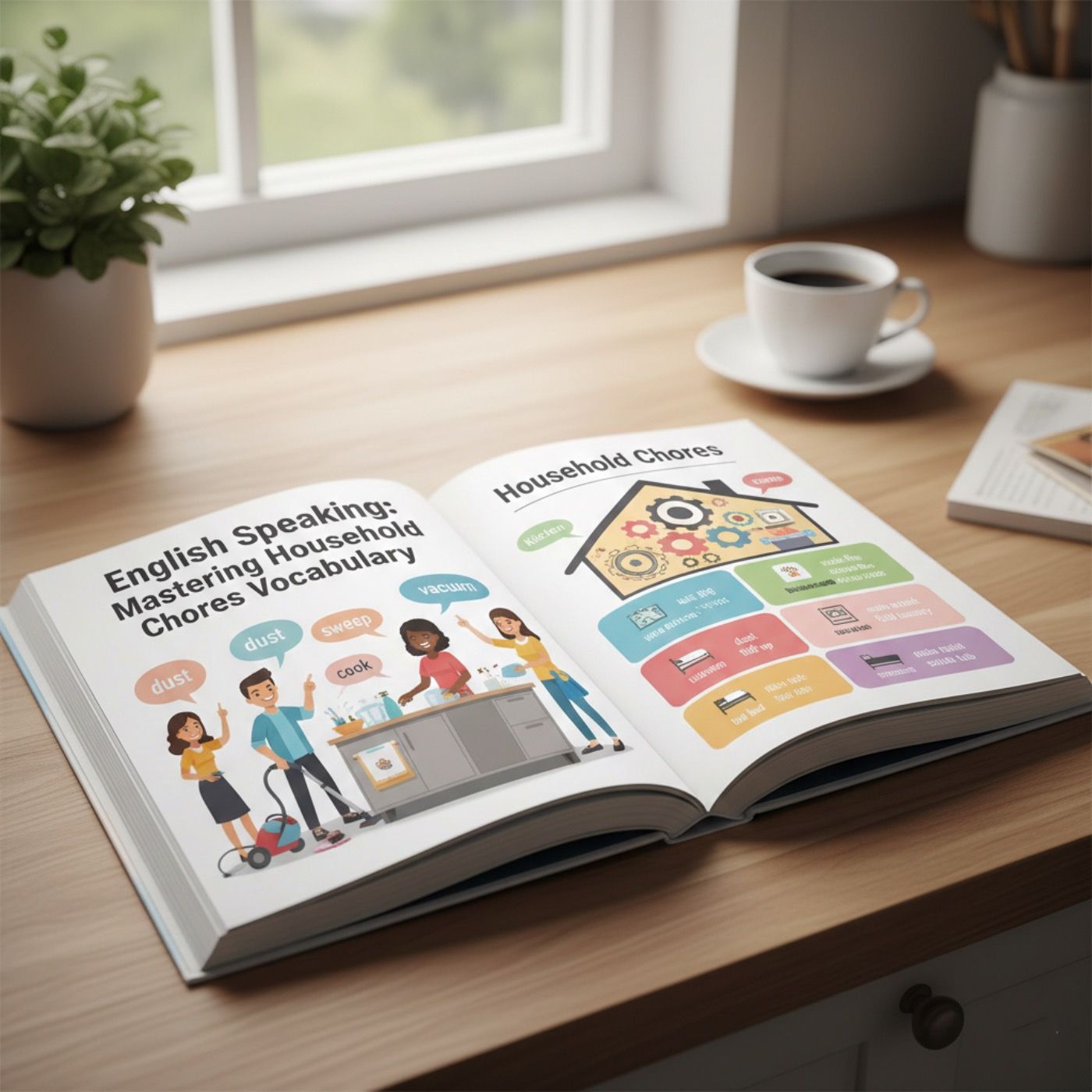
The material is structured into four distinct parts designed to improve listening comprehension, vocabulary retention, and speaking fluency.Core Vocabulary and ContextThe lesson centers on a conversation between two siblings, Mark and his sister, who decide to help their busy mother by dividing various tasks around the house. The sources define and illustrate several key household chores:• Cleaning and Tidying: This includes "cleaning up" to remove clutter from areas like the living room, "vacuuming the carpets" to remove dust, and "sweeping the floors" in the kitchen and dining area using a broom.• Kitchen Tasks: Key activities mentioned are "washing the dishes" (plates, glasses, and utensils) and preparing a meal, which involves "cooking dinner" and "cutting vegetables".• Bedroom Maintenance: The siblings discuss "making the bed" (arranging sheets and pillows) and "changing the sheets" to replace old ones with fresh linens.• General Upkeep and Pet Care: Other chores include "watering the plants," "taking out the trash," and "feeding the cat".• Laundry and Seasonal Work: The transcript covers "doing the laundry" (washing and folding), "ironing the clothes" to remove wrinkles, and "raking the leaves" in the backyard during the fall.Educational MethodologyThe source employs a multi-step interactive approach to help learners "train your brain to speak English fluently":1. Listening Practice: Learners first hear a natural conversation to focus on the general meaning and real-life context.2. Vocabulary Explanation: Specific terms are defined with example sentences, such as explaining that "household chores" are tasks involved in maintaining a clean home.3. Listen and Answer: This section tests comprehension by asking questions about the dialogue, such as "Who suggested cleaning up the living room?" or "What did Mark agree to do regarding the plants?".4. Shadowing Practice: This final stage encourages learners to read lines out loud immediately after the speakers to master the rhythm, intonation, and pronunciation of the sentences.The material emphasizes the concept that "Teamwork Makes the chores easier and faster" and encourages daily repetition of these exercises for at least one week to see significant improvements in English skills.AI tools were used in the translation. Hosted on Acast. See acast.com/privacy for more information.Become a supporter of this podcast: https://www.spreaker.com/podcast/speaksmart-english--6886546/support.

The lesson centers on a real-life scenario—dining out—and is divided into four distinct interactive parts.1. Listening PracticeThe lesson begins with a dialogue between two native speakers, Emily and Mark. Emily suggests going to a new restaurant downtown, and the two discuss the practicalities of their visit. They touch upon whether they should book a table or simply walk in, ultimately deciding to make a reservation because the location is popular and they want to avoid a long wait. Mark expresses an interest in trying the local cuisine, and Emily notes that the restaurant is reasonably priced and known for its attentive staff.2. Vocabulary FocusThe second part of the lesson defines and provides examples for key terms used in the conversation:• To dine out: Meaning to eat at a restaurant rather than at home.• Book a table / Make a reservation: To arrange for a seat or service at a specific time to ensure availability.• Reasonably priced: Describing something that is affordable and not too expensive.• Attentive staff: Employees who are mindful of customer needs and provide excellent service.• Local cuisine: Traditional food originating from a specific region or culture.3. Interactive Listen and AnswerThis segment challenges the learner to answer questions out loud based on the details of Mark and Emily’s conversation. The questions confirm the learner's understanding of the plot—such as the fact that Mark agreed to Emily's suggestion and that the restaurant serves local rather than international cuisine. This section is designed to train the brain to process information quickly and respond confidently.4. Shadowing PracticeThe final exercise is shadowing, where the learner repeats the dialogue lines immediately after the speakers. The focus here is on mimicking the rhythm and intonation of native English expressions. By practicing these lines, learners can sharpen their pronunciation and improve their overall speaking abilities. The lesson concludes with a recommendation to repeat these exercises daily for one week to see significant progress in language skills.AI tools were used in the translation. Hosted on Acast. See acast.com/privacy for more information.Become a supporter of this podcast: https://www.spreaker.com/podcast/speaksmart-english--6886546/support.

The primary goal of the material is to help learners improve English speaking skills, boost vocabulary, and enhance pronunciation through a fun, four-part interactive exercise. The methodology focuses on training the brain to speak English fluently by moving from passive listening to active production.The Four-Part Learning StructureThe lesson is organized into four distinct stages to ensure a well-rounded learning experience:1. Part 1: Listening Practice – Learners listen to a natural conversation between native speakers to focus on real-life meaning and context.2. Part 2: Vocabulary & Grammar – New words and grammatical structures from the dialogue are explained with clear examples.3. Part 3: Listen and Answer – An interactive segment where the learner must answer questions out loud to build confidence and speed.4. Part 4: Shadowing Practice – A technique where learners repeat lines immediately after the speaker to perfect their rhythm, intonation, and pronunciation.The Dialogue: Procrastination and MotivationThe core of the lesson is a conversation between two characters, Jake and Samantha, about schoolwork. Jake admits he has been "putting off" his homework because he finds it boring and would rather play video games. Samantha provides a positive influence, warning him that the longer he waits, the more stressful the work will become. They eventually agree to work together so they can finish quickly and play games "guilt-free".Key Language ConceptsThe sources highlight specific linguistic tools used in the dialogue:• Vocabulary: ◦ Put off: To delay or postpone an action. ◦ Would rather: Used to express a preference for one thing over another.• Grammar (Double Comparatives): The lesson explains how to use structures like "The [comparative]..., the [comparative]..." to show how two things change in proportion to each other. For example: "The more you practice, the better you’ll speak English".Practical Application and TipsThe materials emphasize active participation. In the "Listen and Answer" section, learners are encouraged to speak their responses out loud before the correct answer is revealed to sharpen comprehension. For the shadowing portion, the focus is on mimicking the natural "music" of the English language.The guide concludes with a strong recommendation for consistency: learners should repeat these exercises every day for one week to see significant improvements in their speaking abilities.AI tools were used in the translation. Hosted on Acast. See acast.com/privacy for more information.Become a supporter of this podcast: https://www.spreaker.com/podcast/speaksmart-english--6886546/support.

This educational material offers a structured, multi-dimensional approach to mastering English fluency by integrating listening, vocabulary acquisition, and active verbal participation. The methodology is divided into four distinct phases designed to transition the learner from passive comprehension to active production.Contextual Learning Through Narrative The process begins with an authentic dialogue centered on the theme of unexpected encounters. The narrative follows two individuals, Mark and Sarah, as they recount "running into" figures from their past. Mark describes a chance meeting with a high school friend named Tom, with whom he shared a history of playing soccer. In a parallel experience, Sarah shares a nostalgic moment of encountering her former elementary school teacher at a grocery store. This narrative framework serves not only as a listening exercise but also as a demonstration of how personal history and nostalgia manifest in everyday English conversation.Idiomatic Mastery A core component of the instruction focuses on the nuances of informal English, specifically targeting idioms related to chance meetings. The material breaks down expressions such as:• "Run into": Defined as meeting someone or something unexpectedly.• "Bump into": Described as a synonym for encountering someone by chance.• "I bet": Introduced as a common way to express agreement or confidence in an assumption. By providing clear definitions and practical examples, such as meeting a neighbor while walking a dog, the lesson ensures these phrases move into the learner's active vocabulary.Cognitive and Verbal Activation The third phase shifts the focus to "listen and answer" practice. This segment challenges the learner's cognitive processing speed by requiring them to respond to specific questions about the previous dialogue before the correct answer is revealed. For instance, it asks the user to identify where Sarah met her teacher or what activities Mark and Tom shared in high school. This interactive technique is specifically designed to build the confidence necessary for real-time communication.Prosody and Pronunciation The final stage employs "shadowing," a technique where the learner mimics the speakers' delivery in real-time. The emphasis here is not just on the words themselves, but on the rhythm and intonation of English expressions. By focusing on these acoustic patterns, students can sharpen their pronunciation and develop a more natural speaking flow.Consistency for Fluency The instructional design concludes with a strategic recommendation for mastery: daily repetition. Learners are encouraged to engage with these exercises consistently for one week, which is suggested as the timeframe needed to see significant improvements in overall speaking abilities and fluency.If you would like to test your understanding of these concepts, I can create a quiz based on the vocabulary and dialogue, or I could generate a set of flashcards to help you memorize the key idioms. Would you like me to proceed with either of those?AI tools were used in the translation. Hosted on Acast. See acast.com/privacy for more information.Become a supporter of this podcast: https://www.spreaker.com/podcast/speaksmart-english--6886546/support.

Structure of the Practice SessionThe lesson is organized into four distinct parts to provide a comprehensive training experience:1. Part One: Listening Practice – Learners listen to a natural conversation between native speakers, Sarah and Tom, focusing on the overall meaning.2. Part Two: Vocabulary – Key phrasal verbs and expressions used in the dialogue are defined and illustrated with examples.3. Part Three: Listen and Answer Practice – An interactive Q&A session where the learner is asked questions about the story and must answer out loud to boost speaking confidence.4. Part Four: Shadowing Practice – Learners read their lines out loud immediately after the speakers, focusing on the rhythm and intonation of the sentences.Dialogue Summary and ContextThe practice focuses on a conversation between Sarah and Tom regarding social plans. Sarah invites Tom to a party on Friday, but Tom is hesitant because he has a heavy workload to finish by the end of the week.Sarah is understanding of his situation, leading Tom to propose an alternative: they should catch up the following weekend. They eventually agree to plan a movie night, which Sarah says she is looking forward to.Key Vocabulary TaughtThe sources highlight three specific expressions used in the conversation:• Turn down: To decline or reject something, such as an invitation or an offer.• Catch up: To meet and talk informally, especially to discuss recent events or to renew a friendship.• Look forward to: To feel excited and eagerly anticipate a future event.Learning RecommendationsThe tutorial emphasizes the importance of consistency. It encourages learners to repeat the exercises every day for one week to see significant improvements in their English skills. By focusing on the rhythm and intonation during the shadowing phase, students can sharpen their overall speaking abilities and train their brains to speak more fluently.AI tools were used in the translation. Hosted on Acast. See acast.com/privacy for more information.Become a supporter of this podcast: https://www.spreaker.com/podcast/speaksmart-english--6886546/support.

Daily routines represent the rhythm that keeps life moving forward, consisting of regular habits from the moment of waking until falling asleep. While these routines vary based on individual lifestyles, they generally aim to help a person feel more balanced and in control.A structured morning often begins between 6:30 a.m. and 7:00 a.m.. Many people find it beneficial to take a moment to stretch and breathe before getting out of bed to feel more alert, while others prioritize hydrating with a glass of water immediately upon waking. Basic hygiene, such as brushing teeth and washing face, serves as a refreshing start that sets the tone for the day. To maintain energy for upcoming tasks, a light breakfast is essential; common choices include oatmeal, toast, eggs, or smoothies. Organization is also a key component of a successful morning, often involving a review of a to-do list or class schedule to ensure one is prepared for the day's agenda.The afternoon is typically the period of highest focus and activity. To maintain mental freshness during long study sessions or busy workdays, it is important to take short breaks to stretch and move around. This allows an individual to recharge and avoid feeling sluggish. Diet plays a role here as well; a healthy, light lunch like a salad or sandwich helps prevent a mid-afternoon energy slump. This part of the day is best suited for tackling major assignments or key projects, "knocking them out" while productivity levels are still high. After lunch, taking a moment to regroup helps in organizing thoughts for the second half of the day.As the day ends, the focus shifts to unwinding and de-stressing. Evening activities might include a short walk, light stretching, or listening to music to transition into a peaceful state. Dinner is typically a simple but satisfying meal, such as grilled salmon with vegetables or pasta. Repeating morning hygiene habits, like brushing teeth and washing face, can act as a "reset button" to signal the start of relaxation mode. To prepare for sleep, many people choose to wind down by reading a book or drinking herbal tea. Avoiding screens before bed is a recommended habit for those aiming for a consistent bedtime around 10:00 p.m. to 10:30 p.m.. Ultimately, a well-crafted routine is not just about staying productive, but also about creating time to relax and take care of oneself.AI tools were used in the translation. Hosted on Acast. See acast.com/privacy for more information.Become a supporter of this podcast: https://www.spreaker.com/podcast/speaksmart-english--6886546/support.


Download from Google Play

Download from App Store
 United States
You really worked hard. I don't know how to thank you for your free efforts.
Keep on strongly u r the best for nonnative english speakers
I have hundreds of learning english channels, your channel is the best
I connect you from iran, pls pray us