


 Claim Ownership
Living the Could Life
Subscribed: 0Played: 0
Subscribe

© 2026 Living the Could Life
Description
Life becomes different for those who experience later-in-life challenges. Living The Could LIfe offers tips adjusting your life so that you can still travel and do all the things that you love. No toxic positivity here, just lived experiences from hosts and guests.
33 Episodes
Reverse

Planning the Experience
Have you gone for a cleaning at the dentist and left paralyzed hearing the cost of the work that needed to be done? In this episode, we are sharing our personal experience with traveling to Mexico to get some work done.
There are definitely a few things that you need to know about Dental Tourism in Mexico. We will share our experience from planning to our return home.
Is it Worth It?
There are definitely pros and cons. We live nowhere near a Mexican town where we could simply drive to a dental clinic. But, even with having to fly and having to find lodging, we still found it a good value for us. Listen to the show for all of the details.
Living The Could Life contains affiliate links. They don’t cost you anything, but we may earn a small commission if you use them. We may have been hosted on a trip, excursion or other travel-related event. We may have received or experienced a product for review. Any opinion is our own. AS AN AMAZON ASSOCIATE I EARN FROM QUALIFYING PURCHASES
AS AN AMAZON ASSOCIATE I EARN FROM QUALIFYING PURCHASES.
Transcript
Click Here for Transcript
Robert:
Welcome back to Living the Could Life. Real travel for real bodies. If your body changed before you were ready, but you still want to see the world, this is the place for you.
We talk accessibility, mobility, energy, and joy. Because traveling isn't over, it's just different. There's still so much travel you could do.
I'm Robert.
Theresa:
And I'm Theresa. Today we are talking about our personal experience, and what could be yours too, about traveling to Mexico for dental work.
Robert:
Let's start with the why. Many patients consider Mexico for dental treatment because procedures can cost significantly less than in the United States, while still offering access to modern clinics and experienced dentists. What would you do if you could save thousands of dollars on major dental work while enjoying a short getaway?
Theresa:
Well, we considered just that, and there were three of us who needed dental work.
Robert:
Well, actually two of you in the beginning.
Theresa:
I guess there were two, and Robert was iffy, and as was I. I mean, I had a crown glued in, and the dentist is like, well, do you want to have the crown replaced now, or should I just glue it? And, you know, knowing that it could last two weeks, or two years, or longer.
And I said I would just get it glued in because of the $1,900 cost of a completely new crown. And she said, well, just save up the money, and really $1,900, I could do something a lot better than get dental work. So we started discussing this.
Robert:
And then for me, I recently went to my dentist for a cleaning and checkup, and he had just expanded his dental office, and he had a couple of younger dentists who had begun working for him. And I had seen each of them, and one of them said I needed a couple of crowns. The other one said I needed five surfaces redone on three teeth.
And then when I saw my original dentist in the practice, he said, no, you look pretty good. We can just sort of wait and see. And right now, maybe the other dentists were just a little too aggressive.
And so I thought, hmm, okay. I wasn't in any pain, and so I thought, okay, we can wait and see.
Theresa:
And having traveled in the past, and having had crowns fall off, once after I bit into a grapefruit, another time in Columbia, which I happened to be able to find a dentist, but I was concerned about my crowns. And then our son was going with us, and he needed significant dental work, and we just sat down. Actually, we had talked about this even before.
I was also told I might need another root canal. I recently had one that was several thousand dollars, not including the crown.
Robert:
And we had traveled through Mexico several times before, and our son had also been with us on some of our trips. So we were very comfortable visiting Mexico.
Theresa:
So the first thing you need to do is determine your needs, which we pretty much did. And we knew what we needed.
Robert:
Before comparing clinics, understand exactly what treatment is needed. Options may include implants, crowns, bridges, dentures, veneers, root canals, or full mouth restoration. So think about it.
Do you need a simple procedure? Are you facing extensive treatment that could benefit from dental tourism?
Theresa:
And that also makes a difference depending on where you live. For us, we do not live close to Mexico, but we did meet some of the people at the clinic we went to. They could just drive a few hours, and that makes a big difference because there was a significant savings even for something as simple as a cleaning.
But then again, you have to consider the cost of gas and parking and time and all of that. So most people who flew in or drove in, they were having more extensive work done than something simple like gluing a crown back in or having...
Robert:
So one of the first things you need to do is gather your records and estimates. Collect your x-rays, treatment plans, and quotes from local dentists. These become the foundation for comparing treatment options abroad.
And I need to say here that my dentist and the staff were very supportive of our going to Mexico to get work done. And we had no problem getting x-rays, copies of x-rays sent to us so that we could send them to the Mexican clinics. And they understood.
Theresa:
Right. In fact, I asked my dental hygienist if I would be kicked out or banned from returning if I had some of my work done in Mexico. And honestly, just one crown at $1,900 was worth it for me to go.
But there's a little more to that story that will come later. And your dentist cannot refuse to give you your dental x-rays and records.
Robert:
Okay, you need to research clinics carefully. Not all clinics in Mexico are the same. Focus on credentials, patient reviews, technology, years in practice, and communication quality.
And think about would you choose a clinic based solely on price or would qualifications and patient experiences matter just as much?
Theresa:
Something else that we looked into is what kind of access do they have to a lab? How quickly could they get the work done? What kind of qualifications do they have?
How long they've been in business? Who's on their staff? Ours had dentists, I'll get periodontists, endodontists, you know, a lot of specialized, you know, trained beyond a dentist who could do root canals, implants.
There's something called a four-on-one, which I'm still not sure what that is. I think it's a lot of implants. There's some who did veneers.
There's some who do services for kids like braces and just child dentistry. So you need to select who you think would be the best fit for what you need to have done.
Robert:
The clinic that we chose in Mexico, I was very impressed by when I first saw it. It was a building that was purposely built for doing dental work. It had three floors and first floor was basically examination and then the second and third floor were for doing more serious work.
It had a dedicated waiting area, had the receptionist area. So it was a very new building, very clean, very well organized, and everything ran very efficiently.
Theresa:
Right, they'd obviously done this before. When Robert mentioned the cleaning, they were constantly cleaning. It was a very modern building.
However, there were a few things missing. They did have a ramp outside and I don't speak fluent Spanish, so I asked the driver. They also provide shuttle service from the border to the clinic, which was nice.
And I, on one of my treatment days, I asked for a ride back to my hotel. I have vision loss and Mexico is often difficult to navigate. So I asked him what do they do because they do not have an elevator.
On the first half of the stairway to the second floor where I had to go, they had a handrail. After the landing, there was no handrail, but people helped me navigate that. But that's just something to know and I asked the driver, you know, especially since we, you know, part of our mission is to help people with later in life disabilities and many of the clients there were later in life people still caring about their dental health.
Several had walkers or mobility aids. Now the driver told me, and I didn't verify this, this was the last day, that if you can't do the steps, they will do your work on the first floor, which is where they start your initial exam. But that's something to consider.
There could be clinics that do have elevators. So check into that if you want to be sure about that and ask what they could do. And I guess I was a little surprised because it was a purpose-built building that they didn't consider the elevator.
Robert:
Another thing to consider is to request multiple consultations. Most reputable clinics offer virtual consultations. Comparing several providers can help identify the best combination of care, value, and comfort.
So what questions should you ask during a consultation to feel confident in their decision? Some suggested questions are, what are the dentist's qualifications? And we found that many of the dentists were actually educated, trained in the United States.
How many procedures like mine have they completed? What technology is used? What warranty or follow-up policies are offered?
Theresa:
And I will say too, our clinic was ADA, American Dental Association certified, or I don't know what the what kind of designation you got. All of the dentists I met with were very professional, very efficient. There was also a, I don't want to say a warehouse, a place that could help you.
If you do a Google search or ask AI as I did, that can direct you to clinics. But I think it's a membership-based referral kind of service. I just searched the web, read the reviews.
I like reviews that are usually about four star. And I look at how many people have left reviews. I'm kind o

Part 2 - Travel budgeting Italy: maximize energy and enjoyment with disability
Last time we mentioned several trip tips to help you maximize your money and your energy. When one is out of whack, the other is affected. Take time before your trip to consider what is really meaningful to you.
If you want to do something different than the typical tourist, go for it. You may have a special interest or a dream. It's entirely yours. We mention taking a gondola ride in Venice. Maximizing energy is especially important when a disability wants to challenge you.
Ahhhhhhhhh - Doesn't the Gondola Ride look Dreamy?
Your best trip remains one that brings happiness because you planned it from the start. Personalizing it makes it unforgettable. If there are glitches - and with travel, you should expect that - you have a Plan B.
Counting Spoons
Keep your energy in mind. Below you will find the episode on Spoon Theory. Keep that in mind during your travels.
Shout Out Again to Italy
We used Italy as an example for budgeting. We will continue using Italy as our example destination again the next time. It gets us excited about visiting. But, it is also preparing us to take our own advice.
Living The Could Life contains affiliate links. They don’t cost you anything, but we may earn a small commission if you use them. We may have been hosted on a trip, excursion or other travel-related event. We may have received or experienced a product for review. Any opinion is our own. AS AN AMAZON ASSOCIATE I EARN FROM QUALIFYING PURCHASES
AS AN AMAZON ASSOCIATE I EARN FROM QUALIFYING PURCHASES.
Transcript
Click Here for Transcript
Theresa:
Robert:
(Transcribed by TurboScribe. Go Unlimited to remove this message.)
Robert:
Welcome back to Living the Good Life. Real travel for real bodies. If your body changed before you were ready, but you still want to see the world, this is the place for you.
We talk accessibility, mobility, energy, and joy. Because traveling isn't over. It's just different.
There's still so much travel you could do. I'm Robert.
Theresa:
And I'm Theresa. Today we're diving into episode 2 of our Italy planning series. That's how to use the perfect trip tips that we shared the last time.
Robert:
We're talking points, mobility equipment, spoon-based itineraries, and how to make smart choices when you don't have unlimited money or unlimited spoons.
Theresa:
Because, remember our guiding principle, if saving the money doesn't make your trip better, it isn't really a savings.
Robert:
Let's start with points, because they can make Italy dramatically more affordable, even if you're starting late.
Theresa:
And you don't need to have a wallet full of cards, and I know some people have more cards than I could ever imagine having. So just start with one. And find one, especially if you travel abroad, like to Italy, that has no foreign transaction fees.
Those can add up. It has a simple earning structure, and a good sign-up bonus, and easy redemption options, and I know I started with a lower cost credit card affiliated with the airline just because the luggage charges are now frightening. They can be 50 bucks or more each way for a check back.
Robert:
Most people think points come from flying. Nope. You earn them from groceries, prescriptions, gas, streaming services, utility bills, online shopping portal.
Theresa:
Oh, and I want to talk about online shopping portals, because that's something I often forget. And you can shop through those and earn miles. And these can be things that you always buy from companies you always use.
Robert:
Use points for flights, hotels, upgrades, airport lounges. Avoid redeeming for gift cards, merchandise, cashback conversions.
Theresa:
Remember that you can protect your spoons with points. So points aren't just about saving money. They can also be used to save spoons.
For example, maybe you can find a non-stop flight or one without a lot of connections. Again, like we said in the past episode, if you fly from a small airport, you may not have too many non-stop flight options. Maybe you'd like a hotel closer to the city, a hotel that has an elevator, or even upgrading to business or first class for your comfort.
Robert:
That's the travel advisor rule again. Spend where it protects your body, save where it doesn't cost joy.
Theresa:
And let's talk about mobility equipment, because having the right gear can make or break your trip. You know, be realistic about what you take. Don't say, oh, I don't think I need my walker or my cane or a wheelchair.
I mean, you may even decide to rent a wheelchair at the destination. But you can buy used mobility equipment. There's national online marketplaces, including Mobility Market USA, the Mobility Exchange, and by SellWheelchairs.com.
And of course, look locally as well. Those kind of sites, especially for local where you can check the equipment, they let you buy used scooters, lightweight wheelchairs, travel-friendly walkers. They let you compare prices and read owner reviews.
I mean, also look at estate sales.
Robert:
Italy has rental companies in major cities like Rome, Florence, and Milan. Renting can be cheaper than flying with heavy equipment.
Theresa:
Less stressful as well. Uses fewer of your spoons. Don't have to worry about the airline damaging your equipment or it getting lost or left or not working.
So remember to choose the right equipment that you need. Italy, well, has a lot of old cities, so there's cobblestones, hills, uneven terrain. Be sure your scooter has good battery life or you have a backup.
A wheelchair with sturdy wheels, a walker with strong brakes, or in a cane with a traction tip and good shoes.
Robert:
And always bring extra cane tips, a backup mobility aid, a small repair kit, and a printed accessibility note in Italian.
Theresa:
And that is the accessibility note is also good for admissions into some attractions. They have like an open-to-all policy in many countries in Europe. So in my case, I'm getting a note from my doctor because the note's not only helpful for people with disabilities but also with impairments.
And in my case, even though, you know, I can't drive or do much by myself, I have an impairment, not a disability. So I am bringing along a note from my doctor because that allows me to have my sea night guy come along with me. I mean, we're going to a lot of castles.
I don't always get to see much of them, but I still pay admission. So this letter from the doctor will help immensely. Besides that note, and that also helps reduce fatigue and spending.
If you, um, using your mobility aids might prevent you from having to splurge on an expensive taxi because it's unnecessary when you have the right equipment.
Robert:
Now let's build your itinerary around spoons, not around seeing everything.
Theresa:
And yeah, we all like to see everything because we never know when we'll get back to a place. But consider choosing one dream moment. It can be your anchor, your North Star, the perfect trip moment for you.
For example, maybe you want to see the Sistine Chapel, or you want to eat gelato during sunset in Florence, or ride a gondola in Venice, or visiting a vineyard and sampling wine in Tuscany. Everything else supports this moment.
Robert:
And you want to build recovery days. Every two, three days schedule a low spoon day. And that could include things like cafe sitting, neighborhood wandering, light shopping, scenic viewpoints, slow meals.
Theresa:
And that's really critical, I think, because if you put several high spoon days in a row, you may need a lot of low spoon days to recover. So use the 3-2-1 rule. For every three high spoon activities, add two medium spoon activities and a low spoon day.
Robert:
So plan your meals around energy. High spoon days equal predictable meals. Low spoon days equal exploring, wandering, trying new things.
Theresa:
And avoid false savings. Again, if the results don't make you happy, don't do it. So don't choose a cheaper, and these are examples because you, of course, have the final decision.
Don't choose a cheaper hotel that is far from transit. I mean, that works if you have a car or a long train route with stations that have stairs, but I will say the train stations in Italy are fairly accessible. Don't do a budget tour that is not accessible.
And try to avoid early morning flights if it takes you a long time to get ready. But remember, if you take the first flight out, if there are any problems, usually you have other options in case of delays or cancellations. Whereas if you take the latest flight and it gets canceled, you usually have to stay an extra day.
So any of these situations cost spoons, and spoons cost money.
Robert:
Okay, now let's revisit the downloadable list and talk about how to use it. Number one, choose your dream moment. Build your budget around it.
Number two, protect your body. Spend money where it reduces fatigue. Number three, save where it doesn't cost joy.
Use trains, markets, apartment hotels. Number four, build a fatigue buffer. Add 10 to 15% to your budget for tired day spending.
Number five, use your points strategically. Upgrade for comfort, reduce stress. Number six, use mobility marketplaces.
Buy or rent equipment that supports your body. Number seven, plan meals around spoons. Predictable meals on high spoon days.
Number eight, book accessible rooms early. They always sell out first.
Theresa:
So let's look at a real world example. We will kind of base this on our upcoming trip to Italy.
Robert:
Here's a dream moment. A sunset gondola ride in Venice.
Theresa:
That's something a lot of people want to do. Also, a lot of people say, oh, that's just a touristy thing. So take anything that's considered a touristy thing with a grain of salt.
If it's a tourist scam, that's one thing. But if it's popular with tourists, that might be because ther

Part 1 - Plan Your Best Trip on Your Budget
Your best trip happens when you stick to your budget. In this episode we explore some of the hidden costs to travel. But, we also offer some helpful tips and considerations.
Is Your Budget Just About Money?
As big fans of the Spoon Theory, we must advise that your energy is a big part of your budget. It actually affects your budget immensely. Low energy can definitely increase your budget.
Take a listen to this and the next few episodes to learn more about budgeting for travel. Below, you will find a worksheet with a list of things to consider. There are some hidden items and events that you should be aware of when planning your budget. It's always wise to add some comfort funds.
Never forget that what may seem like savings, may come with a price in time or energy.
Shout Out to Italy
We used Italy as an example for budgeting, However, you can use the same techniques for any destination. Remember, it's your trip!
Living The Could Life contains affiliate links. They don’t cost you anything, but we may earn a small commission if you use them. We may have been hosted on a trip, excursion or other travel-related event. We may have received or experienced a product for review. Any opinion is our own. AS AN AMAZON ASSOCIATE I EARN FROM QUALIFYING PURCHASES
AS AN AMAZON ASSOCIATE I EARN FROM QUALIFYING PURCHASES.
Transcript
Click Here for Transcript
Theresa:
Welcome back to Living the Could Life. Real travel for real bodies. If your body changed before you were ready, but you still want to see the world, this is the place for you.
We talk accessibility, mobility, energy, and joy, because traveling isn't over. It's just different. There's still so much travel you can do.
I'm Robert.
Theresa:
And I'm Theresa. Today we're diving into a topic that so many people ask about. How to budget a trip?
And we're letting you follow along with an upcoming trip to Italy that we're planning. But how do you budget it, especially when you're navigating later-in-life disabilities?
Theresa:
We're talking hidden costs, spoon theory as a budgeting tool, essential documents, all the money-saving strategies that make travel doable, joyful, and sustainable.
Theresa:
So let's start at the very beginning. That's with planning, because budgeting doesn't necessarily start with just money. It starts with information.
Theresa:
Before you spend a dollar, you need your documents in order. For Italy, the basics are passport, travel insurance, and we'll talk about why this is crucial, medical summary from your doctor, medication list with generic names, copies of prescriptions, emergency contacts, accessibility documentation, if you use mobility aids or need assistance, credit card travel notices, and backup digital copies stored in your phone and
Theresa:
another thing I like to add to that list, or should have added, are apps that you can use in planning, like to the Italy government, to see what they need. There is a new document that they've been trying to implement in the EU, but you should be safe at least until the end of this year.
You won't need to have that document. It's pretty much a verification. So I do want to emphasize that documents aren't just for emergencies.
We kind of go by the saying, if you pack it, you hopefully don't need it, but don't go without it. So one thing is airport assistance, and usually you can request that when you're booking a ticket, and that's not only mobility assistance, but also for those with hearing or visual problems, and if you have any dietary needs. If you're seated or flying with an airline that actually gives you any kind of food or food service on the flight, there's hotel accessibility requests.
Often there are a few accessible rooms in a lodging place. And then you may have to visit a pharmacy, so have your prescription. You may need to have any of your mobility aids repaired.
You may want to have a copy of your insurance with you to file claims, or at least to get in touch with them to see if something's covered, or how to go through a procedure to be sure it's covered. So all of that reduces stress, which comes to your budgeting of spoons. It's just as important as budgeting money, maybe even more so.
Theresa:
Exactly. And speaking of spoons, let's bring spoon theory into the planning phase.
Theresa:
We've talked about spoon theory a lot until doing this podcast. Neither of us had ever heard of it, but now we talk about our spoons all the time. So your spoon energy is not just about your energy, but it does figure into your financial planning, because high spoon days often cost more money.
Theresa:
Travel days, high spoons. Use-in days, medium to high spoons. Rest days, low spoons, and usually low cost.
Theresa:
And remember, we are kind of generalizing here. Everybody has their own spoon spending, so just because one person spends so many spoons on one activity, maybe that's not the case for you. You know yourself better than anybody.
When you're budgeting, think of how spoons and dollars are connected. For example, high spoon days, you might eat a taxi, your mobility aids, or pre-booked tours or other arrangements. Low spoon days could be neighborhood walks, cafes, or simple meals.
And a medium spoon day could be flexible, independent sightseeing, or short excursions.
Theresa:
This helps you avoid overscheduling and overspending. Build-in recovery days. They're good for your body and your wallet.
Theresa:
And remember, budgeting spoons means budgeting time. Rushing costs money. Slow travel saves it.
Theresa:
Let's talk about the hidden costs people don't plan for, especially travelers with latent life disabilities. Number one, mobility aid fees, wheelchair batteries, repairs abroad, replacement parts, airline damage, where insurance can help. Number two, accessible transportation, taxis instead of buses, private transfers, accessible trains or ferries.
Number three, medical needs, extra medication, over-the- counter items, compression socks, hydration packets, airport medical assistance. Usually free tipping is customary. Number four, food and hydration, buying water frequently, needing predictable meals, paying more for seating comfort.
Theresa:
Number five, that's fatigue costs. And that's a big one. When you are tired, you spend more.
You grab the nearest restaurant, the nearest taxi, the nearest or the quickest anything, no matter the cost.
Theresa:
And budgeting for fatigue means planning. Rest blocks, easy meal options, nearby cafes, accessible routes, backup plans.
Theresa:
And insurance is a non-negotiable. It's not a luxury. It's really a budget protector.
And I know some people say, and I know all of us now who are listening to this, or a lot of us might have some kind of disability or health condition. But even if you get along perfectly well or you're young, you don't say, well, I'm young, I'm healthy, because on the way to the airport or strolling around in Rome, you could trip and fall and break an arm. And that doesn't matter what age you are.
So be sure to get insurance and watch for the gaps. Check on pre-existing coverage, mobility aid coverage, emergency evacuation, and that's a big one, and there's a huge cost if you need to be evacuated, and then trip interruption or delay. So there's a travel advisor role, and I learned this when I did a stint as a travel advisor.
Not all of the savings are worth it, especially if you're on a once-in-a-lifetime trip. You want to save 10 bucks to skip something important that means a lot to you, or to take transportation that requires a lot of transfers. Time is money, so spending more money to get to a place quicker or to have fewer transfers is worth it.
So if the saving money doesn't make your trip better, it's not really savings. And for late-in-life travelers, this is everything you could be doing a once-in-a-lifetime trip, and budget is still a consideration.
Theresa:
A cheaper hotel up a steep hill? Not really a savings. A long train route with stairs and transfers?
Not savings. A 6 a.m. flight with three connections? Definitely not savings.
Theresa:
KIDD And for people like us who live four hours or more from a major airport, driving that distance to save 50 or 100 bucks, especially with the cost of gas, and then having to pay for parking, is not necessarily savings, and you can't predict traffic. We always are, I'll say 90% of the time, have to make a connection in a hub. So for us, we're used to it, but we do not like to find flights that are 18 hours long because they're $50 less, or you may have three connections or 10-hour layovers.
It's not worth it. So you really have to evaluate that. But if you have a perfect trip, you also need to protect your spoons, which means protecting your comfort, means protecting your comfort and your joy.
Theresa:
Now let's talk about saving money, because Italy doesn't have to break the bank.
Theresa:
Nor does any place you travel to. You may just need to adjust how long you stay there, where you stay, having a home base. It's all what matters to you, what's important, and what maintains your energy.
So one tip is to travel off-season, which we really enjoy. Part of it, there's fewer crowds, and like in my case, because I don't see well, crowds are really difficult for me. So in places in, I'll say, the northern hemisphere, October to April can be very budget-friendly.
There's fewer crowds, the weather can be cooler, and the prices can be lower. Shorter season is also good, and again in the northern hemisphere, because the southern is just the opposite. So late September, early October, late April and May are still good times to travel, and we even have done it in December and January.
But we're used to cooler weather and snow, and it didn't bother us at all. Another tip is to use credit card points and frequent flyer miles.
Theresa:
If yo
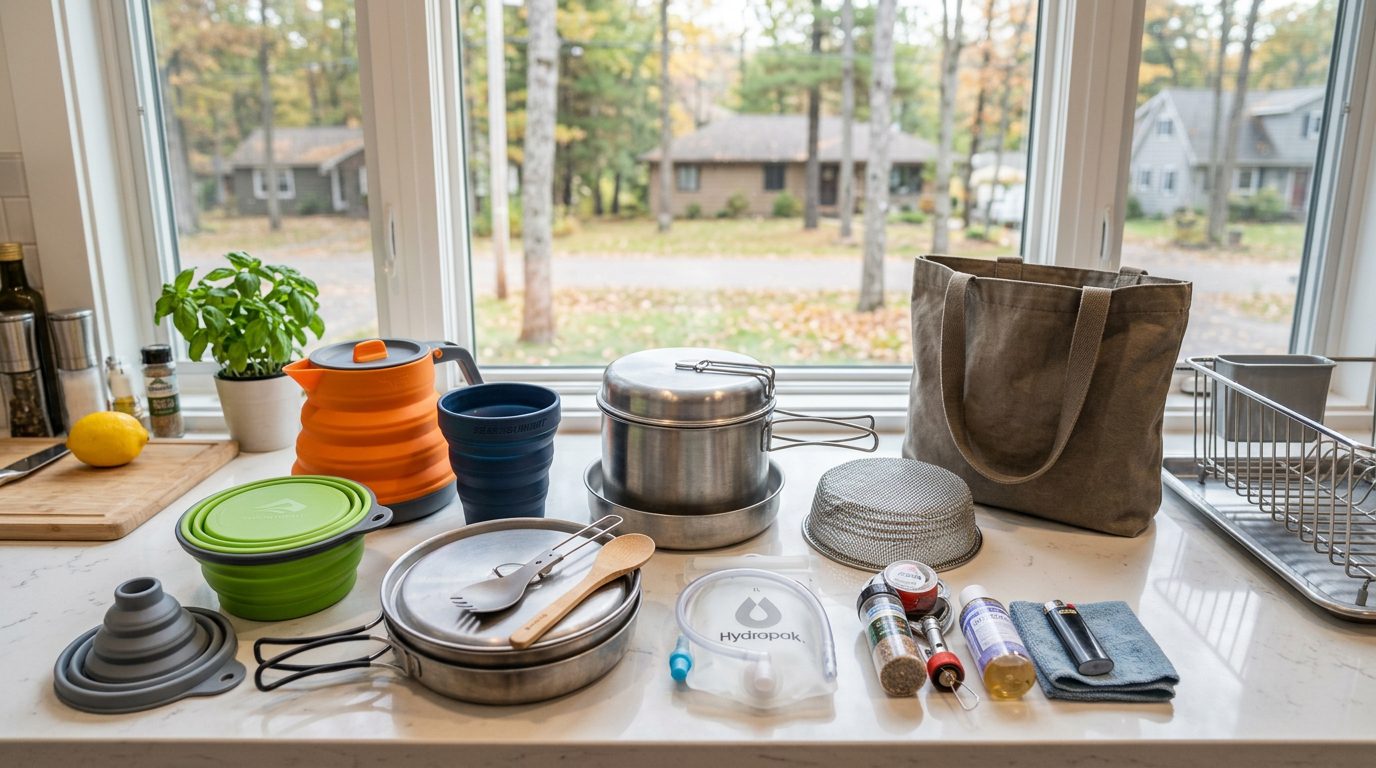
Should You Travel With a Mini-Kitchen?
Traveling with dietary issues requires special planning. One thing to consider is a mini-kitchen. Especially when you need food to maintain a healthy dietary condition, consider packing a few mini-kitchen items.
What should my travel mini-kitchen include?
For those with dietary needs, restrictions and issues, the importance of this add-on is significant. Are you always scrambling to find products and equipment to make your life easier. In this episode, we discuss some of the items that you might need to ease your travel with a mini-kitchen.
However, what you add to your person mini-kitchen is up to you. You can make it as big or small as you like. After all, the reason to travel with a mini-kitchen is to customize it to your personal needs.
Living The Could Life contains affiliate links. They don’t cost you anything, but we may earn a small commission if you use them. We may have been hosted on a trip, excursion or other travel-related event. We may have received or experienced a product for review. Any opinion is our own. AS AN AMAZON ASSOCIATE I EARN FROM QUALIFYING PURCHASES
AS AN AMAZON ASSOCIATE I EARN FROM QUALIFYING PURCHASES.
Transcript
Click Here for Transcript
Welcome back to Living the Could Life. Today, we're going to talk a little bit more about traveling with the food that you may need for your health conditions or for your nourishment when you travel. I'm Teresa.

How to prepare for traveling with Dietary Issues
Traveling with dietary issues may discourage some from traveling at all. Fortunately, there are many ways to plan ahead if you have dietary issues, a problem that some find embarrassing, limiting and depressing
But, there is hope in the travel world for those willing to make some changes in how they are traveling with dietary issues. In this episode, we offer several suggestions. As with any type of body disruptors, changes need to be made. If you are willing to make the effort, you may benefit from some of the suggestions that we have made. Fortunately, you will be able to prepare yourself for traveling with dietary issues
Check the show notes for a free downloadable printout to help you plan yourself for traveling with dietary issues. Happy Travels.
Living The Could Life contains affiliate links. They don’t cost you anything, but we may earn a small commission if you use them. We may have been hosted on a trip, excursion or other travel-related event. We may have received or experienced a product for review. Any opinion is our own. AS AN AMAZON ASSOCIATE I EARN FROM QUALIFYING PURCHASES
AS AN AMAZON ASSOCIATE I EARN FROM QUALIFYING PURCHASES.
Transcript
Click Here for Transcript
Welcome to Living the Qud Life. Today, we're going to talk about traveling with dietary issues, and those can be chronic issues or random acute issues. It can be allergies, it can be digestive issues, it could be things like Crohn's, or it could just be that your system doesn't like certain things.
So we want to treat food just as we would any other logistics for travel. So you'll need to plan ahead, pack intentionally, research your destination's food landscape, and have a reliable backup system. This will reduce stress, prevent emergencies, and keep you nourished even when options are limited.
We're planning a trip to northern Italy in a few months, and I have started transitioning to a strict vegan diet, and I'm a little concerned about how I'm going to be able to maintain that diet. And I'm also thinking about how other people, when they're traveling, might have very restrictive diets and how that's going to work. Right, and that's something you can't just wait until you get to Italy to think about.
I mean, things are different there. And already, I like to have a place, especially when we base ourself in a hub and are in a place for several days, to have kitchen access. And that's especially good when you are following a certain diet.
And if you need to take certain medications that need to be refrigerated, maybe, like for me, tea makes everything better, so having a kettle is good, having a microwave is good, especially if you don't want to go out a lot, or if you have certain favorites that you like to cook no matter where you go. Some of those may not be available locally, and you can do your research before. I'm working on a book about using AI to plan travel, and for our upcoming Italy trip, we are using that to find out where we can find certain things.
And I think we're going to Parma, and I think that will be a real challenge for Robert. I will follow along with his diet, but there's like cheese and prosciutto, so we may have to eat separately. That kind of brings us to the core questions that are going to shape our entire food plan and sort of general food plan for anyone who's traveling with dietary issues, concerns.
And the first question is, will you have kitchen access? Will you have a fridge, a microwave, a kettle, or even a full kitchen? And this is going to determine how much you need to pack and prep.
And some things you do automatically if you're used to it, but especially when you travel abroad, you don't know exactly where you might find gluten-free, low sugar, no sugar, no oil, dairy-free. I mean, if you have lactose intolerance, will that be in the refrigerator at the local supermarket like it is at home, or do you have to go to a separate store to find things like that? So it's just good to plan.
And then one thing that I think both of us have learned is that you can only take care of yourself. Nobody's going to take care of you, so don't assume that, oh, we'll just go to Italy and we'll find what we need. We can find stuff to eat on the plane.
Don't do that. If you need certain foods, say you have hypoglycemia, you have to eat regularly, don't count on getting food on the airplane. You know there are times, oh, we ran out of a certain meal or they forgot to load something to the cart.
So be responsible for yourself and always have your little emergency snacks or medications with you. And I've been thinking about that. I'm going to order a vegan meal for the plane trip across and then coming back also.
So I'll see how that works. That's the first time I'll have done that. Some destinations can be extremely accommodating.
Italy has a gluten-free awareness, so I'm going to be interested in that. I'm not gluten-free, but I'm just curious to how they're approaching that. And then there's other things too you need to think about.
If you have allergies, and you know some people can say, oh yeah, this is gluten-free or this hasn't been mixed with nuts or any other contaminants that may upset your system, you do need to carry your own EpiPens, antihistamines, and you know some people wear the bracelets, especially traveling abroad. Take all of your medications in their original packaging. If you are going to bring some food with you, you need to be aware that some countries do restrict meat, dairy, and fresh produce.
So you need to check the rules before packing any of those items. It's just always good to have backup supplies. I remember one time we were taking the train from Seattle to Portland, and the train just died.
And even though the train was kind of dying along the way, nobody thought about having buses ready to meet us along the route. And one thing that was really interesting was they had provisions on board the train that were designed for just this kind of emergency. However, their food provisions had expired two years earlier.
Right. So some of the things, you know, it's not like it was refrigerated food, but maybe starving could be a better option than eating the expired food. And, you know, nobody showed up with like, oh, you guys haven't had it.
It was also very hot in the train and nobody showed up with water or anything like that. So you really need to plan for those worst case scenarios, delays, closures, limited stock. And an important thing is to build redundancy into your food plan.
Exactly. I go in with the attitude that really nobody cares about me, so I need to take care of myself and plan for the extra snack or the extra water, extra food or whatever it is. So what you need to do is, or a recommendation, you don't need to do anything that we say, but in the first 24 hours, think about what you will need then when you arrive in a new destination, what you need for daily staples or emergency backups and medical essentials.
So this is going to be packing and you need to think about this in layers. So packing in layers and packing for your first 24 hours is what Teresa is talking about. Take things like, I guess, those provisions on the train, like things that are stable and don't expire or haven't expired.
So maybe like nuts, dried fruits, granola bars, maybe candy, sturdy vegetables like pre-washed apples, carrots. And again, just be careful when you arrive in a different country, they may not allow produce. Right.
And then maybe have some meal replacement. Like Ensure, like the milkshakes or those shakes, but you may not be able to travel with those in your carry-on luggage, right, because they're large. Correct.
Although they are medically necessary, I wouldn't trust it. Traveling with kids, you know, they also have dietary considerations, you need to take care of, so be sure you pack and are prepared for them. And then you also need to think about further along in the trip, you need to pack smart staples.
And those are things that will travel well and fill nutritional gaps. Things like rice crackers, dried soups, boxed beans, microwavable grains like oatmeal, rice, shelf stable proteins, tuna packets, jerky, shelf stable tofu, specialty items that sometimes are hard to find, gluten-free bread, dairy-free snacks. Just be sure if you have any perishables, you pack those safely.
You might consider vacuum sealing proteins, taking things that last longer, like yogurts, fruit or cooked meals. Use insulated bags or ice packs while you're traveling. And depending upon where you're going to stay in your hotel rooms, if you don't have, if you don't have a kitchen available, you could sort of build your own mini kitchen.
You could take travel size oil, vinegar, spice blends, collapsible containers, mason jars, maybe a small knife and a cutting board, tiny can opener, sporks. But watch out, you know, with the small knife, don't put it in your carry-on. If you don't have a room with a kitchen, and even if you do, you might want to wait to buy things like oil and vinegar.
Besides foods and a mini kitchen, be sure you have your medical and communication essentials with you. Everybody doesn't know what your needs are or what you may be allergic to, so maybe you want to take two EpiPens and keep those in a carry-on, not in your truck luggage because they'd be useless. Allergy translation cards in the local language and a printed allergy plan.
Like I said, some people do wear the bracelets. Then carry along things like hand sanitizer. And disinfectant wipes.
And disinfectant wipes because you know how well they clean planes. You'll want to research your food options at your destination. This will help reduce uncertainty and build confidence.
You can look at what the local cuisine will entail and find out what ingredients are common, are hidden, maybe unavo

Comments

Download from Google Play

Download from App Store
 United States