



 Claim Ownership
Vyzer Weekly
Subscribed: 0Played: 0
Subscribe

© Vyzer
Description
Vyzer Weekly is a recurring live conversation where investors come together to think more clearly about markets, risk, and private investing. Each Thursday we break down what actually mattered in the markets, take a focused deep dive into a key investing principle, and open the floor for real discussion.
No hype, no pitches, no predictions, just practical clarity and a smarter way to approach investing.
Join these shows live: https://go.vyzer.co/vyzerweeklycalls
No hype, no pitches, no predictions, just practical clarity and a smarter way to approach investing.
Join these shows live: https://go.vyzer.co/vyzerweeklycalls
15 Episodes
Reverse

Most passive investors don't have a real investment strategy — they react to whatever hits their inbox. Scott Trench, former CEO of BiggerPockets (100K to 3M+ members in 11 years), joins Vyzer Weekly to explain why that approach cost him serious money in 2020–2022 syndicated deals, and how he now approaches private real estate investing with a thesis-first framework. The call dives deep into hard money debt funds — how they work, what separates quality operators from disasters, and why geography, leverage structure, and operator background matter more than advertised yield. Highlights:• Why any fund promising conservative underwriting + national scale + zero leverage + double-digit returns all at once is a red flag — not a feature• The 50–250 loan sweet spot for hard money debt funds, and why rapid AUM growth is a warning sign• How to evaluate operators: look for former flippers with deep local networks who can take over a distressed project themselves• Why holding debt fund income in a Solo 401k, IRA, or HSA is critical for high earners — and why a taxable brokerage account often kills the return• Scott's geographic diversification thesis: invest with 5–7 regional operators across unrelated markets instead of betting on one national fund About Scott Trench: Scott is the former CEO of BiggerPockets, host of the Passive Pockets podcast, and a Denver-based real estate investor with 20+ units across seven structures. He spent 11 years helping build BiggerPockets from 100,000 to over 3 million members and oversaw two private equity sales of the company (2018 and 2024). He now focuses on financial planning tools and content at BiggerPocketsMoney. Want to connect with Scott directly? Reach out at scott@biggerpocketsmoney.com Listen on Spotify: https://open.spotify.com/show/7F0JHBoB5SWvAi12WNmR2eListen on Apple Podcasts: https://podcasts.apple.com/us/podcast/vyzer-weekly/id1859061480Watch on YouTube: https://www.youtube.com/playlist?list=PLVH9Pz5-HyDBtJSrgG6tbZhhdX1v-6G6ESubscribe to weekly calls: https://luma.com/vyzerweekly

Most people with wealth think "family office" means something reserved for billionaires. Christopher Nelson, founder of Wealth Ops, argues the opposite: if you have any meaningful wealth, you're already running one — you just might be running it badly.In this episode, Christopher breaks down the seven components of a micro family office, the cautionary tale of the Vanderbilts (a $100B fortune gone in three generations), and why the three-bucket portfolio framework used by ultra-wealthy families applies even at the $1–30M net worth range. We also dig into the CEO question: are you actively managing your wealth, delegating with oversight, or abdicating by default?Highlights:• The Vanderbilt vs. Rockefeller contrast — why $100B disappeared in three generations while the Rockefellers are still growing seven generations later• 87% of financial education targeting executives and business owners comes from firms selling something — the family office playbook is intentionally withheld from the mass market• The three-bucket portfolio model (growth, income, capital preservation) that replaces the retirement drawdown mindset• Why isolation is the #1 hidden challenge for first-generation high net worth individuals — and how community changes the game• The seven components every family office — from $2M to $2B — must have: CEO/vision, portfolio architecture, legal/tax, operations, performance/data, team leverage, and governanceChristopher Nelson is the founder of Wealth Ops, the engine behind the micro family office. He helps first-generation high net worth families build the framework, infrastructure, and systems to manage and grow their wealth across generations.Want to connect with Christopher directly? Reach out at https://www.wealthops.io/goListen on Spotify: https://open.spotify.com/show/7F0JHBoB5SWvAi12WNmR2eListen on Apple Podcasts: https://podcasts.apple.com/us/podcast/vyzer-weekly/id1859061480Watch on YouTube: https://www.youtube.com/playlist?list=PLVH9Pz5-HyDBtJSrgG6tbZhhdX1v-6G6ESubscribe to weekly calls: https://luma.com/vyzerweekly

What does it look like when a recession is already baked in — but most investors haven't noticed yet? In this episode, Litan Yahav sits down with Jeremy Roll, a seasoned real estate and alternative asset investor managing 60+ LLCs, to dig into the macro signals that have him hoarding cash, avoiding private credit, and waiting for one final downturn before deploying capital aggressively into real estate.They cover recession timing, why private credit funds can fail even when assets perform, the hidden CapEx pause that will slow AI adoption, and the specific metrics Jeremy uses to evaluate real estate deals in a high-rate environment.Highlights:• Why PE ratios at the 97th-99th percentile historically precede 30-40%+ market corrections — and why this time isn't different• The "fire door" problem in private credit: how redemption waves can force solvent funds into distressed liquidations with no warning• Oil prices as the #1 historical cause of US recessions — and why the current geopolitical setup has Jeremy watching it multiple times a day• Mobile home parks vs. multifamily: why a 9-year average tenant tenure (vs. 50% annual turnover in apartments) fundamentally changes risk math• The 1,000-day Bitcoin cycle and how Jeremy is positioning around it with puts rather than outright shortsJeremy Roll is a full-time real estate and alternative asset investor based in the US, managing capital across 60+ LLCs spanning multifamily, mobile home parks, senior housing, and more. No guest contact information was shared during this call.Listen on Spotify: https://open.spotify.com/show/7F0JHBoB5SWvAi12WNmR2eListen on Apple Podcasts: https://podcasts.apple.com/us/podcast/vyzer-weekly/id1859061480Watch on YouTube: https://www.youtube.com/playlist?list=PLVH9Pz5-HyDBtJSrgG6tbZhhdX1v-6G6ESubscribe to weekly calls: https://luma.com/vyzerweekly

Most LPs get on a call with a GP, like what they hear, and wire the money. Leyla Kunimoto does the opposite: she reads the financials first, and only 10% of deals make it past the first two minutes. In this episode of Vyzer Weekly, Leyla shares the exact framework she uses to vet GPs, detect fraud, and avoid the herd mentality that gets retail investors into trouble — with specific insights on private credit, real estate funds, and the Cliffwater CCLFX situation unfolding right now. Highlights from this episode: • The Cliffwater CCLFX situation explained: a $32B private credit fund facing 14% redemption requests against a 5-7% quarterly cap — and what it means for everyone holding private fund equivalents• Why unrealized NAV is unreliable and how to use realized gains/losses as the real signal for fund health• The cash flow statement test: why refusing to provide one is an automatic deal-killer, and what auditor requirements should look like at different AUM thresholds• Hard money real estate lending vs. private company lending — and why collateral transparency matters more than advertised yields• How fraud prevalence in private markets dwarfs public markets, and why diversification alone won't protect you from counterparty risk About Leyla Kunimoto: Leyla is an independent retail investor and newsletter writer who has been investing in private markets since 2020. She invests only her own capital, publishes a private newsletter twice a week (nearly 15,000 subscribers) covering private credit, real estate, and infrastructure, and spent years cold-calling hundreds of GPs to build her due diligence process. Want to connect with Leyla directly? This is her website - https://www.accreditedinsight.com/ Listen on Spotify: https://open.spotify.com/show/7F0JHBoB5SWvAi12WNmR2eListen on Apple Podcasts: https://podcasts.apple.com/us/podcast/vyzer-weekly/id1859061480Watch on YouTube: https://www.youtube.com/playlist?list=PLVH9Pz5-HyDBtJSrgG6tbZhhdX1v-6G6ESubscribe to weekly calls: https://luma.com/vyzerweekly

Most investors think vetting a deal is about reading the deck carefully. The real skill is knowing what's missing, what's misleading, and what to ask before you wire money.In this episode of Vyzer Weekly Calls, Litan and Mike are joined by Hans Box, a CPA-turned-real estate operator and LP investor who has raised over $100M across 25+ deals and holds nearly 100 K-1s a year across real estate, private equity, and venture capital.Hans brings both sides of the table — he has underwritten and sponsored deals, and he has been burned as an LP early in his career, which is what pushed him into the operator seat in the first place.In this conversation, we discuss:What the first 10 minutes of reading a deck should tell youWhy unrealistic year-one income projections are one of the most common red flagsHow bridge debt was misused as permanent debt and why it blew up so many 2019–2023 dealsWhat fees to expect and when a fee structure is a warning signThe difference between preferred return and cash-on-cash — and why LPs consistently confuse the twoHow catch-up provisions work and what you're actually giving up when one is buried in a waterfallGP skin in the game: what it signals and what it doesn'tWhere Hans sees opportunity in multifamily right nowThis is not a presentation or a pitch. It's a live, open conversation focused on how experienced investors actually read deals before committing capital.About HansHans is a CPA with a decade of experience as a multifamily sponsor, and an LP portfolio spanning real estate, private equity, and venture capital.Reach out to him here: hbox@boxwilson.com https://boxwilson.com/ 🎧 Listen / Watch the recording:YouTube: https://www.youtube.com/playlist?list=PLVH9Pz5-HyDBtJSrgG6tbZhhdX1v-6G6ESpotify: https://open.spotify.com/show/7F0JHBoB5SWvAi12WNmR2eApple Podcasts: https://podcasts.apple.com/us/podcast/vyzer-weekly/id1859061480📅 Join future sessions live:https://go.vyzer.co/vyzerweeklycallsVyzer Weekly Calls are weekly, live conversations designed to help investors think more clearly about risk, private investing, and long-term decision-making.

DESCRIPTIONMost investors either dismiss life insurance completely or buy it the wrong way. Very few actually use it.In this episode, I sit down with Russ Morgan, co-founder of Wealth Without Wall Street, to cut through the noise. Russ spent years as a certified financial planner who actively advised against life insurance — until the 2008 crash changed everything. Since then, he's built over $50,000/month in passive income, and 100% of that capital came from loans against a life insurance policy.This is not a pitch. We go deep on how it actually works, when it doesn't make sense, and what most people get wrong on both sides of the debate💡 HIGHLIGHTS FROM THE CONVERSATION→ Banks are the largest holders of life insurance in the world. Wells Fargo alone holds nearly $20B in cash value — more than all their real estate assets. They don't have heirs. They use it as tier one capital.→ Russ built over $50,000/month in passive income across 20 asset classes. Every single dollar came from a loan against a life insurance policy.→ The "buy term and invest the difference" argument only works if you actually invest the difference — and keep investing through a crisis, a divorce, a bad year. Most people don't. Human behavior isn't a spreadsheet.→ Loans against your policy are not taxable. And you can deduct the loan interest against investment income if you deploy the capital into deals — same as borrowing from a bank.→ There's no age cutoff. Russ's mentor bought a new policy two weeks before he died at 85.🔗 CONNECT WITH RUSS MORGANBook a free call with Russ's team: https://go.oncehub.com/PassiveIncomeGamePlan?src=vyzer📅 JOIN US LIVEEvery Thursday at 3PM ET - live, open conversation, no slides, no pitches.Register: https://luma.com/vyzerweeklyStay updated: https://go.vyzer.co/vyzerweeklycalls🎙 LISTEN ONSpotify: https://open.spotify.com/show/7F0JHBoB5SWvAi12WNmR2eApple Podcasts: https://podcasts.apple.com/us/podcast/vyzer-weekly/id1859061480Youtube: https://www.youtube.com/playlist?list=PLVH9Pz5-HyDBtJSrgG6tbZhhdX1v-6G6E
Private markets are shifting.Capital is moving. Some managers are adapting. Others are still operating like it’s 2021. Investors are becoming more selective. Transparency expectations are rising.But most of us only see a small slice of what’s actually happening.In this episode of Vyzer Weekly, we sit down with Aleksey Chernobelskiy, founder of GP LP Match, to unpack what he’s seeing across real-world private equity, private credit, and real estate deal flow.This is not theory.It’s pattern recognition from the front lines.00:00 – Why private markets feel “noisier” right now02:00 – Aleksey’s background: From institutional real estate to private markets04:30 – The transparency gap between public and private markets07:45 – Why private deal flow feels fragmented and inefficient11:20 – How investor behavior has changed since 202115:10 – Where capital is actually flowing today19:30 – Why many managers are still stuck in the old cycle23:40 – Real estate vs other private asset classes28:15 – What sophisticated investors are prioritizing now34:00 – Structural mismatches between investors and managers41:30 – The future of private market capital matching• Where capital is actually flowing in private markets• How LP behavior is evolving• Why some private equity and private credit managers are struggling to raise capital• The role of transparency in fundraising• Structural inefficiencies in private deal sourcing• Real estate demand vs broader alternative investmentsIf you invest in private equity, private credit, real estate syndications, or alternative assets, this conversation will sharpen how you think about capital allocation and manager selection.No pitches. No slides.Just clearer thinking.Aleksey Chernobelskiy is the founder of GP LP Match and one of the most followed voices in private markets. He writes extensively about incentives, transparency, and capital allocation dynamics.🎧 Watch more Vyzer Weekly episodes:YouTube Playlist: https://www.youtube.com/playlist?list=PLVH9Pz5-HyDBtJSrgG6tbZhhdX1v-6G6E🎙 Listen on Spotify:https://open.spotify.com/show/7F0JHBoB5SWvAi12WNmR2e🍎 Listen on Apple Podcasts:https://podcasts.apple.com/us/podcast/vyzer-weekly/id1859061480📩 Join our live weekly investor calls:https://go.vyzer.co/vyzerweeklycalls
Most families don’t lose wealth because of bad investments.They lose it because of breakdowns in communication, alignment, and trust.In this episode of Vyzer Weekly Calls, Litan Yahav is joined by Josh Gentine, a family enterprise and governance advisor who works with multi-generational families and large family offices around the world.Josh brings both personal and professional perspective, having grown up inside a multi-generational family business and now advising families on governance, succession, and family dynamics when wealth and business overlap.In this conversation, we discuss:What’s usually already broken by the time families seek helpWhy technically sound wealth plans fail in real lifeHow communication breakdowns quietly destroy alignment across generationsThe different challenges faced by first-, second-, and third-generation familiesWhy conversations about values matter more than conversations about numbersHow issues like prenups, succession, and control often surface deeper family dynamicsThis is not a presentation or a pitch.It’s a live, open conversation focused on how families actually behave when real money, power, and legacy are involved.About Josh GentineJosh Gentine advises families on governance, succession, and long-term family enterprise strategy.Website: http://benchconsulting.com/Email: jgentine@benchconsulting.com🎧 Listen / Watch the recording:YouTube: https://www.youtube.com/playlist?list=PLVH9Pz5-HyDBtJSrgG6tbZhhdX1v-6G6ESpotify: https://open.spotify.com/show/7F0JHBoB5SWvAi12WNmR2eApple Podcasts: https://podcasts.apple.com/us/podcast/vyzer-weekly/id1859061480📅 Join future sessions live:https://go.vyzer.co/vyzerweeklycallsVyzer Weekly Calls are weekly, live conversations designed to help investors think more clearly about risk, private investing, and long-term decision-making.

In this episode of Vyzer Weekly, we host a candid, investor-to-investor conversation with Shelly Hod Moyal, Co-Founder and Co-CEO of iAngels, Israel’s most active early-stage VC platforms.The discussion focuses on how venture investing changes when startups are built under real, persistent uncertainty, not market volatility or macro narratives, but active conflict.This is not a political conversation and not a pitch. It’s a practical discussion about underwriting risk, founder behavior under stress, and how experienced investors think about outcomes when conditions are genuinely hard.Topics we cover:What “real risk” actually looks like in early-stage investingWhich risks are often mispriced or misunderstood from the outsideHow underwriting changes when uncertainty is persistentFounder behaviors that matter most under extreme stressWhether conflict creates opportunity or simply delays outcomesLessons that only emerge after deploying capital repeatedlyTimestamps:00:00 – Why we wanted to have this conversation02:10 – Shelly’s background and iAngels’ investing model05:20 – What “real risk” actually means in early-stage investing10:05 – Risk patterns investors outside Israel tend to misprice16:40 – How underwriting changes during active conflict23:15 – Founder behavior under stress, what matters and what doesn’t30:20 – Valuations, timelines, and liquidity expectations36:45 – Transferable lessons for investing in high-uncertainty markets42:30 – Closing thoughts and key takeawaysHighlights:Why most investors misunderstand “risk”How real-world uncertainty reshapes underwriting decisionsThe founder traits that compound under pressureWhy conflict doesn’t necessarily mean worse outcomesWhat investors should and should not copy from war-zone investingLinks:🔗 Register for upcoming live weekly calls:https://go.vyzer.co/vyzerweeklycalls🎧 Listen on Spotify:https://open.spotify.com/show/7F0JHBoB5SWvAi12WNmR2e🎧 Listen on Apple Podcasts:https://podcasts.apple.com/us/podcast/vyzer-weekly/id1859061480📺 Watch past episodes:https://www.youtube.com/playlist?list=PLVH9Pz5-HyDBtJSrgG6tbZhhdX1v-6G6E🌐 Learn more about Vyzer:https://vyzer.co

As real estate becomes harder to underwrite and operate, more investors are looking at cash-flowing businesses as an alternative. On this week’s Vyzer Weekly Call, we unpack why that shift makes sense, and where it quietly breaks down.This was not a pitch for buying laundromats or rolling up HVAC companies. It was a grounded conversation about operator risk, deal structure, execution mistakes, and the difference between owning an asset and running a business.If you’re considering business acquisitions, either actively or passively, this session is about separating durable opportunity from narrative-driven hype.HighlightsWhy a cash-flowing business is fundamentally different from real estateThe hidden risk most investors miss when chasing “stable income”What actually makes a first acquisition successfulHow deal structure reduces risk more than leverage ever willActive vs passive business investing, where the line really isTimestamps00:00 – Why investors are looking beyond real estate06:00 – Businesses vs real estate, where risk really lives14:00 – What makes a good first acquisition22:00 – Deal structure, seller financing, and earnouts31:00 – Roll-ups, multiple expansion, and reality38:00 – Passive business investing, what still matters45:00 – Open discussion and investor Q&AWho this is forInvestors exploring alternatives to real estateLPs curious about business acquisitions or search fundsOperators thinking about buying their first companyWho this is not forAnyone looking for a “hands-off” income shortcutDeal chasers focused only on IRR headlinesViewers expecting step-by-step acquisition tacticsWatch / ListenYouTube: https://www.youtube.com/playlist?list=PLVH9Pz5-HyDBtJSrgG6tbZhhdX1v-6G6ESpotify: https://open.spotify.com/show/7F0JHBoB5SWvAi12WNmR2eApple Podcasts: https://podcasts.apple.com/us/podcast/vyzer-weekly/id1859061480Join Future Live Calls Register here: https://go.vyzer.co/vyzerweeklycalls

Most investors think fraud is obvious.It usually isn’t.In this week’s Vyzer Weekly Call, Litan Yahav and Mike Arndorfer break down how Ponzi schemes and fraud actually show up in private markets, why even sophisticated investors get caught, and how to spot red flags before it’s too late.This is not about paranoia.It’s about pattern recognition, incentives, and asking better questions.No pitches. No fear-mongering.Just real-world frameworks from experienced LPs who’ve seen both good deals and bad actors up close.• The difference between bad deals vs bad actors• What actually defines a Ponzi scheme (and what doesn’t)• Why long track records can be misleading• Common red flags investors ignore• Why “everyone I know invested” is not due diligence• The role of auditors, reporting, and transparency• When great returns should make you more skeptical, not less• Why fraud often appears after markets tighten• What to do if you’re already invested and feel uneasy🔍 What We Covered⏱️ Timestamps00:00 – Why most fraud doesn’t look like fraud03:45 – Bad deals vs bad actors07:30 – What a Ponzi scheme actually is12:10 – Why past performance can be dangerous18:20 – Common red flags investors rationalize away24:40 – Auditors, reporting, and size-based expectations30:15 – Herd mentality and social proof traps36:50 – Real-world Ponzi and fraud examples43:30 – What to do if you’re already invested48:10 – Final takeaways and investor mindset▶ YouTube (Weekly Calls Playlist):https://www.youtube.com/playlist?list=PLVH9Pz5-HyDBtJSrgG6tbZhhdX1v-6G6E🎧 Spotify:https://open.spotify.com/show/7F0JHBoB5SWvAi12WNmR2e🎧 Apple Podcasts: https://podcasts.apple.com/us/podcast/vyzer-weekly/id1859061480The best part of these conversations happens live.Debate, pushback, and real questions from real investors.👉 Register here: https://go.vyzer.co/vyzerweeklycalls🎧 Listen & Watch📅 Join the Live Calls
In this weekly Vyzer call, we walk through how we’re thinking about 2026, without bold predictions or market hype.We discuss:Why our base case is slow but positive growthWhat limited Fed cuts actually mean for marketsWhy the 10-year Treasury matters more than headlinesWhy public markets may stay choppy and rotationalWhy private market liquidity remains constrainedWhat this means for real estate, multifamily supply, and mortgage ratesThis is not a forecast deck or a sales pitch. It’s a thinking framework designed to help investors stay grounded as markets digest the last few years.
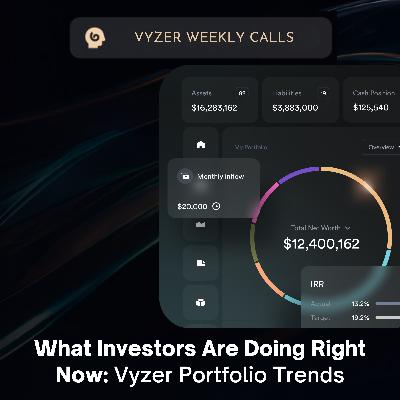
In this Vyzer Weekly Call, Litan Yahav (Co-Founder of Vyzer) and Mike Arndorfer analyze what investors are actually doing right now, based on anonymized, aggregated data from real portfolios tracked on Vyzer.The discussion is grounded in roughly 2,500 investors, 27,000 transactions, and $24B in tracked assets, offering a rare look at how capital is moving across public markets, private investments, real estate, and private credit.Topics covered:Why new capital is shifting toward public equitiesWhat’s really happening with private credit and liquidityHow private investing is rotating, not disappearingReal estate trends, including multifamily, mobile home parks, and industrialOperator quality, incentives, and why alignment matters more than feesBrief market context on inflation, energy, and the Fed (no predictions, no trading advice)These weekly calls are not webinars or pitches. They’re open conversations focused on clearer thinking around markets, risk, and portfolio construction.We’ll resume the series on January 8, where Mike and Litan will share their 2025 outlook and predictions, what they’re watching closely, and where they believe investors are most likely to get surprised.If you invest in public or private markets and care about making better decisions, this conversation is for you.

In this week’s Vyzer Weekly session, we unpack one of the most misunderstood parts of investing: taxes. CPA and tax strategist Steven Gabrielson joined us for a deep, practical conversation about how taxes really work for investors and why so many tax-driven strategies end up hurting returns instead of helping them.We covered the core principles every investor should understand, including:• The real difference between active and passive income• Why dividends, interest, and capital gains are not “passive income”• How depreciation works, and why recapture catches investors off guard• The truth about oil and gas tax incentives• Risks behind heavy equipment writeoff deals• Short-term rental loopholes and real estate professional status• Tax-loss harvesting for stocks and crypto (and why wash-sale rules differ)• QSBS, Opportunity Zones, and other powerful but nuanced tools• How Ponzi-like tax schemes form and how to avoid themThe big idea: taxes should never drive the investment strategy. Clear thinking, not loopholes, leads to better decisions and better long-term outcomes.This session is part of our weekly series helping investors think more clearly about markets, private investing, and risk so they can make smarter decisions with confidence.
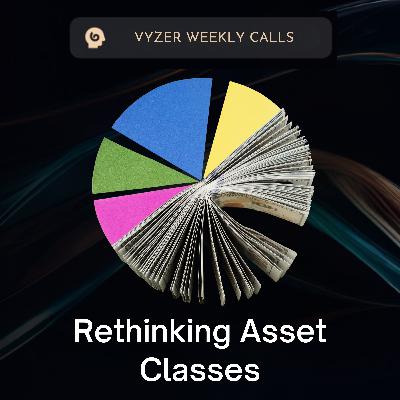
Rethinking Asset ClassesVyzer Weekly, Session 1Investing has become more complicated than ever. Beyond stocks and bonds, investors now face private equity, private credit, real estate funds, crypto, gold, structured products, annuities, REITs, and dozens of other asset types.In this session, we introduce a simple, practical framework for understanding any asset clearly by breaking everything down into:• Cash• Public vs private• Equity vs debt• Underlying asset structureThis framework helps investors cut through noise and see what they’re actually holding, why it behaves the way it does, and how it fits into a broader portfolio.In this recording we cover:• A quick market recap• How to rethink traditional asset class labels• A cleaner model for comparing assets• What matters most when evaluating any investment• Live discussion and Q and AThis is Session 1 of Vyzer Weekly, a recurring series on clearer thinking around markets, risk, and private investing.
Comments


Download from Google Play

Download from App Store
 United States