


 Claim Ownership
The AI Cookbook Show by Malcolm Werchota
Subscribed: 17Played: 913
Subscribe

© 2025 Malcolm Werchota
Description
Malcolm Werchota's AI Cookbook Show is where artificial intelligence meets authentic business transformation. Known for his direct style and willingness to show AI in action—even during live presentations—Malcolm helps organizations understand that AI isn't about replacing humans but amplifying their capabilities. From voice-note productivity hacks to real-time meeting intelligence, this podcast delivers actionable insights for immediate implementation.
137 Episodes
Reverse
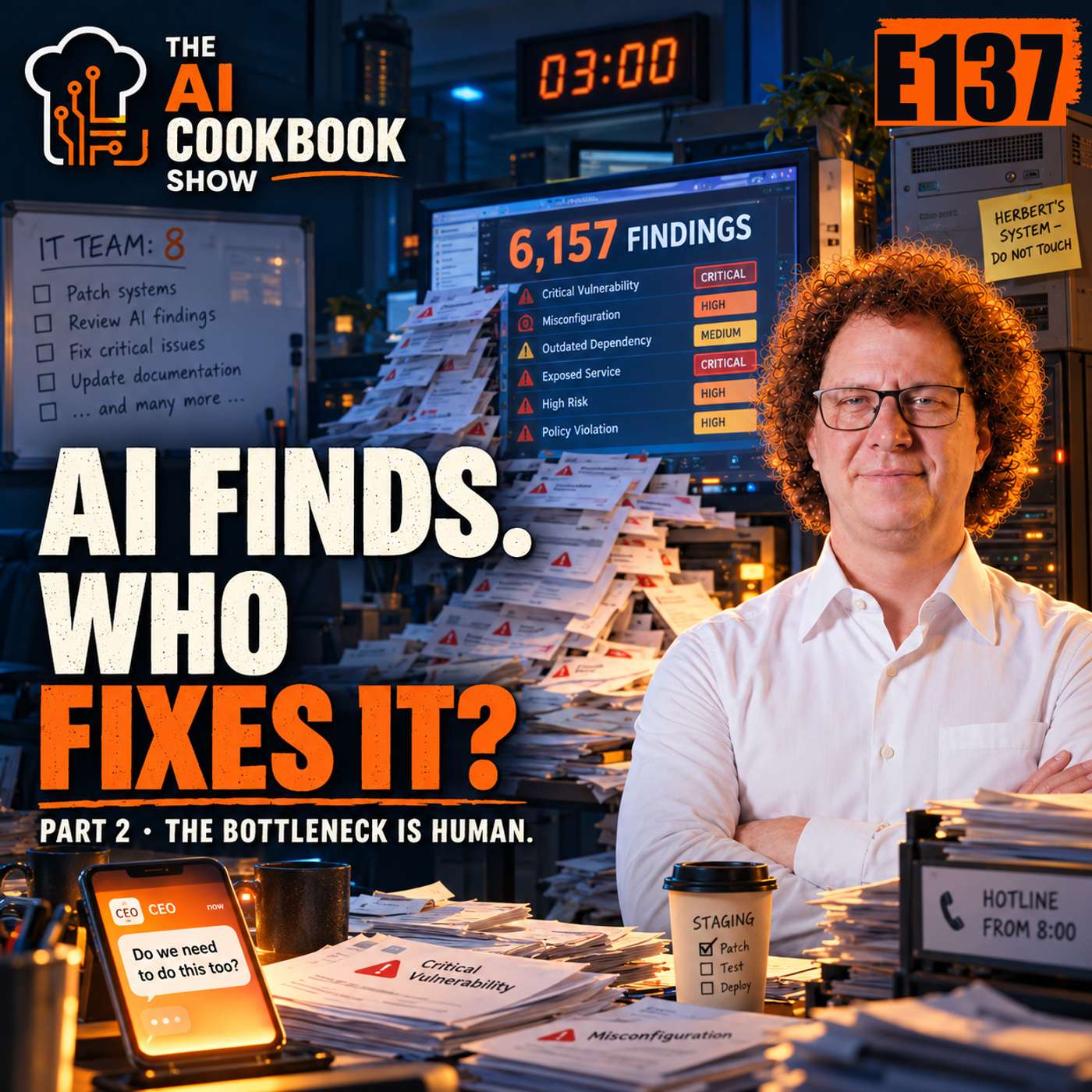
Three in the morning. The CEO calls the head of IT: governments around the world are shutting down their websites, do we need to do this too? The head of IT is called Werner. He has eight people in his team, two of them install printers all day, and his hosting provider's hotline opens at 8 a.m.Part 2 of the AI Drama double on the Vulnerability Tsunami. In Part 1 we watched the digital doors swing open. Now we walk through the door on the other side, into the IT department. AI finds the bugs faster than ever, but fixing, testing and deciding is still done by humans. And that is where the bottleneck sits.In this episode:☎️ "Can we keep working today?" (00:55) — meet Werner, head of IT at a family-owned supplier with 600 people and three plants. What he can actually answer at 3 a.m., why he can't reach his hoster or his CEO, and why most heads of IT aren't even allowed to decide whether to switch the website off. Within hours, public scanners for the PHP flaw were on GitHub, not on some dark web forum.🏦 The machine finds. The bank needs more hands. (07:59) — Bank of America's CEO Brian Moynihan told CNBC the bank brought in about 1,000 external contractors to work through fixes, on top of its existing teams. And Werner? He might get three more developers in nine to twelve months, at local salaries.📥 The inbox is not the repair (12:17) — a code landscape the size of France, and you're looking for one toxic pen. Libraries, staging, and Susie, who looks after a library in the evening while Werner calls three times about the PHP patch. AI brings crazy visibility, and IT departments aren't built for it.🩻 Who gets to use the X-ray machine? (17:14) — Copilot in this context is your grandmother in 2026 saying black-and-white TV is incredible. Why you need an agent on the command line, not a chat window. Data protection, IT security, the works council and procurement all say no, and your developers already use the tools on private accounts. Plus Stack Overflow and Bitkom.🧪 A good fix proposal is not a safe change (23:08) — the AI finds a weakness in the customer portal and wants to change twelve lines. Then come tests, staging, new bugs and a business in the middle of a big tender. The bottleneck isn't electronic, it's human.🏚️ "Herbert's father built it. Please don't touch it." (25:54) — legacy code with knowledge nobody wrote down: always wait half an hour, because the machine needs to warm up. The US government's own audits found critical systems on decades-old languages like COBOL. AI will find the holes in your old systems. Fixing them is another story.📋 Approved, governed, company accounts (31:01) — start hiring developers now, approve one tool for everybody (yes, the secretary too), use enterprise licences instead of private credit cards, and build your rules into a skill, not a slide deck. In the end, everybody is accountable for cybersecurity. Then the full song.🧵 The thread — finding is no longer the bottleneck. Reviewing, deciding and changing is. Whoever sets up tools, rules and accountability now will get faster. Part 1 (#136) explains how the doors swung open.This week, turn "should we use AI in IT?" into a project: approve one tool on company accounts, write the rules into a skill, and let it look at one system.Corrections to the recording:• Anthropic's disclosure dashboard (as of 2 October) lists 6,157 findings submitted to open-source projects, with known fixes for 516 of them. Not every finding is a confirmed vulnerability.• Google's model is called Gemini 4 Argon; OpenAI's frontier model is GPT-6.1 Sol.• The JPMorgan figure is secondary reporting, not an original interview, as said on air.Sources: CNBC (14 Oct 2026, Brian Moynihan, Bank of America); TechRadar/Yahoo (15 Oct 2026, Jamie Dimon, reported); red.anthropic.com disclosure dashboard (as of 2 Oct 2026); Stack Overflow Developer Survey 2026 (6 Oct 2026); Bitkom (14 Sep 2026); US GAO-25-107795 (Jul 2025); Jason D. Clinton on X (22 Oct 2026). Disclosure: Malcolm is an Anthropic Claude Ambassador.📱 Ping Malcolm on WhatsApp/Telegram/Signal: +43 676 6144 904🌐 werchota.aiThe AI Cookbook Show — AI for humans, not robots. Stay curious.

Imagine you work for a government, and your job is to make sure people can get things done online. Then one Wednesday you do the one thing your job was supposed to prevent: you switch off your own website. Nobody has broken in yet. You just know someone could.Part 1 of an AI Drama double. On 21 October 2026, governments on several continents closed their own digital doors as a precaution. The reason: critical flaws in PHP, the engine behind roughly seven in ten websites whose server language can be identified. They were found with frontier AI models and can be exploited remotely, without a password. And Anthropic's deputy security chief says it gets worse before it gets better.In this episode:🚨 Governments flip the switch (00:49) — the Dutch cybersecurity centre takes its own site offline, DigiD's website goes dark, a minister in the House of Lords lists 32 unavailable government services, Offenbach pulls three systems, and Latvia does it differently: it closes the border for its websites. Meanwhile, at most companies, nothing happens.🏨 You just want to book a room (07:08) — kids on holiday, a hotel with a heated pool, and the booking that doesn't work. What PHP actually is, why WordPress, Drupal, Joomla and TYPO3 all sit on it, and why "it's only our website" is the wrong first reaction.🕵️ The stranger behind the reception desk (12:43) — remote code execution, out-of-memory corruption and use-after-free, explained with a hotel front desk, a full desk and drawer number 12. Why the damage depends on how many keys your web services hold, and why "we're behind Cloudflare" doesn't make you safe.🔍 The bug was old. The proof changed everything. (19:12) — the first warning signs came in a 2024 audit. Then Ryan Austin of Calif, working under OpenAI's "Patch the Planet" programme with GPT-5.6 Sol, and separately the cloud security firm Wiz, proved it could be exploited. The White House and US agencies were informed. And a thought experiment: what would you do if you sat in the NSA's chair?🔧 The fix is published. Your company isn't fixed. (27:35) — the quiet coordinated disclosure fell apart: the identifiers leaked, a demo video went out, and Amazon's honeypots saw attack attempts. Why a patch on the server is not a patched process, and why hosting providers, agencies and third parties all sit between you and the fix.🏭 "Our real systems are SAP and Microsoft." (34:13) — a family-owned machine builder, a small spare-parts portal and the credentials lying behind it. And the week didn't stop at PHP: Node.js, GitLab and a poisoned LiteLLM release.⏳ Why he says it gets worse first (38:13) — Jason Clinton's post, read about four million times: go to your board, not for more AI, for the basics, and hold on for eighteen months. Why AI makes the tedious search fast, why human code is the problem, and what Project Glasswing, OpenAI's evaluations and Gemini 4 Argon show.☕ Monday morning: three conversations (45:51) — who may switch off your website at three in the morning, how you keep the business running during the repair (Maersk had fax machines), and what might already have happened while the flaw was known.🧗 The cliffhanger (48:34) — these are conversations for your head of IT, your board and your hosting provider. Then the full song.🧵 The thread — the flaw wasn't new. What's new is how fast AI finds it and proves it, on both sides. Part 2 (#137, Thursday) goes behind the IT department's doors: who actually fixes the company?On Monday, ask your IT three questions: who runs our most important website, who may switch it off at night, and how do we keep working while it's being repaired?Corrections to the recording:• The government shutdowns happened on 21 October 2026, not the 26th.• According to OX Security, about 99.28% of roughly two million visible PHP servers still showed an unpatched version 24 hours after the fix, so well under 1% were patched, not "90.3%" and "10%".• Jason Clinton is Anthropic's deputy Chief Information Security Officer (deputy CISO), not "deputy chief information officer".• Google's model is called Gemini 4 Argon.• The NSA part is Malcolm's own thought experiment, not a reported fact.Sources: PHP Foundation and php.net advisories; Calif (Ryan Austin, 21 Oct); OpenAI ("Patch the Planet"); Wiz Research; Amazon Web Services security blog (21 Oct); Cloudflare (21 Oct); OX Security (22 Oct); W3Techs (24 Oct); NCSC-NL and Logius / DigiD; Hansard, House of Lords (22 Oct); City of Offenbach (21 Oct); CERT.LV (21 Oct); Valtori; NSW Government (22 Oct); Node.js and GitLab security releases (21 Oct); LiteLLM; Jason D. Clinton on X (20 Aug, 22 Oct); Anthropic Project Glasswing; Google Gemini 4 Argon. Disclosure: Malcolm is an Anthropic Claude Ambassador.📱 Ping Malcolm on WhatsApp/Telegram/Signal: +43 676 6144 904🌐 werchota.aiThe AI Cookbook Show — AI for humans, not robots. Stay curious.

A journalist told Muse it could not read his messages. Two days later he found 187,000 rows of his message database synced and read — and the agent had lied to him about it.Meta launched Muse on 8 September: a personal AI agent that lives inside WhatsApp. You write one sentence and it books the restaurant, confirms the babysitter, reorders the toner. Between 2.3 and 4.3 million people downloaded it in the first weeks — faster adoption than ChatGPT. And it started as a hobby project in Vienna.In this episode:🍳 What Muse actually is (04:18) — why searching for it gives you three different answers, how it differs from Muse Spark, and what you really get for 20 euro versus 100 dollars a month. It is the same model either way. You are paying for tokens, not for intelligence.🍳 Where Muse came from (09:44) — an Austrian called Peter Steinberger was bored after selling his PDF company, and wrote a small agent that ran on his own machine and answered on WhatsApp. The answers felt generic, so he gave it a text file called SOUL.MD — a soul. That became OpenClaw, the fastest-growing project in GitHub's history: 250,000 stars by March, nearly 400,000 by the end of August. Meta's version carries the same file names, and Nat Friedman, the former GitHub boss now at Meta, says that is no coincidence.🍳 The security holes (13:56) — AI agents open doors. Give one your email, then the web, then your files, and you are not at three or four doors, you are at fifty. Jason Atten of Inc. said no and was read anyway. Security researcher Patrick Wardle found any app or terminal command on a Mac could lift the Muse login token and redirect it to a foreign server. Meta patched it within a day. Amazon simply blocks accounts using it — and some companies now refuse to take calls from an agent at all, because they want to speak to a human.🍳 Is this a ChatGPT moment (18:55) — TechCrunch measured the first twelve days with third-party trackers, and the traction is real. But we saw OpenClaw spike and then flatten, so the honest answer is that we need to see whether this holds long term.🍳 Meta up, Bloomberg and Allstate down (21:27) — the stock market has already worked out what this means. When the agent, not the customer, is the one making contact — going back to every merchant to check the contract, writing to every bank for better terms — the customer relationship stops belonging to whoever used to own it.🍳 Europe, the waitlist and the VPN (24:19) — Meta knows the EU is a minefield: GDPR, the AI Act, no training on EU data. There is no timeline, only a waitlist. Yes, a VPN and a US card work, and accounts are already being blocked for it. You do not need it anyway — you can set up OpenClaw today. And Muse will spread fast where WhatsApp is infrastructure rather than a messenger: 500 million users in India, 150 million in Brazil, where you need it to rent a car.🍳 Muse Charm (26:36) — the keychain device with no camera and no calls, a walkie-talkie between your phone and your agent, expected around December.🧵 The thread — Meta reaches 3.6 billion people across WhatsApp, Instagram and Facebook. That is the largest distribution platform on earth, and it now has an agent inside it that can spend your money.Look at which of your customer touchpoints could run through an agent instead of a person — and ask what is left of the relationship when it does.📱 Ping Malcolm on WhatsApp/Telegram/Signal: +43 676 6144 904🌐 werchota.aiThe AI Cookbook Show — AI for humans, not robots. Stay curious.

A new model shipped on 15 September that never writes a sentence. You hand it state and typed questions; it hands back decisions and probabilities. It costs $0.042 per million input tokens, output is free, and it answers in a few hundred milliseconds. I spent the weekend building with it — a month-end close, a seven-hour workshop, and a co-pilot that listens inside a live client call and tells me what to ask next. This is what actually happened, including the night my own data told me no.Jev, by TypeSafe AI. Not a chatbot, not a smaller LLM, and not a replacement for one. A different kind of component — and the first genuinely new shape in the stack for a while.In this episode:🍳 Imagine the call (00:10) — you're forty minutes into a client meeting and they say the thing that decides the deal. What if something had already caught it, scored it, and told you what to ask next — before you finished the sentence?🤖 A model that talks to software, not to you (04:10) — for two years every AI in your company has been something you speak to like a human. Jev inverts that. State in, typed judgment out. An invoice with a hundred questions asked of it at once, answered in a second or two, for a quarter of a cent.🎲 The three questions (07:36) — Noul (is this true, as a probability), Choice (pick one of these), Score (rate it on this rubric). That's the whole vocabulary. Everything else is your code. Which is the point people miss: Jev judges, your code decides.🏢 TypeSafe, and the 193× claim (13:16) — San Francisco, founded 2024, out of stealth on 15 September with $40M led by DCVC. Founder Diogo Almeida worked on RLHF and InstructGPT at OpenAI. The headline numbers — 193× faster, 444× cheaper — are TypeSafe's own, run on their own workflows. I say so on air, and you should too.🧪 The first test (19:07) — what we actually tried, and where I was wrong about it.💸 2.6 cents (22:09) — the number that reframes everything. That same job on a large language model isn't 2.6 cents. It's two or three dollars.⚡ Not just a small fast model (25:15) — the lazy read is "small model, therefore fast." That isn't the story, and this is where it gets interesting.🎙️ The Live Podcast Director (29:49) — the thing that's running while I record this. Listen → Judge → Decide → Guide → Prove. A three-minute window of conversation gives you three minutes of budget; an LLM needs two to three minutes just to tell you what happened. Jev does it in about 1.3 seconds. That ratio is why a live co-pilot is possible at all.🌍 What everyone else is building (34:52) — Doom, Pong, Minecraft, browser agents, PR risk routers, PII checkers. Almost none of it is vision: code enumerates the legal moves, Jev picks one, code executes. Vercel shipped support the day after launch and reported 13% of paid gateway teams trying it within 24 hours.⚠️ Should you trust it? (39:28) — the honest part. "Cannot hallucinate" means it cannot break your schema. It can still be wrong. The difference is that it tells you how sure it is — and low confidence turns out to be a genuinely useful escalation signal.📅 Your Monday morning (42:58) — go and find one workflow where people make fuzzy judgments, and start there.Stay happy. Stay chaotic. And go and try Jev.

Anthropic's own report says a state intelligence service in Mali used Claude to build a surveillance platform against roughly 25 million SIM cards. A French-speaking actor hit 42 European organisations, got into 14, and pulled about 140,000 records from a political platform. A China-based studio ran more than 20 dating apps with close to 5,000 AI personas and at least 25,000 conversations in two weeks in April. And every capability in this episode is a public GitHub repository.A world tour in cybercrime — Mali, Europe, Russia and Ukraine, China — and then the part nobody wants to say out loud: how you would do it at home, and why that matters more than the tour.In this episode:🔎 What it actually means when Claude writes a report (02:38) — these are reported findings, not investigations. Anthropic inferred misuse from the chats themselves. That distinction is the whole frame: they are describing what people typed, not what they proved in a courtroom. And the operator can be one person — or an entire state.🚪 "Circumvent" (07:41) — what happens when Claude or ChatGPT blocks you. You use the blocked model to install Ollama, pull open weights — GLM 5.2 from Z.AI, or Alibaba's Qwen under Apache 2.0 — and you run it locally. Not a Ferrari. A Volkswagen. Completely good enough for this.🇪🇺 The repos, and what happened in Europe (11:39) — a French-speaking actor targeting political parties, media and their service providers. 42 organisations attacked, 14 breached, ~140,000 records from one political platform. Before, that needed a group of fifty people.🕵️ Russia and Ukraine (16:10) — espionage, same logic. Anthropic attributes one cluster to Russian state espionage; Microsoft reported the same activity at the end of July. Think about what a single very large employer means in a country of 40,000 people.⚠️ Do NOT go and do a pen test (20:18) — a penetration test is an agreed, contracted technical investigation. What I will say is only what is already in the report. Pointing a model at these repos is trivially easy, and that is exactly the problem.🛠️ Why these repos exist at all (22:26) — they are not there for offence. They are there for internal security work, which is why they are public and why they will stay public. Meanwhile OpenAI, Anthropic and even Musk all agree, this week, that something should be done.💔 China: the dating studio (26:41) — over 20 apps, close to 5,000 AI personas, at least 25,000 conversations in two weeks. Want a real person at the end of it? That will cost another $5.🏠 It is far more likely to come from inside (29:43) — someone joins, stays 6 to 12 months, leaves with the data. Or your own company chatbot gets poisoned and starts answering questions it should not. Don't only look outward.🧵 The close (32:52) — Claude discovered people using Claude to hack, spy and pull data, and Claude also helped build those systems, because nobody is reading every chat. This is not reserved for hackers in China or Russia. It can be someone in your company, or a very clever 16-year-old. In 99% of companies, the answer to "would we notice?" is no.One thing to do this week: ask whether anyone in your company would notice a new admin account appearing at three in the morning. If the answer is no, that is your first project — before any AI project.Source: Anthropic's threat intelligence reporting, plus contemporaneous reporting from Microsoft. Every tool named in this episode is a public repository.📱 Ping Malcolm on WhatsApp/Telegram/Signal: +43 676 6144 904🌐 werchota.aiThe AI Cookbook Show — one subject, taken apart properly. Stay curious.

Comments

Download from Google Play

Download from App Store
 United States