


 Claim Ownership
Eating in America Podcast
Subscribed: 0Played: 1
Subscribe

© Ric Bayly
Description
Eating in America is about the food on our table and who's in charge of keeping it healthy.
www.eatinginamerica.co
www.eatinginamerica.co
61 Episodes
Reverse

From stories of food pantries during SNAP cuts, to coffee and the Ngabe people in Panama who pick the beans, to industry funded research like the 1945 margarine experiment on orphans in Chicago, to the role of sailing ships and the military in shaping our current food environment and the role of food on military ships in shaping morale, to Surgeon General candidates who invest in smoking (still an issue!), to GLP-1s, to a much better way to define and understand ultra-processed food, to the generally recognized as crippled GRAS system of food additive safety, to the dangerous state of cannabis and hemp dysregulation due to greed and politics, and, not at all last or least, to my hero, the father of epidemiology, slayer of cholera, and clean water fanatic, John Snow, the first year of Eating In America has been busy.I was getting my Master of Science in Nutrition Policy and Programs and my Master of Public Health when Covid hit. I rolled up my sleeves and used my epidemiology to make maps of where food assistance would be needed and where hospital beds would run short. I picked up the phone and traced Covid cases and contacts to help contain the epidemic and get assistance to those in need. I thought “good job Ric!,” way to pick a time to be training in public health and epidemiology and nutrition. What no one saw coming, except those who were then planning what has since happened with the American government, was that public health would soon be pilloried, assaulted, defunded, and deprioritized.Stories I have posted in the last year have often pointed out how the science got it wrong or authorities kept their blinders on when presented with the facts. That has always been true.Socrates was executed for teaching youth to think and the Church banned Copernicus’s ideas about the solar system.But as scientific knowledge and capacity have exploded and, coupled with technology, become an overwhelming source of power in our civilization, is the killing of science a more frequent response of the despot? The last 100 years provides all the evidence we need to worry about when extremists take control of science. From the famines in Russia and China stemming from Stalin and Mao’s rejection of agricultural science, to the German brain drain as Hitler rejected Einstein’s physics and Jewish scientists in general, to Pol Pot’s killing fields filled with the hundreds of thousands of corpses of anyone with the executable offense of having an education, men with the certainty of their own infallibility have sent millions to their deaths.My writing in Eating In America has an urgency, for me, because it so often deals with the consequences of the actions and policies of America’s infallible despot, Trump, and his servant, RFK, Jr. As long as Trump and Kennedy are in office, I will have, uh, a lot to report on and analyze coming from our central government.I’ve posted and podcasted 62 pieces since Eating In America launched.Science and facts are the foundation of everything I write, although I try to help our understanding of the facts by, at times, drawing lines to show the connections which are hidden from us and making fair assumptions about what is going on with the motivations of politicians, corporations, researchers, and other organizations.A new phase of Eating In America begins today, as I take a moment to sharpen my quills, and add in a new, I hope important, project for the coming year. Since AI can hear even my faint voice in the public health wilderness, I need to keep to myself just what my new project is at the moment…In the meantime I need to dial back my writing for Eating In America. I’ll keep posting, just not as much.I hope I’ll have your continued support over the next year. Your support has meant so much. It’s absolutely key for Eating In America and related endeavors going forward…Please stick around.Thank you.RicReferencesMann DL. When Facts Become Forbidden: The Past and Present History of Scientific Censorship. JACC Basic Transl Sci. Mar 2025;10(3):402–404. https://doi.og/10.1016/j.jacbts.2025.02.003 This is a public episode. If you'd like to discuss this with other subscribers or get access to bonus episodes, visit www.eatinginamerica.co/subscribe

This is a free preview of a paid episode. To hear more, visit www.eatinginamerica.coA bright ray of hope shone on the breakfast table while visiting friends this morning.Two weeks ago I reviewed Sugar Coated, Unboxing the Hidden Forces Shaping America’s Favorite Breakfast Food, Marion Nestle and Lisa Sutherland’s new telling of the transformation of a 19th century health food, un-sugared granola, into a keystone of the American ultraprocessed food diet. The Kellogg brothers’ of the 1870s, launched as disciples into the American food environment by the fervently health-preaching Seventh-day Adventist church, started a lineage that one-hundred years later resulted in the bastardized, unholy, unhealthy Kellogg’s Froot Loops of 1963 with its 12 grams of added sugar, bright artificial colors, refined flours, and child-targeting Toucan Sam mascot.Today’s food environment: gone to hell in a shopping cartSince 1963 it’s been sixty years of the American food environment generally going to hell in a shopping cart, but, praise be to Nestle and Sutherland, the first a deity in matters of nutrition policy, the descent into ultraprocessed Hades turns out to be a two-way path!Uncommonly intutive pre-schoolersMy friends, let’s call them Pop and Mima just as their three- and five-year-old grandchildren do, made a point of eating healthy breakfasts every day. But Pop and Mima first and foremost, love their grandkids and understand the license that grandparents have in making sure the adoring love of the little ones pours back in return. So Froot Loops were acquired for the first morning of a four-day stay of the preschoolers with Pop and Mima. On the morning of the first day, Pop poured himself a bowl of granola, while Mima got ready to pour two bowls of Froot Loops for the little ones. Lo and behold, at Pop’s first bite, adoring Child 1 said “I want what Pop is having” and adoring Child 2 said “Me, too!” And granola, with yogurt, fruit, and a little drizzle of maple syrup to seal the deal, is all the four of them ate every day for breakfast. Pop and Mima, your medal is in the mail.Pop and Mima deserve a medalIn my experience as a parent there is little precedent for Pop and Mima’s granola magic. It was a breakfast miracle. There is hope.The coffee potToday it’s Breakfast in America on Eating in America, or at least, perhaps, Part One, since, as you will see, I don’t get far on the breakfast menu. We’re going to start where many of us start our day: at the coffee pot.And a lot of Americans drink coffee: ¾ of us. Half of us drink it every day. 1 And mostly in the morning. For some people, breakfast is only coffee.It is not my fault or your faultThese days as the writer of Eating In America, I feel like I’m the bearer of bad news far too much. It’s not really my fault: I am not a wellness influencer peddling hope in exchange for clicks, and neither you nor I are responsible for screwing up the food environment. We’re both just figuring out how to do the best for ourselves and our families with the food we are dealt. And, when I write about the politics and the commercial side of our food environment, it’s about who we can blame, boycott, or vote against, all of which feels better and is far more accurate than blaming ourselves.Coffee: the dependable feel good nutrition storyBut when I write about coffee and tea, it’s a happy, feel good story, with the science continuing to tell us that these beverages that most of us enjoy and that make us feel good, are, in fact, good for us.And the science keeps coming.
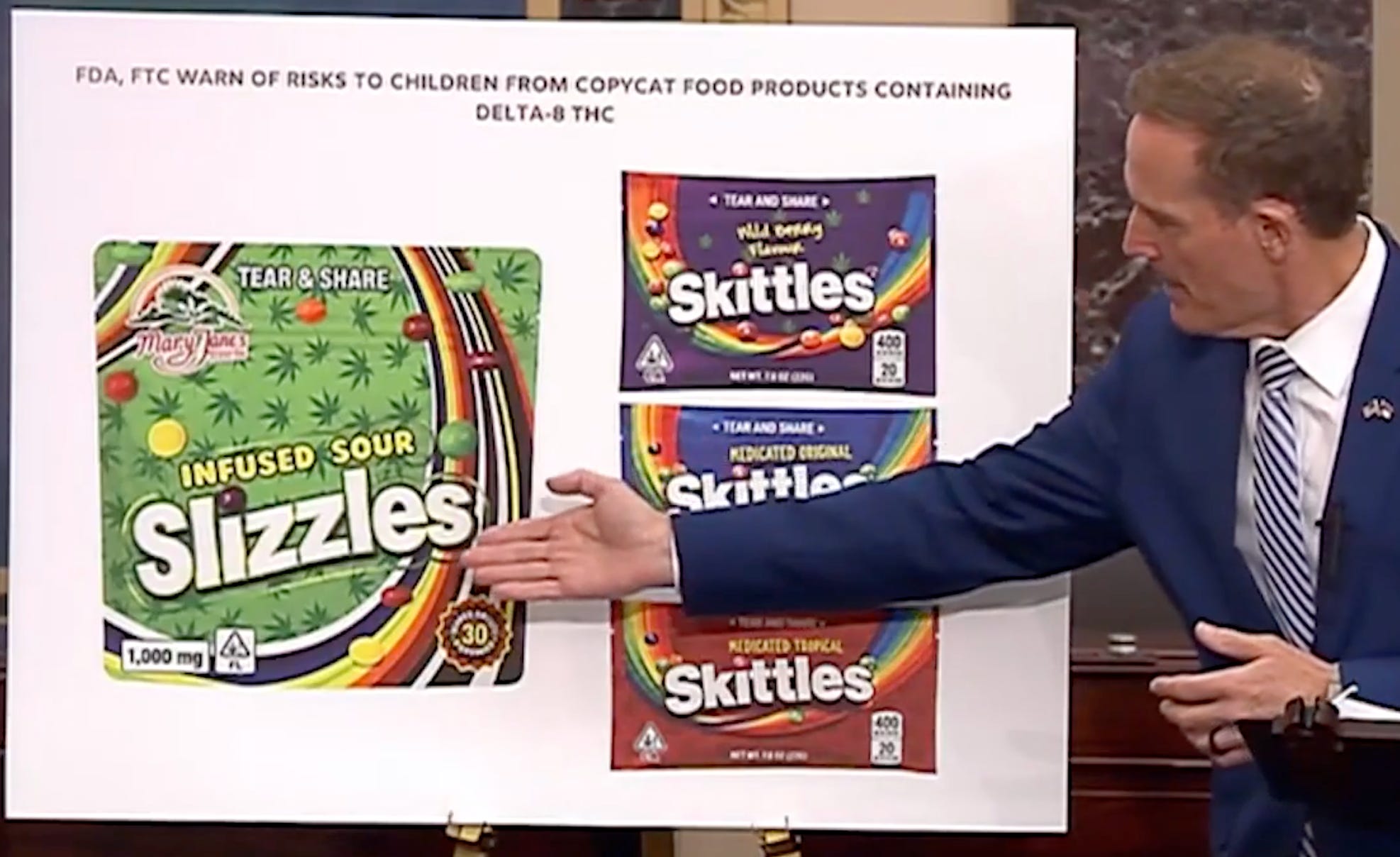
Candy and snacks made with THC, the psychoactive ingredient in cannabis, are for sale to both adults and kids in America: not in cannabis dispensaries but places like convenience stores. These treats are not regulated. Seventh graders on their way to school can stop and pick up packages of THC edibles made to look like familiar name brand candies. Except these candies can get them high, dangerously high.As I reported in my April series “Ultraprocessed Cannabis: Potency, Policy, and Public Health in America,” in 2018 Trump and Congress deregulated hemp, meaning cannabis without an intoxicating amount of THC. While the intent was to allow the unregulated sale of wellness products and supplements containing CBD, or cannabidiol, a non-psychoactive chemical in the Cannabis Sativa plant, there was a loophole. While hemp products couldn’t contain more than a tiny amount of Delta-9 THC, which causes the high in cannabis, nothing forbid using ultraprocessing techniques to make products with potent amounts of the Delta-8 THC that is found in hemp.For years, large quantities of Delta-8 THC have been added to canned drinks, gummies, and other snacks that have been sold without restriction, including purchasing age.To receive new posts and support Eating in America, please become a free or paid subscriber!Some states have taken action, but more than half have notThirteen states ranging from Idaho to New York have banned hemp products with Delta-8 THC. Another seven allow intoxicating products but impose limitations or regulation. It is alarming from a public health viewpoint that intoxicating hemp products are legal and unregulated in about 25 states.Federal action at lastLast year, as part of a continuing funding bill, Congress, with Trump’s signature, set this coming November 12th as the date when all hemp-based products with intoxicating levels of THC would be banned federally. Some legislators pushed for an additional one-year delay in the ban, but that effort failed.Trump changes mind, now favors a delay in action. Did the White House Chief of Staff’s daughter marrying a hemp products CEO have anything to do with Trump’s reversal?In June, Trump reversed himself and began asking Congress either to enact a regulatory framework allowing hemp-based products or to delay the ban. MS-NOW has pointed out this is the same month that White House Chief of Staff Susie Wiles’ daughter got married to the CEO of MC Nutraceuticals, a large wholesaler of hemp-based products, including Delta-8 THC. Could Trump’s reversal on the ban be a wedding gift? Forgive me for suggesting this possibility, but Trump’s past behavior is consistent with an inability to see himself in a conflict of interest in anything he fancies to do.What was the political game with the delay?At the beginning of August the quest for a delay turned into a proposed 4-week postponement of the ban ostensibly to allow legislators time to work out a hemp regulatory proposal. This ask for a small one-month delay baffled me at the time. It came an entire three months before the ban was meant to go into effect. I could understand if November 12th was drawing close after three months of hard lobbying and work constructing a compromise proposal and then a delay to the ban was asked for, but to ask so far ahead for a small one-month delay?Clearly, some political gamesmanship and heavy hemp industry lobbying was at play. Maybe the hemp lobby thought waiting until after the mid-terms would free up some favorable votes, or maybe they thought just being able to get one positive outcome in favor of hemp, even if just a short delay, would swing momentum in hemp’s favor. Or maybe the fact that Congress was not going to be in session at the start of the ban was a factor.One month delay slid into a funding bill and passed.In any case, the hemp ban delay was added to a must-pass federal short-term funding extension and the hemp industry got their 4-week reprieve. As it stands the ban will now end on December 11.Three types of hemp-based products: not gross, gross, and the big money maker to be.So let’s try to make sense of what is at stake. There are three types of hemp-based products.In the first, the hemp form of the Cannabis Sativa plant is used to make CBD products, such as tinctures, gummies, edibles, teas, and topical creams. The same plant is used for making rope and fabric.Within this first, non-intoxicating CBD category, there are three sub-categories. The first subcategory of hemp products use full spectrum CBD, meaning small amounts of different types of THC are retained. Some users regard full spectrum as providing the most beneficial effect. However, full spectrum consumable products can have enough total THC to cross the federal threshold of 0.4 mg, in which case they would be banned beginning December 11th.In the second sub-category, broad spectrum CBD has Delta-9 THC, the main kind of THC in cannabis, but the total quantity of is not enough to have any psychoactive effect.Thirdly, CBD isolate is, as the name implies, just the cannabidiol with other compounds, including any kind of THC, removed.The worst harm with this whole category of CBD products - it is not a huge harm but it is a harm - is that people are usually spending money on the basis of health claims which are not proven and are not regulated. The actual amount of active ingredient can vary from what is claimed on the package, which is never a good thing. There is, however, strong evidence for the usefulness of CBD in treating epilepsy, although using an unregulated product for this important purpose carries risks.The second type of hemp-based product is of greatest concern and most in need of regulation. Those are the consumables like gummies and edibles that can have very high levels of Delta-8 or other synthetic THC components. Some makers have gone so far as to put these dangerous psychoactive products into forms and packages which look like well-known, colorful, innocent candies.No alcohol but still a buzz in the canTHC beverages represent the third type of hemp-based product. I suspect the enormous financial potential of THC drinks sold outside of cannabis dispensaries is the biggest motivator for the hemp lobby to try to kill the hemp ban. Currently these drinks are being put on shelves in stores that sell alcohol.Can hemp leapfrog cannabis to get federal approval and regulation?As alcohol sales decline and cannabis consumption increases, major voices on the retail side of the alcohol industry are in favor of regulating THC drinks made from hemp so that liquor stores and restaurants can sell them. Some major brewers like Constellation (Corona, Modelo), Heineken (Lagunitas), and Coors Molson, along with some craft brewers, are already investing in hemp-based beverages. Restaurant associations are also part of the lobby to legalize intoxicating hemp drinks. This whole beverage segment would love to leapfrog the possibility of federal legalization of cannabis and reap big gains in this quickly developing market.The big dog in the fight: THC in a can or martini glassSo, to review, in the realm of hemp first we have the fairly innocent CBD products, then the THC gummies and edibles, a segment that has been grossly tarnished by the those who make hemp products targeting a market that doesn’t have an adult understanding of psychoactive drugs and their hazards, including kids who end up hallucinating at school. Third is the big dog in the fight, the hemp-based THC beverage market.The wild, wild west of cannabis at 90% potency vs. a regulated hemp industry? Hmmm…The current state of legal cannabis access is a hodge-podge wild west, not regulated at all by about half of the states, with many products having excessive levels of THC. High potency THC in hemp or cannabis products is associated with increased risk of cannabis use disorder and mental illness.A strong federal structure of cannabis regulation is needed. However, the medical and adult-use cannabis dispensary lobby is influential, bringing in substantial revenues for states where cannabis has been legalized. The cannabis industry is likely to push for a light federal regulatory hand when, and if, it is legalized on the national level. This could mean continued high THC content products in dispensaries.Eating in America is a reader-supported publication. To receive new posts and support my work, consider becoming a free or paid subscriber.Could hemp products provide a model for federal approval and regulation of cannabis?If hemp-based THC beverages are legalized at the federal level, it would likely be with enough regulation and moderation to serve as a model for when the eventual federal legalization of cannabis occurs, assuming it does. So I am rooting for the hemp-based THC beverage industry to succeed in getting sensible regulations in place and soon. I just wish they didn’t have to play mysterious political games to get there in such a volatile and corrupt political environment.Thanks for reading Eating in America. Please help spread the word and share this post!Thank you for reading. Your support for Eating In America is key for my work. I appreciate it!ReferencesRittiphairoj. High-Concentration Delta-9-Tetrahydrocannabinol Cannabis Products and Mental Health Outcomes. Ann Intern Med. 2025;178(10):1429–1440. https://doi.org/10.7326/annals-24-03819Senator Ted Budd, Republican, North Carolina on Hemp Ban Delay legislation, (August 5, 2026) (Senate). Rossheim M, Tillett K, Loparco C, Livingston M, Soule E, Berg C. Pediatric Cannabis Poisonings, United States Hospital Emergency Departments, 2018-2023. Health Behavior Research. 06/25 2025;8 https://doi.org/10.4148/2572-1836.1301Bayly R. Ultraprocessed Cannabis: Potency, Policy, and Public Health in America. April 14, 2026. Eating In America. https://www.eatinginamerica.co/p/ultraprocessed-cannabis-potency-policy-aebMarijuana Policy Project. What are state regulators doing about delta-8? Accessed September

Surgeon General nominee Dr. Nicole Saphier will testify at her Senate confirmation hearing tomorrow. If she is approved as Surgeon General it will represent another major corruption of America’s public health authority.Eating In America previously reported that Saphier owns a supplement company. Her pricey tinctures have unquantified, ultraprocessed ingredients, and the health claims she makes for them are unsupported by science. One of them contains kava root, a supplement that is banned in the U.S. military because of its association with liver damage.Her involvement in supplements should have immediately dismissed her from consideration as Surgeon General. Newly disclosed is that she has profited by $270,000 from these products.Eating in America is a reader-supported publication. To receive new posts and support my work, consider becoming a free or paid subscriber.Equally disqualifying are new revelations in the financial disclosure and ethics agreement she submitted last week that she owns stock in the three major tobacco companies, Altria Group, British American Tobacco, and Philip Morris.Equally disqualifying are the new revelations Saphier owns shares of Nestlé, a giant ultraprocessed food company, who’s ethics include vigorously marketing infant formula to women who could have breast fed but were convinced by Nestlé to use formula, even though they did not have clean water to mix the formula, resulting in the deaths of hundreds of thousands of babies and children.Equally disqualifying are the new revelations that she is an owner of Coca-Cola, PepsiCo, Mondelēz, Taco Bell, McDonald’s, KFC, makers of food linked to obesity, diabetes, heart disease, and many other ailments.Saphier owns stock in 239 major corporations apart from these nine who peddle toxic products. She did not have to sacrifice profit to make choices that were less abhorrent for a health leader.With these new revelations of tobacco and sugar-based food investments, Saphier draws even closer to matching the profiles and disqualifications of the two Surgeons General nominees who were “voted off” before her.As I point out in my May podcast/post “Survivor, Surgeon General,” Saphier shares with the first nominee, Dr. Janette Nesheiwat, graduation from a medical school in the Caribbean and broadcasting at Fox News. With failed nominee #2 Casey Means, Saphier shares profiting from the supplement industry and stated ambiguity about vaccines. Newly disclosed and also thoroughly damning are the tobacco investments Saphier has made, like Means, in Altria Group and Philip Morris.Trump’s need to insist repeatedly that his choices are right until they are accepted, despite the consequences Americans are suffering, is again reflected in his third Surgeon General nominee, stamped in the very same mold as the first two.Unfortunately, back in her hearing in February, the Senate paid little attention to Casey Means’ involvement with tobacco, so that black stain on Saphier’s public health resume may not be a factor in her hearing tomorrow.Thank you for reading. Your support for Eating In America is appreciated.ReferencesSaphier, Nicole. Surgeon General nomination, financial disclosure details. September 7, 2026. Provided by U.S. Office of Government Ethics, September 15, 2026.Saphier, Nicole. Letter of financial disclosure and ethics agreement. September 7, 2026. https://extapps2.oge.gov/201/Presiden.nsf/PAS+Index/54788BB045EFAE6E85258E6E002DFF11/$FILE/SaphierBayly R. Survivor, Surgeon General, podcast/post on Eating In America. May 26, 2026. https://www.eatinginamerica.co/p/survivor-surgeon-general-who-will This is a public episode. If you'd like to discuss this with other subscribers or get access to bonus episodes, visit www.eatinginamerica.co/subscribe

Are you one of the 300 million Americans who together spend $23 billion to eat breakfast cereal each year? Is there nostalgia in that bowl or just a pleasant-enough dose of food to push you out the door in the morning?Marion Nestle and Lisa Sutherland’s new book, Sugar Coated, Unboxing the Hidden Forces Shaping America’s Favorite Breakfast Food, is a not-sugar-coated history of the invention and evolution of cereal in America, inspired by and told through an extraordinary collection of Kellogg cereal box reproductions dating back to 1919 and given to Nestle by Kellogg in 2010. Nestle and Sutherland, who was Vice President for Nutrition at Kellogg at the time, understood immediately that these artifacts embodied - and displayed in bright colors - a macro case study of the way processed food has been marketed in the United States in the last hundred years.Granula, the sanctified but inedible beginningAs Nestle and Sutherland recount the history, the first granola was created in 1863 in a sanatorium in western New York. “Granula,” as it was called, was inedible unless it was soaked overnight. Nonetheless, the idea for the whole grain breakfast food was quickly appropriated by two brothers, the Kelloggs, who added a moralistic wrapper as they served it along with the beliefs of the health and nutrition conscious Seventh-Day Adventist Church. C.W. Post, of the soon to be Postum Cereals, helped in the kitchen of the Kelloggs’ sanatorium in Battle Creek, Michigan where Post also, let’s not sugar coat it again, appropriated stole the idea of a healthy whole grain cereal. Snake oil and whole grainsBy the turn of the century, the shift from pulpit to profit was complete in the cereal market and soon 100 cereal makers populated Battle Creek. In 1906, health-promising snake oil sales were at their peak in America, but purchases of genuinely healthy cereal were taking off, albeit with the help of snake-oil-like health claims such as Postum Grape-Nuts’ “rebuilds the soft gray matter in your brain.”Cereal had already been industrialized with extrusion and crushing processes that break the whole grains down into a more digestible form. Some cereal makers in Battle Creek were adding barley malt to sweeten their products, but the elder Kellogg, Dr. John Harvey, was adamantly opposed to sugar in the diet. The younger W.K. Kellogg saw great wealth in the future, however, and in 1906 added cane sugar to the new Kellogg’s Corn Flakes. The road to the prominence of breakfast cereal as a highly- and ultra-processed food in our culture was paved.The cereal industry’s manipulation of … everybodyIn Sugar Coated, Nestle and Sutherland carefully lead us through formulation of cereals over time with the addition of artificial colors, vitamins, minerals, fiber, protein, artificial sweeteners, and, of course, sugar, and lots of it. The book thoroughly and frighteningly tracks the industry’s manipulation of the Food and Drug Administration for food and labeling standards, the Federal Trade Commission for commercial advertising, academia and the nutrition research community for production of the supporting science, along with the USDA and Congress for laws and policies, all to help avoid or reduce regulation and gain license to market in ways that would best promote cereal sales.Health claims, laughable and cringeworthyThe authors by turn amused and enraged me in sorting out the confusing and contentious history of health claims on cereal boxes, from the reasonable “avoids constipation” of the Kellogg 1919 All-Bran to the icky-sticky endorsement of the America Diabetes Association on boxes of Post’s sugary cereals.Sugar Coated is bound to be frequently cited for detailing the way the industry has doggedly pursued its marketing goals, through managing to get government regulations changed, creating self-imposed regulation to deflect government efforts to regulate, or just ignoring the rules, often paying the penalty in court while reaping the bigger benefit in sales. Other writers will undoubtedly extend the lessons of Sugar Coated to help examine and link the tactics of highly- and ultra-processed food segments and other industries which market addictive or regulated substances. (I include sugar as an addictive substance, a conclusion W.K. Kellogg himself might have intuited.)Sugar as the essence of cereal’s rise to be a keystone of the diet of many AmericansAs the name Sugar Coated implies and Nestle and Sutherland convincingly detail, sugar has long been the essential ingredient for the success of breakfast cereal, as well as one of the key battlegrounds in regulatory and court struggles. The unhealthiness of added sugar is also the reason that the behavior of the Big Four cereal makers in targeting children is unethical. Of the four giants, General Mills, Kellogg, Post, and Quaker Oats, it is no coincidence that Kellogg, now split into W.C. Kellogg for North America and Kellanova for the rest of the world, is owned by Ferraro, the Italian candy maker, and Mars, the American candy maker. Quaker Oats is also owned by a sugar-centric food maker, PepsiCo.Candy for the breakfast of kids as a new normWith marshmallows, chocolate, and candy-names in and on our cereal, we live in a food environment where candy is promoted for breakfast and breakfast is marketed as a sugary snack for eating throughout the day. The authors’ incense at the TV ads, cartoon characters, in-box prizes, colored cereals in unusual shapes, and other marketing tricks that drive the buying of sugar-laden cereal for children is restrained but palpable.The idea of stop signals to warn usChange is coming in other parts of the world and Nestle and Sutherland provide examples. The most important and potentially achievable change the authors describe would be the addition of an instantly understandable and nutritionally-sound front-of-box indication of the healthiness of the cereal or other processed food product being examined. This consumer-friendly heads up has been enacted in the form of octagonal stop-sign shaped warnings in the majority of countries in South America and has greatly reduced sugary cereal sales there. Our Secretary of Health and Human Services and the Make America Healthy Again leader, Robert F. Kennedy, Jr., has advocated for perhaps the strongest choice for such a warning system, red-yellow-green light icons. Of course, after reading Sugar Coated, we shouldn’t be left with any delusions about the forces the Big Four and the rest of the highly- and ultra-processed food industry are bringing to bear to fight back against RFK, Jr.’s idea.Happy birthday, Marion Nestle!Look at the photo and guess how old Marion Nestle is. This week she celebrated a birthday that ends with a zero. You probably guessed 70th and would be in disbelief that it was her 80th, but it was actually Nestle’s 90th. Where does the impressive nutrition advocacy, book-producing, interview-giving, lecture-delivering, FoodPolitics.com post-writing energy come from? Good luck, but also good nutrition, Nestle says.Happy birthday and thank you and Lisa Sutherland, for this perfect insight into the way Big Food markets, lobbies, and formulates its way onto our tables with the only consideration of healthiness being the ultimate effect on the bottom line.In two weeks, we’ll set Nestle and Sutherland’s Sugar Coated cereal story in the context of the other choices made in the morning by Americans. It will be Breakfast in America on Eating in America. Please join me then and every week at EatingInAmerica.co.Thank you for reading and your support of Eating in America through your subscriptions, comments, and likes. This is a public episode. If you'd like to discuss this with other subscribers or get access to bonus episodes, visit www.eatinginamerica.co/subscribe

Comments

Download from Google Play

Download from App Store
 United States