


 Claim Ownership
The Walk
Subscribed: 166Played: 4,378
Subscribe

© Father Roderick Vonhögen
Description
A weekly walk with Fr. Roderick during which he shares his thoughts as a priest on the struggles and challenges as well as the joys and surprises of day-to-day life.
fatherroderick.substack.com
fatherroderick.substack.com
407 Episodes
Reverse
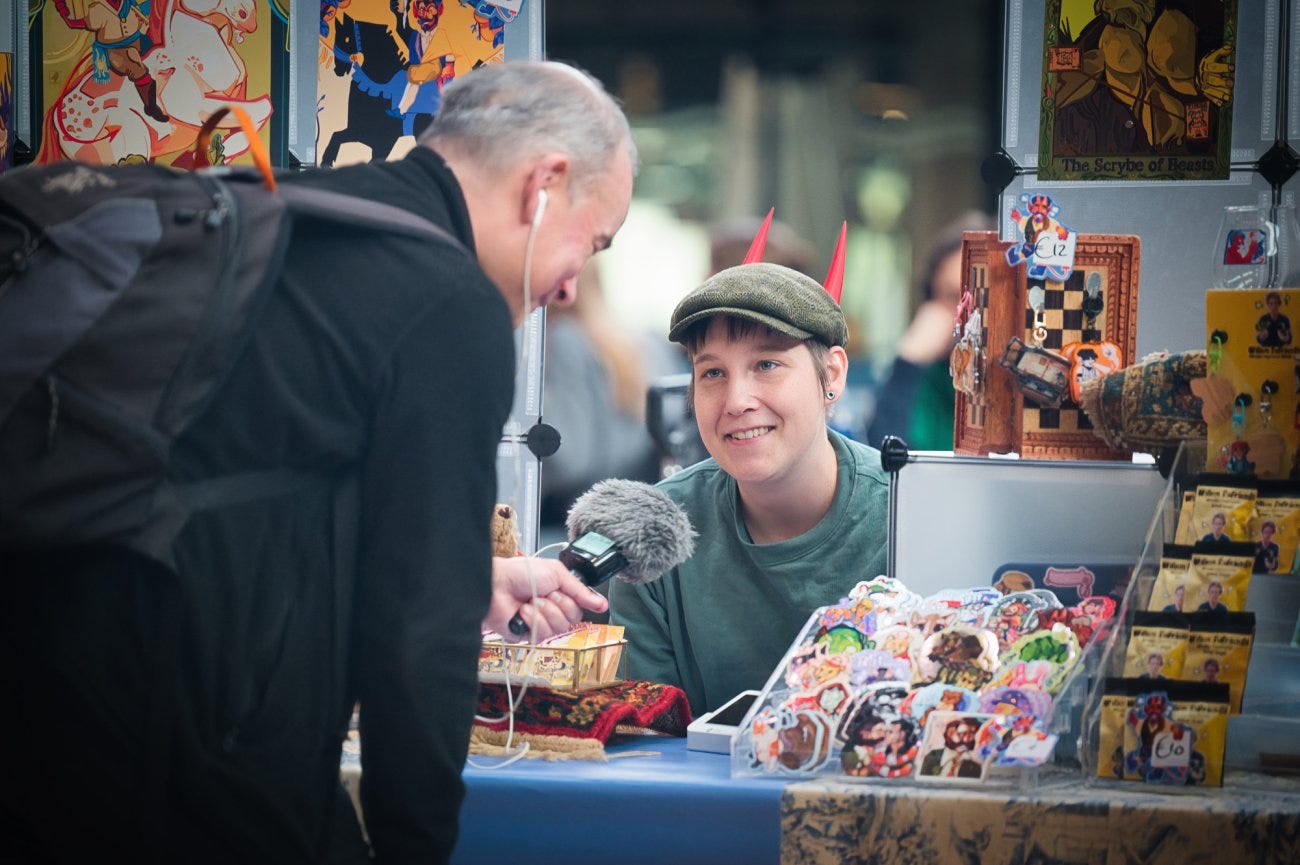
Last Saturday I took an early train to Tilburg for Fantastic Reads, which has become one of the biggest fantasy and science-fiction book events in the Netherlands.As usual, I spent most of the day running around with a microphone.This Substack is reader-supported. To receive new posts and support my work, consider becoming a free or paid subscriber.By the time I went home, I had recorded more than three hours of interviews with authors. Some write books I would probably never pick up myself, simply because they’re not in the genres I normally read. But that has never really mattered to me.What interests me is the person behind the book.Why did you write this story? Where did these characters come from? What were you going through when you started writing it? What are you trying to say that perhaps you couldn’t say in any other way?Those are the conversations I enjoy most.And something happened on Saturday that made me realise how much that has changed the reason why I keep doing this.The conversation behind the bookA few of the authors told me afterwards that they had rarely been interviewed that way.Usually, apparently, interviews are about the book itself. What is it about? Where can people buy it? What comes next?I’m interested in all of that too, of course. But after twenty minutes I usually find myself somewhere else entirely.One author I spoke with is chronically ill. Writing gives her a way to participate in a world that she often feels is moving past her while she is standing on the sidelines. When she publishes a book and readers respond to it, she feels part of that flow again.Those are the kind of conversations that stay with me long after the interview is done.It is also the kind of thing you only discover when you give someone enough time to tell the story behind the story.And the next time I meet that person at another festival, it doesn’t really feel as though I’m meeting an interviewee anymore. It feels like seeing someone I know.I thought I was building a networkWhen I started doing more with the Dutch fantasy community, there was a practical reason behind it.I knew I wanted to publish my own fantasy books, and it seemed rather sensible to get to know the people who were already active in that world. Authors, illustrators, cosplayers, booksellers, festival organisers, readers.If I waited until my first novel was finished, I would be starting from scratch.So yes, part of the idea was building a network and growing an audience.That still matters.I’ve also learned quite a lot recently about how to use the interviews themselves to reach more people. After recording a conversation, I now often make a short video with the author, perhaps asking one simple question on camera, and use that as a teaser for the full podcast. I tried the same approach with my saints podcast and saw the audience grow, so I’m now applying it to Fantasyfans as well.It’s nice when that works.But somewhere along the way, the network stopped being the main point.I simply like these people.I like hearing what they’re working on. I like seeing them again. I like helping someone tell a story that perhaps doesn’t normally get much space.And increasingly, when I walk around an event like Fantastic Reads, I don’t feel like an outsider documenting a community anymore.I feel part of it.The friendships we don’t hear aboutThat feeling came back to me a few days later when I met with the priests I was ordained with almost thirty years ago.There were seven of us when we became priests in 1996. Five of us are still alive now, and getting everyone together has become increasingly difficult. One works in a hospital, another is now a bishop, there are health issues, family obligations and diaries that somehow never seem to line up.But this time it worked.And there was something very comforting about sitting together again after all those years. We’ve all changed enormously. Our lives went in different directions, we’ve been through things none of us could have imagined when we were ordained, and yet there is still that shared history underneath it all. You don’t have to explain where you came from to people who were standing next to you at the beginning.At some point I looked out of the window of the apartment where we had gathered, near Nijmegen, and realised that I was looking down on part of the route of the Four Days Marches. I had walked along that very stretch earlier this year, together with tens of thousands of other people.Seeing it from above immediately brought the whole experience back. The crowds, the people cheering from the roadside, strangers helping each other, and that strange feeling that for four days everyone is moving in the same direction.I miss that.Maybe because everyday life so often gives us the opposite impression.Turn on the news and you mostly see conflict. Social media isn’t much better. Anger gets attention. Division gets clicks.Friendship generally doesn’t.Nobody sends a camera crew because two people had a really good conversation at a book festival.But those conversations are happening all the time.I think I notice them more now because my work keeps putting me in situations where people tell me things about themselves. Sometimes for twenty minutes, sometimes during a long walk, sometimes thirty years after the start of our priestly ministry.And perhaps that is one of the reasons I still enjoy podcasting after all these years.I get to ask someone a question and then listen.Quite often, I come home with much more than an episode.Fr. Roderick VonhögenP.S.: this article is based on this week’s episode of my podcast ‘The Walk’. You can listen via the audioplayer at the top of this page. Get full access to Father Roderick at fatherroderick.substack.com/subscribe
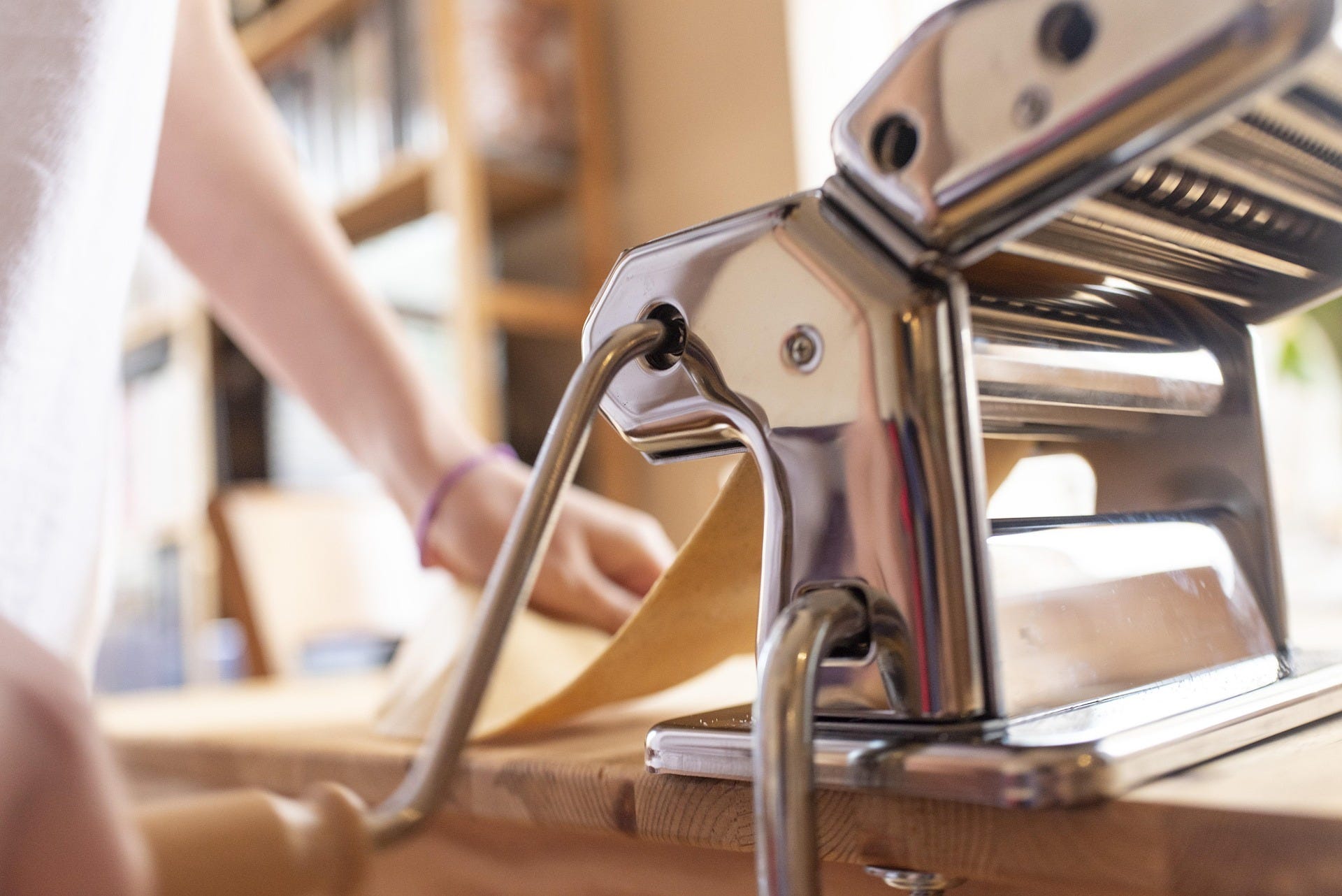
I have a pasta machine somewhere in the house.At least, I think I still do.There was a period when I watched MasterChef almost religiously and imagined myself becoming this adventurous home cook who would make everything from scratch. So obviously I needed a pasta machine. And a bread machine. And various other things that would allow me to cook the way people on television cooked.I did use some of them for a while. I learned a lot. I still love cooking.But these days I’m much more likely to find a simple recipe on TikTok, grab a good knife and make something that tastes great without turning dinner into a three-hour project.And yet some of those machines are still sitting there.I’ve been thinking about that this week because I’m beginning to notice how often I do the same thing with other parts of my life.The things that once matteredFor years I had this feeling that once I had started something, I somehow had to keep it going.A podcast. A website. A social media channel. A project. Sometimes even a hobby.If I stopped, it felt suspiciously like failure.I would tell myself that if only I were more disciplined, or had a better system, or managed my time more efficiently, I could keep all of it alive.Which is obviously nonsense.At one point I also decided I was going to build a huge Lego city. I bought quite a lot of Lego for it, and I still like the idea. Little buildings, lights inside the houses, streets, the whole thing.The problem is that it takes me several months to finish one Lego set.So unless I suddenly get an extra lifetime, that city may have to remain imaginary.The funny thing is that some part of me still says: but you already bought all this. Maybe someday.That “maybe someday” can take up an enormous amount of space.Not just physical space either.I already ran the marathonsI noticed the same thing on today’s walk when I passed the place where I once injured myself while training for a marathon.For almost twenty years I ran a marathon nearly every year. For the past few years I haven’t.And occasionally this thought pops up that perhaps I should run another one, if only to prove to myself that I still can.But then I think about what marathon training actually means. Running four or five times a week, and eventually some of those runs take two or three hours.Do I really want to spend that time on proving something I’ve already proven many times?I still enjoy running. I still want to be healthy. I just don’t know if I need another marathon.Maybe that period of my life already did what it was supposed to do.That’s surprisingly difficult for me to accept.There are things we buy, habits we build and projects we start because they fit the person we are at that moment. They can be genuinely good. They can teach us something, give us joy, introduce us to people or help us become healthier or more creative.But that doesn’t necessarily mean they have to come with us forever.It served its purposeSometimes you just have to accept that something has reached the end of its usefulness, at least for now.That can be an object. It can be a hobby. It can be a project, or even an image of yourself that you have been carrying around for years.I scanned a lot of my childhood drawings a few years ago. Some of them are terrible, of course. There is probably a green blob somewhere that six-year-old me considered the most magnificent frog ever committed to paper.I don’t look at that drawing and think I should still be drawing frogs exactly like that.It was practice.It got me somewhere.I’m trying to become a little more comfortable thinking that way about other things too.Not everything I once loved has to remain part of my life forever. Not every project needs another season. And not every version of myself needs to be maintained simply because I invested a lot of time becoming that person.I’m still not throwing out all the Lego tomorrow.But I may finally be ready to admit that the city can wait.Father Roderick VonhögenP.S.: these thoughts were part of this week’s podcast episode of The Walk; you can listen via the player at the top of this page. Get full access to Father Roderick at fatherroderick.substack.com/subscribe

The woods are absolutely beautiful at the moment. On my walk today I passed an old tree trunk covered in tiny yellow mushrooms, almost like little houses built against the side of a cliff, with a sea of brown and golden leaves underneath. And immediately my imagination went somewhere else entirely. I could see little creatures living underneath those mushrooms, sitting inside at the end of the day drinking hot chocolate.I have no idea how that would work in a mushroom house, but apparently my imagination does not care about practical details.This really is peak fairy-tale season for me. Last year, around this time, I wrote 30 or 31 short stories in a month. This October has been very different because I deliberately tried to focus more. I wanted to work on my fantasy novel, on Pangur’s story, and on some of the other writing projects that have been waiting for me.What I hadn’t expected was that October would also teach me something about the circumstances in which I seem to work best.This Substack is reader-supported. To receive new posts and support my work, consider becoming a free or paid subscriber.The retreat I didn’t go onOriginally, I had this idea that I needed to go away somewhere. Maybe Ireland. Maybe some sort of writing retreat. I had already cleared most of my calendar, so the plan was to travel, walk, write, and create that sense of separation from normal life.In the end I stayed home.And after a slightly restless beginning, the rhythm just settled by itself. I went to bed around the same time, woke up around the same time, wrote in the mornings and went for long walks in the afternoons. There were very few appointments, hardly any travel, and not much external pressure.At some point I noticed that I wasn’t missing the retreat anymore.Apparently, what I needed wasn’t another place. I needed predictability.That has been interesting to discover because I’m actually very good at improvising. I’ve been doing that for most of my working life. Podcasting certainly trains you to solve problems quickly, and I have a very associative brain, so if something changes I can usually think of three other ways to make it work.But it costs energy.I noticed that again this week when some plans for the saints podcast suddenly changed. It wasn’t even necessarily the amount of extra work that bothered me. It was having to rearrange everything. I woke up much too early the next morning and my brain immediately started trying to solve the entire month of November.I can do that. I’ve always done that. But I’m beginning to see more clearly what it does to the other work I want to do.What happened when things got quietOnce October became predictable, I had much more room to think.I spent a lot of time rebuilding the plot of my fantasy novel, and I’m very glad I didn’t give myself a deadline of 3,000 words a day or decide that the book had to be finished by Christmas. I’ve done those kinds of writing sprints before, and they can be wonderful, but this book needed something else. I had forgotten how many pieces of the world were still vague in my own head. Going back to the foundations forced me to think again about the history, the magic, the characters and, most importantly, why I want to tell this particular story.That takes time. There isn’t really a word-count target for thinking.Of course, social media doesn’t help. You see another writer announce that they finished a novel in six weeks, or that they wrote 5,000 words before breakfast, and immediately part of your brain goes: I should be doing that too.But you don’t see the ten years before those six weeks. You don’t see the days when they were tired or sick or simply didn’t write anything. You see the part that makes a good post.I would love to have several finished books by now. I’m very impatient about that. But since I don’t, rushing the first one in order to feel as though I’m catching up with somebody else is probably not going to help me very much.And strangely enough, the month in which I stopped pushing for that kind of visible progress has been one of my most creative months in a long time.Keeping some of thisAll of this is on my mind because my work is going to change quite dramatically at the end of the year. The daily saints podcast will stop in its current form, which also means that a large part of my income disappears. So I have plenty of practical questions to answer.But I don’t want to answer those questions only by asking what kind of work I can find.I’m also asking what kind of life allows me to do the work I’m actually good at.I love telling stories. I love travelling and interviewing people. I love history, saints, books, fantasy, walking and writing. There are probably ways to combine much more of that than I have done in the past, and I’m exploring quite a few of them at the moment.What I don’t want is to fill every empty space in the calendar again simply because it is empty.October has been a useful experiment in that sense. My world became physically quite small. I spent most mornings in the same little room and most afternoons walking through the same woods. Yet my imagination went everywhere.Tolkien once wrote that “the realm of fairy-story is wide and deep and high and filled with many things.”He was so right!Father Roderick VonhögenP.S.: these thoughts were part of this week’s podcast episode of The Walk; you can listen via the player at the top of this page. Get full access to Father Roderick at fatherroderick.substack.com/subscribe

Of all the rooms in my house, I spend most of my working day in what is basically a closet.It was never meant to be an office. When I moved into the former rectory where I live, this tiny room beside the front door was simply where people hung their coats. It measures 2.5 meters (about 8.2 feet) in length and 2 meters (about 6.6 feet) in width. Last year, I turned it into my Hobbit hole.There was just enough space for a small IKEA desk, a chair, and a few bookshelves. One wall holds a cupboard with all the house’s electronics, and there’s a single square window.I’ve always loved the image of Bilbo Baggins sitting safely inside Bag End, surrounded by books and familiar things, writing down his adventures while the outside world disappears. That’s more or less what I wanted for myself: a small, warm place where I could shut out distractions and step into a story.There was also a very practical reason for choosing the smallest room in the house: it was the only room I could afford to keep warm.Writing with gloves onThe rectory was built in the 1950s, when apparently nobody expected heating a house to become a luxury.The roof has never been properly insulated. The insulation inside the walls has largely deteriorated. Downstairs there are enormous old windows through which both heat and money disappear at alarming speed.Last January, I spent around €1,200 on heating alone.So during the winter I mostly retreat to my Hobbit hole. I keep the rest of the house at a fairly low temperature and heat only the room where I work. Last year there were days when even that wasn’t enough and I sat behind my computer wearing thin gloves.It turns out that typing fantasy novels with cold fingers is considerably less romantic than it sounds.This week I finally decided that something has to change.I had two people from a local energy service inspect the house and explain where the biggest problems are. A company is coming to look at the walls and give me a quote for new insulation. I’m also investigating how to insulate the attic without spending a fortune.And for the Hobbit hole itself, I’m considering an infrared panel.Bilbo had a fireplace.I’ll take what I can get.The unromantic side of a creative lifeI’ve been thinking about this because October has been such an intensely creative month for me.Every morning I sit in that little room and work on stories. My big fantasy novel is slowly being rebuilt. The children’s book about Pangur the magical monastery cat is evolving almost every day. Then, after several hours behind the desk, I put on my coat and walk into the woods to solve whatever story problem is currently occupying my brain.It is pretty close to the life I imagined when I decided I wanted to become a writer.Except that imaginary writers never seem to spend much time comparing insulation quotes. They don’t worry about natural gas prices or whether their hands will be warm enough to type in January.Real life insists on being considerably more practical. But perhaps those practical things matter more than I used to think.The stories may happen in my imagination, but I still need somewhere to sit while I write them. I need enough peace to concentrate. I need food, electricity and a room that is not thirteen degrees Celsius.Creativity doesn’t exist separately from all of that.A small room can hold a very large worldThe funny thing is that I don’t wish my office were bigger.There are much larger rooms in this house, but I rarely want to work in them. I like being surrounded by bookshelves. I like being able to reach almost everything without getting out of my chair. I like that when I close the door, the room feels separate from the rest of the house.The physical world gets smaller, and somehow that makes the imaginary world bigger.Over the past two years, that tiny room has contained medieval Ireland, dragons, saints, magical storytellers, short stories, podcasts and now a white monastery cat who is causing considerably more trouble than I originally expected.So I don’t want a different writing room.I just want this one to be warm.Hopefully, by the time winter really arrives, my Hobbit hole will have received its first major renovation.No round window or a fireplace. After all, this is not Bag End.But if I can write without gloves on, I’ll consider it a success.Fr. Roderick Vonhögen.P.S. This article grew out of this week’s episode of The Walk. In the full episode I also talk about Pangur’s latest adventures, my plans for a Story Magic magazine, and why this writing retreat has generated far more ideas than I expected. You can listen via the player at the top of the page. Get full access to Father Roderick at fatherroderick.substack.com/subscribe

Today, I ran into some parishioners while walking in the woods. “I thought you were going to be in Ireland,” they said. So did I.For months, October had been blocked out in my calendar as my writing month. The original plan was to travel to Ireland, move from hostel to hostel, walk for hours every day and spend the rest of my time working on my fantasy novel.Then I looked at the prices.Travel alone had become expensive, accommodation would add another considerable amount, and suddenly my supposedly simple writing retreat was turning into a trip of several thousand euros.So I stayed home.At first that felt a little disappointing. Now, halfway through October, I’m beginning to think it may have been exactly what I needed.This Substack is reader-supported. To receive new posts and support my work, consider becoming a free or paid subscriber.Walking without going anywhereOne thing I knew I would miss about Ireland was the walking.When I’m there, I can easily spend most of the day on foot. Walking helps me think. Problems that seem impossible behind a desk often begin to loosen after an hour or two outside.So I’ve simply kept doing that here.This week I spent three hours wandering through the woods and the park around a nearby castle. Autumn has arrived properly now. The leaves are changing, the light is getting warmer, and at one point the late-afternoon sun hit the moss on the trees in such a way that I had to stop recording and take a picture.The strange thing is that I don’t feel as if I’m missing Ireland very much.I’m spending so much time inside the world of my stories that Ireland seems to be following me around anyway.A different kind of retreatWhat I didn’t expect was how personal the writing would become.I’m rebuilding the fantasy novel I started last year, and the main characters are young people trying to work out who they are, how much they should conform to what others expect from them, and whether they can trust their own gifts.The more I develop them, the more memories return from my own twenties.I spent the first five years of seminary in Louvain-la-Neuve, in the French-speaking part of Belgium. I was incredibly happy there. It was international, exciting, and for a long time it felt as if I had found exactly where I belonged.Returning to the Netherlands was much harder. Suddenly I felt like the outsider. The culture was different, the expectations were different, and during those early years of priesthood I often struggled with a question that I now recognize much more clearly: can I be myself, or do I have to become the person other people expect a priest to be?At the time, I didn’t have the language for some of what was happening. Looking back now, I can recognize things like masking and the strain of constantly trying to fit myself into roles that didn’t quite fit me.Writing fictional characters who wrestle with similar questions has brought all of that back.Sometimes I go to bed after working on the novel and dream about seminary again.Seeing the same road differentlySomething similar happened earlier this year when I walked the Camino again.I returned to places I had first visited almost ten years before. The landscape hadn’t changed very much, but I had.That made it possible to look at old experiences differently. Things that once seemed like failures or difficult detours now belonged to a much larger story.October is beginning to feel like that too.I thought I had cleared the month so I could travel somewhere and finish a book. Instead, staying home has given me the space to look backwards, write, walk, sleep properly and take care of things I’ve been postponing for far too long.Some of those things are extremely ordinary. I’m finally looking into fixing the insulation in my house before another cold winter. I need new glasses; apparently twelve years between eye tests may be pushing it slightly. I’m also taking the first steps towards getting proper professional help with some of the ADHD-related issues I’ve been learning to recognize and manage.None of this was on my romantic picture of a month-long writing retreat in Ireland.But perhaps a retreat doesn’t always require going somewhere.The ideas are coming backThe easiest way for me to tell whether this slower rhythm is working is that ideas have started appearing again.I’m working on the novel. A little side project about a magical monastery cat has unexpectedly turned into an entire book. Other stories are beginning to connect. I’m walking more, sleeping more and feeling increasingly like myself.There are still plenty of practical questions waiting for me. My daily saints podcast ends at the end of December, so I have to work out how to replace a substantial part of my income next year without creating another job that consumes all the time I want to spend writing.But I don’t have to solve all of that this week.For now, I’m walking through autumn woods, working on stories and slowly sorting out the things that have been waiting for my attention.Ireland would have been wonderful.This is pretty good too.P.S. This article grew out of this week’s episode of The Walk. You can hear the full update via the player at the top of this page. Get full access to Father Roderick at fatherroderick.substack.com/subscribe

Comments

Download from Google Play

Download from App Store
 United States