


 Claim Ownership
The Weekly Dev's Brew
Subscribed: 4Played: 2
Subscribe

© Jan-Niklas Wortmann
Description
The people building AI developer tools have stories most of us never hear. Stories of failed experiments, unexpected wins and workflows they swear by. The Weekly Dev's Brew host Jan-Niklas Wortmann pulls those stories out through honest conversations about what AI actually changes for developers and how we write software.
22 Episodes
Reverse

Why did AI coding make Dillon Mulroy more productive and less happy? He stopped writing most of his own code after Claude Opus 4.5. Six months later he ships more than he ever has, still reads every line, and enjoys the work less. The small implementation hits that used to create flow are gone. The day is now one hard design problem after another, and that is more exhausting.
Dillon is a principal engineer at Cloudflare. This episode answers what Cloudflare's May layoff of about 1,100 people looked like from inside, why lab-style agent loops are a poor default for most teams, and how he keeps a model on a short leash with Ghostty, Herdr, Pi, and Plannotator. Specs are TypeScript types, call stacks, and tests. Pull requests stay in the 300 to 800 line range. He uses Pi's slash tree instead of sub-agents.
Dillon is on X at @dillon_mulroy, GitHub at @dmmulroy, and Twitch at @dillon. https://dillonis.online

You can't get 10x with AI coding. Not today. Dex Horthy (Human Layer) makes the case for 2-3x if you refuse to ship slop, and why a perfect spec still produces garbage if you give the model permission to skip quality. That permission is how you burn a codebase into ash.
We get into context engineering, where AI coding actually fails, why PR review is the bottleneck, how to use specs without worshipping them, cheap models vs Opus, compaction and sub-agents, and what to tell a 20-year engineer who is not living on Twitter.
Dex is the founder of Human Layer. https://humanlayer.dev
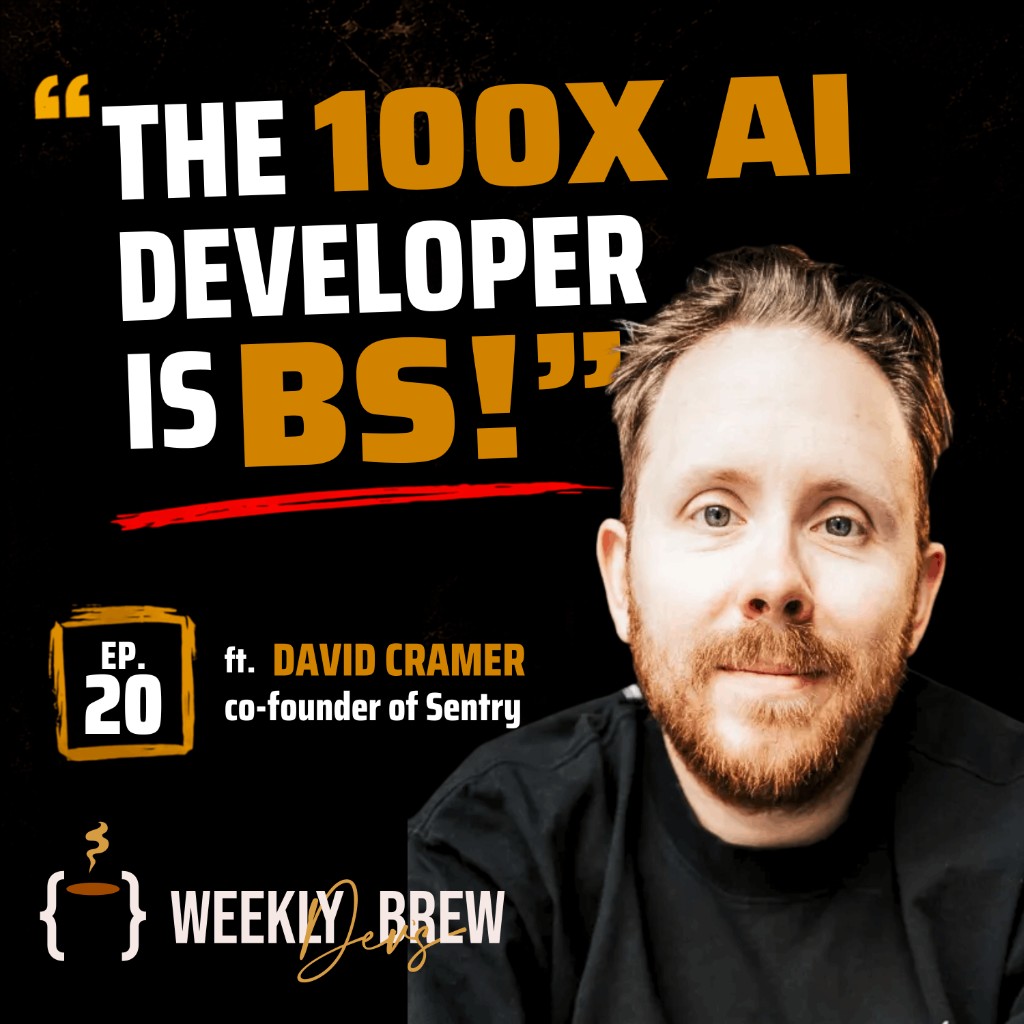
Everyone is selling 100x developer productivity, but David Cramer runs production software at Sentry and says LLMs are not making his own work faster. We talk about what actually holds up when AI meets real codebases, security review, open source economics, and why verification beats generation.

Mario Zechner has watched people generate 500,000 lines of code in a week with a swarm of agents. He'll tell you exactly how that ends.Mario is the creator of Pi, the minimal, self-modifying coding agent that took off after Claude Code stopped fitting his workflow. He now builds it alongside Armin Ronacher at Earendil. This one is a grumpy, honest conversation about where AI coding is actually heading, and the places the hype quietly falls apart.We get into:- Why "code is never free," and how a lot of today's productivity just delays the bill- The case that spec-driven development is hyper-waterfall, repeating a mistake the industry thought it solved 30 years ago- Why an army of parallel agents wrecks his brain, and the "absolute caveman" workflow he actually uses to ship- Running AI fully local on a normal MacBook, and why that future is closer than most people think- The clanker problem- What we lose when AI strips out the friction we used to learn fromThe tension we kept circling: agents make exploring solutions faster than ever, but the thinking was always the hard part, not the typing. 0:00 Intro2:20 Why Pi Fits Workflows8:53 What Success Looks Like for Pi10:58 Building Beyond the Coding Agent13:13 Local AI Is Getting Real20:13 How Mario Actually Works26:38 Discipline, Atrophy, and Juniors29:08 Spec-Driven Dev Is Just Hyper-Waterfall35:03 Code Isn't Actually Free37:56 Async Agents and Thinking Time44:42 Learning Without the Pain49:13 AI's Sloppy Software Wave52:11 GitHub Under Clanker Load53:31 Family, Work, and Balance57:05 The Pi Team and Leadership58:52 Refactoring Pi's Core1:03:32 Security, YOLO, and Trust1:06:27 Taming the PR Flood1:12:11 Token Prices and Budgets

In this episode, I sit down with Minko Gechev — Google Engineer, former Angular team lead, and one of the most thoughtful voices on AI and developer productivity.We get into why AI won't replace engineers anytime soon (and what that actually means for your career), how Google's Angular team is affected by AI, the security risks of the current AI coding wave, and the single most valuable skill developers should be building right now.If you're a developer trying to figure out where you fit in the age of AI, I hope this one helps you.Connect with Minko:X/Twitter: https://twitter.com/mgechevGitHub: https://github.com/mgechevLinkedIn: https://linkedin.com/in/mgechevTopics covered:AI-powered developer productivity • LLM skill evaluation • Angular + AI • Software engineering career • Imposter syndrome • Open source security • Future of coding

Comments

Download from Google Play

Download from App Store
 United States