


 Claim Ownership
The Board Drill Podcast
Subscribed: 5Played: 230
Subscribe

© Board Drill
Description
Join seasoned coaches Kyle Bradburn and Matt Dixon on The Board Drill Podcast, a dynamic journey into the intricate world of high school football. With a passion for the game that extends beyond the field, Kyle and Matt delve deep into the challenges facing coaches today. This podcast is more than just X's and O's; it's a guiding light for high school coaches nationwide, offering valuable resources and insights to empower them on their journey to becoming better, more effective leaders on and off the field. Tune is for engaging conversations on football with The Board Drill Podcast!
www.boarddrill.com
www.boarddrill.com
107 Episodes
Reverse
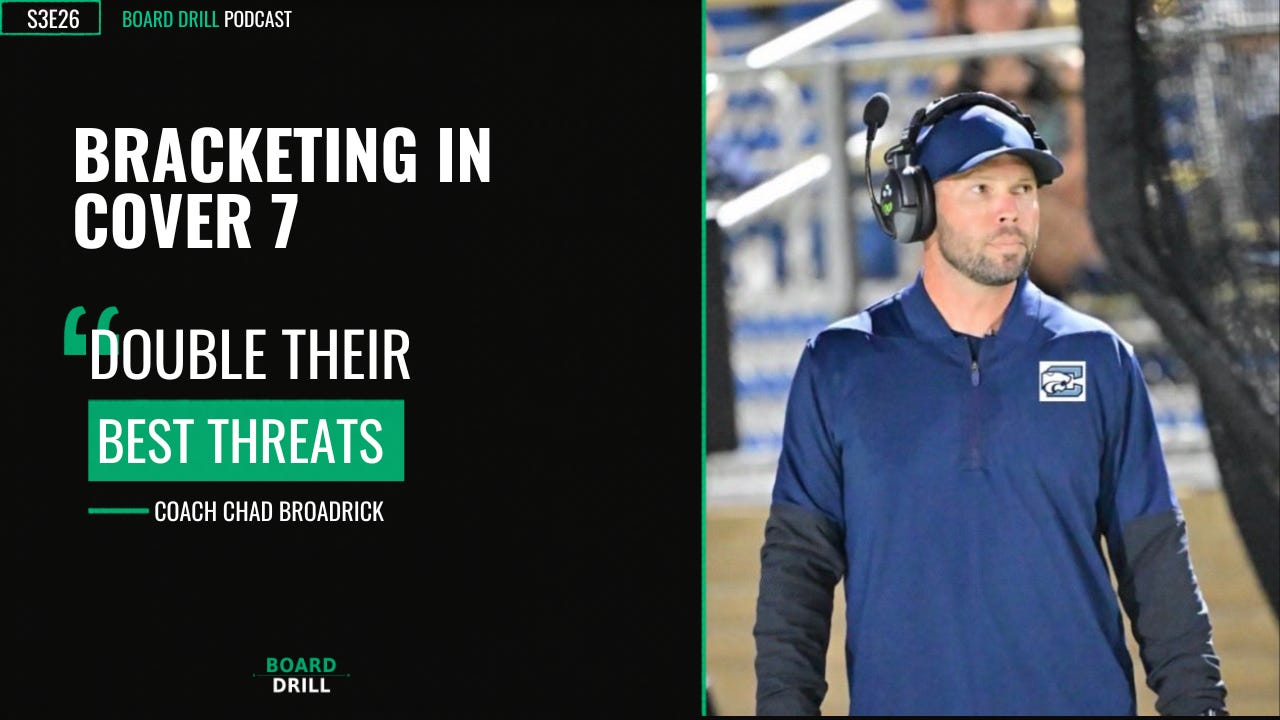
Most coaches treat quarters as a set of rules that react to what the offense does after the snap. Chad Broadrick treats it as a way to decide, before the ball is ever snapped, which two players he is going to take away.In this episode, the Head Football Coach and Athletic Director at Centennial High School in Tennessee walks through his Cover 7 film and the single question that drives every call in it: how do we double the two guys we are worried about on Friday night? Everything else is built backward from that answer.Broadrick lays out the four buckets he lives in out of Cover 7, which are cones, brackets, triangle concepts, and box concepts, and shows how each one is really just a different tool for getting a double team on the right player. The star and the money carry outside leverage, the safety plays the aggressor on any in-breaking route, and the Mac takes the back. From there it becomes a language: ink and orc to set the corners’ press, Seahawk to wall and midpoint a vertical, Connie to keep from getting picked on the rail route, stump and smash rules to the field, cut and buster to trips. For coaches who want a cleaner way to organize their quarters answers instead of memorizing a hundred unrelated checks, this is someone who has done that work.He is also honest about where the coverage lives and dies. Cover 7 can look rough in seven-on-seven, where isolation routes get exposed and there is no rush to bother the quarterback. In a game, with a four-man rush and a plan for who you want doubled, it is a different picture. That is where Broadrick gets animated, because the real value shows up when you build pressure out of the structure. He shows how the same bracket calls turn into simulated pressures and creepers, tracing the back, VTeching the center, and getting a hit on the quarterback while still doubling the vertical routes behind it.The conversation closes in the red area, where cut becomes a two-man concept with trap rules and the corners play as waterfall defenders protecting the goal line, then moves into Turkey and Clifford and when it actually makes sense to dial them up. Matt jumps in from the offensive side to compare it all to Palms, and makes the case that Cover 7 gives a coach more pre-snap structure and control over exactly who gets doubled, without the practice cost that Palms demands.The film gremlins were out in full force during this one, so a few clips fought back, but the ideas came through clearly. If you run any form of quarters and want a smarter way to take a team’s best player out of the game, this one is worth your time.This episode is presented by Sideline HQ.Sideline HQ is the equipment and operations management platform built for football programs. Keep your gear, inventory, and operations organized in one place so you can spend your time coaching. Learn more at sidelinehq.co and let them know Board Drill sent you. This is a public episode. If you'd like to discuss this with other subscribers or get access to bonus episodes, visit www.boarddrill.com/subscribe
Some coaches collect plays. Coach Shawn Cooley collects ways to run the same one.In his third visit to the Board Drill, the East Ridge offensive coordinator makes the case that you do not need a thick call sheet to be multiple. You need one play your kids believe in and a hundred ways to show it. For Cooley, that play is counter, and over the course of the episode he takes GH counter from its plainest form all the way out to the edges of what a defense will let you get away with.Along the way he gets into GT and split-flow counter, a first-level slice RPO he calls emo, counter quick borrowed off the college game, and a long-trap ISO wrinkle he is half convinced should have gotten him fired. From there it turns into a quarterback run clinic: a center-turned-quarterback lowering his shoulder between the tackles, jet and empty-formation keeps, a guard-tailback counter, and a shovel pass he simply calls Tebow. The thread running through all of it is the part most offenses skip. The offensive line barely changes a rule, and the defense never gets to tee off on your base.If you run gap scheme, this is an hour well spent with the whiteboard open. This is a public episode. If you'd like to discuss this with other subscribers or get access to bonus episodes, visit www.boarddrill.com/subscribe
This week on The Board Drill Podcast, Kyle sits down with Coach Wallie Kuchinski, Associate Head Coach and Defensive Coordinator at the University of St. Thomas, for an hour-long install of what Coach K calls the king of all blitz patterns.On tape it looks like the NCAA pressure everybody runs. It is not. It is a single five-man zone pressure built on reading offensive linemen instead of assigning gaps, and that one distinction is what makes it hold up against every run scheme and every protection a coordinator can dial up. Coach K teaches it the way you wish every clinic taught it, all the way down to the footwork: the flat step, the pound-step head fake, the lean off the snap so you never tip the pressure, and the term the Tommies use instead of box or force, splatter.From there it builds. How the front cuts the field in half and turns pulls into tackles for loss. Why a bunch of single teams gets extra hats to the ball. How the pattern beats outside zone, power, and RPOs, and the three-man loop that asks a center to do something he simply cannot do. Coach K also shows how the whole thing travels from a 3-4 into a 2-4-5 nickel, so the 4-2-5 crowd can run it too.It is a heavy install with a ton of drill tape, and it closes with Coach K on what 19 years with the program has taught him about teaching defense, plus the story behind the Tommies’ jump from Division III to FCS Division I.If you coach the odd front, or you have ever written NCAA pressure on a call sheet and wondered if there was a better way to read it, this one is worth the notebook.This episode is brought to you by Sideline HQ. Rosters in one spreadsheet, equipment in another, helmet reconditioning tracked on a napkin. Sideline HQ puts all of it in one place: rosters, inventory, gear assignments, and the stuff that eats up your Sundays. Built by football people for football people. Spend less time on paperwork and more time coaching ball. Check it out at sidelinehq.co and tell them Board Drill sent you.TIMESTAMPS00:00 Intro and tonight’s topic, the king of all blitz patterns01:11 Sponsor, Sideline HQ01:59 The 3-4 front and kicking into a 2-4-5 nickel05:00 Non-pressure run fits, scrape, spill, and splatter08:40 The scoop technique and the arrow-to-contain player11:00 Drilling the line, flat step, point the toe, pound-step head fake12:30 The trace technique on the tight end and the five-minute install16:00 Force and scrape in space18:50 Why this beats the NCAA pattern, cutting the field in half23:02 Defending outside zone and mid zone from the pistol26:00 Run-throughs that turn pulls into tackles for loss29:56 Splatter and why phone-booth tackles win35:50 Denting the tight end and the second-step climb40:49 Falling back across the formation versus zone42:01 The C gap power counter44:00 The no-tight-end catch-all and attacking RPOs47:02 The power of simplicity50:00 Protection beaters, the half slide and the hot throw52:35 Three-man loops and the center who cannot pass it off57:00 Running the same pattern from 11 personnel in a 2-4-559:55 The closing question and the jump from D3 to FCS This is a public episode. If you'd like to discuss this with other subscribers or get access to bonus episodes, visit www.boarddrill.com/subscribe
Stump coverage does not get talked about enough. Most cover 7 teams run Stubbie as their three by one answer and stop there, but the moment a good offensive coordinator figures out you are in Stubbie, the double in from three becomes a weekly problem. Stump is the answer, and Coach Colin Lark from Bishop Lynch High School in Dallas, Texas breaks the whole thing down.Coach Lark walks through every position rule in the coverage: the corner in mod technique, the in call and what it triggers, the nickel reading three to two, the safety’s vertical tracking rules, and how the three by four push changes linebacker responsibilities. He then puts it under pressure against trips concepts you actually see on Friday nights, including dagger, sail, and stick, and shows spring film of the coverage working against each one.Kyle and Matt bring their own history with the coverage into the conversation, from using Stump almost exclusively as a high red zone answer to beat the double in corner, to the linebacker communication nuances that made it difficult to run full time at the high school level. The result is a real coach to coach conversation about not just how the coverage works, but when to use it, how to teach it, and what it takes to make it stick with your kids.Coach Lark also demos Football U, his interactive playbook tool that lets players rep coverages from their phones and gives coaches accountability on whether their guys actually know their assignments.This one is worth a full listen. This is a public episode. If you'd like to discuss this with other subscribers or get access to bonus episodes, visit www.boarddrill.com/subscribe
Coach Nathan McPeek has built Frederick Douglass High School (Lexington, KY) into one of the most consistent programs in Kentucky 6A football: a 2022 state championship, a perfect 39-0 record against city opponents, 27 playoff wins, and five players currently in the NFL. In this episode, he breaks down the player-led leadership system behind it all, from the core values that run the locker room to trust sessions, the game-day beast lift, and the branding that gets his kids recruited.If you coach high school, youth, or small college football and want a blueprint for developing leaders instead of just managing talent, this one is for you.TIMESTAMPS00:00 Welcome and meeting Coach Nathan McPeek01:44 Building Frederick Douglass from 13 players to a 6A power06:31 Living the core: the four values that run the program11:31 Leadership as influence and why tradition doesn't graduate17:04 Beating Instagram culture with a real value system21:44 Player-driven vs. player-run: getting the team out of neutral26:16 Trust sessions: small groups, captains, and 6 a.m. accountability29:29 The game-day beast lift, velocity training, and five NFL players36:59 Branding and social media that gets the program noticed40:01 Process over outcome: starting 0-3 and finishing 8-545:44 A recruiting one-stop shop and final thoughtsSPONSOR: SIDELINE HQStop spending your off season chasing down equipment. Sideline HQ tracks who has what so you don't have to remember. Go to www.sidelinehq.co for your free 30 day trial and get the app that makes equipment checkout as easy as 1, 2, 3.Subscribe for more coach-to-coach conversations on scheme, technique, and program building. New episodes drop regularly. For more from the show, visit www.boarddrill.com. This is a public episode. If you'd like to discuss this with other subscribers or get access to bonus episodes, visit www.boarddrill.com/subscribe

Comments

Download from Google Play

Download from App Store
 United States