


 Claim Ownership
Worthy for Thirty: Where stories of leaders doing good while doing well are told!
Subscribed: 0Played: 1
Subscribe

© Eric Tash
Description
Worthy for Thirty is a conversation series with founders, leaders, and creators who pair business success with purpose. Each week, host Eric Tash explores the choices, values, and hard-won lessons behind building something that actually lasts. www.worthyforthirty.com
103 Episodes
Reverse
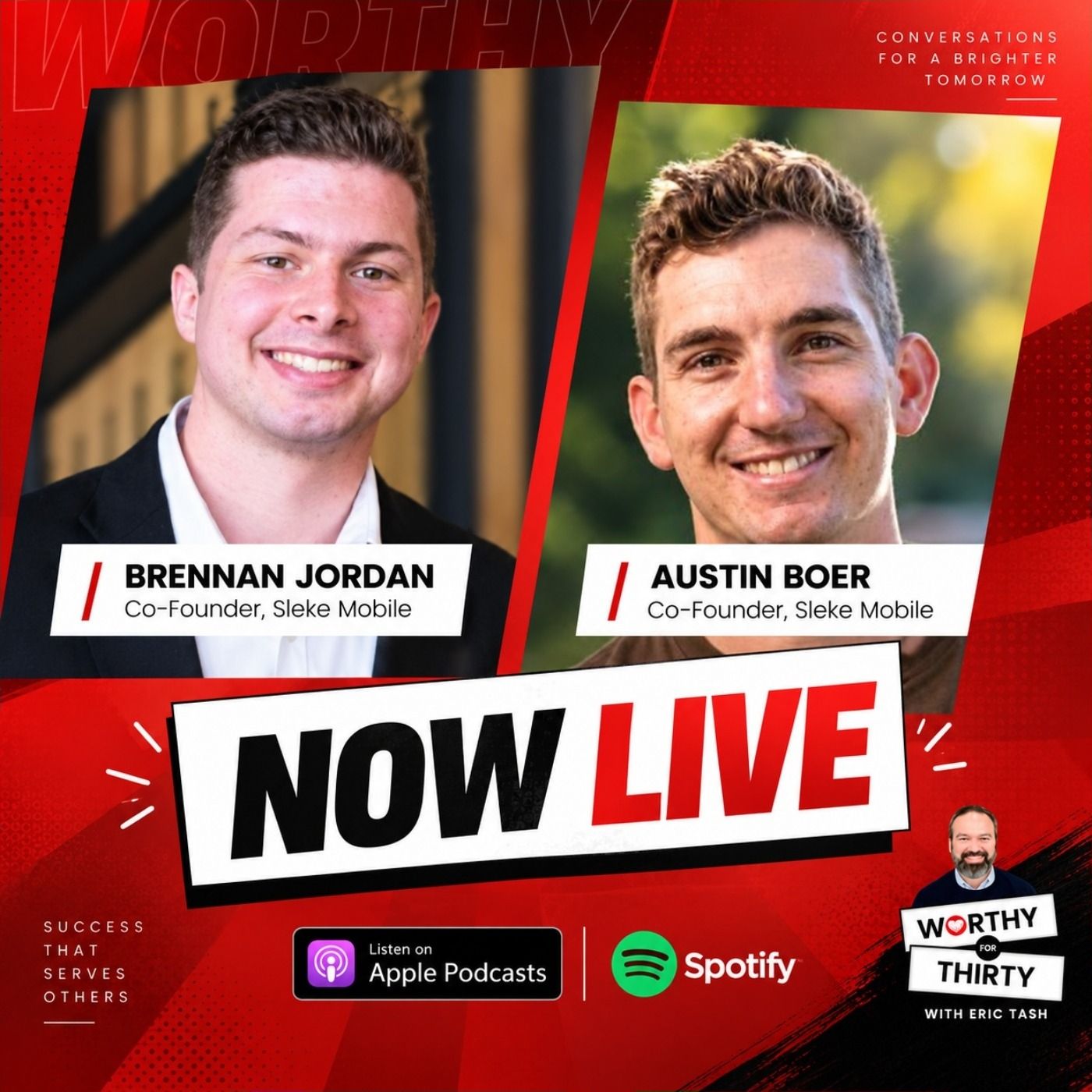
What if the measure of a great technology product wasn’t how long it kept you engaged, but how it helped you derive value from using it?On this episode of Worthy for Thirty, I sit down with Austin and Brennan, co-founders of Sleke, a technology company rethinking the smartphone around a radically different goal: to give people the means they need without the doomscrolling, addictive apps, and attention traps we’ve come to accept as part of contemporary life.The concept began with a problem they experienced first hand. While living abroad, Austin and Brennan relied on platforms like Instagram and Facebook to stay connected with friends and family, but quickly realized the frustration caused by the constant pull of their phones. They wanted the connection and convenience of a smartphone without being tethered to it.When they couldn’t find an alternative to their smartphones, they decided to build the phone they've envisioned.Sleke sits between the traditional smartphone and the increasingly popular “dumb phone.” Built around its Odyssey operating system, Sleke focuses on what Austin calls the “five M’s”: messaging, money, maps, music, and life management. The company's philosophy is straightforward: technology's primary objective is to help you accomplish a task and then get out of the way.We discuss how Austin and Brennan went from college friends to bootstrapped founders, why they started by interviewing hundreds of potential users, and what they’ve learned from roughly 1,000 users around the world. We also explore why they chose refurbished Google Pixel devices, how they decide which apps belong on Sleke and why some people need more than app blockers or screen-time limits (I use Brick) to change their relationship with technology.But the bigger conversation goes beyond phones.Brennan explains why screen time itself may be too blunt a metric. Reading, learning a language, or using a health app might increase the number of minutes spent looking at a screen while still creating something valuable. That raises a more interesting question: Is the technology consuming our attention, or helping us use our attention intentionally?We also get into privacy, product design, and Sleke’s decision to collect remarkably little user data. Rather than building around maximum engagement, the team is exploring how mobile technology can become more efficient, intentional, and privacy-conscious.And perhaps most importantly, we talk about what happens after we put the phone down.Austin and Brennan aren’t anti-technology maximalists. They believe technology can be used for real-world connection, helping people find communities, make plans, accomplish tasks, and spend more time living offline. As Austin states, the question becomes less about whether technology is inherently good or bad and more about the reason behind how we use it.In this conversation:• Why smartphones feel so difficult to put down• The difference between a smartphone, dumb phone and minimalist phone• Digital minimalism without giving up modern conveniences• The “five M’s” Sleke believes a phone actually needs• Building an operating system around intentional technology• Screen time, social media and digital wellbeing• Why not all screen time is created equal• Designing technology around privacy instead of engagement• Bootstrapping a hardware and software startup• Why Sleke chose a one-time purchase instead of another subscription• Using technology to create more real-world human connection• What the future of healthier mobile technology could look likeFor anyone who has ever picked up their phone to do one thing, and then realized, 30 minutes later wondering where the time went., this conversation asks an increasingly important question:What if better technology isn’t technology we use more, but technology that helps us live fully and present? It can be not mutually exclusive.Find this episode on your favorite podcast listening platform Hosted by Simplecast, an AdsWizz company. See pcm.adswizz.com for information about our collection and use of personal data for advertising.
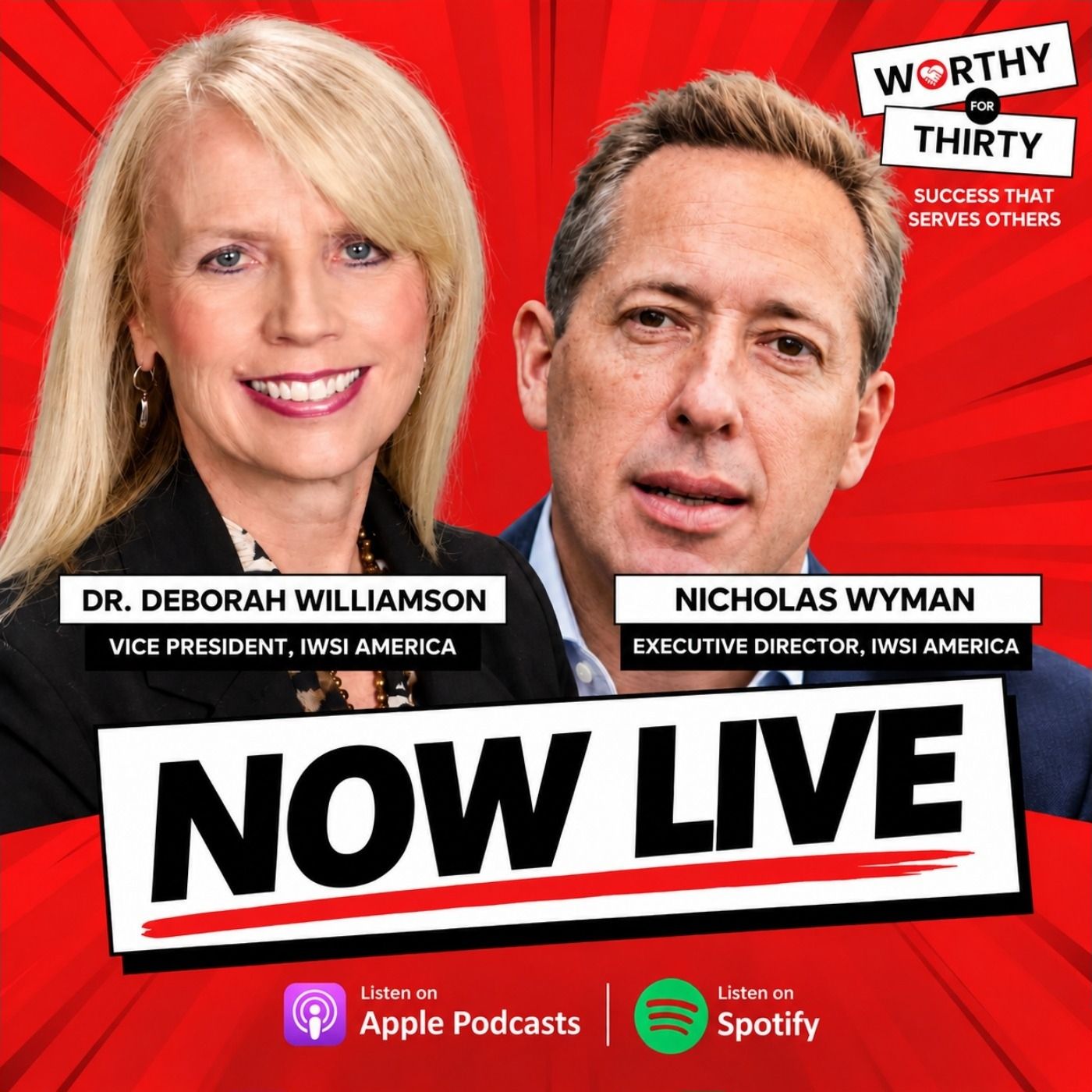
What skills are necessary to stay competitive and employable when AI, automation, layoffs, and a rapidly changing economy are rewriting the rules of work?On this episode of Worthy for Thirty, I sit down with Nicholas Wyman and Dr. Deborah Williamson, co-founders of the Institute for Workplace Skills and Innovation America (IWSI America), to discuss the future of work, and why preparing for it may have less to do with predicting what is around the corner and more to do with understanding the skills you already have.Nicholas and Deborah have spent their careers helping employers build stronger talent pipelines while connecting job seekers with apprenticeships, skills development, mentorship, and meaningful employment. Their point of view is especially resonant right now: entry-level opportunities are changing or being wiped out, experienced workers are being displaced, and AI is forcing people at nearly every stage of their careers to reconsider where they fit.But this conversation isn't about fearing AI.It's about becoming more adaptable because of it.We break down why Nicholas and Deborah prefer the term “employability skills” over “soft skills,” and how qualities like reliability, resilience, communication, curiosity and the ability to work with others can become genuine career advantages.We also talk about one of the ideas that resonated most with me: sometimes the best way to figure out where you're going is to connect the dots looking backward.What have you already done? What did those experiences teach you? Which skills have you developed without realizing they could transfer to an entirely different career?Deborah calls it “backwards design” taking inventory of your past experiences rather than simply looking at a job description and trying to force yourself into it.Nicholas also makes the case for apprenticeships as an increasingly relevant alternative, or complement, to traditional education: a way to earn, learn, and develop practical skills on and off the job. His own career began through apprenticeship before eventually taking him from professional kitchens to workforce development.We get into:• How AI is reshaping jobs without eliminating the importance of human skills• Why recent graduates need to get out from behind the screen and build real relationships• How apprenticeships can create alternative pathways into growing careers• Why transferable skills are often hiding in plain sight• What employers are actually looking for from entry-level talent• Why mentorship matters after someone gets hired—not just before• How IWSI helps bridge the gap between what employers need and what workers bring to the table• Why job retention can be a more meaningful measure of success than simply getting someone hired• How lifelong learning can help us remain adaptable at any ageAnd Nicholas leaves us with perhaps the simplest advice of the entire conversation:**“Do it now.”**Make the call. Take the course. Follow up on the application. Meet someone for coffee. Learn something new. Get yourself into circulation.Deborah's advice underscores it perfectly: understand what you've already accomplished and stop selling your experience short.The future of work may be unpredictable and perhaps a bit scary. But our ability to remain curious, adaptable, useful, and human is still very much within our control.This is Worthy for Thirty. Hosted by Simplecast, an AdsWizz company. See pcm.adswizz.com for information about our collection and use of personal data for advertising.

One pill or substance can kill. And for parents, waiting until there’s a problem may already be too late.
In this episode of Worthy for Thirty, I spoke with Leah Shepherd, Executive Director of Victoria’s Voice Foundation, for a candid conversation about fentanyl, drug and alcohol prevention, naloxone (Narcan), teen substance use, and what parents can do now to help protect their children.
A tough but worthwhile listen as the new school year gets underway.
Victoria’s Voice was born from unimaginable loss. In 2015, David and Jackie Siegel lost their daughter, Victoria, to a drug overdose. What followed was a mission to help prevent other families from experiencing the same tragedy through education, advocacy, overdose prevention, and greater access to naloxone.
Leah explains how that mission has evolved into a national effort focused on reaching parents and young people before substance use becomes a crisis.
For parents, one message comes through clearly: **have the conversation early.**
Eric and Leah discuss why parents need to move beyond simply asking, “How was your day?” and start asking more specific questions about what their children are experiencing anywhere. From being in school, with friends, on their phones, and especially across social media.
They also explore the growing danger of fentanyl-laced counterfeit pills and the reality that young people may encounter drugs through platforms they already use. Leah explains why prevention education, parental involvement, and direct conversations about drugs can be critical tools for keeping kids safe.
The conversation also goes inside Victoria’s Voice Foundation itself: how Leah transitioned from the for-profit world into nonprofit leadership, why she believes nonprofits must be operated like businesses, how the organization measures impact, and why collaboration between nonprofits can extend the reach of prevention programs.
Leah also discusses Victoria’s diary, which the Siegel family published as a cautionary resource for other parents, along with the warning signs and conversations they wish they had recognized sooner.
In this episode:
• Why David and Jackie Siegel founded Victoria’s Voice after losing their daughter Victoria
• What parents should know about fentanyl and counterfeit pills
• Why naloxone/Narcan awareness remains an important part of overdose prevention
• How parents can recognize potential warning signs of teen drug or alcohol use
• Why talking openly about substance use can help break the stigma surrounding addiction
• The role social media can play in exposing young people to drugs
• Why Leah encourages parents to ask their children direct, specific questions
• How Victoria’s Voice approaches drug prevention education in schools
• How nonprofits collaborate to reach children from elementary school through high school
• Why approximately 70% of Victoria’s Voice funding comes from individual donors
• How nonprofit organizations can measure impact beyond dollars raised
• Why Leah believes prevention works and conversation is one of its most important tools
This is a difficult conversation, but a necessary one.
Whether you’re a parent of a young child, teenager, or college student, or simply want to better understand fentanyl, opioid overdose prevention, naloxone, substance use, and addiction, this episode offers a practical perspective on why education needs to begin before a family is facing a crisis.
Worthy for Thirty features conversations with founders, executives, and nonprofit leaders working to build organizations where purpose and performance can coexist. Hosted by Simplecast, an AdsWizz company. See pcm.adswizz.com for information about our collection and use of personal data for advertising.

Chef Ed Porter is a multi-hyphenate professional: he's a chef, musician, filmmaker, entrepreneur, and host of the Taste Music Hear Food Podcast. In this conversation on Worthy for Thirty, Ed shares how food, music, culture, and creativity became the foundation of his life’s work.
Raised in the Bronx and mentored early in his culinary journey by chefs including Marcus Samuelsson and Patrick Clark, Ed reflects on discovering food as an art form, pursuing culinary education at the Culinary Institute of America, and building a career that has taken him from fine dining and restaurant consulting to private chef work, television, film, and podcasting.
Ed discusses his appearances on Guy’s Grocery Games, Tournament of Champions, and Netflix’s Pressure Cooker and how those experiences helped him finally unite the two sides of his creative identity: chef and musician. He shares the origin of de zéro, his 12-song album and 12-course tasting experience, where each dish and song work together to tell one intentional story.
The conversation also explores representation in the culinary industry, mentorship, entrepreneurship, creative leadership, and Ed’s belief that food and music are universal languages that can bring people across cultures together. He also discusses and teases The Food That Fuels, his short film and developing docuseries about the food system of California’s San Joaquin Valley, the relationship among farmers, chefs, students, and consumers, and the future of sustainable agriculture.
Plus, Ed shares what drives his curiosity, why he calls himself an “executive intern,” the importance of asking better questions, and his advice for artists, entrepreneurs, and creators who want to turn knowledge into action.
Both Ed and I have 2027 SXSW panels submitted. Please take a moment to vote! Voting ends on Sunday August 23rd. My panel: https://bit.ly/WFTSXSW2027 and Ed's: https://participate.sxsw.com/flow/sxsw/sxsw27/community-voting-sxsw/page/community-voting/session/1785019416595001UPhb Hosted by Simplecast, an AdsWizz company. See pcm.adswizz.com for information about our collection and use of personal data for advertising.

What happens when the life that looks successful from the outside is quietly falling apart on the inside?
Jason Senzon, co-founder of Wyndcrofte Coffee, joined me on the podcast to share the deeply human story behind a mission-driven coffee company created through recovery, mental health, service, and the belief that the most important conversations often start over a cup of coffee.
Nearly nine years sober, Jason reflects on the late-night moment he told his wife, “I need help,” and how treatment, community, and a commitment to honest self-examination changed his life as a husband, father, entrepreneur, and person in recovery.
He and his co-founder met in sobriety and created Wyndcrofte Coffee to turn experience into impact. The company is a for-profit coffee brand that supports nonprofit partners expanding access to mental-health and recovery treatment, while creating an invitation for more open, vulnerable conversations in workplaces, homes, and communities.
In this episode, we discuss:
Why asking for help is an act of courage, not weakness
The connection between addiction, anxiety, mental health, and isolation
How families can make emotional honesty part of everyday life
Why coffee is the perfect medium for connection and conversation
Building a mission-driven company with charity partnerships in its DNA
The entrepreneurial realities of launching a coffee company in a crowded market
What founders can learn from recovery: service, community, humility, and taking the next right action
Why doing good without expecting something in return can change the way you lead and live
Jason also shares how Wyndcrofte Coffee is growing through B2B partnerships, why quality and price still matter alongside mission, and his work raising funds through the New York City Marathon to help people access treatment. He's running to support Release Recovery Foundation -- click here to donate and support: https://donations.nyrr.org/donations/new?fundraiser=fe14e05478260f9c6a43
If you’re building something meaningful, or perhaps navigating recovery, supporting someone you love, or simply trying to have more honest conversations, this episode is a reminder that you do not have to carry everything alone.
Wyndcrofte Coffee’s mission: vulnerable conversations often start over a cup of coffee. Hosted by Simplecast, an AdsWizz company. See pcm.adswizz.com for information about our collection and use of personal data for advertising.

Comments

Download from Google Play

Download from App Store
 United States