


Notes from the Edge
Subscribed: 18,763Played: 61,725
Subscribe

© Lisa Lacy
Description
Notes From the Edge is where polished stories end and the truth begins. Hosted by writer, trauma educator, executive advisor, and author Lisa Lacy, this globally ranked podcast explores survival, identity, trauma, addiction, recovery, leadership, relationships, and reinvention through raw, deeply human conversations. No scripts. No small talk. Just the stories we were taught to hide, the roles we performed to survive, and the truths that set us free. What did you perform in order to survive? Welcome to the edge. www.lisalacy.com
115 Episodes
Reverse
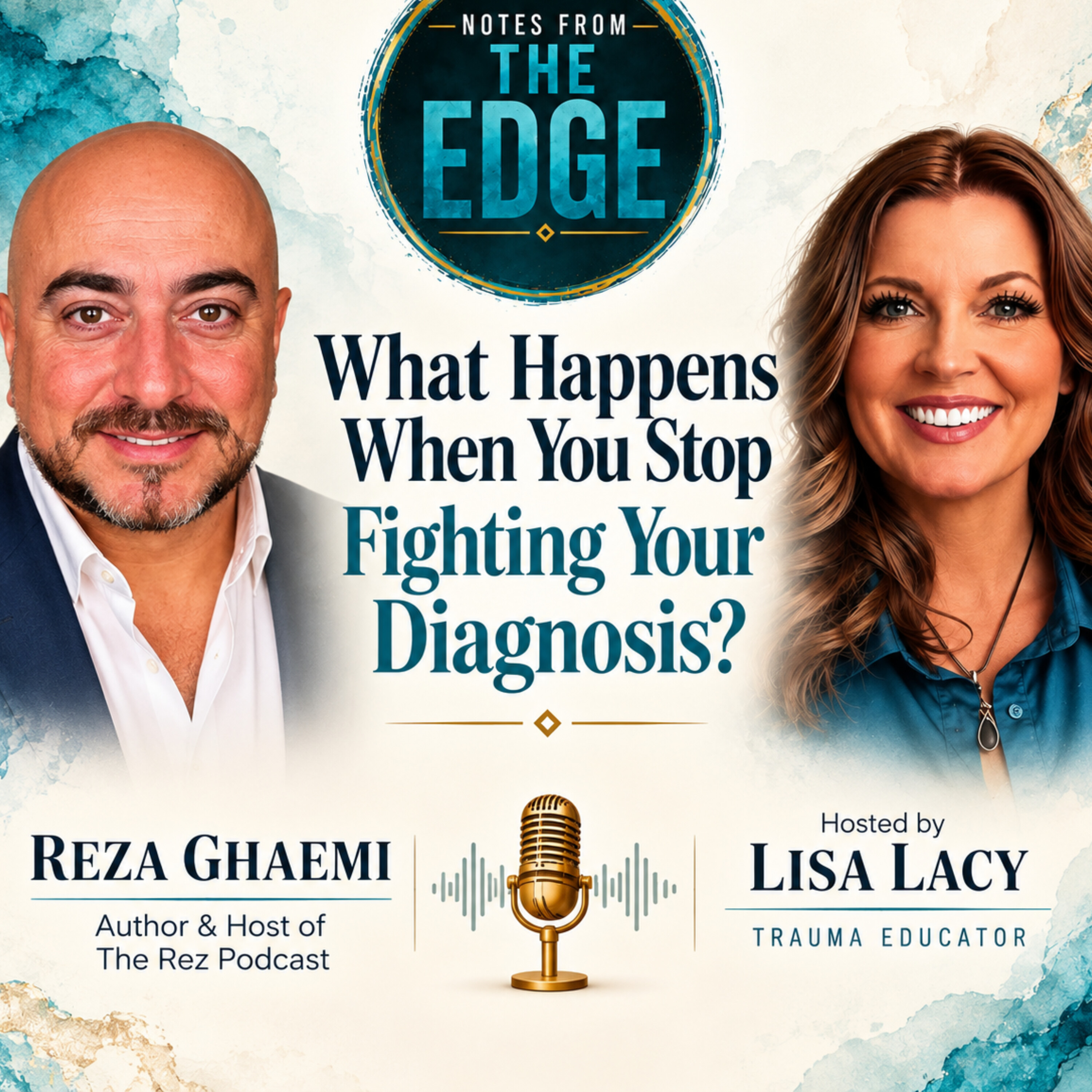
What happens when accepting a diagnosis stops feeling like surrender and becomes the beginning of recovery?In this episode of Notes From the Edge, Lisa Lacy sits down with author and podcast host Reza Ghaemi for an honest, funny, and deeply human conversation about living with Bipolar I Disorder, surviving mania and hospitalization, resisting treatment, and eventually learning to work with his diagnosis instead of fighting against it.Reza, author of Bipolar Is My Superpower: How Acceptance Changed My Life and host of The Rez Podcast, shares why acceptance became a turning point in his recovery and why calling bipolar his “superpower” is not about romanticizing mania or psychosis. It is about the self-awareness, resilience, recovery skills, and responsibility he built afterward.Lisa and Reza also dig into stigma, medication, faith, family support, disclosure, relationships, and what changes when you stop hiding your story and start owning it.In this episode:• Bipolar I Disorder, mania, psychosis, and hospitalization• Moving from denial and stigma toward acceptance• Medication, treatment, sleep, and building recovery skills• Mental health disclosure in work, dating, and relationships• Replacing shame and fear with self-awareness and ownershipConnect with Reza Ghaemi:The Rez Podcast: https://www.rezpodcast.comConnect with Lisa Lacy:https://www.lisalacy.comWhat did you perform in order to survive?Welcome to the Edge.See Privacy Policy at https://art19.com/privacy and California Privacy Notice at https://art19.com/privacy#do-not-sell-my-info.

What happens inside your body in the seconds between a trigger, a craving, and a choice?Dr. Deborah Rozman is a behavioral psychologist and President/Co-CEO of HeartMath. In this episode of Notes From the Edge, she joins Lisa Lacy to explore what happens physiologically when stress activates old patterns, why the familiar can feel safer even when it is destructive, and whether we can train the nervous system to create more space between an urge and our response.They unpack heart-brain communication, heart rate variability, coherence, and real-time biofeedback, while Lisa shares how biofeedback became part of her own recovery experience. Dr. Rozman also walks through a simple heart-focused breathing practice that can be used when stress, overwhelm, or cravings begin to rise.In this episode:Addiction recovery, cravings, triggers, and relapse preventionWhy the brain can reach for familiar patterns during stress and overwhelmHeart-brain coherence, HRV, and nervous system regulationUsing real-time biofeedback to recognize and shift physiological stress patternsHeart-focused breathing and creating space between an urge and a reactionConnect with Dr. Deborah Rozman:HeartMath.comConnect with Lisa Lacy:www.LisaLacy.comWhat did you perform in order to survive?Welcome to the Edge.See Privacy Policy at https://art19.com/privacy and California Privacy Notice at https://art19.com/privacy#do-not-sell-my-info.

What happens when telling the truth about your mental health could cost you your credibility, your career, or the way people see you forever?In this solo episode of Notes From the Edge, Lisa Lacy talks openly about living with Bipolar I, psychosis, borderline personality disorder, addiction, hospitalization, and recovery while simultaneously building businesses, leading teams, earning six figures, and appearing highly functional to the outside world.This is a conversation about what happens when a psychiatric diagnosis becomes a verdict instead of information. Lisa explores the pressure to hide serious mental illness in professional spaces, the difference between mental health awareness and actual psychological safety, and why people should not have to prove recovery by pretending they were never sick.In this episode:• Bipolar I, psychosis and borderline personality disorder stigma• Mental illness, employment and the fear of professional disclosure• High-functioning mental illness, leadership and hidden struggles• Psychiatric hospitalization, addiction, recovery and rebuilding a life• Why workplaces need real systemic change beyond mental health awarenessConnect with Lisa:https://lisalacy.comWhat did you perform in order to survive?Welcome to the Edge.See Privacy Policy at https://art19.com/privacy and California Privacy Notice at https://art19.com/privacy#do-not-sell-my-info.

Licensed marriage and family therapist and educator Renée Calhoun joins Lisa Lacy to unpack a deceptively simple question: when does “being strong” stop being resilience and start becoming survival mode?In this conversation, Renée and Lisa explore why highly capable people can look successful on the outside while their nervous systems remain stuck on high alert. They talk about guilt-free rest, people pleasing, overfunctioning, emotional safety, family systems, toxic relationship patterns, and the ways trauma adaptations can become so familiar that we mistake them for personality. Renée also explains why intelligence alone can’t logic us out of relationships or behaviors our nervous systems still associate with connection and safety.In this episode:Trauma and nervous system survival responsesThe difference between resilience and survival modeWhy high-functioning people can still be sufferingPeople pleasing, overfunctioning and emotional laborWhy rest can feel unsafe or uncomfortableWhen trauma adaptations get mistaken for personality traitsInternal Family Systems and parts workEmotional safety versus emotional discomfortToxic relationships and repeated relationship patternsHow family systems shape our earliest ideas about love and belongingBoundaries, self-worth and learning to say noMoving from autopilot into curiosity and conscious choiceWhy healing isn’t becoming someone new, but discovering who you are when you no longer have to surviveConnect with Renée Calhoun:https://reneecalhounlmft.comConnect with Lisa Lacy:https://lisalacy.comWhat did you perform in order to survive? Welcome to the Edge.See Privacy Policy at https://art19.com/privacy and California Privacy Notice at https://art19.com/privacy#do-not-sell-my-info.

What happens when being capable becomes the very thing that keeps people from seeing you’re struggling?In this episode of Notes From the Edge, Lisa Lacy sits down with Nigerian-American physician, novelist, and storyteller Dr. Nneka Oluoha for a conversation about high-functioning depression, cultural expectations, motherhood, immigrant identity, and the roles we perform to survive.Dr. Nneka explores why the person who appears strongest may be carrying the most, why “I’m fine” can become a practiced performance, and how competence, strength, and responsibility can eventually become a prison when we never allow ourselves to put them down.She also shares her experience moving from Nigeria to the United States, navigating multiple identities as a physician, mother, wife, immigrant, and writer, and finally reclaiming the part of herself that had always wanted to write.Her novel, Live For Me Nkem, uses fiction to take readers inside depression not only through the person experiencing it, but through the family living beside her.In this episode:• High-functioning depression and performing “fine”• Competence and strength as survival roles• Immigrant identity and navigating two cultures• Motherhood, responsibility, and mom guilt• Why successful people struggle to ask for help• Depression’s impact on the entire family• Listening instead of trying to fix someone• Reclaiming parts of yourself buried beneath responsibility• The power of storytelling to create empathy around mental healthSometimes support is not having the perfect advice. Sometimes it is simply being willing to sit beside someone in the dark.Connect with Dr. Nneka Oluoha:LinkedIn-Nneka OluohaConnect with Lisa Lacy:https://www.lisalacy.comWhat did you perform in order to survive?Welcome to the Edge.See Privacy Policy at https://art19.com/privacy and California Privacy Notice at https://art19.com/privacy#do-not-sell-my-info.

Comments

Download from Google Play

Download from App Store
 United States