


 Claim Ownership
AI Neanderthal by Malcolm Werchota
Subscribed: 1Played: 133
Subscribe

© 2026 werchota.ai FlexCap G
Description
AI news for humans, not robots.
Every weekday, Malcolm Werchota comes out of the cave and explains what actually happened in AI — in plain language, with the numbers checked and the hype taken out. Around ten stories a day: three explained slowly, the rest fast.
No jargon. No breathless futurism. Just what happened, what it costs, and who gets handed the bill — explained the way you would explain it to a smart friend who does not work in tech.
If you run a company, sit on a board, or simply want to understand the technology reshaping your industry, this is your daily 25 minutes. Keep the stories that touch your world.
Stay curious, stay human.
57 Episodes
Reverse
Intel falls almost 30% in a day as investors sell AI stocks, UBS counts more than 12,700 personal AI agents, and a Google satellite answers with a haiku. Is the AI bubble popping? Malcolm thinks it is a recalibration.
Recorded around midnight in Beijing, a day after Shanghai, with a visit to the Unitree offices planned for Thursday.
In this episode:
📉 Intel and the AI stock sell-off (01:26) — Malcolm says CNBC reported an AI stock sell-off last Friday that began with Alphabet's worst day ever; the Nasdaq fell sharply, Micron and Nvidia dropped, and Intel fell most, by about 25 to 30 percent, its worst day in 40 years. Intel's quarter looked good, with 16.5 billion dollars of revenue, up 21 percent, but the outlook of 15 to 16 billion disappointed analysts, and a deadly explosion at an Intel factory in Israel is expected to cost about 300 million dollars of revenue. Money moved into Coca-Cola, Walmart and pharma stocks, and he cites a chart from an Andreessen Horowitz newsletter showing the AI gains of January to June largely gone. His view: a recalibration after a high, not the start of an AI bear market, because chipmakers cannot meet demand for the next two to three years, although AI profits are not automatically good news for investors.
🏦 UBS: more than 12,700 personal AI agents (07:30) — Malcolm says UBS, the Swiss bank that took over Credit Suisse in 2023, reports that its staff built more than 12,700 personal AI agents, and he stresses that there are many ways to define an agent. For him the number shows this is no longer a pilot. He adds that UBS claims 18,000 software developers use AI coding tools, which he finds notable because many European companies are scared of them, and he says UBS's slow job cuts come mainly from the merger, not from AI. He admits UBS is only where AI Neanderthals were two years ago, but gives it kudos for starting.
🔑 Cisco: unlimited tokens for a young engineer (11:27) — Cisco, the American network equipment maker, gave a 27-year-old engineer unlimited AI usage, which Malcolm explains as no budget limit on tokens. In his telling, Cisco's president Jeetu Patel found the engineer, Paddy, about five levels below him; the goal is to rewrite 98 percent of Cisco's old code within 24 months, and Paddy said two people could do it and that he could prove it in four weeks. Malcolm notes that not everyone is cheering, since some software engineers on X say regenerating code with AI is not refactoring or modernizing it. For him it shows a new time for talent: a young person asking for a lot of tokens can beat teams of 10 to 30 with big plans, and a 50- or 60-year-old who reimagines processes can get the same visibility.
🤖 AgiBot wants to count robot work (15:04) — Since he is in Beijing, Malcolm turns to China and says he visits the offices of Unitree on Thursday. He says AgiBot, which makes more humanoids than Unitree, claims to have built 20,000 robots and is proposing a new measure called Worken, work plus token, as reported by Robotics & Automation News: count not just the robots but the hours they work on their own and what they produce, compared with human output. Malcolm sees much more ecosystem thinking in China, with robots connected to a language model, a knowledge base and tools, while what sells, in his words, is a dancing robot doing kung fu.
🏛️ Austria and the UN: a data center for Vienna? (18:12) — Malcolm, who is Austrian, says State Secretary Alexander Pröll wants a data center that costs a couple of billion dollars and that the UN should pay for (the corrections below say what was actually proposed). He explains why Vienna hosts so many international organizations, from UN offices and the IAEA to OPEC, and imagines something like an IAEA for AI. In his view the plan is an absolute joke, because Austria either builds a data center for its own companies or does not, and a UN decision would take years. He ends with Chancellor Christian Stocker, who in his translation says Austria is not afraid of AI and wants to give it a frame.
🛰️ Google's satellite writes a haiku (21:14) — Malcolm says Google's Project Suncatcher satellite carries a TPU, Google's own AI chip, and runs Gemma 4, so engineers on Earth could prompt it, and it answered with a haiku: "Blue marble below, data streams in silent grace, starlight feeds my core." Sundar Pichai called it a "hello world" milestone. Malcolm expects data centers in orbit one day, links the idea to his offshore years on drill ships with patchy internet, and loves the thought of running a proprietary model in space. He also passes on Carnegie Mellon professor Brandon Lucia's view that it is very sci-fi, with open questions on heat and radiation, and says Google wants to link satellites in 2027.
Malcolm's advice: go and count your AI agents, and be like UBS and roll out thousands of them.
Corrections to the recording:
• Intel: Q3 revenue of $16.5 billion (up 21%) and the Q4 outlook of $15 to 16 billion are as stated; analysts had expected about $17 billion. The CEO is Lip-Bu Tan, whose stated priority is adding supply for Xeon server chips. The roughly $300 million is lost Q4 revenue from the 14 October explosion at the Kiryat Gat fab, not property damage; Intel's CFO expects a similar hit in Q1 2027, about $600 million over two quarters. A weak PC market was the second reason for the soft outlook (Intel, Reuters, Times of Israel).
• Intel's share price: it closed about 29% lower on Friday 30 October, so the corrected "25 to 30 percent" fits. It was Intel's worst day since 5 July 1974, so "worst in 40 years" understates it (Yahoo Finance, CNBC).
• Alphabet and Nasdaq: Alphabet's record fall of more than 12%, about $500 billion in market value, was on Thursday 29 October after its quarterly results; Friday brought the broad sell-off. The Nasdaq Composite closed about 2.8 to 2.9% lower that Friday; the 3.4% figure is the Nasdaq 100 during the day, not "3.5%" at the close. Micron (about 5.5%) and Nvidia (about 4%) fell as stated (CNBC, NBC News).
• The Andreessen Horowitz newsletter is presumably "Charts of the Week" of 30 October. It says Goldman Sachs's "AI Winners" basket has given back all its gains relative to its "AI At-Risk" basket after winning from January to June. That is relative performance, not a 20 to 30% absolute gain wiped out, and the text gives no such percentage. CNBC puts a broad AI ETF about 15% below its summer record (a16z, CNBC).
• The intro speaks of a panic around Anthropic's planned IPO. That is Malcolm's description, not a sourced fact: Reuters reported on 15 October that some investors were weighing a lower valuation, and the latest reports found still pointed to a mid-November listing with no postponement (Reuters, IFR).
• Malcolm's remarks about the market, investors and a recalibration are his personal view, not investment advice.
• UBS: "More than 12,700 personal AI agents" is UBS's own figure from its Q3 2026 results of 28 October. The 608 is something else: 608 AI use cases in live production, up 81% on a year earlier. So the comparison with "81 percent less a year ago" does not hold, and "12,000" is a rounding of 12,700 (UBS).
• UBS does not name "Unique" in its results or technology pages, which mention an in-house assistant called Red and a platform called AI Foundations. Unique is a separate Swiss company, and a link to UBS could not be confirmed (UBS, Unique).
• UBS says over 18,000 of its software developers use AI tools; it names GitHub Copilot as a cornerstone tool, not Claude Code or Codex. UBS's internal headcount fell from 104,427 to 97,593 full-time equivalents in a year; UBS itself does not ...

Samsung SDI's revenue is up more than 50%, partly thanks to backup batteries for AI data centers, and when AI agents start shopping for you, a merchant needs to know: is this Malcolm paying, or his agent?
Fresh from Shanghai, on Malcolm's first trip to China, with Beijing, Shenzhen and more cities to come, a new city every two or three days.
In this episode:
🔋 Samsung: batteries for AI data centers (00:58) — Samsung SDI reports 52.6% more revenue, and Malcolm says the growth came from batteries for AI data centers rather than for cars. Data centers need backup batteries to bridge power gaps of a few milliseconds, like emergency power in a hospital. About 60 gigawatt-hours of energy storage equals a million car batteries side by side (he is not saying Samsung builds the cars). Then Shanghai: a quiet major road, green license plates, one million charging points, and delivery scooters that swap batteries in seconds. In Malcolm's view, that kind of infrastructure is missing in Europe.
🚗 Huawei: AI computing and a luxury car (06:20) — Huawei is known in the West for phones and mobile networks, but on 28 October it starts a new AI computing service in Wuhan with 1,000 specialized accelerator cards, a kind of pendant to Nvidia. The hard part is making the cards exchange data fast enough, so Huawei builds the connections too. Then the car: Malcolm sits in a Maextro S800, built by JAC with Huawei, feels half Maybach and half Rolls-Royce, and calls it half an AI car. Against that, his VW ID. Buzz: in his words, VW is really bad at building and integrating software.
💳 Tencent and Visa: you or your AI agent? (11:40) — Tencent, the company behind WeChat, and Visa. Malcolm paid a restaurant, a hotel booking and an ice cream with WeChat in the last 24 hours, plus a Photoshopped photo on the Shanghai skyline for about a euro. Visa wants in because agentic payments are next: a merchant needs to know whether Malcolm or his AI agent made the payment, especially in B2B, where accounts payable teams still lose half an hour in supplier portals. He describes Visa's Trusted Agent Protocol as the way to say "this is Malcolm's agent and it may spend up to a set amount", a huge and still untapped market.
🤖 Singapore: a robot challenge with Micron (15:36) — Singapore launched a manufacturing challenge for AI robots on 21 October, partnered with Micron: a robot arm has to service a production chamber, replace a component and close the chamber properly. That can mean a thousand steps for a robot, Malcolm says, like fitting a part while wearing thick ski gloves and opaque glasses. Singapore cares because industry earns one fifth of every dollar there. He closes with his friend in Shanghai, who runs a printed-circuit-board maker heavily invested in robotics, and a thought experiment: bring a Unitree robot into a German factory and the next question is where the data goes.
Corrections to the recording:
• Samsung SDI: The 52.6% is Q3 2026 revenue versus the year-earlier quarter. Samsung names energy storage and backup batteries for AI data centers as a driver, but also cylindrical cells for power tools and EVs. "Not cars, but AI data centers" was too sweeping (Samsung SDI).
• "About 60 gigawatt-hours" are energy-storage orders secured this year overall, not deliveries and not only for AI data centers (Samsung SDI).
• EV share in Shanghai: not 71 or 75%, and not "three out of four". In March 2026, 56.99% of passenger cars sold in Shanghai were fully electric (22,915 of 40,203), so more than every second car (Shanghai city government).
• The comparison is not like for like: Germany 19.1% (Destatis) and Austria 21.3% (Statistik Austria) are full-year 2025 figures for battery-electric new registrations, while Shanghai's is a single month of sales. At the end of 2024, Shanghai had about 980,000 charging points, not quite a million.
• Huawei ADS 4 is a driver-assistance system, not a self-driving car. JAC describes assisted driving and says the S800 has 36 sensors (JAC).
• Porsche and Nvidia is a thought experiment. The actual partners behind the Maextro S800 are JAC and Huawei (JAC).
• The Tesla/Grok and VW comparisons are Malcolm's own experience. What a car's voice assistant can do depends on model, software version and settings; Tesla's Grok launched in Europe in February 2026 with navigation commands in beta (heise).
• Tencent: 1.4 billion is the combined monthly active accounts of Weixin and WeChat (1.439 billion on 30 June 2026), not 1.4 billion distinct people and not a count of people who pay with WeChat (Tencent).
• The Tencent-Visa announcement of 29 October is a memorandum of understanding to explore cross-border payments, remittances and AI-agent shopping, not a launched product. It does not cover B2B invoice payments (Tencent).
• The supplier-portal invoice story belongs to a separate pilot: Visa, BILL and Billtrust announced it on 20 October, with an agent paying already-approved invoices. Tencent is not part of it (Visa).
• Visa's Trusted Agent Protocol lets merchants recognize and verify an AI agent through signed requests. It does not itself set or enforce spending limits such as "$500 a month"; limits and payment authorization are handled separately (Visa).
• Singapore: The challenge is run by the National Robotics Programme, A*STAR and the PINE Lab at NTU, with Micron as title sponsor and first use case; manufacturing is "close to 20 per cent" of Singapore's GDP. The official task has six subtasks, "a thousand steps" was a figure of speech (Minister Gan Siow Huang's speech, National Robotics Programme).
• The Unitree remark is a hypothetical objection, not a finding for every deployment. Security researchers reported in 2025 that Unitree G1 humanoids send telemetry to servers in China; whether and where data flows depends on model, firmware and configuration (Alias Robotics, Help Net Security).
Sources: Samsung SDI (Q3 2026 results), Shanghai city government, Destatis, Statistik Austria, Hubei Provincial Department of Economy and Information Technology, Huawei Cloud, JAC, heise, Tencent (Visa announcement and Q2 2026 results), Visa (BILL/Billtrust pilot, Trusted Agent Protocol), Singapore MTI/METI (speech by Gan Siow Huang), National Robotics Programme, Alias Robotics, Help Net Security.
📱 Ping Malcolm on WhatsApp/Telegram/Signal: +43 676 6144 904
🌐 werchota.ai
AI Neanderthal — AI news for humans, not robots. Stay curious.
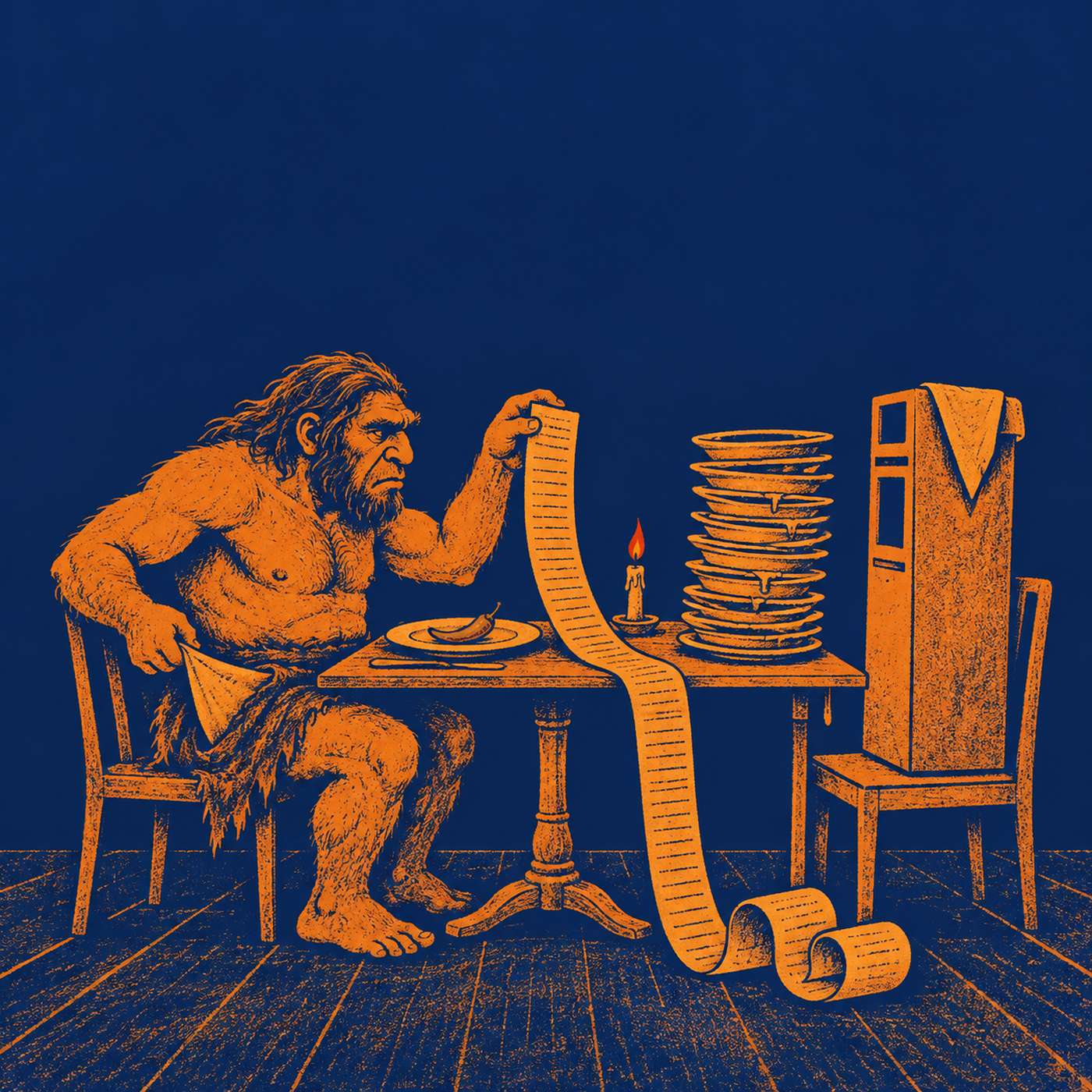
China's most famous chili-sauce maker put AI cameras on its line: more than 600 pepper sorters before, 48 kept for the final checks. So who actually pays the bill for AI?
Recorded at Zurich airport, just before the flight to China. The show keeps going, and the next ten days get a bit more China-heavy.
In this episode:
💸 Google borrows to build AI (02:11) — Alphabet: $127.6 billion in sales in three months and Google Cloud up 103%, but $51.4 billion of capex (a year ago: $24 billion) and free cash flow of minus $9.1 billion. Paid for with about $12.4 billion of new shares, bonds, and zero buybacks, while the Fed keeps rates high. Like a 200-year-old family firm that always paid cash and suddenly takes loans.
💾 AI is eating the world's memory chips (06:20) — SK hynix: more than 100 trillion won in one quarter (roughly $78 billion) and an 80% operating margin, up from 47% a year ago. The memory crunch runs until 2030, and new phone models are already about 25% more expensive this year. Jun Song on X: "Hardware is as cheap today as it is going to get." Teng Yan pushes back: not all of "sold out through 2029" is signed.
🌶️ China: 600 chili sorters, now 48 (10:42) — Lao Gan Ma, "Old Godmother", China's best-known chili crisp: a camera checks each pepper in 0.3 seconds and an air jet blows the bad ones into a bin. The story was the number two trend on Weibo on 13 October; the company denies layoffs. Malcolm's point: on a mass-production line you don't save 5 or 10%, you save 90% of the people.
🧵 The thread (00:07) — Google pays with borrowed money, you pay with pricier phones and laptops, and people on the line pay with their jobs.
Malcolm's advice: if your company needs laptops or phones next year, buy them now. Memory won't get cheaper before 2030.
Corrections to the recording:
• The chili company's chief quality officer is Li Xin. Per Yicai Global, they once had more than 600 sorters, and 48 were kept for a final round of checks.
• "25% more expensive" is Counterpoint's figure for new phone models this year (via Rest of World), not a forecast for laptops next year.
Sources: Alphabet Q3 2026 results, TechCrunch, The Register, Rest of World (Counterpoint), Yicai Global, Jiemian News (36Kr), X (Jun Song, Teng Yan).
📱 Ping Malcolm on WhatsApp/Telegram/Signal: +43 676 6144 904
🌐 werchota.ai
AI Neanderthal — AI news for humans, not robots. Stay curious.

Imagine you finally got the job at Microsoft. Three months later, on a Monday morning, the email arrives: you can leave voluntarily, for money. And the company sending it isn't struggling. It made $331.8 billion in revenue last fiscal year and $133.7 billion in net income.
Today a deep dive on one single story: what happens when one of the most profitable companies in the world offers roughly 60,000 employees a way out, and what it tells the rest of us.
In this episode:
📧 The email on Monday (01:25) — A young developer in Hyderabad, three months at Microsoft, six months of savings: if I stay, am I next in the next round? If I go, I'm entering a market where tens of thousands of people with Microsoft on their CV may be looking at the same time. Important: about 60,000 people are eligible for a voluntary programme. Nobody knows yet how many will actually leave.
💰 The company makes billions (03:23) — Revenue up 18 percent, net income up 31 percent, and still an offer to roughly a quarter of the workforce. A mother in Canada, almost ten years at the company, coming back from parental leave: ten months' salary sounds generous, until you have a mortgage, childcare and a saturated job market.
🚗 BMW and the rush for the exit (08:39) — The continental European version: BMW opened a voluntary severance programme on 8 October, the internal portal buckled under the demand, and on 20 October it closed early because the target had been reached.
📉 More revenue, fewer people (11:18) — Microsoft's headcount fell two percent year on year while revenue grew eighteen percent. Managers being cut at double the rate, and why this is not only a US and German story. Only the few companies that really roll AI out everywhere get these results, and that doesn't mean handing people ChatGPT or Copilot.
🪜 The first rung of the ladder (14:50) — Amazon cut about 14,000 office jobs in October 2025 and another 16,000 in January 2026, while sales and profits went up. And if companies need fewer entry-level people, how are young people supposed to climb a ladder that's missing its first rungs?
🧑💻 Jensen Huang, Andre and what I really want to say (19:15) — At GTC in Berlin a young woman asked NVIDIA's CEO what he would do if he were starting his career today. His answer: become one of the best users of AI. Plus a weekend with our family friend Andre, my eight-year-old asking "why don't you just ask a couple of AI agents?", and why your agents should keep working after your employees go home at five.
🧵 The thread — It's no longer enough to be good at your job. Good work itself is changing. Learn the tools, and to the bosses: measure before you cut, and make sure this technological revolution doesn't become merely a revolution on corporate balance sheets.
Corrections to the recording:
• Microsoft has not offered "a third of all its employees" a way out: about 60,000 employees in selected teams in the US, Canada, India and the UK are eligible for a voluntary, time-limited programme, roughly a quarter of the workforce. How many will accept is not known, and Microsoft has not said it is cutting "10% or 15%".
• Microsoft says explicitly that AI is not the driver of this programme. That AI is the main reason has not been shown.
Sources: Microsoft (Amy Coleman, Amy Hood, annual report), Reddit posts by affected employees, BMW (8 and 20 Oct 2026), Amazon, NVIDIA GTC Berlin (Jensen Huang).
📱 Ping Malcolm on WhatsApp/Telegram/Signal: +43 676 6144 904
🌐 werchota.ai
AI Neanderthal — AI news for humans, not robots. Stay curious.

Imagine you're abroad, you try to pay your taxes online, and you can't get in. Your friend at home can. The whole country has put up a border around its websites. That was Latvia in October 2026. And a few thousand kilometres away, Japan's prime minister told every business: patch your website tonight, or switch it off.
Today one question: when the patch itself can be poisoned, who do you still trust?
In this episode:
🗾 When a country goes into lockdown: Tokyo and Riga (02:55) — Japan's "Black October": more than 20 major Japanese companies disclosed attacks, according to the Financial Times. Rail company JR East lost about 1.67 million customer email addresses, car-sharing service Times Car leaked data from about 6.6 million member accounts including driving-licence images, a ransomware attack on a SoftBank cloud unit hit 495 companies and local governments, and on the 24th the internet company GMO disclosed unauthorised trades in customers' foreign-exchange accounts. Prime Minister Sanae Takaichi told businesses to patch or go offline. Latvia's CERT.LV took another route: it restricted access to state websites from abroad while keeping them open at home.
☠️ The poisoned official update: LiteLLM (11:20) — LiteLLM is the switchboard that connects a company's apps to OpenAI, Anthropic, Google and others, so it holds the keys to all of them. An official release, version 1.107.0, shipped with a credential stealer inside, slipped in through a look-alike repository in the packaging process. It was live for about two hours and was downloaded tens of thousands of times. Most CEOs don't even know whether their company uses it.
🌊 Altman and Clinton: the vulnerability tsunami (20:05) — Sam Altman, speaking at Stanford's Graduate School of Business, said in essence that he no longer thinks we will be able to patch all the bugs (paraphrased on air). Two days later Anthropic's Jason Clinton wrote that things will get a lot worse for the next 18 months. Two rivals, one message: AI finds the flaws in human-written code faster than companies can fix them.
🧵 The thread (25:55) — Black October isn't one bad week. Discovery runs at machine speed, repair runs at meeting speed. Ask your IT this week: do we know which AI tools and packages we run, and who checks an "official" update before it goes in?
Corrections to the recording:
• 24 hours after the PHP fix, about 99.28% of roughly two million visible PHP servers still showed an unpatched version, according to OX Security, not "90%".
• The poisoned LiteLLM release was downloaded tens of thousands of times in its roughly two-hour window, not "hundreds of thousands".
• Jason Clinton is Anthropic's deputy Chief Information Security Officer (deputy CISO).
Sources: Financial Times, JR East, Times Car, SoftBank, GMO, Sanae Takaichi on X (21 Oct 2026), CERT.LV, LiteLLM incident post, Wiz, BleepingComputer, GitGuardian, Stanford GSB, Jason D. Clinton on X (22 Oct 2026), OX Security. Disclosure: Malcolm is an Anthropic Claude Ambassador.
The full hour on the vulnerability tsunami: The AI Cookbook Show #136 (out now) and #137 (Thursday).
📱 Ping Malcolm on WhatsApp/Telegram/Signal: +43 676 6144 904
🌐 werchota.ai
AI Neanderthal — AI news for humans, not robots. Stay curious.

Comments

Download from Google Play

Download from App Store
 United States