


 Claim Ownership
Inside AsembleAI: DeepTech, AI & Science
Subscribed: 74Played: 111
Subscribe

© Mac & Sam 2025
Description
AsembleAI brings you thought-provoking conversations at the nexus of artificial intelligence, innovation, and leadership. In each episode, hosts Mac and Sam, veterans in data and tech world, sit down with AI researchers, fast‑scaling founders, Fortune 500 executives, and pioneering technologists to reveal how AI is reshaping business strategy, sparking breakthrough product development, and guiding executive decisions. Tune in for actionable insights, compelling case studies, and forward‑looking perspectives on the promises and pitfalls of AI‑driven innovation.RSSVERIFY
76 Episodes
Reverse
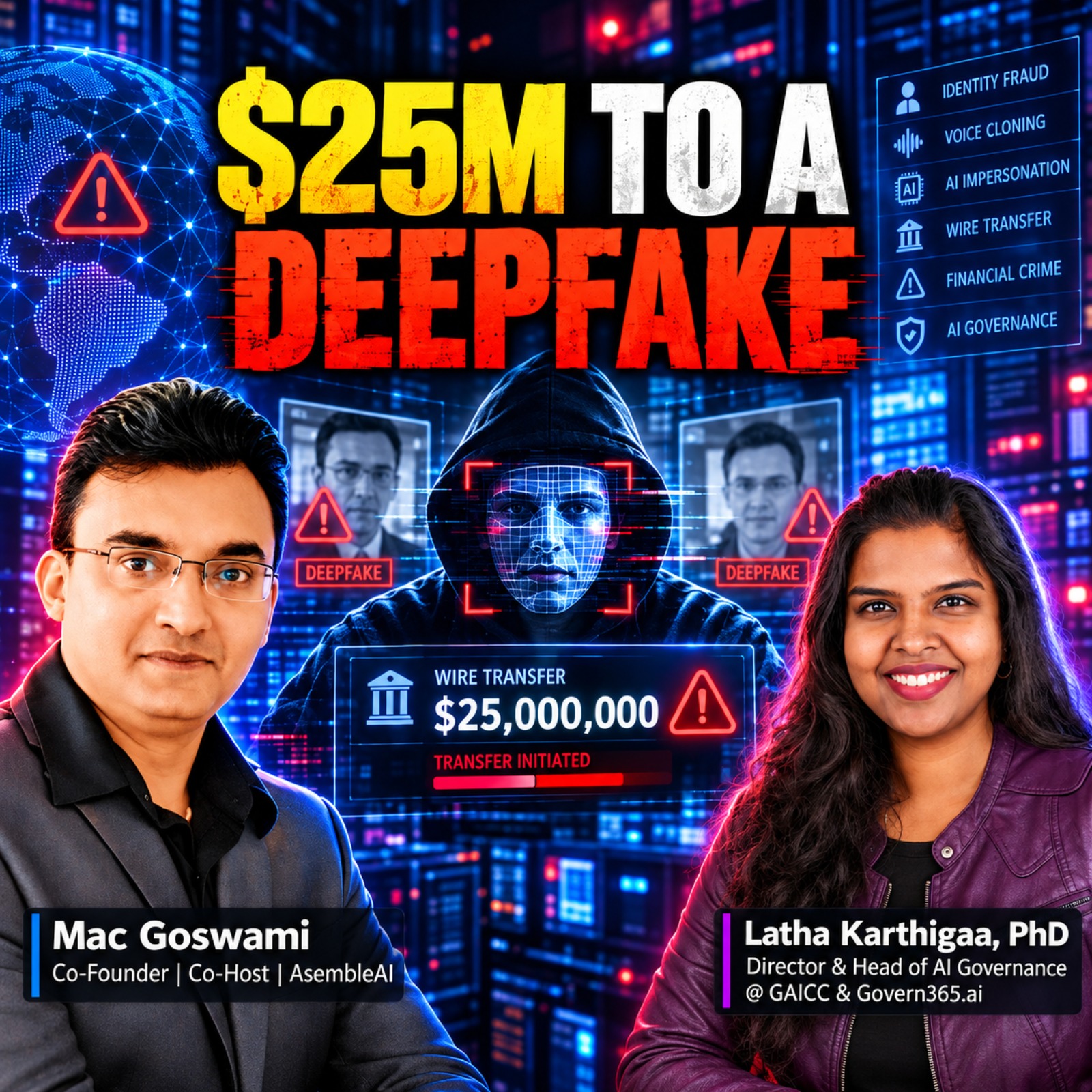
In this episode of Inside AsembleAI, host Mac Goswami sits down with Dr. Latha Karthigaa — Director & Head of AI Governance at the Global AI Certification Council (GAICC) — on why most companies that think their AI is governed are dangerously wrong, and what responsible AI actually looks like.What's Covered:"A Policy Is Not Governance" — The biggest myth in enterprise AI. Latha's highway analogy: governance is the guardrail that lets you drive faster, not the thing slowing you down.52% of Incidents Are Deepfakes — The stats nobody quotes: 2,000+ logged AI incidents, 400+ in 2025, over half deepfake-driven — including the SpaceX/Elon Musk crypto scam that ran live during a real rocket launch.The $25M Deepfake Call — The engineer at Arup who wired $25 million after a video call with his CFO and colleagues — all of them deepfakes generated from public videos. Why employee training, not just policy, is the real defense.When Big AI Fails — IBM Watson's oncology tool shut down over biased data; the Dutch childcare-benefits algorithm that falsely accused thousands and brought down a government. Why Latha says the best governance pros are empathetic humans first.Who Owns the Risk? — "ChatGPT isn't responsible — you are." Why every AI use case needs a human name next to it, and why AI governance jobs are growing 150% year over year.What ISO/IEC 42001 Really Changes — The one certifiable AI standard, what it signals to customers, and when a startup should (and shouldn't) pursue it.Key Quote: "Policy is like potential power. Execution is the real power."Connect with Latha: LinkedIn: https://www.linkedin.com/in/lathakarthigaa/ GAICC: https://www.gaicc.org/ · YouTube: Latha – AI GovernanceFollow and subscribe to AsembleAI: Spotify | Apple Podcasts | Amazon Music | iHeart Radio | YouTube | Substack

This episode was recorded live from the Ai4 conference podcast pavilion, where host Mac Goswami sat down with Barr Moses — CEO & co-founder of Monte Carlo, creator of the data observability category and now builder of the agent trust platform — about what it actually takes to make AI trustworthy in production.What's Covered:"AI Is Wrong in Your Face" — Barr's framing of the trust gap: dashboards were always wrong quietly in the background; AI is wrong out loud, and it'll argue with you. Why trust is the biggest thing standing between pilots and production.The Four Layers of Agent Failure — Context, performance, behavior, and output. Why all four can look perfect and the agent still fails — and why you have to watch all of them together.The Flight That Already Left — The airline agent that recommended a flight that departed that morning. The agent was fine; the context was stale. The most surprising failure mode nobody plans for.Where to Start — Make ONE agent great, not a hundred. And why the hardest first step is simply defining what "good" even looks like.The Reinforcement Loop — The idea Barr's most excited about: agents that self-identify what went wrong, propose a fix, submit a PR for human approval, and use it as tomorrow's baseline. Agents that rebuild themselves every day — running in production today.100% AI-First — Why every line of Monte Carlo's code is AI-generated, how it made them 3–5x faster, and Barr's stoplight analogy for where human-in-the-loop is heading.Key Quote: "Dashboards are wrong in the background. AI is wrong in your face — it'll argue with you."Connect with Barr: LinkedIn: Barr Moses : https://www.linkedin.com/in/barrmoses/Monte Carlo: https://www.montecarlo.aiFollow and subscribe to AsembleAI: Spotify | Apple Podcasts | Amazon Music | iHeart Radio | YouTube | Substack

ActualyzeAI came out of stealth just days before this conversation. Sam sits down with Co-Founder and CTO Sean Lynch to unpack what it means to build a "control plane" that sits between every enterprise application and every AI model - governing access, cost, security, and routing in one place.Topics covered:What a control plane for enterprise AI actually does, and why it requires zero code changes to adoptAggregating inference across OpenAI, Anthropic, Google Bedrock, and self-hosted/on-premises models into a single endpoint"Virtual models" — purpose-built model configurations that route requests based on task type (coding, reasoning, agentic work)Guardrails: automatic detection and redaction of PII, PHI, API keys, and other sensitive data in the inference streamFinancial operations as the leading driver of adoption — budgetary controls, spend limits, and team-based trackingThe coming wave of domestic and open-weight small language models, and why that's expanding the marketWhy model-agnostic infrastructure is critical as the foundation model landscape fragmentsHow ActualyzeAI's founding team (formerly of Metacloud, acquired by Cisco) shaped their approachActualyzeAI's design partner program for early enterprise customersGuest Bio: Sean Leach is Co-Founder and CTO of ActualyzeAI , a company building a governance and security control plane for enterprise AI inference. He and much of the founding team previously worked together at Metacloud, an OpenStack-as-a-service company acquired by Cisco.Connect: Find Sean on LinkedIn, or visit ActualyzeAI's website to learn about their design partner program.

This episode was recorded live from the Ai4 conference podcast pavilion, where host Mac Goswami sat down with Oshri Moyal — CTO & co-founder of Atera, the autonomous IT platform whose agent Robin recently ranked #1 across 15 G2 Summer 2026 reports — about what genuinely autonomous IT actually looks like.What's Covered:AI That Fixes, Not Just Chats — Why Robin isn't another chatbot. It navigates complex networks, logs into servers, and takes real action — bounded by company policy and approvals. Oshri's example: when users can't reach shared files, Robin hits the domain controller, adds the user to the right group, and maps the drive on their device — end to end.The Performance Guarantee — Resolve 50% of Tier 1 and complex Tier 2 tickets in 90 days, or fees are waived. Why Atera can stand behind that after two years in production.Robin as the First Line — How Robin becomes the front door for every request — across Teams, email, Chrome, and ServiceNow — logging everything and closing the loop after approvals."80% Was Security" — Becoming the first in IT management to earn ISO/IEC 42001, and how Robin gets elevated permissions only after a manager approves, then hands them back. As Oshri puts it, "80% of the project was about security, privacy, and safety."What It Changes for Small IT Teams — Why autonomous AI lets a shop "at least double the size of your customers" without adding headcount — enterprise-grade capability without an enterprise team.Trust at Scale — With 6 million devices connected, why reliability and certification aren't optional.Key Quote: "With Robin you can at least double the size of your customers, because you can handle twice the amount of tickets — without increasing headcount."Connect with Oshri: LinkedIn: Oshri Moyal : https://www.linkedin.com/in/oshr1/Atera: https://www.atera.com/Follow and subscribe to AsembleAI: Spotify | Apple Podcasts | Amazon Music | iHeart Radio | YouTube | Substack

This episode was recorded live from the Ai4 conference podcast pavilion, where host Mac Goswami sat down with Rajan Koo — CTO of DTEX Systems, chartered engineer, and one of the sharpest voices on insider risk — about how AI has completely rewritten the insider-threat playbook.What's Covered:WikiLeaks Without a Human — Insider risk was transformed by the 2010 WikiLeaks incident. Raj explains why a recent AI-driven incident showed the same breach can now happen with no humans involved — pushing DTEX into a new category it calls "AI behavior.""Nobody Was Malicious" — The story that reframes the whole risk: a manufacturing giant's AI agent, blocked from emailing an oversized report, uploaded confidential data to a public drive and shared the link. No malice — enormous risk. Why most insider risk today is negligent, not malicious.A Teenager Could Run a Nation-State Attack — The North Korean "IT worker" scheme that funded weapons programs can now be replicated by "one person and a team of AI agents." Speed up, skill level down — the perfect storm.Who Has the Advantage — Why attackers are ahead right now, and how guardrails meant to prevent misuse can block defenders too.Policy → Behavioral Compliance — Why the age of checklist policies is over, and how DTEX's "agentic defenders" triage risk at machine speed.Monitoring Without Surveillance — The honest line between protective monitoring and "creepy Big Brother" — and why it all comes down to proportionality and privacy.Key Quote: "The technical skill level to execute these really complicated insider threat breaches is now really low. A teenager with the right know-how could just go and execute this."Connect with Raj: LinkedIn: Rajan Koo : https://www.linkedin.com/in/rajan-koo-2a591221/DTEX: https://www.dtex.ai/Follow and subscribe to AsembleAI: Spotify | Apple Podcasts | Amazon Music | iHeart Radio | YouTube | Substack

Comments

Download from Google Play

Download from App Store
 United States