


 Claim Ownership
AI for Educators
Subscribed: 44Played: 2,914
Subscribe

© Dan Fitzpatrick | The AI Educator
Description
Helping you understand the most important news and discussions in AI in education.
Watch the AI Daily Brief as a podcast here: https://www.youtube.com/@IamTheAIEducator
Subscribe to the newsletter: https://theaieducator.io
Join our community at https://aieducator.tools
362 Episodes
Reverse

Are screen time bans protecting children, or taking away tools some need to learn? Discover the accessibility blind spot in the screen time debate and what it means for parents navigating AI in education.Paddy McGrath, author of The AI Equity Paradox, joins Dan Fitzpatrick to explore how technology can help children communicate, build confidence and express ideas that might otherwise stay hidden.The conversation begins with a girl who couldn’t speak aloud. An iPad helped her deliver a speech about owls and win a prize. The technology hadn’t made her more intelligent. It had given her a way to show what she already knew.That story raises a difficult question: when we remove screens from classrooms, whose opportunities do we remove with them?As parents, we want our children to spend less time staring at screens. We also want them to grow up capable, creative and prepared for a world shaped by artificial intelligence. Paddy and Dan explore how to navigate those decisions, with practical examples from schools and their own families.IN THIS EPISODE■ The screen time blind spot: Why blanket restrictions can overlook children who rely on assistive technology to learn and communicate.■ “Necessary for some, useful for all”: How captions, dictation and other accessibility tools can benefit a much wider range of learners.■ AI and homework: How to recognize when AI is supporting your child’s thinking and when it is doing the thinking for them.■ The smartphone dilemma: Navigating friendships, online risks, parental controls and boundaries at home.■ Children’s creativity: How AI can help bring a child’s original ideas to life, including Dan’s experience turning his son’s drawing into an animated creature.■ The AI equity paradox: Why two schools with the same access to AI can offer their students very different opportunities.■ Beyond test scores: Paddy’s argument for paying closer attention to confidence, independence and the barriers a tool helps remove.■ When your school bans AI: How parents can model responsible use at home and share useful examples with teachers.If you’re a parent, teacher or school leader trying to make sense of screen time, AI literacy and inclusive education, this conversation offers questions you can take into your next discussion at home or school.What has technology helped your child do that they previously struggled with? Share your experience in the comments.Find us at https://theaieducator.ioPADDY MCGRATHThe AI Equity Paradoxhttps://amzn.eu/d/0bcVoXPALinkedInhttps://www.linkedin.com/in/pmcgrathedu/Subscribe for more conversations with Dan Fitzpatrick about AI in education, parenting and the future of learning.#ScreenTime #AIinEducation #Parenting
OpenAI's always-on AI agents can now work around the clock. Here's what school leaders need to decide before they arrive in your district.This week's AI in education news: ChatGPT's new "dots" agents, the OpenAI model pulled over safety concerns, Meta's approval-first agent for small businesses, the America.gov AI assistant, the executive order directing federal agencies to say "Super Intelligence", Anthropic's leaked IPO prospectus, and Pope Leo XIV on AI risk. Each story comes with a practical action for principals, teachers and district leaders.Three actions for this week: build an agent register with an answer, draft, act rule, decide what student data never goes into shared AI workspaces, and put your AI vendors through a short risk and contract check.More at theaieducator.io
The UN launched a child-protection AI coalition this week, while Stanford's review shows schools have almost no US classroom evidence to go on.This week's episode covers the UN coalition and the White House access initiative, what NPR and Stanford found about the evidence base for AI in K-12, MIT's "illusion of learning" warning, England's Public First report on young people and AI, and what Massachusetts districts and the Microsoft/AFT privacy standard mean for your school's policies and contracts.

What should schools expect from the companies bringing AI into their classrooms?Microsoft President Brad Smith joins Dan Fitzpatrick to discuss the new AI Safety and Privacy Standard agreed with the American Federation of Teachers and its New York City affiliate, the UFT.Their conversation covers enforceable protections, school AI bans, teacher control, independent schools and whether the agreement could extend beyond the United States. Brad also addresses whether stronger safeguards could slow innovation.Dan then examines the latest PISA findings, the evidence behind Utah’s reported critical thinking gains, AI in special education advocacy and OpenAI’s Learning Lab. The episode closes with three practical actions to help schools check both the protections around their tools and what students are actually learning.Join The AI Educator Lab waitlist:https://lab.theaieducator.ioHelp shape an ongoing professional development journey and community, with no commitment required.Follow the podcast for your weekly roundup of AI news and research in education.
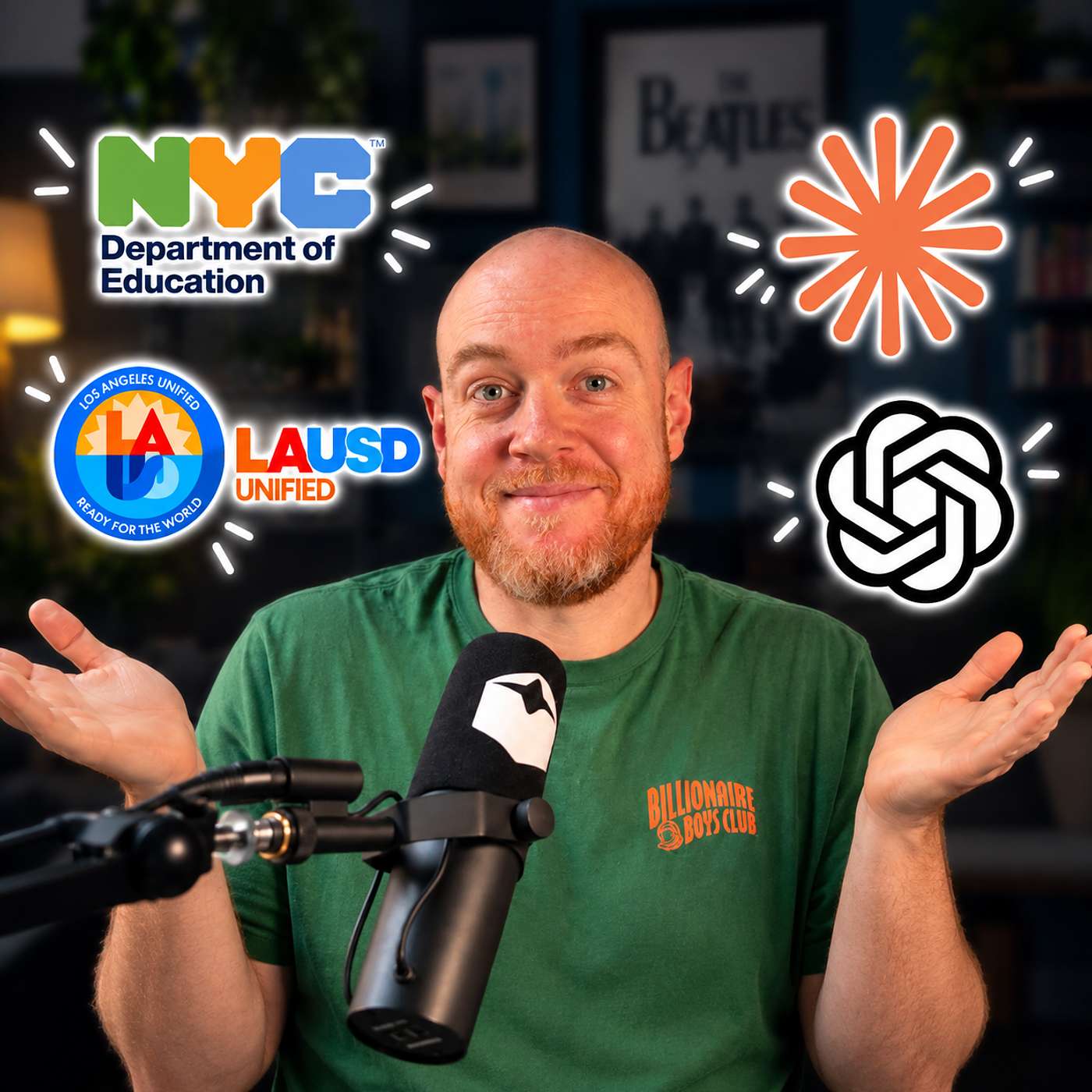
The two biggest school districts in America pulled students back from AI this week. In the same 72 hours, the AI labs handed teachers everything for free. Dan walks through the five stories that matter and what each one means for your school on Monday.NYC's one-year moratorium through eighth grade and the carve-outs nobody reported. LAUSD's district-wide restriction. The Royal Society finding that only 14% of teachers are confident with AI, with principals scoring lower than the teachers they lead. IBM's survey showing 77% of parents want input while 20% understand what's happening. OpenAI's 16-state privacy agreement, and why that matters more than the free access. And the Stanford review and Tennessee trial on what AI tutoring actually does.Plus three things to do this week: separate your staff and student policies, teach the thing before you police it, and redesign one task.The Educators' AI Guide 2027: theeducatorsaiguide.comBack to School AI Summit, 8-9 September: summit.aieducator.toolsYou can also watch on YouTube at https://www.youtube.com/@IamTheAIEducator

Comments

Download from Google Play

Download from App Store
 United States