


 Claim Ownership
Calm Companion
Subscribed: 5Played: 163
Subscribe

© ColoredJuice Podcast Studio 2026
Description
Calm Companion is an evidence-informed meditation podcast that explains why contemplative practices work—and turns the science into guided exercises you can use today. Each episode explores the neuroscience and physiology behind breathing, attention, repetition, relaxation, sleep, and the mind-body connection.
Drawing on published work by researchers and science communicators including Huberman, Davidson, Suzuki, Walker, Marks, and others, Calm Companion connects research findings with clear, accessible practices. Sources are identified so listeners can explore the ideas further. The show is independently produced and does not imply endorsement or affiliation with the researchers discussed.
You will not find background music or empty affirmations promising overnight transformation. Instead, you will learn the reasoning behind each practice: what the breath may influence, how the body responds, why repetition matters, and how meditation can become a realistic part of everyday life.
Short ten-minute guided meditations are released throughout the day for the moments when you need a reset between meetings, before sleep, during a stressful afternoon, or whenever the day feels loud.
Four-hour long-form episodes are designed to accompany deep focus, quiet afternoons, extended relaxation, or a full night of rest. With no music and no unnecessary interruptions, Calm Companion gives each practice room to unfold at an unhurried pace.
Understand the science. Practice the method. Make calm something you can return to.
Calm Companion is a ColoredJuice Podcast Studio production.
This podcast is for educational and informational purposes only and is not medical or mental health advice. If you have a mental health condition or questions about whether a practice is appropriate for you, consult a licensed healthcare professional. Listen only when it is safe to relax or fall asleep.
Become a supporter of this podcast: https://www.spreaker.com/podcast/calm-companion--6861885/support.
155 Episodes
Reverse

Morning light exposure — stepping into outdoor daylight soon after waking — is a simple circadian reset practice for sleep and morning alertness, and this Calm Companion episode (November 23, 2026) explains how light sets the human body clock, then guides a full morning-light ritual you can follow anywhere.Can morning light really reset your body clock? Yes — light is the strongest signal, the zeitgeber, that sets the human circadian clock. In a 2013 study at the University of Colorado Boulder, Kenneth Wright and colleagues found that eight adults who spent a week under natural light only while camping, exposed to about four times their usual daytime light, shifted their melatonin onset about two hours earlier, so biological night began near sunset and ended near sunrise; under modern electrical lighting the same clock ran about two hours later (Current Biology, 2013). The study was tiny — eight people — and camping is not daily life, and this episode says so plainly: the everyday version is simply getting outdoor light in the morning, which even on a cloudy day is far brighter than indoor light. Never stare at the sun; soft eyes and ordinary daylight are the whole practice.Calm Companion is supported by our network affiliates:Our sponsor: Willow turns your voice into polished text in any app. Emails, messages, docs, AI prompts, without the typing. Dictate your gratitude list and mission notes in seconds. Try it here: https://go.willowvoice.com/coloredjuiceLove the music in this episode? It is all licensed from Uppbeat — get 20% off and support the show when you join here: https://share.uppbeat.io/b1d396uc1nkeUppbeat — music for creators · Willow — your writing partner · ElevenLabs — lifelike AI voiceovers for creators (https://try.elevenlabs.io/81wzrb63uxz9) · Noota — the best transcription and AI meeting alternative (https://noota.cello.so/MfzMQhRASVY) · Moxie — invoicing, CRM, projects, expenses, proposals and time tracking for freelancers (https://www.withmoxie.com?_get=paul64) · Castmagic — turn audio into content with presets and community prompts (https://get.castmagic.io/l6g5zae3d7g5) · FeedPress — podcast hosting, stats and feed tools for serious podcasters (https://feedpress.com/?affid=35174)Support the show: https://www.patreon.com/cw/hustlestudiosChapters:0:00 The Town Clock and the Keeper1:17 Welcome to Calm Companion2:17 A Word From Our Sponsors3:01 Let Us Learn Why It Works4:31 What the Science Does Not Say5:49 The Morning Light, Together7:11 The Morning Light, Quietly8:22 A Quiet CloseProduced with the help of AI, under full human creative supervision.Become a supporter of this podcast: https://www.spreaker.com/podcast/calm-companion--6861885/support.Brought to you by:🎵 Uppbeat — music for creators✍️ Willow — writing partner🔊 ElevenLabs — lifelike AI voiceovers🎙️ Noota — AI meeting notes💼 Moxie — invoicing & CRM for freelancers✨ Castmagic — audio into content📡 FeedPress — podcast hosting & stats📱 Ocoya — AI social scheduling────────❤️ Support Calm Companion!Supporter Club: HERE · Patreon: HERE

Interoception and calm — how listening to your heartbeat and other body signals works in the brain, and a guided practice in quiet, unscored listening — is the subject of this Calm Companion episode from November 21, 2026, which explains the insula's role in body awareness and then guides the listening twice, the second time more quietly.What is interoception, and can listening inward calm you? Interoception is the body's sense of itself from the inside — heartbeat, breath, hunger, temperature and tension — carried to a brain region called the insula, which builds a running picture of how the body is doing. In a 2004 Nature Neuroscience study, Critchley and colleagues in London found that activity in the right anterior insula predicted how accurately people could judge their own heartbeats. In a 2015 Biological Psychology study, Garfinkel and colleagues at the University of Sussex tested 80 adults and showed interoception has three distinct parts — accuracy, sensibility and awareness — and that believing you read your body well is often a stranger to actually doing so. The honest edges matter here: Khalsa and colleagues reported in Psychophysiology in 2008 that experienced meditators were no better than nonmeditators at detecting their heartbeat at rest, and a 2020 meta-analysis of 724 participants found little evidence that meditation improves cardiac interoceptive awareness. Training can help, but slowly: in the German ReSource Project, Bornemann and Singer reported in 2017 that heartbeat perception accuracy improved only after six to nine months of daily practice, with small-to-medium effects (Cohen's d = .173 at six months, .273 at nine months), while three months of practice improved how people used body signals to steady themselves day to day. This episode presents the practice as listening, not as a test, and not as a treatment.Calm Companion is supported by our network affiliates:Our sponsor: Willow turns your voice into polished text in any app. Emails, messages, docs, AI prompts, without the typing. Dictate your gratitude list and mission notes in seconds. Try it here: https://go.willowvoice.com/col...Love the music in this episode? It is all licensed from Uppbeat — get 20% off and support the show when you join here: https://share.uppbeat.io/b1d39...Uppbeat — music for creators · Willow — your writing partner · ElevenLabs — lifelike AI voiceovers for creators (https://try.elevenlabs.io/81wz... · Noota — the best transcription and AI meeting alternative (https://noota.cello.so/MfzMQhR... · Moxie — invoicing, CRM, projects, expenses, proposals and time tracking for freelancers (https://www.withmoxie.com?_get...) · Castmagic — turn audio into content with presets and community prompts (https://get.castmagic.io/l6g5z... · FeedPress — podcast hosting, stats and feed tools for serious podcasters (https://feedpress.com/?affid=3...) · Ocoya — AI social media scheduling and content for creators (https://www.ocoya.com/?via=hus...) · PodMatch — guest matching for podcasters (https://joinpodmatch.com/color...Support the show: https://www.patreon.com/cw/hus...Chapters:0:00 The Clock in the Other Room1:10 Welcome to Calm Companion2:39 A Word From Our Sponsors3:36 Let Us Learn Why It Works4:55 What the Studies Found6:26 Listening Inward, Together7:51 The Same Listening, More Quietly9:16 A Quiet CloseOur team: writers, researchers, narrators, producers, and editors. AI assistance helps us move faster, but the work is done by people. We believe in transparent production and full compliance with every platform we publish on, including Spotify, Apple Podcasts, YouTube, and Spreaker.Become a supporter of this podcast: https://www.spreaker.com/podcast/calm-companion--6861885/support.Brought to you by:🎵 Uppbeat — music for creators✍️ Willow — writing partner🔊 ElevenLabs — lifelike AI voiceovers🎙️ Noota — AI meeting notes💼 Moxie — invoicing & CRM for freelancers✨ Castmagic — audio into content📡 FeedPress — podcast hosting & stats📱 Ocoya — AI social scheduling────────❤️ Support Calm Companion!Supporter Club: HERE · Patreon: HERE

Gratitude practice and the brain — what thankfulness does to attention, mood and sleep, and a guided two-minute gratitude pause — is the subject of this Calm Companion episode from November 20, 2026, which explains the three-step judgement behind gratitude and then guides the pause twice, the second time more quietly.What does gratitude actually do in the brain? It behaves like an act of attention with an address: you notice a benefit, weigh what it cost, and trace it to its source. In a 2015 Frontiers in Psychology study, Fox and colleagues at the University of Southern California scanned 23 volunteers imagining receiving life-saving gifts in stories drawn from Holocaust testimonies; the more gratitude they felt, the more active the medial prefrontal cortex and anterior cingulate cortex were — regions for value, social meaning and emotion. In a 2016 NeuroImage study, Kini and colleagues at Indiana University found that people entering therapy who wrote gratitude letters for three weeks still showed greater medial prefrontal response in a gratitude task three months later. In a 2009 Journal of Psychosomatic Research study, Wood and colleagues at the University of Warwick surveyed 401 adults and found more grateful people slept better, through more positive and less negative thoughts before sleep — a cross-sectional association, not proof of causation. And Emmons and McCullough's 2003 Journal of Personality and Social Psychology experiments found weekly blessing lists left people more optimistic, exercising more, with fewer physical symptoms. This episode states the limits plainly too: the studies are small, mostly self-report, and gratitude is a support, not a cure.Calm Companion is supported by our network affiliates:Our sponsor: Willow turns your voice into polished text in any app. Emails, messages, docs, AI prompts, without the typing. Dictate your gratitude list and mission notes in seconds. Try it here: https://go.willowvoice.com/col...Love the music in this episode? It is all licensed from Uppbeat — get 20% off and support the show when you join here: https://share.uppbeat.io/b1d39...Uppbeat — music for creators · Willow — your writing partner · ElevenLabs — lifelike AI voiceovers for creators (https://try.elevenlabs.io/81wz... · Noota — the best transcription and AI meeting alternative (https://noota.cello.so/MfzMQhR... · Moxie — invoicing, CRM, projects, expenses, proposals and time tracking for freelancers (https://www.withmoxie.com?_get...) · Castmagic — turn audio into content with presets and community prompts (https://get.castmagic.io/l6g5z... · FeedPress — podcast hosting, stats and feed tools for serious podcasters (https://feedpress.com/?affid=3...) · Ocoya — AI social media scheduling and content for creators (https://www.ocoya.com/?via=hus...) · PodMatch — guest matching for podcasters (https://joinpodmatch.com/color...Support the show: https://www.patreon.com/cw/hus...Chapters:0:00 The Basket You Carry1:10 Welcome to Calm Companion2:28 A Word From Our Sponsors3:14 Let Us Learn Why It Works4:40 What the Studies Found6:11 The Gratitude Pause, Together7:43 The Same Walk, More Quietly9:13 A Quiet CloseWe make this show with real research, real writers, and real voice talent. AI assistance helps us draft, edit, and QC faster — but nothing ships without a human making the final call. We're fully transparent about the workflow and compliant with all major platforms: Spotify, Apple Podcasts, YouTube, and Spreaker.Become a supporter of this podcast: https://www.spreaker.com/podcast/calm-companion--6861885/support.Brought to you by:🎵 Uppbeat — music for creators✍️ Willow — writing partner🔊 ElevenLabs — lifelike AI voiceovers🎙️ Noota — AI meeting notes💼 Moxie — invoicing & CRM for freelancers✨ Castmagic — audio into content📡 FeedPress — podcast hosting & stats📱 Ocoya — AI social scheduling────────❤️ Support Calm Companion!Supporter Club: HERE · Patreon: HERE

Habit formation and tiny daily calm practices — how small doses of practice stick through repetition, the same cue, and an if-then plan — is the subject of this Calm Companion episode from November 19, 2026, which explains why a new habit takes weeks to months, not 21 days, and then guides a one-minute practice built to be repeated daily.How long does it really take for a small daily practice to become a habit? The best-known measurement says about 66 days on average, with a wide range. In a 2010 European Journal of Social Psychology study, Lally and colleagues at University College London followed 96 volunteers building one new daily behaviour in the same context for 12 weeks; the time for the behaviour to feel automatic ranged from 18 to 254 days, the earliest repetitions produced the largest gains, and missing one opportunity did not materially affect habit formation. The popular 21-day figure comes from Maxwell Maltz's 1960 book Psycho-Cybernetics, where a plastic surgeon described patients taking a minimum of about 21 days to get used to a changed face — an observation about self-image, not a habit study. A simple if-then plan also helps: Gollwitzer and Sheeran's 2006 meta-analysis of 94 independent tests found implementation intentions improved goal attainment with a medium-to-large effect (d = 0.65). This episode states the limits plainly too: the London study was a single study of simple health behaviours, self-reported, and it did not test meditation — its cue-and-repetition mechanism is applied here to a tiny calm practice, not presented as a trialled protocol.Calm Companion is supported by our network affiliates:Our sponsor: Willow turns your voice into polished text in any app. Emails, messages, docs, AI prompts, without the typing. Dictate your gratitude list and mission notes in seconds. Try it here: https://go.willowvoice.com/col...Love the music in this episode? It is all licensed from Uppbeat — get 20% off and support the show when you join here: https://share.uppbeat.io/b1d39...Uppbeat — music for creators · Willow — your writing partner · ElevenLabs — lifelike AI voiceovers for creators (https://try.elevenlabs.io/81wz... · Noota — the best transcription and AI meeting alternative (https://noota.cello.so/MfzMQhR... · Moxie — invoicing, CRM, projects, expenses, proposals and time tracking for freelancers (https://www.withmoxie.com?_get...) · Castmagic — turn audio into content with presets and community prompts (https://get.castmagic.io/l6g5z... · FeedPress — podcast hosting, stats and feed tools for serious podcasters (https://feedpress.com/?affid=3...)Ocoya — AI social scheduling: https://www.ocoya.com/?via=hus...Podcasters: find your next guest, or get booked as one, on PodMatch: https://joinpodmatch.com/color...Support the show: https://www.patreon.com/cw/hus...Chapters:0:00 The Path Across the Field1:10 Welcome to Calm Companion2:16 A Word From Our Sponsors3:04 Let Us Learn Why It Works4:26 What the Studies Found5:58 Your Small Dose, Together7:24 The Same Path, Quietly8:55 A Quiet CloseStories come from people first. That's been true since we started and it stays true now. AI assistance is in our production workflow — we use it for scripting support, audio cleanup, and quality checks — but the heart, the voice, and the craft are all human. Compliant with Spotify, Apple Podcasts, YouTube, and Spreaker.Become a supporter of this podcast: https://www.spreaker.com/podcast/calm-companion--6861885/support.Brought to you by:🎵 Uppbeat — music for creators✍️ Willow — writing partner🔊 ElevenLabs — lifelike AI voiceovers🎙️ Noota — AI meeting notes💼 Moxie — invoicing & CRM for freelancers✨ Castmagic — audio into content📡 FeedPress — podcast hosting & stats📱 Ocoya — AI social scheduling────────❤️ Support Calm Companion!Supporter Club: HERE · Patreon: HERE
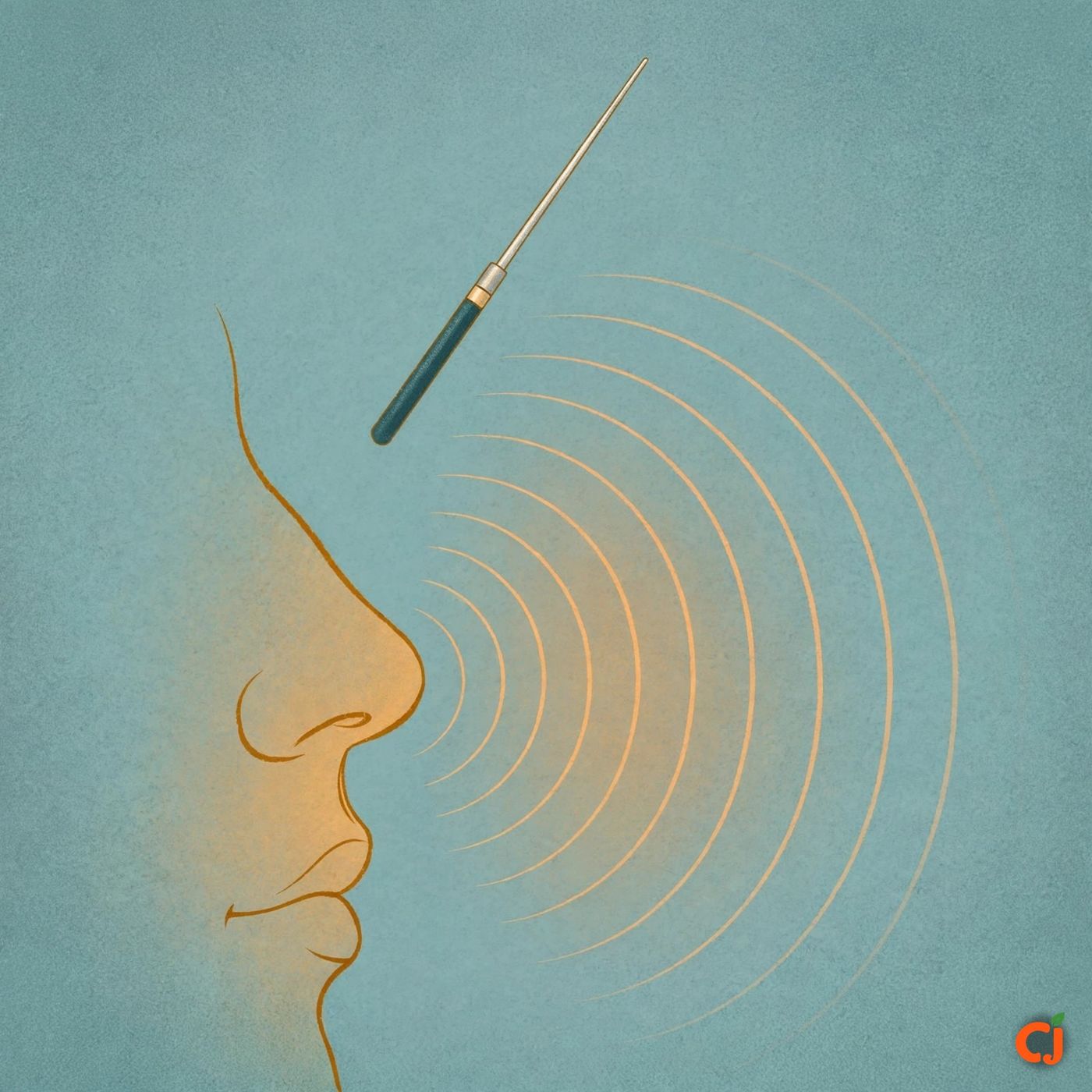
Nasal breathing and the brain — why breathing through your nose entrains memory and emotion rhythms — is the subject of this Calm Companion episode from November 18, 2026, which explains how each nasal in-breath sets a tempo deep in the brain and then guides a full follow-the-beat nasal breathing practice.Does breathing through your nose actually change what your brain does? The evidence so far says yes, in a specific and measurable way. Each breath in through the nose sends a pulse of rhythm from the olfactory bulb into the amygdala and hippocampus — regions for emotion and memory — and their electrical activity rises and falls in time with the breath, an effect called entrainment that peaks on the in-breath and fades when breathing switches to the mouth. In a 2016 Journal of Neuroscience study, Zelano and colleagues at Northwestern University recorded this synchrony directly in epilepsy patients and, across three experiments with 62 healthy participants, found fearful faces were recognised faster and objects remembered better when encountered during a nasal in-breath. In a 2018 Journal of Neuroscience study, Arshamian and colleagues at Karolinska Institutet had 24 young adults rest for an hour breathing only through the nose or only through the mouth after learning odours, and the nose breathers recognised the odours better afterwards. This episode states the limits plainly too: these were small laboratory studies, the brain recordings came from a handful of patients, and mouth taping was a laboratory tool, never advice.Calm Companion is supported by our network affiliates:Our sponsor: Willow turns your voice into polished text in any app. Emails, messages, docs, AI prompts, without the typing. Dictate your gratitude list and mission notes in seconds. Try it here: https://go.willowvoice.com/col...Love the music in this episode? It is all licensed from Uppbeat — get 20% off and support the show when you join here: https://share.uppbeat.io/b1d39...Uppbeat — music for creators · Willow — your writing partner · ElevenLabs — lifelike AI voiceovers for creators (https://try.elevenlabs.io/81wz... · Noota — the best transcription and AI meeting alternative (https://noota.cello.so/MfzMQhR... · Moxie — invoicing, CRM, projects, expenses, proposals and time tracking for freelancers (https://www.withmoxie.com?_get...) · Castmagic — turn audio into content with presets and community prompts (https://get.castmagic.io/l6g5z... · FeedPress — podcast hosting, stats and feed tools for serious podcasters (https://feedpress.com/?affid=3...)Ocoya — AI social scheduling: https://www.ocoya.com/?via=hus...Podcasters: find your next guest, or get booked as one, on PodMatch: https://joinpodmatch.com/color...Support the show: https://www.patreon.com/cw/hus...Chapters:0:00 The Baton in Your Nose1:12 Welcome to Calm Companion2:29 A Word From Our Sponsors3:22 Let Us Learn Why It Works4:48 What the Studies Found6:14 Follow the Beat, Together7:30 The Beat, Quietly9:04 A Quiet CloseColoredJuice Podcast Studio is a small workshop, not a content farm. Our writers draft, our producers record, our editors polish, and AI assistance helps with transcription, scripting, and quality control. The finished product is reviewed by a person before it ever goes live. Compliant with Spotify, Apple Podcasts, YouTube, and Spreaker.Become a supporter of this podcast: https://www.spreaker.com/podcast/calm-companion--6861885/support.Brought to you by:🎵 Uppbeat — music for creators✍️ Willow — writing partner🔊 ElevenLabs — lifelike AI voiceovers🎙️ Noota — AI meeting notes💼 Moxie — invoicing & CRM for freelancers✨ Castmagic — audio into content📡 FeedPress — podcast hosting & stats📱 Ocoya — AI social scheduling────────❤️ Support Calm Companion!Supporter Club: HERE · Patreon: HERE

Comments

Download from Google Play

Download from App Store
 United States