


 Claim Ownership
New Books in Geography
Subscribed: 1,615Played: 20,539
Subscribe

© New Books Network
Description
This podcast is a channel on the New Books Network. The New Books Network is an academic audio library dedicated to public education. In each episode you will hear scholars discuss their recently published research with another expert in their field.
Discover our 150+ channels and browse our 28,000+ episodes on our website: newbooksnetwork.com
Subscribe to our free weekly Substack newsletter to get informative, engaging content straight to your inbox: https://newbooksnetwork.substack.com/
Follow us on Instagram and Bluesky to learn about more our latest interviews: @newbooksnetwork
Support our show by becoming a premium member! https://newbooksnetwork.supportingcast.fm/geography
Discover our 150+ channels and browse our 28,000+ episodes on our website: newbooksnetwork.com
Subscribe to our free weekly Substack newsletter to get informative, engaging content straight to your inbox: https://newbooksnetwork.substack.com/
Follow us on Instagram and Bluesky to learn about more our latest interviews: @newbooksnetwork
Support our show by becoming a premium member! https://newbooksnetwork.supportingcast.fm/geography
606 Episodes
Reverse
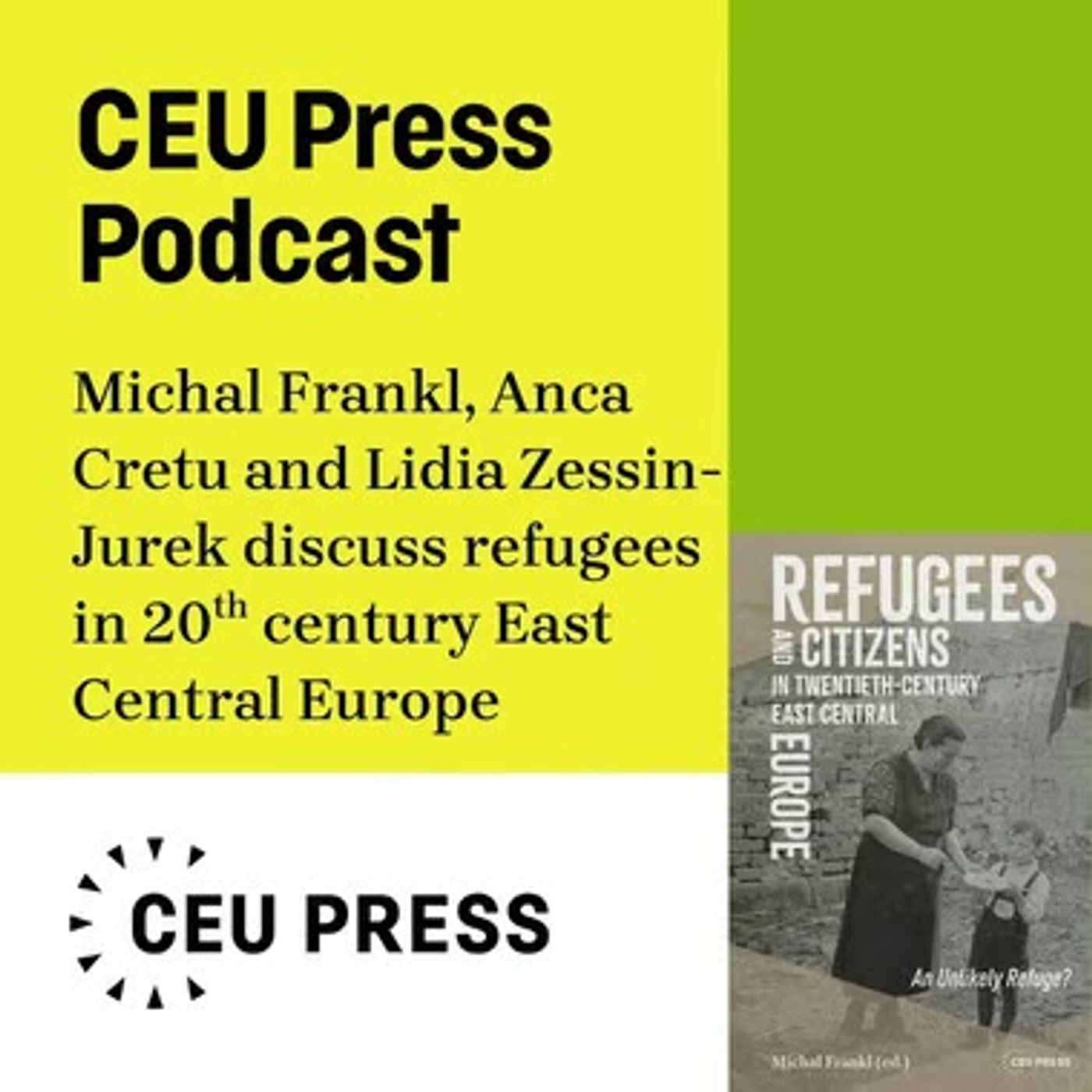
In this episode of the CEU Press Podcast host Andrea Talabér talked to Michal Frankl, Doina Anca Cretu and Lidia Zessin-Jurek about the new edited volume Refugees and Citizens in Twentieth-Century East Central Europe: An Unlikely Refuge? We discussed the reception of the ERC-project the volume is based on at a time of heightened narratives about refugees and the place of Central and Eastern Europe in the scholarship, reflecting on the current relevance of the project.The Zotero bibliography for the project is openly available, please click here to access it.You can purchase a copy here. The book is also available Open Access here.The CEU Press Podcast delves into various aspects of the publishing process: from crafting a book proposal, finding a publisher, responding to peer review feedback on the manuscript, to the subsequent distribution, promotion and marketing of academic books. We also talk to series editors and authors, who will share their experiences of getting published and discuss their series or books.Interested in CEU Press’s publications? Click here to find out more: here Stay tuned for future episodes and subscribe to our podcast to be the first to be notified. Hosted by Simplecast, an AdsWizz company. See pcm.adswizz.com for information about our collection and use of personal data for advertising.
Green Thinking: Unlearning Outdated Ideas in Science, Economics and Politics (Routledge, 2026) is about unlearning, discarding damaging, outdated ideas deeply rooted in our societies. It seeks to “compost” the views of dead white men (René Descartes, Thomas Hobbes, Adam Smith, Norman Borlaugh) and of some not white or dead (Francis Fukuyama, Richard Dawkins, Richard Thaler), and explores the flowering of probiotic Green thinking, and the rediscovery in the 21st century of powerful indigenous and other previously repressed thinking. Natalie Bennett understands that the foundation of life is cooperation, not competition; that diversity is essential to resilience and health of systems; that humans are just one more species of animal, or, rather, holobiont; that reductionism has to be replaced by relational thinking; that financialising society has destroyed – as it was meant to do – relationships essential to wellbeing; and, perhaps most crucially of all, that we have to draw on the knowledge and wisdom of indigenous societies that have maintained themselves and their environments in healthy balance for tens of thousands of years. This means acknowledging that the time, energy and talents of all life must contribute to a new way for humans to live in balance with the more-than-human world. This book will appeal to fans of David Graeber, Kate Raworth, Tyson Yunkaporta, Jason Hickel, Anna Tsing, Robin Wall Kimmerer, Ursula Le Guin, Bruno Latour, Wangarii Maathai, Merlin Sheldrake, Vandana Shiva, Lynn Margulis, Kim Stanley Robinson, as well as listeners to the New Books Network, Past Present Future, and HPS podcasts. This interview was conducted by Dr. Miranda Melcher whose book focuses on post-conflict military integration, understanding treaty negotiation and implementation in civil war contexts, with qualitative analysis of the Angolan and Mozambican civil wars. You can find Miranda’s interviews on New Books with Miranda Melcher, wherever you get your podcasts. Hosted by Simplecast, an AdsWizz company. See pcm.adswizz.com for information about our collection and use of personal data for advertising.
Belize is often described as a “pristine” ecotourism destination with a landscape that is “naturally” valuable. Yet for much of the twentieth century, British Honduras—as the country was known under colonial rule—was seen as lacking value, an unprofitable backwater. Valuing Nature at the Ends of the World: Natural Capital and Climate Disaster in Belize (Columbia UP, 2026) explores how Belize’s precarious coastal environment has become a site for a new kind of capitalist value production, in which landscapes and ecosystems derive worth from their vulnerability or looming destruction in the era of climate change. Drawing on a decade of ethnographic research, Dr. Patrick M. Gallagher offers a critical account of market-oriented conservation in the Caribbean that ranges across everyday coastal life, emergent ecological science, and climate policy spaces. He shows how the long material and social histories of racialized colonialism shape the making of technocratic tools for valuing nature. Gallagher traces how new forms of capitalist value emerge from the interaction among colonial pasts, contemporary conservation practices, and vivid scenarios of imminent climate change–driven disaster and loss. He also examines how people and policymakers in Belize imagine and create new ways of life in a changing environment. Ethnographically grounded and rich in theoretical insight, this book illuminates how the Anthropocene environment, newly visible and valuable at the moment of its presumed disappearance, came into being in Belize and around the world. This interview was conducted by Dr. Miranda Melcher whose book focuses on post-conflict military integration, understanding treaty negotiation and implementation in civil war contexts, with qualitative analysis of the Angolan and Mozambican civil wars. You can find Miranda’s interviews on New Books with Miranda Melcher, wherever you get your podcasts. Hosted by Simplecast, an AdsWizz company. See pcm.adswizz.com for information about our collection and use of personal data for advertising.
On May 3, 1887, an earthquake struck near the U.S.-Mexico border. Forty-three people died in Bavispe, Mexico; sixty miles north in Arizona, buildings swayed and a few collapsed, but no one was killed. Today, every person in southern Arizona lives with the underground aftermath of this earthquake: a drained aquifer. The estimated 7.4 magnitude earthquake created a sixty-two-mile rupture, the longest known surface rupture by a normal fault. The Quake That Drained the Desert (University of Nebraska Press, 2026) by Mary Elizabeth Reynolds tells the story of the men who investigated the earthquake: a doctor and photographer from Tombstone and an engineer from Mexico. Reynolds retells the terror of the survivors while exploring the ways the earthquake continues to shape water use and legacies in the greater Southwest. In this rigorous and gripping narrative, Reynolds unearths the aftermath of the quake, showing how it dramatically altered aquifers in southern Arizona and changed rivers that ensured the prosperity of two Mormon communities in southern Arizona and Mexico. With an eye to the present, this book asks us to consider how this underexamined quake marked the beginning of the water crisis in the region today, compacted by a century of groundwater pumping for agriculture, mining, and urban uses. As local governments and nonprofit organizations on both sides of the border now work to restore streams for wildlife habitat and flood control, they also hope to preserve water supplies for future generations. This interview was conducted by Dr. Miranda Melcher whose book focuses on post-conflict military integration, understanding treaty negotiation and implementation in civil war contexts, with qualitative analysis of the Angolan and Mozambican civil wars. You can find Miranda’s interviews on New Books with Miranda Melcher, wherever you get your podcasts. Hosted by Simplecast, an AdsWizz company. See pcm.adswizz.com for information about our collection and use of personal data for advertising.
Climate action is at an impasse. Its political opponents are stronger than ever, its advocates powerless. Almost every major government and corporation expresses their commitment to tackling climate change, yet decades of discussion, governance, and action have failed to stop carbon emissions advancing to record annual levels. How has so little been achieved for so long on such an urgent issue? In Climate Hegemony: Confronting the Politics of Environmental Impasse (LSE Press, 2026), Laurie Parsons shows how the architecture of environmental thinking has been locked into ineffective pathways. We don’t need to be coerced into inaction on climate, because our understanding is constrained by metaphors, rhetoric and assumptions so embedded we have long since ceased to see them. To confront this, Climate Hegemony brings us a human’s-eye view of the climate crisis, building up from lived experience to reveal the interests and politics that underpin the impasse. Drawing on almost two decades’ research at the frontline of global development in Cambodia, Parsons reveals the chasm between how climate change appears in a newspaper, or a policy bulletin, and how it appears to those immersed in the places it affects. From this perspective, the limitations of current environmental thinking become clear, but so too do a great many alternatives. In this powerfully argued work, Parsons set out how, if we were to rethink the perspective from which we understand climate change, we can build knowledge from and for marginalised communities, from the ground upwards, challenging the impasse and creating new pathways to address and adapt to the social impacts of climate breakdown. Hosted by Simplecast, an AdsWizz company. See pcm.adswizz.com for information about our collection and use of personal data for advertising.

Comments

Download from Google Play

Download from App Store
 United States