


Fun Facts Daily
Subscribed: 81Played: 4,912
Subscribe

© Copyright 2026 All rights reserved.
Description
Start your day smarter with Fun Facts Daily. Every episode explores a different topic giving you a quick and easy way to enjoy learning something new every weekday! Fun Facts Daily cuts through the noise of the world to deliver positive, uplifting, and fascinating trivia about art, biographies, geography, history, pop culture, science and anything else that might pique your curiosity. Get your daily dose of knowledge with a word of the day, five fun facts to blow your mind as well as practical tips and tricks that you can actually use. Every episode is safe for work (SFW) and appropriate for curious listeners of all ages.
400 Episodes
Reverse

The cultural history of ghosts intersects stagecraft, visual technology, and human physiology. Theatrical illusions long predated modern cinema, originating with 18th-century phantasmagoria shows that used optical lanterns to project moving phantoms onto smoke and translucent screens. By the 19th century, optical techniques advanced with Pepper’s Ghost, an illusion using angled glass plates and controlled lighting to superimpose translucent figures alongside living performers. The technique quickly transcended London theatres, influencing 19th-century spirit photography and remaining a fixture in contemporary theme park attractions and digital holographic stage performances.
Scientific investigations regularly uncover natural explanations behind perceived supernatural encounters. Environmental hazards such as carbon monoxide poisoning can induce hypoxia, causing sleep paralysis, hallucinations, and intense feelings of dread. Similarly, low-frequency sound waves known as infrasound can produce standing waves that resonate with human ocular tissues, distorting peripheral vision into shadowy silhouettes. Concurrently, archaeological artifacts, such as a 3,500-year-old Babylonian clay tablet depicting an exorcism ritual to guide a spirit to the afterlife, demonstrate that historical views of ghosts often emphasized restorative community duty and compassion rather than inexplicable terror.
Listen Ad-Free on Patreon.
For just $3 per month, you can get ad-free versions of Fun Facts Daily, Who ARTed and Art Smart. Head over to https://www.patreon.com/cw/FunFactsDailyPod if you are interested.
Want to learn more? Head over to my website www.funfactsdailypod.com and be sure to listen to my other podcasts Who ARTed: Weekly Art History for All Ages or Art Smart. For family fun, check out my son's podcast Rainbow Puppy Science Lab
The image used in the episode cover art came from Adobe's stock assets.
Fun Facts Daily is an Airwave Media Podcast. If you are interested in advertising on this or any other Airwave Media show, email: [email protected]
Learn more about your ad choices. Visit megaphone.fm/adchoices

The history and lore of witchcraft encompass a blend of linguistic evolution, early folk medicine, and protective folklore. The term grimoire, referring to a textbook of magic containing instructions for talismans and rituals, originated from the Old French grammaire (grammar); in the Middle Ages, Latin grammar books were indecipherable to the illiterate majority, leading to the widespread assumption that such scholarly texts contained arcane incantations. Similarly, the folkloric imagery of witches flying on broomsticks evolved from early modern herbal preparations. Healers used plants from the Solanaceae family, such as henbane, belladonna, and mandrake, to compound medicinal salves rich in tropane alkaloids like scopolamine, atropine, and hyoscyamine. Because these toxic compounds could not be ingested safely, they were suspended in oils and applied topically to the skin or applicator rods. The alkaloids disrupted inner-ear balance and receptor activity in the brain, inducing waking hallucinations, spatial disorientation, and sensations of weightlessness that observers interpreted as flight. Concurrently, ordinary households actively employed apotropaic practices to repel malevolent forces, etching protective "witch marks" such as six-petaled daisy wheels or overlapping Marian "V" monograms into doorframes, fireplace mantels, and sills, and concealing "witch bottles" filled with pins, broken glass, and vinegar within walls.
Institutional persecution and legal codification shifted dramatically across Europe and North America between the sixteenth and twentieth centuries. Violent storms during a 1589 North Sea voyage prompted King James VI of Scotland to believe he was targeted by sorcery, driving him to oversee the North Berwick witch trials, author his 1597 treatise Daemonologie, and ultimately inspire the cauldron-stirring witches in William Shakespeare’s Macbeth. While witchcraft accusations in Western Europe predominantly targeted women, male defendants accounted for roughly 20 to 25 percent of overall trials and made up the overwhelming majority in regions such as Normandy, France (about 70 percent) and Iceland (over 90 percent). Legal systems gradually moved away from supernatural interpretations, exemplified by Britain’s Witchcraft Act of 1735, which redefined magic as fraudulent deception rather than demonic intervention. This statute remained enforceable well into the twentieth century, famously used in 1944 to prosecute spiritualist Helen Duncan after she revealed classified wartime losses prior to D-Day, before its formal repeal in 1951. Formal legal reckonings have extended into modern times, including the 2022 Massachusetts exoneration of Elizabeth Johnson Jr., the final remaining convict of the 1692–1693 Salem witch trials, following a legislative effort spearheaded by middle school civics students.
Listen Ad-Free on Patreon.
For just $3 per month, you can get ad-free versions of Fun Facts Daily, Who ARTed and Art Smart. Head over to https://www.patreon.com/cw/FunFactsDailyPod if you are interested.
Want to learn more? Head over to my website www.funfactsdailypod.com and be sure to listen to my other podcasts Who ARTed: Weekly Art History for All Ages or Art Smart. For family fun, check out my son's podcast Rainbow Puppy Science Lab
The image used in the episode cover art came from Adobe's stock assets.
Fun Facts Daily is an Airwave Media Podcast. If you are interested in advertising on this or any other Airwave Media show, email: [email protected]
Learn more about your ad choices. Visit megaphone.fm/adchoices

Salem, Massachusetts, boasts a rich maritime and colonial history deeply intertwined with the economic and military development of the United States. During the Revolutionary War and the War of 1812, local merchants transformed the coastal city into a thriving hub of privateering, capturing hundreds of British vessels and generating immense wealth that propelled figures like Elias Hasket Derby to become America's earliest documented millionaires. This era of oceanic commerce also established Salem as the epicenter of the international spice trade, highlighted by adventurous voyages to Sumatra that supplied a major share of Western black pepper and filled municipal coffers with vital customs duties. Beyond commerce, Salem holds a foundational place in American defense history as the official birthplace of the National Guard, tracing its roots back to the historic 1637 muster of the East Regiment on Salem Common.
The city's legacy extends far beyond its early maritime dominance, cementing its status as a cultural and industrial center. In 1799, returning sea captains established the East India Marine Society, creating what is now recognized as the oldest continuously operating museum in the United States, the Peabody Essex Museum, housing an extensive global collection of art and maritime artifacts. Furthermore, Salem became a prominent manufacturing powerhouse for iconic entertainment, housing the Parker Brothers complex where generations of workers produced legendary board games such as Monopoly, Clue, Risk, and the Ouija board. Additionally, despite enduring cultural misconceptions popularized by fiction regarding the 1692 witch trials, historical records confirm that none of the accused were burned at the stake; rather, under 17th-century English common law, those convicted faced execution by hanging or died while imprisoned.
Related Episodes:
Fun Facts About Monopoly
Fun Facts About the Ouija Board
Listen Ad-Free on Patreon.
For just $3 per month, you can get ad-free versions of Fun Facts Daily, Who ARTed and Art Smart. Head over to https://www.patreon.com/cw/FunFactsDailyPod if you are interested.
Want to learn more? Head over to my website www.funfactsdailypod.com and be sure to listen to my other podcasts Who ARTed: Weekly Art History for All Ages or Art Smart. For family fun, check out my son's podcast Rainbow Puppy Science Lab
The image used in the episode cover art came from Adobe's stock assets.
Fun Facts Daily is an Airwave Media Podcast. If you are interested in advertising on this or any other Airwave Media show, email: [email protected]
Learn more about your ad choices. Visit megaphone.fm/adchoices

Black cats owe their dark coloration to melanism, a genetic condition driven by high concentrations of eumelanin, which is typically inherited through recessive alleles that suppress the agouti gene. Although twenty-two feline breeds can feature solid black coats, the Bombay is the only breed that is exclusively black. The genetic mutations responsible for melanism are linked to cell-surface pathways that researchers suggest may confer evolutionary resistance to viral infections in both domestic and wild felines. In addition to genetics, black fur responds uniquely to environmental factors: prolonged ultraviolet sun exposure or dietary deficiencies in the amino acid tyrosine can cause "rusting," a process where eumelanin degrades to reveal reddish-brown hues and faint underlying tabby patterns known as ghost striping. Successfully photographing black cats requires diffuse natural lighting, locked manual exposure, and contrasting backgrounds to capture coat texture while preventing unnatural eye glare caused by the reflective tapetum lucidum.
Throughout history, black cats have occupied prominent and contrasting roles across maritime lore and global folklore. British and Irish mariners sought black ship cats not only for vital rodent control in cargo holds, but also as good-luck charms believed to ensure fair weather and safe voyages, while sailors' wives kept them at home as protective talismans. In many cultures, including traditions across Japan, Scotland, and England, black cats are celebrated symbols of prosperity, wealth, and happy marriages. In contrast, Western superstitions associating black cats with witchcraft and bad luck were reinforced in the Middle Ages by documents such as Pope Gregory IX’s 1233 letter Vox in Rama, which linked dark felines to heretical rituals. Black cats have also achieved modern notoriety, including Blackie, an antique dealer's pet who inherited approximately £7 million in 1988, officially earning recognition from Guinness World Records as the world's wealthiest cat.
Listen Ad-Free on Patreon.
For just $3 per month, you can get ad-free versions of Fun Facts Daily, Who ARTed and Art Smart. Head over to https://www.patreon.com/cw/FunFactsDailyPod if you are interested.
Want to learn more? Head over to my website www.funfactsdailypod.com and be sure to listen to my other podcasts Who ARTed: Weekly Art History for All Ages or Art Smart. For family fun, check out my son's podcast Rainbow Puppy Science Lab
The image used in the episode cover art came from Adobe's stock assets.
Fun Facts Daily is an Airwave Media Podcast. If you are interested in advertising on this or any other Airwave Media show, email: [email protected]
Learn more about your ad choices. Visit megaphone.fm/adchoices
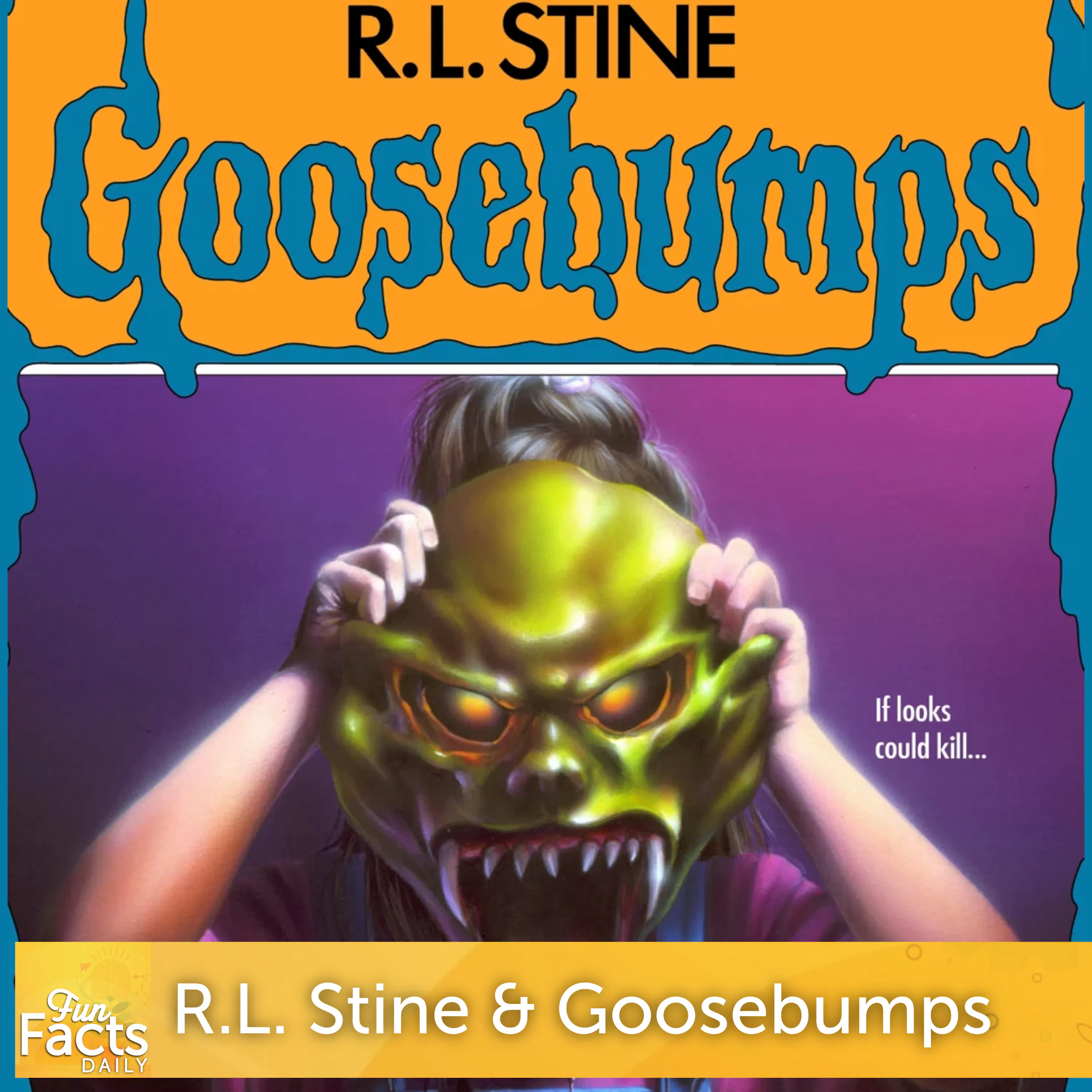
R.L. Stine revolutionized children's literature with the creation of the Goosebumps book series, a global cultural phenomenon that dominated the 1990s. Before cementing his legacy as a master of youth horror, Stine spent decades writing comedy and joke books, including serving as the editor-in-chief of Scholastic’s Bananas magazine under the pen name Jovial Bob Stine. His transition to spooky fiction began with the bestselling teen thriller Blind Date in 1986 and the Fear Street series in 1989. The iconic name Goosebumps was later inspired by a local television guide advertisement for a horror movie marathon. Launched in July 1992 with Welcome to Dead House, the original series achieved unprecedented success, with Scholastic publishing a new book every single month. Stine maintained a rigorous daily writing routine, producing 2,000 words every morning, which let him complete the 62 original novels in under five years.
The Goosebumps franchise expanded far beyond the printed page, becoming a massive multi-media empire that included an award-winning television series, board games, merchandise, and a Guinness World Record for the best-selling children's book series. Selling hundreds of millions of copies worldwide and translated into dozens of languages, the books played a significant role in improving youth literacy rates by transforming reading into an engaging social activity. Stine carefully structured his narratives by establishing strict creative boundaries, avoiding real-world violence, permanent harm, or heavy gore while relying on supernatural monsters, cliffhangers, and isolated characters to maximize suspense. By prioritizing supernatural thrills over gritty realism and isolating protagonists from modern technology like smartphones, Stine ensured that generations of young readers could experience safe, spine-tingling adventures that continue to define children's horror fiction today.
Listen Ad-Free on Patreon.
For just $3 per month, you can get ad-free versions of Fun Facts Daily, Who ARTed and Art Smart. Head over to https://www.patreon.com/cw/FunFactsDailyPod if you are interested.
Want to learn more? Head over to my website www.funfactsdailypod.com and be sure to listen to my other podcasts Who ARTed: Weekly Art History for All Ages or Art Smart. For family fun, check out my son's podcast Rainbow Puppy Science Lab
Fun Facts Daily is an Airwave Media Podcast. If you are interested in advertising on this or any other Airwave Media show, email: [email protected]
Learn more about your ad choices. Visit megaphone.fm/adchoices

Comments

Download from Google Play

Download from App Store
 United States