


 Claim Ownership
The Gender at Work Podcast
Subscribed: 100Played: 818
Subscribe

© Gender at Work 2017
Description
The Gender at Work Podcast is a bi-monthly podcast series, featuring diverse voices from Gender at Work's international network of feminist scholars, activists, and community-led development practitioners. In our informal conversations, we discuss merging ideas, issues and trends in Gender and Development that help us to find new ways of understanding our work, our institutions, our society and ambitiously, ourselves! By coming together in this new space, we seek to re-examine the resilience of patriarchy and assess the willingness and resistance of organizations and communities to create cultures of equality. We aim to amplify voices crucial in this transformative process of cultivating promising alternatives for a feminist future.
40 Episodes
Reverse

This final episode of our series "What's Love Got to Do With It" features Kumi Naidoo and Amitabh Behar. Kumi is a South African human rights and climate justice activist who is currently President of the Fossil fuel Non-Proliferation Treaty initiative and former head of international organizations including Civicus, Greenpeace and Amnesty International. Amitabh is the Executive Director of Oxfam International who has with decades of experience in human rights, economic inequalities, governance accountability, philanthropy, democracy, social justice and building citizen participation. Both are globally known civil society leaders. In this conversation, Kumi and Amitabh reflect on weaving love, solidarity and justice in activism amid rising authoritarianism, polarization, economic inequality and climate crisis. Kumi talks about the need to reframe our messaging to avoid "us versus them" and to build bridges to people beyond existing movements and to avoid pessimism. Amitabh stresses the need to combine love with structural change and justice and to confront patriarchal institutional cultures that undermine internal change. The episode ends with a cautious but hopeful call for bold, systemic rethinking of movement strategy. Please listen in and send us your thoughts!

It isn't often that we interview social justice activists working in the United States but in the last few years the US context has dramatically worsened. Democratic freedoms have been curtailed, women's rights have been eroded, immigrants are being expelled and incarcerated, and we are seeing armed responses in several major cities to civil society protests. So, in this episode we talk to three extraordinary US social justice leaders: Carly Hare, an equity activist and advocate for the collective power of community solutions who comes from the Pawnee/Yankton nations; Masha Chernyak, an immigrant from Russia, who worked for more than a decade at the Latino Community Foundation where she boldly centered love in all of its programs, helping build the largest Latino donor network in the nation and a Latino Nonprofit Accelerator that has changed the game for grassroots nonprofits; and Ava Bynum a resource mobilizer, organizer, and movement leader. Ava is the Director of Impact at Showing Up for Racial Justice (SURJ), where they work to resource social justice movements, lead workshops, coach donors, and raise critical funds to support collective liberation efforts. We asked them to explain how they center love and solidarity in their work to challenge current moves against democracy and human rights in the US. All of them acknowledge that solidarity work isn't light and it isn't easy. Carly navigates the different communities she belong to – tribal, family, inter-racial communities – and asks "how do you skill build, how do you hold enough space to love and believe that people can be mobilized? And then how do you hold enough self-love to not put yourself in harm's way". Masha reflects on how she used to be laughed out of the room when she led strategic planning sessions where she put love squarely at the center but she prevailed. Recounting the words of Shiree Tang she says "when the house is burning, what else do you do? ... We need to make love just as sexy and powerful as fear." Ava says clearly that "it's really hard to organize people you don't love or at least have some openness to." Speaking as someone who has worked with poor white communities in Appalachia and other rural areas in the US, she has important lessons to share. Do these strategies change systems of oppression? Listen in and hear their views!

In our second episode on exploring love as a basis for organizing and solidarity, we interview Pregs Govender (South Africa) and Srilatha Batliwala (India) – both globally well-known feminist activists and authors. Pregs aligns love with the inherent dignity of human beings and speaks eloquently of how oppressive systems, from apartheid in South Africa to Israel's genocide against the Palestinian people, use power to eradicate our humanity. What can we do about it? Srilatha offers brilliant insights about how we need to reconstruct our narratives to build inclusive societies and intentional alliances across movements. Both agree that our greatest defeat is when we are made to feel hopeless and helpless. They encourage each one of us to nurture our own sense of love, keep enacting it, build collective power with love and replenish ourselves through the earth's energy. As Pregs says, "Lie on the ground, look at the sky, get into water and see ourselves as part of nature. We are not separate. Find pathways from apathy to empathy, how to break and end silences about the oppressive forces, systems, narratives, how to recenter every single moment, every single day when you are being shattered." Join us in this moving and inspiring conversation.
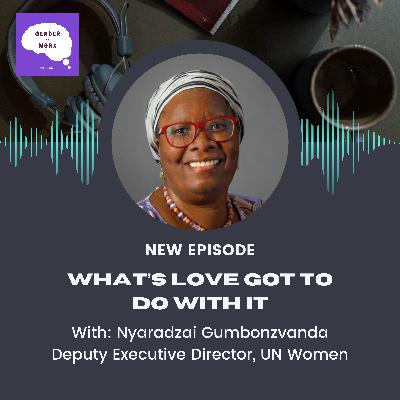
In the new season of the Gender at Work podcast – What's Love Got to Do With It? – we ask the question - can love in the vision of Audre Lord, bell hooks, Martin Luther King, Desmond Tutu, Mahatma Gandhi and so many social justice leaders worldwide, help us in shifting systems of oppression. How does social justice action from the basis of love help us to transform ourselves while also eliminating the profound cruelty and manipulation we see all around us? And how are women and gender equality leaders incorporating these questions and values into their practice? We also explore ideas and practical solutions that are based on love, on connection, coexistence, and understanding. Our opening episode features Nyaradzayi Gumbonzvanda, the Deputy Executive Director of UN Women. Nyaradzayi, a Zimbabwean national and lawyer, has a long history of activism on issues of women's rights and gender equality. She is the founder and former executive director of the Rosario Memorial Trust in Zimbabwe and prior to that served as the General Secretary of the World YWCA. Nyaradzayi was appointed the first African Union Goodwill Ambassador on Ending Child Marriage. What is love? For Nyaradzayi it means "saying no to discrimination". She says that "we need a world that respects diversities" and that "if we have love, we have courage". We are inspired by this brave and eloquent feminist warrior who draws on her vast experience to lead with justice from the halls of the UN to rural communities and organizations around the world and who explains how to organize with love.


Comments

Download from Google Play

Download from App Store
 United States