


 Claim Ownership
AI After 50
Subscribed: 2Played: 12
Subscribe

©2026 AI After 50
Description
Your experience and years on the job is not a liability when it comes to AI. It's your biggest advantage.
'AI After 50' is the practical podcast for professionals over 50 who want to learn the skills that matter, to build smarter and faster.
Real lessons from the field, from developing and teaching inside a medical manufacturer training facility, to helping businesses across Northeast Ohio work smarter, to building a live media brand from scratch, with all the mistakes in-between.
No coding required. No tech background needed. Just honest, practical skills.
New episodes every Tuesday.
'AI After 50' is the practical podcast for professionals over 50 who want to learn the skills that matter, to build smarter and faster.
Real lessons from the field, from developing and teaching inside a medical manufacturer training facility, to helping businesses across Northeast Ohio work smarter, to building a live media brand from scratch, with all the mistakes in-between.
No coding required. No tech background needed. Just honest, practical skills.
New episodes every Tuesday.
12 Episodes
Reverse
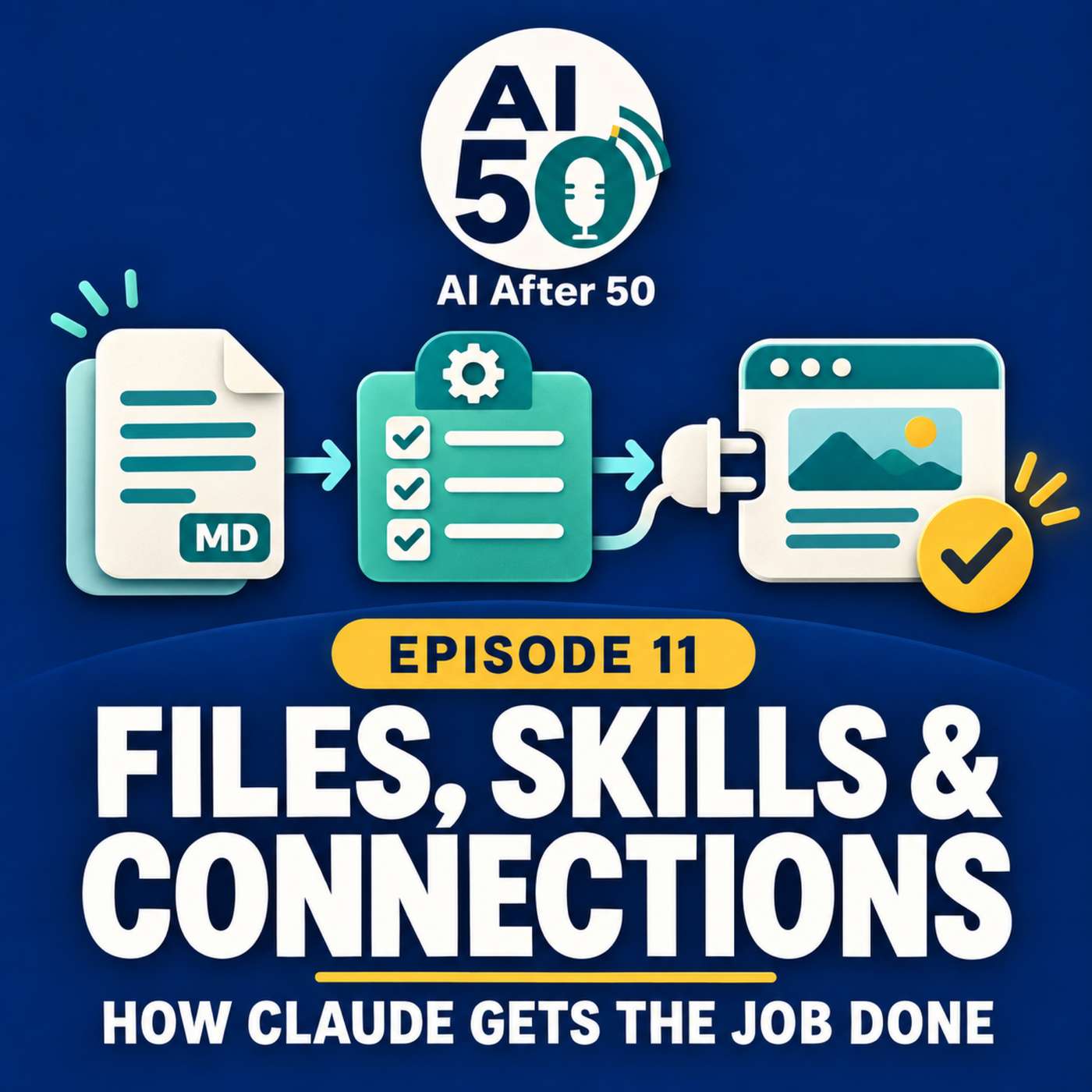
AI After 50 — Episode #11 - Show NotesPutting it all Together: The Technical Side of The Lake & Grape WeeklyEpisode # 11 Recorded: Monday, November 9, 2026Host: Mark TennantEpisode SummaryThis is the technical episode, but Mark keeps the language simple.In Episode 11, Mark explains how Claude helps produce The Lake and Grape Weekly every Friday morning. He walks through the files Claude reads, the instructions it follows, the sources it checks, and the connections it uses to place the finished newsletter into Beehiiv.The process begins with Markdown files that describe the newsletter, its readers, its format, and its rules. Reference files provide verified winery links, musician information, and local events. Claude skills store instructions for writing and checking each issue. Connectors and browser tools let Claude work with outside applications.Mark also explains why mistakes should become written rules. When Claude makes the same mistake twice, Mark adds a new instruction or checklist item so the problem does not continue.Claude performs much of the research, writing, and setup, but Mark still reviews every issue before it is scheduled. AI prepares the work. Mark makes the final decision.What to RememberA Markdown file is a plain text file that Claude can read and follow.A project brief tells Claude what the project is, who it is for, and how it should work.Reference files provide facts such as names, links, locations, and event information.A skill contains saved instructions for a job you perform more than once.A checklist catches mistakes before the work is finished.If you correct Claude twice on the same issue, write a rule for it.Connectors give Claude access to approved applications such as Google Drive or Microsoft 365.MCP is the standard working underneath many AI connections.When an application cannot be reached through a connector or API, Claude may be able to work through a browser.Events and links should be checked against current sources before publication.Extra research can be saved and used for social media posts or later content.Messages, publishing, file changes, and account actions should remain under human review.This Week’s TopicHow Claude Runs the Weekly Newsletter ProcessThe Lake and Grape Weekly is not produced from one prompt. Claude follows a set of files, rules, sources, and steps.The project brief explains the newsletter. It describes the audience, the three county area, the five section format, the writing style, and the location of each file.The reference files contain facts Claude should not guess. The winery master list includes verified winery websites and Facebook pages. The entertainment list contains information about the musicians who perform in the area. A monthly events file gathers information from local sources.The newsletter skill tells Claude how to perform the job. It includes the reader, the purpose, the section order, the word count, the writing style, words to avoid, and the checks Claude must run before finishing.Each Wednesday, Claude searches for events taking place from Thursday through Monday. Every event must be confirmed from a current source, and the source address is saved in the draft notes.Items that do not fit in the newsletter are saved in an overflow file. Mark uses those items for Facebook posts during the week.Claude then writes the issue as a Markdown file, runs the checklist, opens Beehiiv through Chrome, chooses the correct template, and places the content into the correct sections.Mark reviews the finished email, checks anything that does not match his knowledge of the area, and schedules it for Friday morning.Tool SpotlightMarkdown FilesA Markdown file is a plain text file that usually ends with .md.You do not need special software to create or read one. It can be opened in a basic text editor.Markdown files work well with AI because they can store instructions, facts, headings, lists, links, and project background in a format that is easy for both people and AI to read.Mark compares his project brief to the binder given to a new employee. It tells Claude what The Lake and Grape Weekly is, who reads it, which area it includes, how it is arranged, and which decisions have already been made.This means Mark does not have to explain the entire project every time he starts a new conversation.Memory can hold general information, but Mark prefers written files for exact links and rules that must be followed every time. He can open those files, check what they say, and change them when needed.Your One Move This WeekCreate a one page project brief for a job you perform more than once.Open Claude or your preferred AI assistant and enter:Interview me about this project one question at a time. When we finish, write a one page summary that explains the result I want, the format I need, the source material you should use, the people the work is for, the rules you must follow, and the actions that require my approval.Read the finished summary and correct anything that does not match how you work.Save the file and provide it at the beginning of your next work session.You have now created the first piece of a repeatable AI workflow.Coming Up NextIn the next episode, Mark will step away from The Lake and Grape Weekly and share a business problem from his full time job at Phillips.He will explain how Microsoft Copilot was used to reduce a manual administrative process that took about 10 to 12 hours each month.The problem was not glamorous, but it was real. The next episode will show how AI can reduce repetitive work without removing the person responsible for the process.Subscribe - Click to subscribeStandard Show Notes: In the description on your podcast platformPremium Show Notes: Subscribe for deeper thoughts, bonus resources, and things you can reflect on as our journey together continuesNew episodes every week: Mash that Subscribe button/link on your platform to be notified....Website: AIAfter50.com⚠️ HUMAN IN THE LOOP: Reviewed for accuracy before publishing. AI After 50 | Episode#11 | Show Notes | 11/10/2026
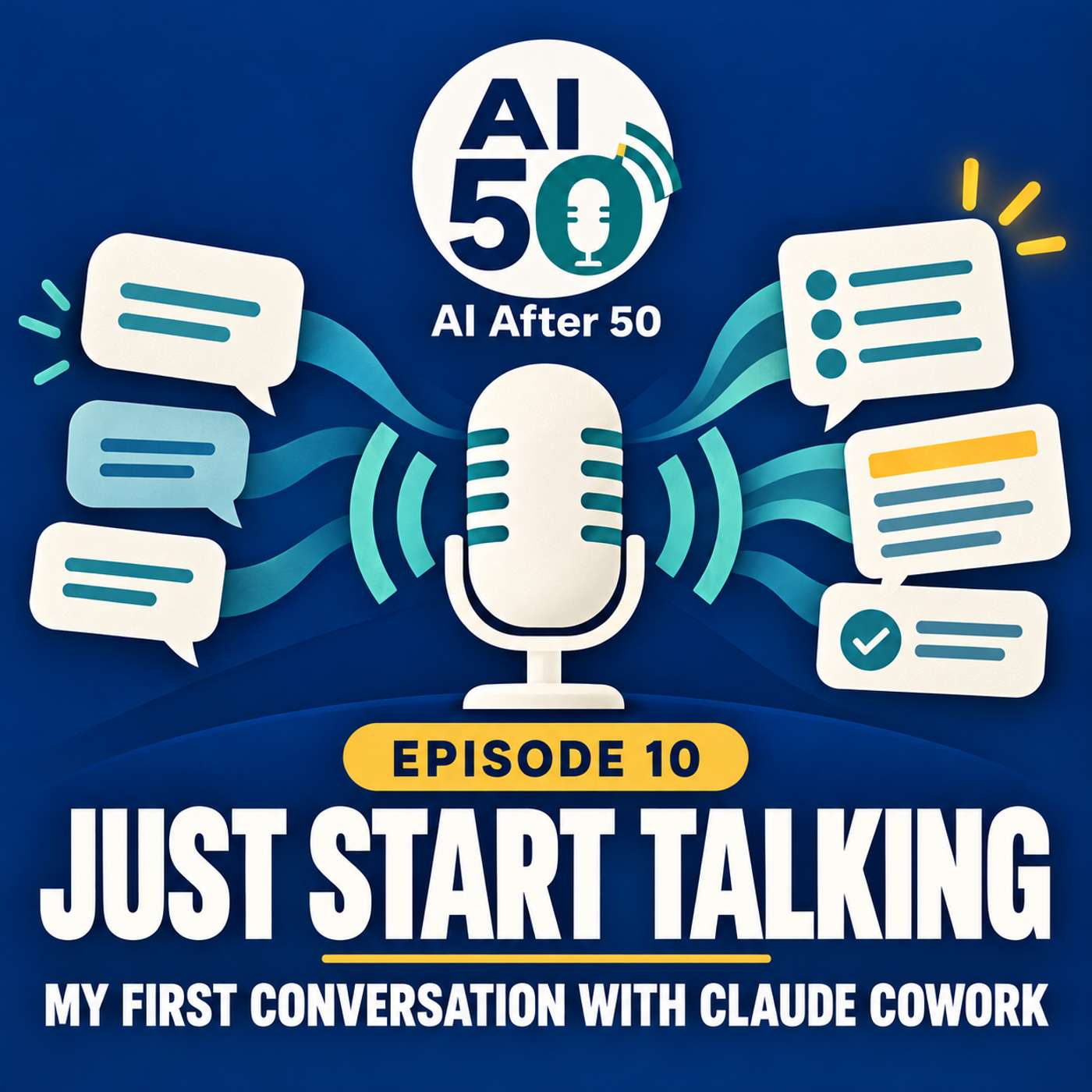
AI After 50 Episode #10: My First Conversation With Claude CoworkEpisode SummaryYou do not need a perfect prompt to start working with AI. You do not even need to know exactly what you want to make.When Mark began working on The Lake and Grape Weekly, he opened Claude Cowork and started talking. He had noticed that information about Ohio Wine Country was spread across winery websites, tourism pages, and Facebook accounts. Anyone trying to plan a weekend had to search through all of those places.Mark thought a local newsletter might solve the problem, but he was not sure if the idea made sense. He did not ask Claude to write the newsletter or create a business plan. He described what he had noticed and asked Claude to help him think about it.The newsletter did not come from one conversation. Its audience, format, design, research process, and weekly routine took more time and more work. The first conversation gave Mark a place to begin.What to RememberYou do not need a polished prompt before talking with AI.You can speak to AI instead of typing if talking feels more natural.Start with an idea, an interest, or a problem you have noticed.Ask AI to help you think before asking it to create something.You do not need to decide whether the idea should become a newsletter, website, service, class, or something else.Ask the AI to work through the idea one question at a time.Correct the AI when it misunderstands you.Change direction when a suggestion does not fit.AI can help you organize your thoughts, but you still make the decisions.The work does not disappear because you are using AI. You still have to research, make choices, fix mistakes, and keep showing up.This Week’s Topic: Start With the IdeaThe Lake and Grape Weekly began with something Mark had noticed about his own community.Ohio Wine Country has wineries, live music, local events, and places to stay, but the information is spread across many websites and social media pages. Visitors have to do a lot of searching before they can make weekend plans.Mark wondered whether one newsletter could bring the information together.He opened Claude Cowork and talked about the idea. He was not ready to build anything yet. He wanted help deciding whether the newsletter would be useful and who might read it.As the conversation continued, Claude helped him think about the audience and the problem the newsletter could solve. Later conversations dealt with the format, design, research, and weekly production process.Your idea does not have to involve wine or a newsletter. It could come from your town, profession, hobby, club, or community. It might begin with a question people keep asking you or information that is harder to find than it should be.You can start by telling AI what you have noticed and asking it to help you sort through the idea.Tool SpotlightWispr Flow: https://wisprflow.ai/Mark prefers to speak many of his ideas instead of typing them. He uses a voice dictation tool called Wispr Flow.Wispr Flow turns speech into written text inside the application where you are working. It can clean up filler words, punctuation, and spoken corrections before inserting the text.For Mark, speaking makes it easier to get his thoughts out and have a natural conversation with AI. He recommends Wispr Flow based on his own experience and is not paid to mention it.You do not need Wispr Flow to try the method from this episode. You can use the voice feature in your AI application or type the conversation. Choose the method that makes it easiest to explain what you are thinking.Learn more at the Wispr Flow website.Your One Move This WeekChoose one idea you have been thinking about but have not started.Open your preferred AI assistant and say or type:“I have an idea, but I am not sure what it should become. Ask me one question at a time and help me think it through.”Tell the AI about the following:What you care aboutWhat you have noticedWho may find the idea usefulWhat problem you think it could solveWhat you do not know yetDo not ask it to build the whole project. Have one conversation and see if the idea becomes clearer.You are not trying to finish anything this week. You are finding a place to begin.Coming Up NextIn the next episode, Mark will explain how the first conversation became a repeatable process for producing The Lake and Grape Weekly.He will talk about how he organized the information, researched the wineries and events, and created files that Claude reads before working on each issue.Those files include skills and Markdown files that store the newsletter’s recurring instructions. They help Claude remember the audience, writing rules, source material, and weekly routine.Mark will also share what took longer than expected, what went wrong, and what he changed after making mistakes.

AI After 50 — Episode #9 - Show NotesTITLEEpisode # 9Recorded: 09/24/2026Hosts: Mark TennantEpisode Summary: AI After 50 is back with a new direction. Instead of talking about artificial intelligence in the abstract, Mark is using it to build something real—and inviting listeners to follow the process from the inside.In this relaunch episode, Mark introduces The Lake & Grape Weekly, a local newsletter he created for visitors to Ohio Wine Country. With Claude as his AI collaborator, he turned a 15-year-old idea into a working publishing operation complete with an audience strategy, editorial mission, content database, writing guidelines, weekly workflow, and social media system.This is not a polished overnight-success story. Mark also shares the mistakes that reached real subscribers, including a design problem that affected the newsletter’s first five issues. His lesson is simple: building with AI is an iterative process. Every mistake can become a rule that improves the system the next time around.Going forward, AI After 50 will document what it actually looks like to build with AI—what works, what fails, and how experience and good judgment become even more valuable when paired with the speed and structure AI provides.Key Takeaways: AI is most useful when it helps you build something real, not merely discuss possibilities.You do not need a technical background to work effectively with AI. Curiosity, judgment, and subject-matter knowledge are more important.Start with a conversation about your idea instead of immediately asking AI to produce a finished product.A clearly defined audience makes every later decision easier, including content, voice, format, and promotion.A strong editorial mission helps you decide what belongs in your publication—and what does not.Saved instructions, reference files, and repeatable workflows prevent you from starting from scratch each week.Mistakes are part of building. When something goes wrong, determine why it happened and create a rule to prevent it from happening again.People over 50 bring valuable experience, credibility, and judgment to AI collaboration. AI contributes speed, structure, and help with repetitive work.A focused presence on one social platform can be more manageable and effective than trying to publish everywhere at once.This Week's Topic: Building Something Real With AIMark explains why he paused AI After 50 and why the show is returning in a different form. The podcast will now follow the real-world development of The Lake & Grape Weekly, a newsletter serving Ohio’s Grand River Valley wine region.The project began with a simple conversation with Claude: Who is the newsletter for? What does that person need? What problem should the publication solve?That conversation produced a specific primary reader and a clear editorial mission: the newsletter is not there to overwhelm readers with information—it is there to help them make their weekend plans.From there, Mark and Claude built the supporting operation: a database of wineries and entertainment, a five-section newsletter structure, voice and tone rules, a banned-words list, reusable AI instructions, and a weekly publishing workflow.The result is a growing publication with 11 issues released and a twelfth on the way—and a real project listeners can learn from as it develops.Tool Spotlight: Claude CoworkClaude is an AI assistant created by Anthropic. Its Cowork feature allows you to develop an idea through an ongoing working conversation instead of relying on a single prompt.Mark used Cowork to clarify the newsletter’s audience, define its editorial mission, establish its structure, organize source information, create repeatable instructions, and troubleshoot problems.The most important lesson is how he began. He did not ask Claude to “write a newsletter.” He explained what he was considering and asked, “What do you think?” That opened the door to a collaborative process in which the idea became more focused through questions, responses, and revision.Similar collaborative work features are also available through tools such as ChatGPT and Microsoft Copilot.Your One Move This Week: Choose one idea you have postponed because it feels too large or because you do not know how to begin.Open your preferred AI assistant and start a conversation with:“I have an idea I’ve been thinking about. I don’t want you to build it yet. Help me talk it through, identify who it is for, and clarify the problem it should solve.”Do not worry about creating a business plan or finished product. Your goal this week is simply to turn a vague idea into a clearer one.Coming Up Next: In the next episode, Mark will revisit the first conversation he had with Claude about The Lake & Grape Weekly.He will walk through how they defined the audience, developed the newsletter’s mission, and chose its name—including what Mark asked, how Claude responded, and how the idea improved through conversation.Future episodes will explore the infrastructure behind the publication, including its master spreadsheets, reusable skills, reference files, folder structure, and the systems that make weekly publishing repeatable.Subscribe - Click to subscribeStandard Show Notes: In the description on your podcast platformPremium Show Notes: Subscribe for deeper thoughts, bonus resources, and things you can reflect on as our journey together continuesNew episodes every week: Mash that Subscribe button/link on your platform to be notified....Website: AIAfter50.com⚠️ HUMAN IN THE LOOP: Reviewed for accuracy before publishing. AI After 50 | Episode# | Show Notes | DATE
AI After 50 — Episode #8 - "Three Skills That Will Set You Apart as an AI Leader"Show Notes"Three Skills That Will Set You Apart as an AI Leader"Episode Number: 9 Recorded: Saturday, March 14, 2026 Hosts: Mark Tennant & John PaganiniEpisode Summary:What separates a leader who talks about AI from one who actually leads it inside their organization? In Episode 9, Mark and John break down the three skills every leader needs to develop right now — starting with where John just spent the week: the HIMSS National Conference in Las Vegas, where 24,000 healthcare IT professionals gathered and AI governance, patient outcomes, and human-centered AI were the dominant themes.From the conference floor to your desk, this episode gives you the practical starting points: what to learn first, what to understand about AI capabilities, and how to move from basic use to real organizational impact.Key Takeaways:AI is already in your organization — with or without a strategy. According to a 2026 AMA poll, 81% of US physicians report using AI. A Gallup poll shows nearly 50% of public sector employees use it regularly. Your people are using these tools now. The question is whether leadership is guiding that or not.AI literacy is the foundation — but fluency is the goal. Understanding how to use a tool is the mechanics. Knowing how AI can support human judgment and act as a thought partner is where the real value lives.Most people dramatically underestimate what these models can do. The capabilities have advanced far beyond writing emails. Deep research, agentic workflows, multi-step automation — leaders who understand this have a real competitive edge.The human in the loop is non-negotiable. From the HIMSS conference floor to your boardroom: the message resonating across industries is that AI amplifies human judgment — it does not replace it.The Three Skills:Skill 1 — AI Literacy: Make It Priority Number OneStart here. Understand what AI can do at a foundational level. Host lunch-and-learns. Identify your internal AI champions. Give people tools — and the training to go with them. Organizations that deploy tools without training find no value. Literacy across the organization, led from the top, is the foundation everything else is built on.Skill 2 — Understand What These Models Are Actually Capable OfMost people think AI is a glorified Google search or an email writing tool. It is far more than that. Large language models (ChatGPT, Claude, Gemini, Perplexity) can conduct deep research, build workflows, analyze complex documents, and increasingly — through agentic AI — manage multi-step processes in the background without constant human direction. Leaders who understand the real capability landscape make better decisions about where and how to deploy AI.Skill 3 — Advanced AI Literacy: Use Cases and What's WorkedOnce you understand the basics, start mapping AI capabilities to real business problems. Onboarding. Training. Sales and marketing. Operations. Find out what's worked in other organizations and apply it to yours. Move beyond random prompts toward intentional, structured use. This is where AI literacy becomes organizational value.From the HIMSS Conference — John's Highlights160,000 global HIMSS members; approximately 24,000 attended the conference with hundreds of vendorsAI governance, patient outcomes, and ethical AI were dominant themesStrong consensus: AI must have a human in the loop at all stages — especially in clinical settings"This is the year of the patient" — patients now have direct access to AI tools to monitor and manage their own health, with smart devices feeding real-time data into clinical conversations81% of US physicians are now using AI (2026 AMA Physician Survey on Augmented Intelligence) — primarily for note summarization, medical research, discharge instructions, billing codes, and chart documentationTool Spotlight: NotebookLMGoogle's NotebookLM was discussed as a standout tool for organizing and synthesizing conference materials. Key points:Free to use at notebooklm.google.com — full access included with Google Workspace accountsYou feed it your own documents, PDFs, and research; it answers questions and creates outputs only from those sourcesReduces hallucination significantly because it works from what you give itOutputs include: summaries, podcasts, mind maps, infographics, PowerPoint slides, and (new) videoAs AI models improve over time, NotebookLM improves with them — your existing projects become more powerful automaticallyJohn's use case from HIMSS: Fed conference session PDFs into NotebookLM, then used it to summarize, organize, and synthesize five days of content into usable insights.Your One Move This WeekPick one AI platform. ChatGPT, Google Gemini, Perplexity, or Claude and commit to it for six weeks. Pay for the full version ($20/month). Use it every day. Break it. Build with it. Make it part of your daily workflow. That firsthand experience is what turns AI literacy into AI fluency, and it's what makes you credible when you bring it into your organization.Coming Up NextEpisode #10: Which AI platform is right for your organization? Mark and John will highlight the major platforms, what each one does best, and how to make the right choice for your specific needs.Subscribe - Click to subscribeStandard Show Notes: In the description on your podcast platformPremium Show Notes: Subscribe for deeper thoughts, bonus resources, and things you can reflect on as our journey together continuesNew episodes every week: Mash that Subscribe button/link on your platform to be notified....Website: AIAfter50.com⚠️ HUMAN IN THE LOOP: Reviewed for accuracy before publishing. AI After 50 | Episode 9 | Show Notes | March 2026
🎙️ AI After 50 – Episode #8A Shift for AI After 50: The Leadership Pivot📅 Recorded: February 20, 2026👤 Hosts: Mark Tennant & John Paganini⏱️ Duration: ~20 Minutes🔄 The Relaunch: Same Name. New Mission.AI After 50 is officially evolving.What started as a podcast teaching AI basics has transformed into something far more powerful:🎯 A weekly leadership briefing on AI for experienced professionals.This episode marks the pivot — away from beginner prompting tips and toward helping leaders over 50 strategically leverage AI to sharpen decision-making, compress timelines, and amplify decades of hard-earned judgment.If you're in leadership, management, or have built deep expertise over 20+ years, this show is now built for you.🧠 Why This Shift Matters📊 The Leadership GapRecent research from McKinsey & Company reveals:68% of executives feel unprepared for AI integrationOnly 26% of workers aged 55–64 report extensive AI familiarity (lowest of any age group)Organizations where senior leaders actively champion AI outperform peers by 3x🔗 McKinsey Insights:Superagency in the WorkplaceMillennials Are Gen AI EnthusiastsThis isn’t about intelligence.It’s about who the conversation is speaking to.That changes now.🚨 The Tipping PointAI entrepreneur Matt Shumer published a viral article titled:👉 Something Big Is HappeningViewed 84+ million times on X/Twitter alone, the message was clear:AI capabilities have accelerated overnight.Most leaders are not ready.But you're not too late.🎧 Audio Overview available via NotebookLM (link in show notes)The comparison?AI’s moment feels like early 2020 before COVID fully hit. Quiet. Underestimated. Then suddenly… transformational.👥 Who We Are (And Why You Should Listen)We don’t just talk about AI.We build with it.Between us:Training global healthcare teams in applied AIDeveloping compliance AI tools (including an Ohio Senate Bill 1 checker)Building AI-powered applications with Google AI Studio and Claude CodeCreating real-world business automation tools in days — not months🚗 Example: Autovision Garage

Comments

Download from Google Play

Download from App Store
 United States