


 Claim Ownership
AI Hope
Subscribed: 0Played: 0
Subscribe

© (c) 2026 Generative Buzz Incorporated
Description
What's your AI success story? What made you realize you had to change? And what does a hopeful future with AI look like to you? AI Hope with Geoff Livingston asks three simple questions of people doing the hard work of adapting and thriving in the AI era.
20 Episodes
Reverse

This week’s solo episode tackles arrogance, a trait I know a little too well from my own career. I’ve regretted it every time I acted that way, and I’m seeing the same pattern play out across the AI industry right now. That includes the Nvidia situation and the Department of Transportation’s aviation grounding, which came three days after an AI system deployment that the FAA has since ruled out as the cause. The administration’s track record with AI rollouts, including the Weather Service, makes these answers worth questioning.For practitioners, arrogant AI means assuming the technology will work, and that it will act morally, ethically, and effectively without question. In my work with companies and nonprofits, the biggest misses usually come from the same big swing: replacing an entire process, or even a person’s job, without understanding the workflow, the nuance of the task, or where human judgment is needed. When that fails, people decide the technology doesn’t work. Part of the problem is that we gave it too much power and bought into Silicon Valley’s hype. I see Anthropic’s IPO as a test of how long LLMs can go financially before a crash.The hope is humility, which means building AI that assists people and takes on rote tasks while keeping humans in their seats. I believe the future belongs to smaller, task-specific models built for fields like science and medicine instead of ever-larger general models like Fable.I close on leadership and how the arrogance, ethical lapses, and missing succession plan on display at Nvidia show what happens when morals and ethics leave the room. Humility is hard, but it’s worth striving for.1:20 What arrogant AI means for practitioners2:32 Why humility matters in AI deployment2:55 The big swing: replacing whole processes and jobs4:30 A humbler, assistive approach to AI4:58 Anthropic’s IPO and the economics of LLMs6:19 Leadership lessons from the marketplace

This episode is a little different. It’s a dharma-like talk I gave to a small sangha at Radiance Yoga this past Saturday. It was a windy fall morning, with the leaves coming off the trees and change literally in the air. Trees handle impermanence with ease. Most of us, myself included, struggle with it, especially when the change is unwelcome, and AI has become one of the most unwelcome changes in many people’s working lives.I walk through how I came to Plum Village practice, from a childhood of iron Buddhas and incense to the retreat Caitlin brought me to, and why impermanence stuck with me through the years.. Staying relevant across 30 years of technology change, from fax machines to the web to AI, turned out to have very little to do with technology and everything to do with mindset. I also share how last year’s business collapse and my father’s death two weeks later sent me back to the mat, and how those morning sits became Now Is Gone.From there, I apply the Four Noble Truths to AI. We suffer when we cling, whether to absolutes like “I will never touch this” or “we’ll cut 30 percent of our workforce,” or to the way our kids, our bodies, and our careers used to be. I can’t stop every software company from bolting on a chatbot or every data center from going up without care for its community.I can voice my dissent, and I can use the technology where it genuinely helps, like supporting underfunded global health work in India and Africa. My hope is that we pause, reflect, and use AI only where it serves our North Star, like water finding its way to the sea.Listen today on Spotify, iTunes, YouTube, or wherever you get your podcasts! 1:36 AI as the latest change at work 3:37 Why staying relevant isn’t about technology 4:46 Impermanence and the Four Noble Truths 10:38 Surrender and letting go of what was 11:36 Dukkha: suffering and clinging 16:18 What I can’t stop about AI, and what I can do 18:27 Letting go of absolutes and binary thinking 21:43 Pause, reflect, and respond from your North Star 23:23 Taking stock and discarding what doesn’t serve you
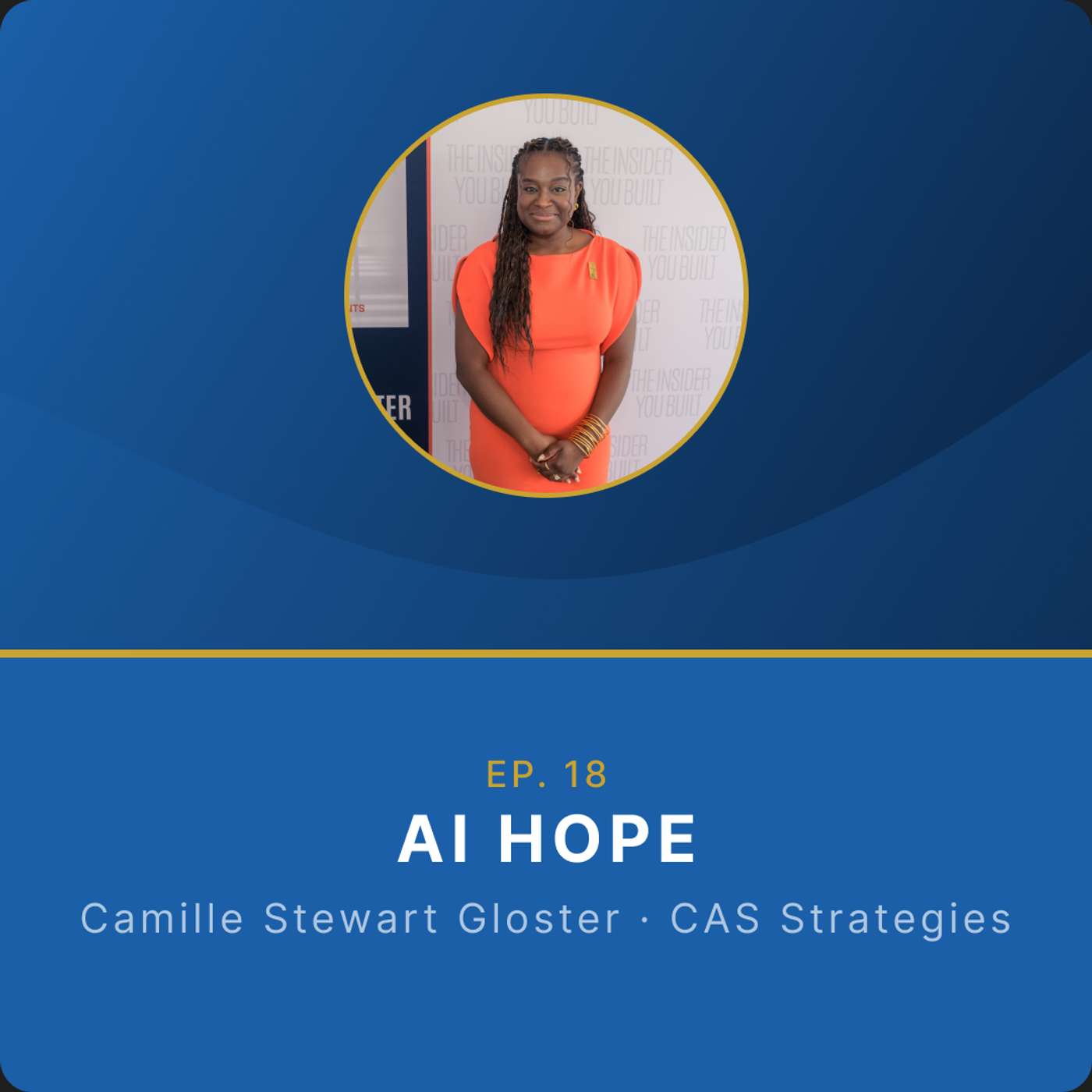
She helped shape the nation’s tech security strategy from the White House. Now she helps companies clean up after sprinkling AI on everything like glitter.Camille Stewart Gloster has spent her career where emerging technology meets security. She served as the first deputy national cyber director for technology and ecosystem security at the White House, led global product security strategy at Google, and now runs CAS Strategies, a cybersecurity and emerging tech advisory firm. She is also the author of The Insider You Built.AI is nothing new in cybersecurity, where it has powered anomaly detection for years. Camille’s wake-up call came when ChatGPT launched and her mom called to ask what it was. After leaving government to help companies adopt AI, she found many of them “just kinda sprinkling some AI on things.” Like glitter, it looks fun until you’re the one who has to clean it up.Her biggest pet peeve is how organizations hand agents the keys to the kingdom. Agents are not people, she cautions, yet they act inside your organization with real access and authority, making decisions on your behalf. We traded intern analogies (plus a hypothetical agent that answers a request for a cheeseburger story by ordering actual cheeseburgers on DoorDash) and landed in the same place: agents need specific instructions, clear boundaries on what they should not do, and human checks.Camille hopes we land somewhere between Terminator and tech utopia, closer to the utopia, where AI helps solve challenges like climate change and health outcomes and gives us time back to be human. Getting there depends on people making intentional, risk-based decisions about AI, the same way they do about everything else in their lives.0:49 From the White House and Google to CAS Strategies2:40 Sprinkling AI like glitter, and who cleans it up3:51 Building an AI chief of staff without email access5:14 Why agents are like hiring a new employee7:26 Smart enough to be dangerous8:49 Camille’s hope for AI: intentional, risk-based decisionsLearn more about CAS Strategies at https://www.cas-strategies.com/aboutGet the Insider You Built: https://www.amazon.com/clp/1394430892
Data centers have dominated the AI news cycle lately, from local concerns about noise and heat to questions about who pays for the added strain on the electric grid. In this solo episode, I take stock of the build-out and why I think it’s happening with very little mindfulness. A conversation last week likened it to the railroad boom of the Industrial Revolution, when tracks went down everywhere, towns boomed or withered depending on where the line ran, and nobody planned for the environmental damage.Two questions rarely come up in the coverage. First, how much of this capacity is actually needed? Every frontier lab is building its own, with no real effort to treat compute as a shared resource that could lower the environmental impact. Second, why are we running every query through massive general-purpose language models? I compare them to department stores, where everything is on the shelf and none of it is as good as it could be.Running makes a good example. The AI coaching features in Strava, Runna, and Garmin lean on frontier models, and as a coach I think they suffer for it. A narrow model trained only on running knowledge would likely coach better and draw far less from the grid.So where’s the hope? I’d like to see companies build data centers alongside environmental groups and communities, pay for their own grid impact instead of passing it to taxpayers, and invest in narrower, more efficient models. For the rest of us, it comes down to mindfulness. Before reaching for a chatbot, ask whether the use case is warranted or just a dopamine hit. Is the scratch really worth it?0:58 Environmental and grid concerns2:22 How much capacity do we really need?4:11 AI as a department store6:12 Where the hope lies
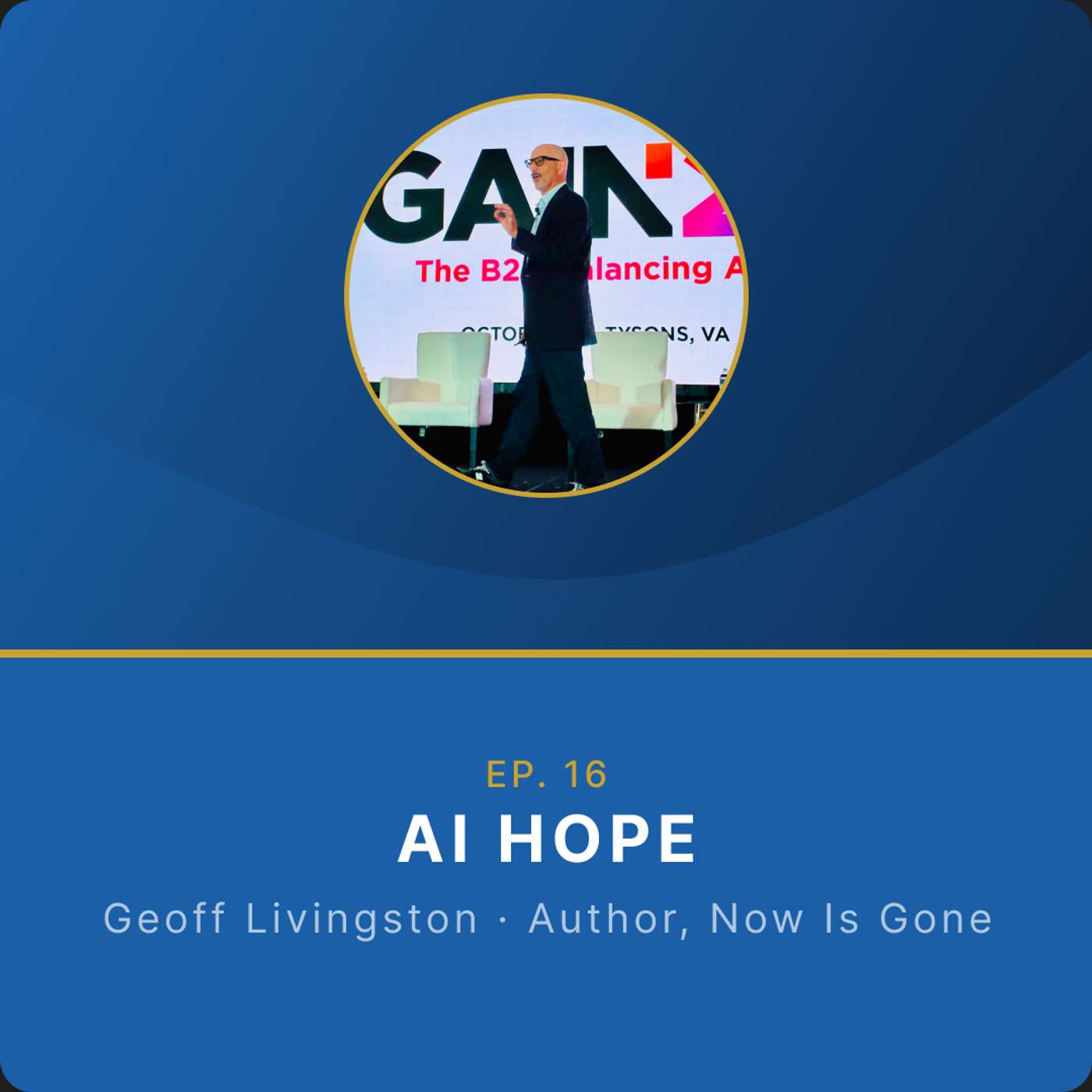
Last week I gave efficacy versus efficiency about a minute. This week it gets the whole episode. On Thursday I spoke at the GAIN Conference to business-to-government marketers, a room full of contractors and professional services firms still recovering from DOGE while facing heavy pressure to adopt AI. The distinction landed immediately, and it’s resonating with the nonprofits and professional services firms I work with, too.Efficiency has become AI code for cut costs, cut people, cut, cut, cut. Employees know it, and few employers have promised to bring them along if AI succeeds. Meanwhile, this year’s labor data suggests the promised productivity gains largely haven’t shown up. That leaves a hard question many executive teams can’t answer: beyond doing things cheaper, how does AI help you reach your business goals?Efficacy is where the hope is. It’s the mission, the North Star, and the brand promise to the customers you serve. If AI helps me reach more people, or improves the quality of what I deliver to the people I already reach, that’s efficacy. It also gives leaders a simple filter for use cases: is this on mission, and does it make us more effective? So what’s your North Star, and which AI use cases actually move you toward it?0:36 The GAIN Conference and the federal market’s AI moment2:23 Efficiency as code for cut, cut, cut5:30 Efficacy as the mission and North Star7:31 Choosing AI use cases that stay on mission

Comments

Download from Google Play

Download from App Store
 United States