


AI Unveiled - Hype vs. Reality
Subscribed: 1Played: 0
Subscribe

© Asif Waliuddin
Description
AI Unveiled - Hype vs. Reality is NextGenAI (NxtG.ai)’s evidence-led podcast on what artificial intelligence is actually changing in business, technology, and governance.
Host Asif Waliuddin separates AI theater from mechanisms, evidence, and consequences. Each episode breaks down the systems behind the headlines: agentic workflows, trust failures, governance gaps, AI-assisted development, enterprise adoption, and the operating decisions leaders will have to make as AI moves from demo to dependence.
This is not a hype show and not a generic news recap. It is for builders, operators, and decision-makers who want to understand what is real, what is breaking, and what will actually matter next.
Subscribe for:
* sharp evidence-backed analysis
* series such as The Honor System
* practical operating frameworks for AI leaders
* (nxtg.ai/insights) direct links between public signals and real enterprise consequences
Host Asif Waliuddin separates AI theater from mechanisms, evidence, and consequences. Each episode breaks down the systems behind the headlines: agentic workflows, trust failures, governance gaps, AI-assisted development, enterprise adoption, and the operating decisions leaders will have to make as AI moves from demo to dependence.
This is not a hype show and not a generic news recap. It is for builders, operators, and decision-makers who want to understand what is real, what is breaking, and what will actually matter next.
Subscribe for:
* sharp evidence-backed analysis
* series such as The Honor System
* practical operating frameworks for AI leaders
* (nxtg.ai/insights) direct links between public signals and real enterprise consequences
65 Episodes
Reverse

NextGen AI Unveiled - Hype vs. RealitySeries: "The Honor System"Episode 5.6Europe’s AI transparency rules are live. California moved on the same date. Asif Waliuddin follows a valid provenance receipt back into a compromised build environment, then asks the question U.S. leaders should answer before regulation settles: can your AI policy actually change production behavior?The episode separates principles, policies, controls, and receipts, then introduces Governance Closure: scope, control, evidence, and correction around every consequential AI decision.This is not a prediction that America will copy the EU AI Act. It is a preview of the operating questions that survive every regulatory architecture.Working evidence and series notes: nxtg.ai/insights

NextGen AI - AI Unveiled (Hype vs. Reality)Series: The Honor SystemEpisode: 4 - Trust-LaunderingA false claim becomes more dangerous when an institution signs, files, publishes, or indexes it as accepted truth. Asif Waliuddin follows a fabricated authority into a judicial order, names the signature fallacy, and builds an evidence-bearing promotion model: claim receipts, proof-set approval, and correction that reaches downstream systems.Expanded notesThe signature was real. The authority underneath it was not.Episode 4 follows an unsupported claim across the institutional promotion boundary. Once a court, consultancy, publisher, regulator, or enterprise system signs or indexes the artifact, downstream consumers inherit the institution's authority without repeating the original verification.This episode explains:- the difference between generating an error and promoting it;- why institutional familiarity compresses verification;- the signature fallacy;- claim-level evidence receipts;- why approvers should sign the proof set, not only the prose;- how corrections and revocations must reach dependent systems.Published is not proven.Never let synthetic work become organizational memory without evidence.Working evidence: nxtg.ai/insightsChapters:- 00:00 The judicial signature- 01:35 Why institutions compress verification- 03:25 Familiarity and borrowed authority- 05:30 Fresh institutional failures- 10:45 Trust laundering- 12:55 Evidence-bearing promotion- 15:35 Practice, not product- 16:20 Authority must carry receipts

NextGen AI - Unveiled - Hype vs. RealitySeries: The Honor SystemEpisode: 3 - The Memory Trust TrapA memory can be factually accurate, perfectly retrieved, and operationally wrong. Asif Waliuddin separates memory write admission from retrieval authorization and shows how stale or poisoned context becomes institutional authority.Expanded notesA hallucination invents something. A stale memory can describe the past perfectly and still drive the present in the wrong direction.Episode 3 names memory authority inversion: provisional information survives storage, returns later with more authority than it had when it entered, and influences a live action without proving it is current.The operating model separates:write admission from retrieval authorization;relevance from source authority;storage accuracy from present-tense currency;single-agent recall from cross-agent propagation;retrieval confidence from evidence-carrying recall;correction from portable revocation."The most dangerous agent memory may be the one that used to be true.""Never let synthetic work become organizational memory without evidence."Working evidence: nxtg.ai/insightsChapters:- 00:00 The memory was real; the reality was old- 01:40 Why memory is valuable- 03:10 The persistent-memory attack pattern- 07:10 Delayed activation and composition- 11:15 Memory authority inversion- 13:20 Write admission versus retrieval authorization- 16:00 Practice, not product- 16:45 The rule for organizational memory
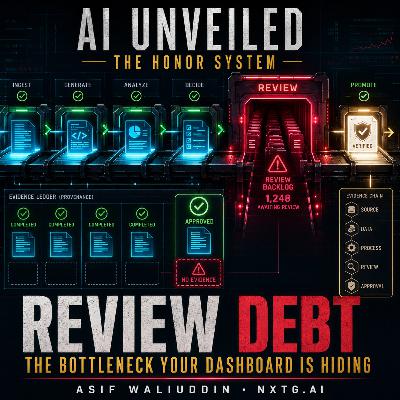
AI Unveiled — The Honor System, Episode 2Review Debt: The Bottleneck Your Dashboard Is HidingAI made generation faster. It did not make judgment faster. Asif Waliuddin follows a green status back to an empty evidence ledger, defines review debt, and gives enterprise leaders three metrics for seeing what their velocity dashboards miss: review queue age, unreviewed promotion, and unknown provenance.Expanded Spotify episode descriptionThe sensor said grounded. The evidence ledger underneath it was empty.The workflow had completed. The evidence had not.In Episode 2 of AI Unveiled — The Honor System, Asif Waliuddin names the hidden liability created when AI-generated work moves faster than qualified review: review debt.Review debt is the growing difference between what an organization has promoted as trustworthy and what a qualified reviewer or independent verifier has actually understood, challenged, and validated.This episode explains:• the four forms of review debt: queue, bypass, provenance, and comprehension;• why workflow status is not proof of validation;• how AI-generated work can distort the denominator before review metrics even begin;• what current research and industry telemetry reveal about the downstream cost of machine-speed generation;• three metrics leaders can stand up now: review queue depth and age, unreviewed promotion rate, and provenance-unknown ratio;• the honest limits of NxtG.ai’s own internal review-load instrumentation.Your workflow can move an artifact through five states without moving it one inch closer to the truth.Never let synthetic work become organizational memory without evidence.Working notes: nxtg.ai/insights

NextGen AI Unveiled - Hype vs. RealitySeries Premiere: "The Honor System"Episode 1/6: "Organizational Model Collapse — When Your Company Starts Believing Its Own AI"Notes:In June, KPMG withdrew a published report. 40 of 45 citations couldn't be verified as real.The report's title? "Redefining Excellence in the Age of Agentic AI."The machine wrote the hype about itself — and humans signed it.That's not a one-off. EY Canada. Deloitte Australia (a partial refund on a government contract). The EU's own cybersecurity agency. A national government withdrawing a policy document over an AI-invented bibliography. 1,300+ court proceedings over fabricated legal citations.Different institutions. Same mechanism: synthetic work entering trusted memory without evidence — then being consumed as ground truth.In 2023–24, researchers warned that AI models feeding on their own outputs degrade — "Model Autophagy Disorder." The under-reported finding from that same literature: collapse is avoidable IF verified real data is accumulated, never replaced.The frontier labs listened. They built verification into every serious training pipeline. Model-level collapse is largely contained — by evidence discipline.Enterprises did the opposite. Agent output flows into backlogs, knowledge bases, RAG corpora, and agent memory with no equivalent discipline. We searched the 2025–26 literature and found no one naming this failure mode, so we're naming it on the show:Organizational Model Collapse.The first real bottleneck in agentic organizations is not generation. It's digestion.In the series premiere of our new AI Unveiled series, I cover: → The 2023 lab prophecy, and the accumulation finding everyone missed → The 2025–26 evidence: Microsoft's document-corruption benchmark, DORA's instability data, the open-source "slop" revolt → The asymmetry: labs solved this with evidence discipline; enterprises are recreating it with none → Five principles of evidence governance — and the one metric we admit we haven't built ourselves yetNever let synthetic work become organizational memory without evidence.#AIUnveiled #AgenticAI #EnterpriseAI #AIGovernance #ModelCollapse

Comments

Download from Google Play

Download from App Store
 United States