


 Claim Ownership
AM Radio
Subscribed: 21Played: 214
Subscribe

Description
This 3D printing podcast doesn't shy away from asking the big questions about where additive manufacturing is currently and where it is headed.
On AM Radio, Additive Manufacturing Media hosts share stories of companies succeeding with 3D printing today; talk about emerging trends; and discuss the future opportunities and potential for AM in the context of the larger manufacturing landscape.
On AM Radio, Additive Manufacturing Media hosts share stories of companies succeeding with 3D printing today; talk about emerging trends; and discuss the future opportunities and potential for AM in the context of the larger manufacturing landscape.
60 Episodes
Reverse
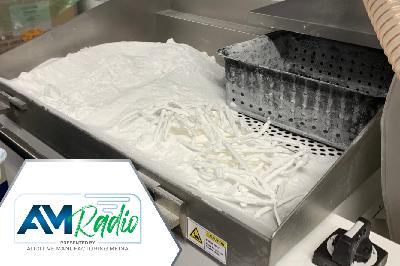
Postprocessing is a necessary part of the additive manufacturing (AM) workflow in almost every instance, because 3D printing alone rarely yields a finished part ready for use. Depending on the materials and processes they choose, AM adopters have to account for depowdering, curing, heat treat, cleaning, dyeing, tumbling, machining and many other post-print operations. Coupled with the high-mix, low-volume production typical in AM, such steps are difficult to automate or optimize — leading many companies to develop innovative and often secretive internal processes. In this episode of AM Radio, Stephanie Hendrixson, Peter Zelinski, Jessica Pompili and Jodee McElfresh share examples of how additive manufacturers solve their varied postprocessing challenges and seek to answer some of the questions around these critical steps. Thanks to listeners who sent questions, left comments or lent their expertise to this episode, including Matt Havekost, Rick Beddoe, Miguel Valenzuela, Konstantin Rybalcenko, Rey Chu, John Whalen and those who responded anonymously. Find photos, related links and the transcript for this episode on AdditiveManufacturing.Media. This episode is brought to you by Additive Manufacturing Media. Never miss a story. Mentioned in this episode: Our calls for questions — and discussion— around postprocessing on LinkedIn Meet Jessica Pompili, Additive Manufacturing Media assistant editor A conversation on finishing's role in AM with Products Finishing editor-in-chief Scott Francis Our story on ATI's new Florida facility Article on Rivelin's robotic machining technology from Derek Korn, editor-in-chief of sister brand Production Machining Video on how the Rivelin solution works AM-Flow's sorting solution for mixed part batches The Cool Parts Show LIVE: Special 5-Year Anniversary Episode with support removal "hatch" 3D Printed Metal Component for CNC Machining Center | The Cool Parts Show #47 with sacrificial powder removal feature Micro Factory's enclosed mSLA system The modular JENI production system from Photocentric Solvent recycling technology company CBG Biotech How metal injection molding and metal binder jetting coexist at Smith Metal Products The metal binder jetting workflow at Freeform Technologies An example of a thin-fin cold plate produced by Conflux Technology Resolution in vat photopolymerization and smoothing techniques developed at the Technical University of Denmark
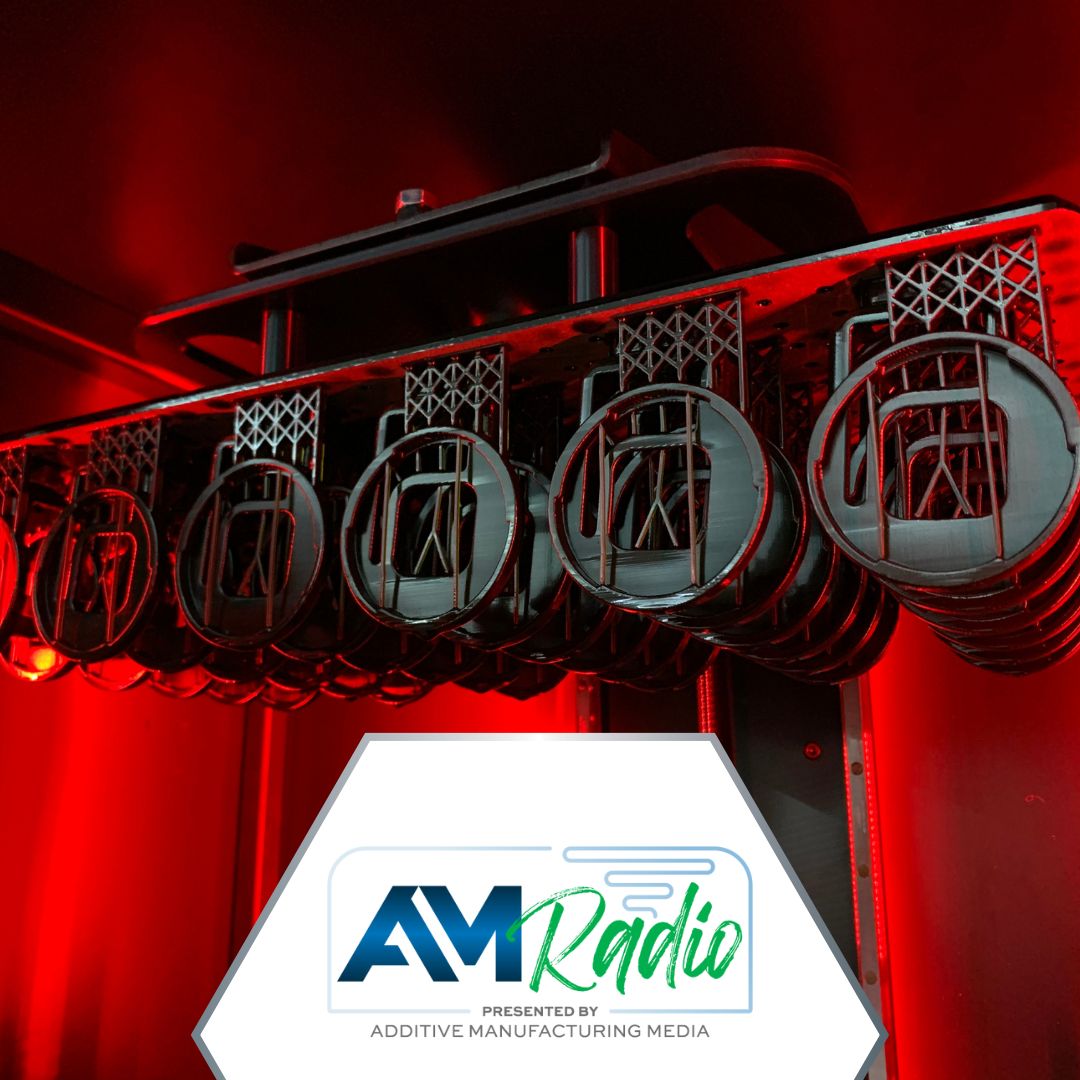
A question from an audience member about competing production rates for a forged metal part that might be made through additive manufacturing instead got Pete Zelinski thinking about production rate in general, and what this rate does and does not tell us about productivity overall. Additive can win a production "race." An example involving a 1,000-piece production run of parts otherwise made through molding was documented by Formlabs (more info below). However, is a head-to-head comparison like this the measure by which additive must succeed? Pete explores this question. Find photos, related links and the transcript for this episode on AdditiveManufacturing.Media. Mentioned in this episode: From Formlabs, 3D printing vs. injection molding for a 1,000-piece run. Our report at Big Metal Additive on directed energy deposition for Navy projectiles. Subscribe to The BuildUp, our twice-weekly Additive Manufacturing newsletter.
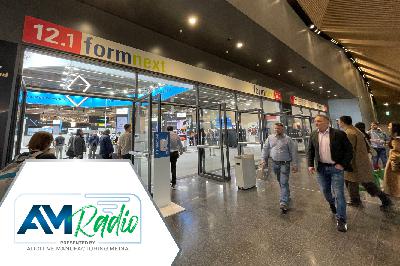
Formnext 2024 lived up to its reputation as additive manufacturing's largest trade show, attracting more than 34,000 attendees to 54,000 m2 of exhibit space. It was also large in the sense of showcasing just how big 3D printing can go, with plenty of showpieces and demos running to illustrate the current scale of large-format additive manufacturing (LFAM) technology. But beneath the robotic arms and towering prints, there were also plenty of new machine introductions, software advances and application examples. Over the course of their time at the show, AM Radio cohosts Peter Zelinski and Stephanie Hendrixson noted more semiconductor applications than ever before, an increased use of tungsten, software developments aimed at solving AM's design bottleneck, various approaches to cutting cost per part, and indications that additive manufacturing has crossed various tipping points expanding where the production method makes sense, and is on trajectory to continue that advance. In this episode of the AM Radio podcast, hear observations from the show floor and takeaways for additive manufacturers. Find photos, related links and the transcript for this episode on AdditiveManufacturing.Media. This episode is brought to you by Additive Manufacturing Media. Never miss a story.
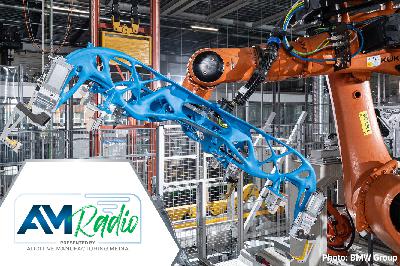
Additive manufacturing and robots are parallel technologies, both digitally enabled tools for manufacturing that are advancing in adoption. But they also enable each other. 3D printing can provide the grippers, end effectors and other specialized tooling that robots require to serve production. And robots are driving AM forward as well. Collaborative robots or cobots are being used to tend 3D printer farms, sometimes mounted on autonomous guided vehicles (AGVs) for a fully mobile, as well as automated, solution. And robots are opening opportunities for larger and more complex part production, by providing the motion for a growing number of large format additive manufacturing (LFAM) systems. In this episode of AM Radio, Gardner Business Media Robots & Autonomy editor Julia Hider joins Stephanie Hendrixson and Pete Zelinski to discuss how AM and robots interact, and specific examples of this interaction. Find photos, video, related links and the transcript for this episode on AdditiveManufacturing.Media. This episode is brought to you by The Cool Parts Show. Sign up for All Access. Mentioned in this episode: Julia's Robots and Autonomy reporting How Savage Automation produces 3D printed end effectors for injection molders Rapid Robotics and Robots as a Service (RaaS) Large, 3D printed grippers used by BMW to handle car parts Pete's Formnext robot gripper encounter (first photo) Julia's story on the Advanced Robotics for Manufacturing (ARM) Institute, home of the 3D printed LEGO gripper More advanced and additive manufacturing work happening in Pittsburgh How AM enables cobot automation for Thyssenkrup Bilstein Examples of 3D printed cobot tooling provided by EMI Corporation, as seen in the Universal Robots booth at NPE Evco Plastics' Markforged printer cell, tended by a cobot informed by email Soft grippers and their potential usefulness for handling 3D printed parts The Mosaic Array 3D printer cell, enclosing four individual printers tended by one gantry system Javier, Ford Motor Company's AGV-mounted cobot for tending polymer printers Branch Robotics' mobile robot for tending a farm of potentially dissimilar 3D printers How Alquist 3D supports both on-site construction and in-house serial production with robot 3D printing A large casting replacement produced by Lincoln Electric using robot-based wire arc additive manufacturing (WAAM) What Additive Engineering Solutions (AES) is learning in the transition from gantry- to robot-based LFAM How Double D plans to build next-generation horse trailers with robot-enabled 3D printing
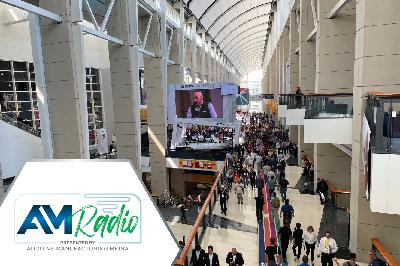
The 2024 edition of IMTS – The International Manufacturing Technology Show welcomed more than 89,000 attendees to Chicago last week. While only a portion of the show's 1,500 exhibitors were offering additive manufacturing equipment or services, AM nevertheless had a significant footprint at this show. Conversations with speakers, exhibitors and attendees revealed insights about where additive is finding traction now, and where it is heading next. In this episode of AM Radio, I talk with Pete Zelinski about equipment launches during the show, advances in usability and accessibility, AM's role in the casting supply chain, the increased presence of service providers, and how the next "phase" of AM will look different. Find photos, related links and the transcript for this episode on AdditiveManufacturing.Media. This episode is brought to you by Additive Manufacturing Media. Never miss a story. Mentioned in this episode: LinkedIn feeds: Stephanie | Pete Videos from the show: Robot Machining and Robot DED Video: Scanning for Fast Model Capture and Validation of AM Parts More to come — subscribe to The BuildUp Markforged FX10 Metal Kit 3D Systems Titan EXT 800 pellet printer Formalloy, developer of the DED Smart Path scanning module Stratasys F3300 and Origin 2 One Click Metal (video to come) EOS dual setup system for laser powder bed fusion Mazak hot wire hybrid deposition machine Würth Additive Group's DIS platform (video to come) How DIS integrates with Raise3D's resin 3D printers A test of Spee3D's cold spray technology in expeditionary manufacturing Meltio M600 DED machine Colibrium Additive (formerly GE Additive) and the impact of binder strength for production Oak Ridge National Laboratory integrated machining/DED system Perspective on hybrid manufacturing from Hybrid Manufacturing Technologies, which showcased its 45° deposition head More on service providers 3DEO and Forecast 3D/GKN Additive Desktop Metal Studio System Nikon SLM Solutions on continuing adoption: Here is an example (valves) HP 3D printing

Comments

Download from Google Play

Download from App Store
 United States