


 Claim Ownership
Additive Snack
Subscribed: 42Played: 340
Subscribe

© 2026 EOS
Description
Join host Fabian Alefeld and a range of guests as they discuss all things additive manufacturing (AM) and 3D printing news, with interviews and real-world stories to educate and entertain. Each episode, Fabian talks to AM experts, professionals in specialist fields, and 3D printing users from all walks of life to deliver a well-rounded view on the state of AM.
Cut through the confusion surrounding polymer and metal additive manufacturing solutions with our digestible, down-to-earth discussions that deliver insights into common mistakes and best practice tips so you can get a clear understanding of AM — layer for layer.
Whether you’re curious about 3D printing technology for the aerospace industry, a deep dive into post processing, or applications of injection molding — we leave no spare parts behind. We want to provide you with the additive insight needed to stay laser focused and leverage every opportunity 3D printing materials have to offer.
Join us for an Additive Snack and we’ll help you and your business achieve growth and success through the latest developments in AM.
No marketing B.S. and no product pitches. Just the education, inspiration and information you and your organization need to drive business growth, brought to you by global AM leader EOS.
Get ready to feed your AM knowledge and find your path to success!
Cut through the confusion surrounding polymer and metal additive manufacturing solutions with our digestible, down-to-earth discussions that deliver insights into common mistakes and best practice tips so you can get a clear understanding of AM — layer for layer.
Whether you’re curious about 3D printing technology for the aerospace industry, a deep dive into post processing, or applications of injection molding — we leave no spare parts behind. We want to provide you with the additive insight needed to stay laser focused and leverage every opportunity 3D printing materials have to offer.
Join us for an Additive Snack and we’ll help you and your business achieve growth and success through the latest developments in AM.
No marketing B.S. and no product pitches. Just the education, inspiration and information you and your organization need to drive business growth, brought to you by global AM leader EOS.
Get ready to feed your AM knowledge and find your path to success!
105 Episodes
Reverse
Fabian Alefeld welcomes back Harshil Goel, founder and CEO of Dyndrite, to discuss how current additive manufacturing (AM) qualification practices limit advanced laser powder bed fusion toolpaths by locking variables such as software, machine, strategy, layer height, and material. Harshil reviews MQ, IQ, OQ, and PQ, noting cost and rigidity increase toward part qualification. They discuss Dyndrite’s roles in multiple America Makes efforts: AI4AM to reduce the specimen counts needed for material allowables (starting with 17-4PH) using improved statistical methods; DeltaQual 2.0 to enable “bracketed qualification” so parameter changes within a defined process window don’t retrigger requalification (including varying layer heights within a part); and Gotham to transfer scalable, qualified parameter approaches across different machines and sizes using materials like Scalmalloy. Harshil describes “Sasquatch,” a physics-based KPV framework using ratios (e.g., energy density, enthalpy, melt pool dimensions) to bound process windows and increase confidence without relying solely on sensors or simulation, and highlights software and AI accelerating DOE and parameter iteration with a target program timeline of about two years.01:34 What Dyndrite Builds02:11 Why Qualification Blocks Innovation03:58 IQ OQ PQ MQ Explained08:22 PQ Locks Everything Down09:00 America Makes Program Overview09:57 AI4AM Materials Allowables12:39 Process Windows Not Fixed Params14:57 Delta Qual 2 Bracketed Qual17:38 Partners Sensors And Confidence19:25 Sasquatch New KPVs25:33 Gotham Scaling Across Machines27:07 Future Less PQ More Reuse28:39 Industry Impact Of Faster Qual29:52 Customer Owned Parameters30:54 Additive As Moat32:13 Microstructure Driven IP33:12 Selling Machine Control34:31 Breaking Vendor Silos35:36 Two Year Timeline37:57 Risks And Adoption41:23 Software As Glue42:11 AI Accelerated DOE45:34 Math Meets Empiricism49:48 Future Outlook Wrap
Fabian Alefeld interviews Brandon Brodie, co-founder and CEO of Annihilator Broadheads, about how an Idaho elk hunt and a lost bull sparked a new broadhead concept sketched by Brandon’s future partner Micah. They describe turning the 2D sketch into plastic CAD prototypes via Boise State, a makeshift “wind tunnel” test using Instant Pot steam, and early performance goals of flight, penetration, durability, and lethality. Field and improvised tests (steel drum, long-range accuracy, animal kills) plus third-party fluid dynamics modeling suggested Annihilator’s design created unusually large high-pressure and low-tension effects. After major supply failures with investment casting and metal injection molding - causing shortages, high scrap rates, and lost dealers - Brodie brought manufacturing in-house, adopting metal laser powder bed fusion, improving repeatability and enabling new geometries like the Katana. He outlines ongoing innovation, potential adjacent products, and plans to leverage Annihilator’s additive capabilities for partnerships and contract manufacturing. 02:26 Elk Camp Origin 06:43 Sketch to Prototype 11:36 Instant Pot Wind Test 14:44 Performance Pillars 18:41 Steel Drum Proof 22:45 Real Hunt Validation 26:45 Fluid Dynamics Breakthrough 30:41 Engineering Led Marketing 33:32 Manufacturing Growing Pains 34:27 Industry Award Surprise 35:53 COVID Demand Crunch 36:54 Casting Supplier Failures 39:40 MIM Tooling Disaster 42:30 Additive Breakthrough 46:35 Learning Metal Printing 49:55 Repeatability and Materials 52:56 Katana Broadhead Innovation 57:49 Scaling R&D Team
Host Fabian Alefeld interviews Professor PS Lee, Head of National University of Singapore Mechanical Engineering & Program Director of STDCT, and founder of CoolestDC, about heat as a key constraint in AI infrastructure as data centers shift from CPU-heavy to GPU-dense systems with higher power density, hotspots, and bursty workloads. Lee explains why cooling must be treated as an integrated “chip to grid” system spanning cold plates, racks, CDUs, piping, controls, and operations, and discusses single-phase versus two-phase direct-to-chip liquid cooling and the added need for condensation in closed loops. Professor Lee describes how additive manufacturing (AM) enables complex fin structures and unibody cold plates that reduce leakage risk, lower junction temperatures (~10°C), cut pumping power (60–70%+), and reduce material use, while requiring TCO evaluation. At NUS’s live testbed (22 liquid-cooled racks, ~500 kW), AM cold plates are being deployed and show promising thermal, power, and compute-performance improvements; future work includes two-phase cooling and broader system-level heat rejection, warm-water operation, and waste-heat reuse, plus a discussion of challenges and potential AM roles in space-based data centers. 02:13 Meet Professor Lee 05:26 Chip To Grid Cooling 10:22 Liquid Cooling Maturity 14:15 Two Phase Explained 18:12 Cold Plate Tradeoffs 20:40 AM Unibody Cold Plates 24:41 Benchmarking AM Gains 30:18 AM For CDUs 34:13 Inside STDC Testbed 38:09 Reliability And Leakage 39:00 Next Phase Roadmap 42:31 Orbital Data Centers
In this episode, Fabian Alefeld sits down with Ante Lausic, Lead Process Engineer at General Motors' Additive Industrialization Center (AIC), to explore what it takes to successfully scale additive manufacturing (AM) in the automotive industry. Ante explains why automotive manufacturing demands more than innovative technology - it requires AM-native designs, cost-effective production, automotive-qualified materials, and repeatable processes capable of supporting high-volume manufacturing. He also shares how GM has evolved from using AM primarily for rapid prototyping to establishing the Additive Industrialization Center in 2020 to evaluate new technologies, validate production readiness, and strengthen collaboration across the supply chain.The conversation highlights real-world production applications, including the Cadillac Celestiq, which incorporates more than 130 AM components, such as a safety-critical binder-jetted stainless steel seatbelt guide and aluminum steering wheel trim. Ante also discusses the rapid growth of additive manufacturing for tooling, including die-casting inserts, plant fixtures, and end-of-arm tooling, and offers his perspective on where the technology is delivering the greatest value for automotive manufacturers today.01:56 Scaling AM in Automotive05:10 Value and Cost Reality07:27 GM Additive Center Origins11:02 Educating Engineers and Suppliers14:34 Celestiq AM Success Stories19:44 Supplier Freedom and Standards23:00 Tooling Inserts Big Wins27:50 End of Arm Tooling Growth29:36 Motorsports and F1 Links32:10 Aftermarket Digital Warehousing33:39 Materials and PPAP Hurdles36:14 PPAP Explained Simply38:43 Rethinking Qualification Costs41:07 Scaling to Corvette Volumes
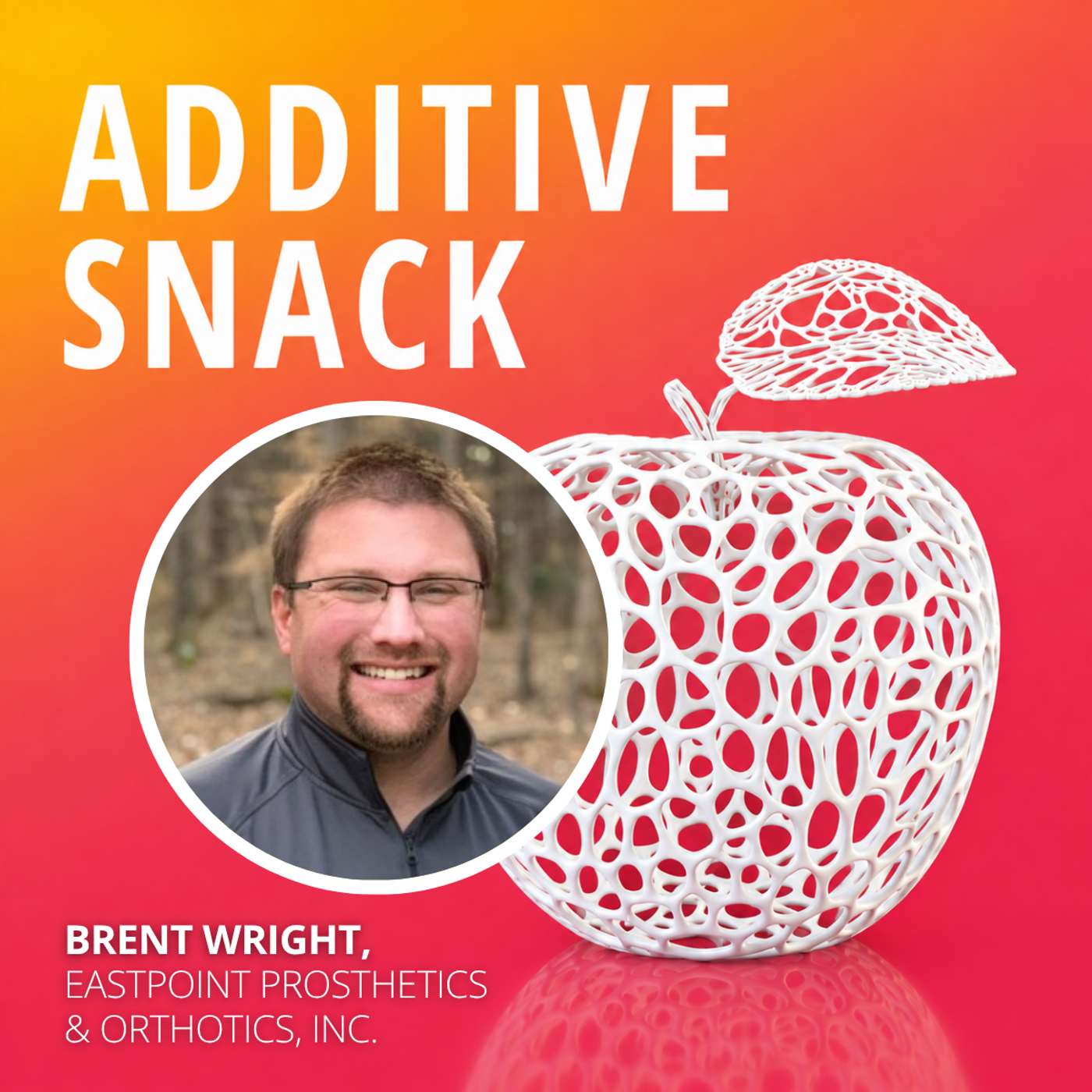
Fabian Alefeld interviews certified prosthetist/orthotist and EastPoint Prosthetics VP Brent Wright about his career path into O&P, his shift from being anti-digital to adopting scanning and additive manufacturing, and the impact on patient care and global access. Wright describes traditional fabrication workflows (casting, plaster positives, vacuum forming thermoplastics for orthoses, and carbon fiber/resin layups for prostheses) as artistic but time-consuming, hazardous, and lacking records. His digital journey accelerated after a Guatemala trip with Life Enabled highlighted the need to scale care; he focused on scanning, digital modification, and later powder-bed fusion, moving toward SLS with materials like PK5000 and TPU. He emphasizes pressure casting for prosthetic sockets, the value of digital records for insurance, and how AM can change socket “dynamics” to improve comfort and heal wounds. The discussion also covers RADii’s data-driven fitting approach, Life Enabled’s mix of traditional and 3D-printed solutions (including pediatric feet), modular “kit” concepts for developing regions, and barriers to sensors/actuators in the US due to reimbursement.02:33 Brent Origin Story09:30 Why Go Digital11:17 Scaling Global Access17:32 Traditional O&P Workflow20:02 Casting And Fabrication Steps24:07 Digital Workflow And Scanning33:22 Benefits Of Digital Records36:36 Flexible Liner Heals Wound40:47 RADii Data Meets Craft46:06 Life Enabled Model01:01:50 Democratizing via Manufacturing01:08:01 Sensors vs Simplicity

Comments

Download from Google Play

Download from App Store
 United States