


Ag Emerge Podcast
Subscribed: 48Played: 1,394
Subscribe


© All rights reserved
Description
Soil health, regenerative practices, and emerging technology — The AgEmerge Podcast. Join our host, Monte Bottens, as he engages with guests from diverse agriculture interests to discuss experiences, practices and scalable applications for any operation. Tune in to new episodes every other Tuesday to regenerate your ideas, soil, crops, livestock and livelihood.
ag-emerge
ag emerge
ag-emerge
ag emerge
198 Episodes
Reverse

Rob discusses moving from dairy farming into custom hay work, using strip till and diverse cover crops to improve soil, and adopting robotic sprinklers to apply water more precisely. He also shares lessons from experimenting with new equipment, why he sees winter cover crops as a profit center, and how his definition of legacy changed after the family sold its dairy.
About Robert Boyle: Robert is an innovative Arizona farmer and the 2026 Strip-Till Innovator, recognized for his commitment to water conservation, efficiency and sustainable agriculture. Raised on a dairy farm in Chandler, Arizona, Boyle later moved south to Coolidge, where he expanded into dairy production, forage crops and custom farming. After transitioning fully to crop production in 2019, he built an intensive forage operation that now includes baling roughly 4,000 acres every 28 days, producing up to 10 cuttings annually plus green-chop harvests. His practical approach to conserving water while maintaining productivity has made him a leader in advancing more resilient farming systems in the arid Southwest.
Rob jokes that Coolidge is “a quarter mile from hell,” describing the area’s unusually hot well water. He explains how cover crop roots helped improve soil conditions where repeated tillage had fallen short. After selling the family dairy, Rob came to see his daughter—not the cows—as his legacy.
Robert shares how a third-generation Arizona farm evolved from dairying into a highly efficient custom hay and row-crop operation. The conversation centers on strip till, high-diversity cover crops, and precision irrigation, with a strong focus on making farming work in a hot, salty, high-pressure water environment. Monte and Robert talk about adapted machinery, water management, and crop rotations to stay profitable under urban pressure and shrinking water access.
Timestamps:
03:20 Building an efficient operation with technology
04:31 How steamers changed desert hay baling
06:28 Making premium horse hay
08:09 Getting started with strip till
15:40 What changed Rob’s mind about cover crops
16:36 Cover crops as a profit center
18:45 Winter forage economics and seed costs
19:41 Water availability and making cover crops work
21:38 Lessons from turnips and radishes
24:47 Why Rob pursued 360 Rain irrigation
26:43 Adapting robotic irrigation to Arizona conditions
29:57 Comparing targeted irrigation with flood irrigation
32:44 Using lagoon water with irrigation equipment
35:02 Portable irrigation on rented ground
38:02 Managing salinity and pH with humic acid
40:09 Development pressure around Coolidge
44:51 Family, farming, and the future of the operation
49:07 Redefining legacy after selling the dairy
52:06 Rob’s vision for smaller autonomous machines
59:42 What could come next for irrigation robots and biologicals

Iowa’s fight over water quality is no longer academic. Monte Bottens sits down with Chris Jones—a research scientist, author, water-quality expert, and candidate for Iowa Secretary of Agriculture—to examine how nitrate pollution, agricultural policy, public health, and rural decline are shaping the future of farming.
Chris has spent more than 40 years advocating for clean water and sustainable agricultural practices. He managed the water-quality testing laboratory at Des Moines Water Works for eight years, helping oversee operations at one of the world’s largest nitrate-removal facilities. He later worked as an environmental scientist at the Iowa Soybean Association, where he helped establish some of the state’s first independent water-quality monitoring systems.
At the University of Iowa, Chris worked as a research engineer and helped develop Iowa’s first real-time public water-quality sensor network, giving the public unprecedented access to information about the condition of the state’s rivers and streams. He is also the author of The Swine Republic: Struggles With the Truth About Agriculture and Water Quality, selected by the Library of Congress to represent Iowa at the 2024 National Book Festival. In 2024, he helped found Driftless Water Defenders, a grassroots organization protecting the waters of northeast Iowa’s Driftless Area.
During their conversation, Monte and Chris explore the forces behind polluted rivers and stressed water systems—from tile drainage across the Des Moines Lobe to the timing and rate of nitrogen and manure applications. Chris explains how fall fertilizer applications, concentrated livestock production, CAFO placement, and wet soils influence what appears in rivers months later. He also discusses why cover crops may provide their greatest water-quality benefits during the spring.
Chris Jones Online:
https://www.facebook.com/chrisjones4ia
https://www.instagram.com/chrisjones4ia
https://www.youtube.com/@chrisjones4IA
Timestamps:
02:15 - Chris Jones explains his run for Iowa Secretary of Agriculture
09:17 - How the Des Moines water system faces nitrate pressure
13:07 - How tile drainage carries nitrate from fields to streams
16:20 - Why nitrate loss is driven by weather, soils, and mineralization
23:53 - Rate, timing, and distribution as the real nutrient challenge
28:04 - What cover crops can and cannot do for nitrate reduction
31:13 - Spring versus fall manure timing and nitrate loss reduction
34:28 - Why fall anhydrous often means more total nitrogen applied
39:16 - Why diversification, not just regulation, may be the long-term fix
43:30 - Meat processors, livestock diversity, and rebuilding local economies
44:56 - Oats, food hubs, and creating a third crop for Iowa
49:27 - Soil health as the underlying system behind better water quality
53:03 - Why the burden should not fall only on farmers
54:35 - Getting 50% of Iowa school food from Iowa farms
59:09 - Food hubs, small-acre farming, and opportunities for young growers
61:12 - Dignity, consolidation, and what agriculture has taken away
63:12 - Five policy changes Jones says Iowa should pursue
73:32 - Help for beginning farmers and access to land

Autonomous tractors are only the beginning. The next breakthrough in ag tech is a physical AI layer that can learn, adapt, and make farms dramatically more efficient without forcing every grower to become a robotics expert. Colin Hurd returns to the AgEmerge Podcast with a behind-the-scenes look at where ag autonomy really stands now, why retrofit solutions are only part of the story, and what has to change before self-driving machines become truly useful in the field.
From dusty harvest conditions that break today’s sensors to the opportunity for AI systems to preserve hard-earned farming knowledge, this conversation gets into the real bottlenecks - and the real upside - of the next five years.
Colin has devoted his career to leading innovative companies in the machinery industry. In 2016, Colin founded his second company, Smart Ag, which developed the first retrofit driverless system to automate tractors. After funding and growing the company, he led Smart Ag successfully through an exit to Raven Industries (NYSE:RAVN) in 2019. Raven was then acquired by CNH Industrial in 2021 (NYSE:CNHI). Colin stayed with Raven and managed business development until forming Mach in 2022.
Learn about Mach: https://mach.io/about-us/
Timestamps
07:08 - Why physical AI could transform the next 5 to 10 years on the farm
10:39 - Colin’s first startup and the soil compaction problem behind Track Till
12:06 - Why preventing compaction led him into autonomy
13:05 - Smart Ag, autonomous grain carts, and the Raven acquisition
14:34 - Building Mock by acquiring autonomy companies with complementary strengths
16:56 - Mach's thesis: OEMs can source autonomy instead of building or buying it all
18:18 - Why off-road engineering talent is hard to recruit and even harder to localize
20:05 - Why lidar struggles in dusty ag environments
21:04 - Radar-based sensing as Mock’s bet for off-road autonomy
22:53 - Why OEM size creates different autonomy needs across large, mid-sized, and shortline brands
24:21 - Mach's modular stack and why it stays OEM-only
26:20 - Why large enterprise users can help accelerate OEM go-to-market timing
27:29 - Retrofit autonomy and why Mach is avoiding that business model
29:14 - Why smaller, autonomy-first machine designs may be the real future
31:20 - Redesigning machines for autonomy instead of bolting it on
34:15 - One operator supervising eight machines in orchard autonomy
35:08 - Where humanoids fit into agriculture and what they would actually do
37:28 - From rigid path planning to non-deterministic physical AI
39:05 - Machines that understand objectives instead of only following pre-programmed routes
40:44 - The three core autonomy buckets: connectivity, situational awareness, and navigation
42:03 - Physical AI as a supervisory intelligence layer on top of the stack
43:03 - Agentic systems, self-repair, and the right-to-repair conversation
45:46 - Transferring farm knowledge, field history, and terrain awareness into machine behavior
47:16 - Using autonomy to support sustainable practices and reduce cost per acre
48:14 - Why cover crop adoption could accelerate if machines could learn from broader experience
50:37 - Physical AI as a way to reduce fear of failure in new practices
55:23 - Why recursive learning on-device is difficult, but data collection and fleet learning are realistic
58:32 - How farmers can connect with autonomy companies and stay current on emerging tech
63:07 - How Ag Startup Engine was built as an investor-managed fund with farmer input
65:39 - PlowVision and AI-guided cutting in meat processing
67:18 - Terra Blaster and real-time nutrient application for soil health
68:47 - Why founder feedback and customer validation matter more than hype
73:18 - The tradeoffs between angel investing and participating in a fund
74:13 - How farmers can get involved as accredited investors and pilot early autonomy tech
75:39 - Why Mach's technology aims to make agriculture more efficient and more regenerative
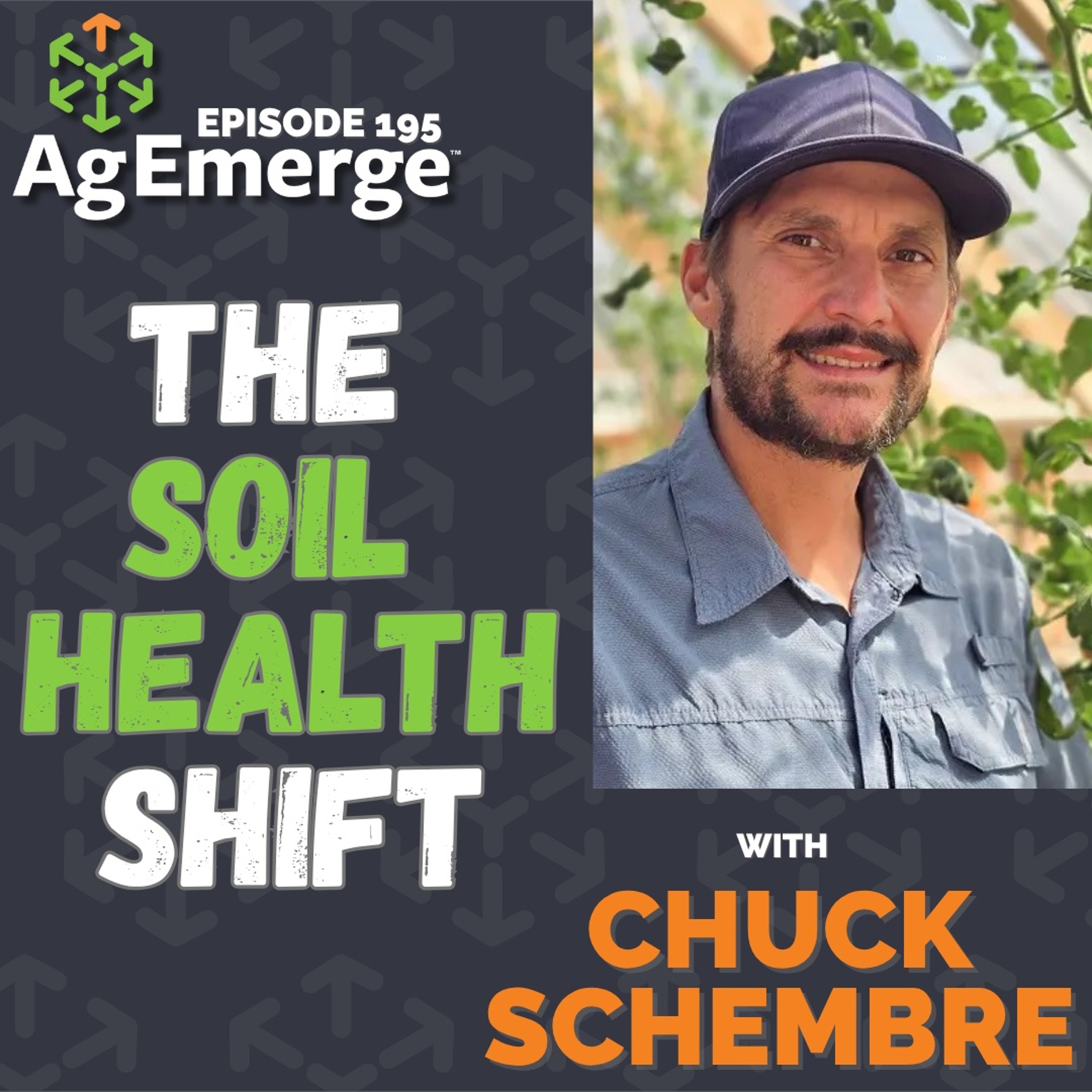
Regenerative agriculture is not a slogan—it is a system. And Chuck Schembre knows where that system can break, where it works, and how growers can make the transition without throwing yields out the window.
If you care about specialty crops, produce, vineyards, apples, almonds, or the real-world economics of farming differently, this conversation is for you.
Chuck brings a rare perspective shaped by both science and hands-on farming. From working restaurant lines with peak-season tomatoes and onions that changed how he thought about food, to farming across California, Sonoma, Napa, and now the high desert of Nevada, he shares the path that led him into soil health, ecological farming, and regenerative consulting.
This conversation gets into the realities behind regenerative agriculture—not just the ideals. Chuck and Monte discuss why transitions are so complex, what actually motivates growers to change, and why removing one conventional practice can create ripple effects across an entire production system.
They explore herbicide reduction in orchards and vineyards, cover crop termination, fertility management, phosphorus overapplication in organic systems, food safety challenges in produce, and why regenerative farming doesn't necessarily mean eliminating every conventional tool.
Chuck also explains why context matters. A practice that works on a small diversified farm may not translate directly to a large produce operation, vineyard, or orchard. Successful transitions require understanding the entire system, the economics behind it, and the realities growers face in the field.
**About Our Guest**
Chuck Schembre is the owner of High Desert Harvest Farm, a small diversified regenerative farm in Washoe Valley, Northern Nevada, and founder of EcoSoil Solutions, a soil health and regenerative agronomy consulting company.
A Certified Professional Soil Scientist and agronomist, Chuck has two decades of experience farming organically and regeneratively while interpreting soil and plant health metrics and connecting them to practical farm management. His experience ranges from small-scale organic vegetable systems to large orchard and vineyard operations.
He holds a B.S. in Earth and Soil Science from California Polytechnic State University, San Luis Obispo.
Find Chuck online: https://ecosoilsolutions.com
**Timestamps**
06:14 – Napa demo farm and the move to northern Nevada
08:40 – Cal Poly: soils, organic farming, and surf
10:31 – How fresh tomatoes and onions changed his understanding of food
17:35 – Regenerative transitions and finding committed buyers
21:23 – Soil tests, sap testing, and grower experience
23:47 – What motivates growers to change
31:23 – Why chemical reduction often starts with weed management
36:38 – Moving beyond herbicide dependence
37:07 – Systems thinking: one change affects everything else
42:20 – Why cover crop termination is the key decision
43:14 – Myth-busting regenerative agriculture in specialty crops
46:33 – When conventional fertility may still have a role
47:55 – Phosphorus overapplication in organic systems
48:49 – The tool chest: conventional, organic, and regenerative constraints
50:20 – Restoring orchards before replanting
51:08 – Food safety rules and soil health in produce
53:02 – Why large-scale produce is difficult to transition
58:34 – How small growers can profit through creative sizing and packing
64:49 – Why being a farmer makes Chuck a better consultant

Unlock the future of sustainable farming with Dr. Jessica Chiartas, currently serving at the University of British Columbia. Her research focuses on the long-term impacts of agriculture on soil carbon and overall soil health with a unique focus on carbon at depth. Jessica shares her inspiring journey from corporate pharma sales to pioneering soil health measurement frameworks that could transform global agriculture. Discover how her RegenScore provides a practical, evidence-based way for farmers, brands, and consumers to quantify and promote regenerative practices—beyond mere labels and checkboxes.
In this episode, Jessica breaks down the complexities of regenerative agriculture, from soil’s vital role in climate resilience, water quality, and human health, to the challenges of creating scalable scoring systems that respect local context. You'll uncover the innovative process behind developing region-specific metrics, the importance of community and farmer-centric approaches, and how technology and storytelling are shaping a new era of transparency and impact. We dive into the intersection of soil science, market mechanisms, and consumer choices, revealing why understanding soil health is essential not just for farmers but for everyone invested in a sustainable future.
Jessica shares why regenerative farming isn’t a one-size-fits-all solution but a nuanced, evolving journey—one that requires collaboration across sectors and disciplines. She emphasizes the psychological and social shifts needed to inspire widespread adoption, highlighting the power of education, trust, and tangible health outcomes. Learn how soil health ties directly to climate resilience, biodiversity, and human wellbeing—and why immediate action is critical to avoid slow, irreversible damage.
This episode is perfect for farmers needing practical pathways to adopt regenerative practices, investors and brands seeking credible impact metrics, educators passionate about soil awareness, and anyone curious about how farming can heal the planet while supporting healthy communities. Jessica’s optimistic outlook reminds us that rapid, positive change is possible—if we leverage science, technology, and storytelling to fuel systemic shifts. Tune in to feel empowered to connect with the ground beneath your feet and imagine a healthier, more resilient future for all.
Resources
Regen Score Framework - https://regenscore.org
Soil Life Project - https://soil.life
Jessica Chartis - UBC Profile - https://ubc.ca/jessica-chartis
Chapters
00:00 Introduction and Jessica's background
01:59 Jessica's journey from pharma to soil science
03:52 Soil health and its impact on human well-being
06:46 Development of Regen Score and its principles
10:14 Regional specificity and scaling of Regen Score
14:57 Challenges and opportunities in regenerative measurement
19:45 Market drivers and consumer engagement
25:07 Food as medicine and health impacts
30:14 Soil health, biodiversity, and environmental benefits
34:51 Policy, economics, and market pull for regenerative farming
40:08 Future outlook and hope for regenerative agriculture
45:00 Practical steps for farmers to adopt regenerative practices
49:58 Jessica's vision for education and soil awareness
55:04 Closing thoughts and optimism for the future

Comments

Download from Google Play

Download from App Store
 United States