


 Claim Ownership
All For Literacy
Subscribed: 45Played: 519
Subscribe

© Copyright 2023 All rights reserved.
Description
The All for Literacy podcast connects you with the voices, research, and practices transforming how we teach reading—because every student deserves instruction that works. Through monthly podcasts, hosted by Lexia’s Senior Education Advisor Kerri Larkin, this series forges connections between literacy research and educators’ knowledge and skills. This is a conversation that will have a real impact on teachers and students, with actionable information and research designed to support our goal of literacy for everyone.
All for Literacy brings together researchers, educators, and experts to elevate literacy in America and create real equity in the classroom.
35 Episodes
Reverse
In this episode of All For Literacy, host Kerri Larkin sits down with Dr. Marisa Ramirez Stukey, Chief Academic Officer of The Reading League, to explore what it really takes to turn literacy research into meaningful classroom practice. Together, they unpack why the science of reading—while essential—is not enough on its own, and how the science of learning and implementation science are critical to achieving lasting, equitable literacy outcomes.
This conversation dives into the realities educators face every day, from competing initiatives to limited time and resources. Dr. Stukey challenges traditional ideas of fidelity, emphasizing integrity, context, and systems-level alignment. Listeners will come away with a clearer understanding of why real change requires not just adding new programs, but also removing barriers, de-implementing what no longer works, and supporting educators with coherent, connected professional learning.
Why knowledge alone doesn’t change practice
What implementation science looks like in real classrooms
Fidelity vs. integrity in literacy instruction
Identifying and removing systemic barriers
The importance of de-implementation for long-term change
A must-listen for educators, school and district leaders, and anyone committed to evidence-based literacy transformation.
In this episode of All For Literacy, host Kerri Larkin sits down with Maggi Lambert, principal of Cloud Peak Elementary in Buffalo, Wyoming. Together, they unpack how a rural school community transformed its approach to literacy—moving from one-size-fits-all interventions to a dynamic, data-driven, and collaborative model that empowers every educator and student.
Maggi shares her journey from classroom teacher to principal, the pivotal role of professional learning, and how including paraprofessionals and using data as a tool (not a weapon) led to measurable student growth. If you’re a school leader, teacher, or literacy advocate, this episode is packed with actionable insights and hope.
00:00 – Welcome & The Power of One
01:28 – Community & Collaboration
03:15 – Maggi’s Journey: Teacher to Principal
07:25 – The Catalyst for Change: Data & Discomfort
12:07 – From Intervention to Prevention
15:27 – Collaboration & Professional Learning
18:04 – Data as a Tool, Not a Weapon
21:57 – Student Impact & Results
37:53 – Advice for School Leaders
45:08 – Maggi’s Reading Stack
👍 If you found this episode helpful, please like, comment, and subscribe for more conversations on literacy, leadership, and school transformation.
What happens when a district empowers its teachers to lead change? In this episode, three educators from Federal Way Public Schools in Washington share how a grassroots effort turned into a systemwide literacy transformation across one of the state’s most diverse districts.
A “middle-out” professional development approach that started with teachers and coaches instead of administrators
Teacher-led transformation sparked by a kindergarten and first grade teacher exploring the science of reading
LETRS training implementation with stipends, accountability emails, and protected learning time
A comprehensive five-year literacy plan addressing curriculum, assessment, schedules, and support structures
Systems change, not just PD, ensuring a holistic approach to districtwide literacy improvement
Voluntary teacher engagement, with hundreds of teachers requesting LETRS by Year 4
Support structures that work, based on the idea that accountability + collaboration = more impactful training
Listen now to learn how this team is redefining literacy success—and how your district can, too.
Don’t forget to subscribe to the podcast for more stories of innovation, leadership, and impact in education.
Season 5 of All For Literacy kicks off with new host Kerri Larkin, Lexia’s Senior Education Advisor, who brings years of classroom and leadership experience to the mic.
Come join us as we dive into how the science of reading implementation is landing in real classrooms with real educators who are making this happen.
Does maintaining their heritage language help students develop literacy skills in English? The research says “yes.”
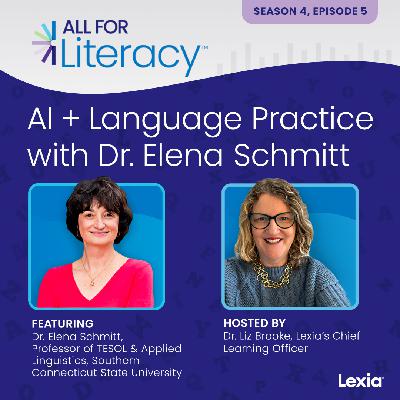
Dr. Elena Schmitt, professor of applied linguistics and educational researcher, joins All For Literacy host Dr. Liz Brooke for a detailed discussion about how supporting a student’s bilingualism supports the whole child. From maintaining access to key cultural and social interaction to supporting English literacy acquisition, helping students maintain their first language is worth the effort.
Gain an understanding of:
How to apply the research when it comes to supporting English language learning
Actionable ways educators can support bilingual students in their classrooms
Why the advice to “speak English at home” can be detrimental to students
How to create an inclusive environment centered around translanguaging
Tune in to Episode 5 for an inspirational, research-backed discussion about how heritage languages, bilingualism, and translanguaging affect student identity and success.
About Dr. Elena Schmitt
Dr. Elena Schmitt is a professor of applied linguistics and coordinator of the master’s in bilingual education and TESOL program at Southern Connecticut State University. Her research focuses on language contact, first language attrition, classroom interaction, teacher education, and technology-assisted teaching.
Join our community of listeners at All For Literacy today!

Comments

Download from Google Play

Download from App Store
 United States