


 Claim Ownership
Ankler Agenda
Subscribed: 90Played: 5,459
Subscribe

© Ankler Media
Description
"Ankler Agenda" breaks down the headlines, trends and creativity shaping the evolution of Hollywood, the creator economy and entertainment.
The show is hosted by Elaine Low, author of Ankler Media’s popular “Series Business” Substack newsletter, who is joined weekly by her colleagues Sean McNulty (“The Wakeup”) and Natalie Jarvey (“Like & Subscribe”) -- in addition to Richard Rushfield, the Ankler himself. Episodes will also be available every Thursday on YouTube.
292 Episodes
Reverse
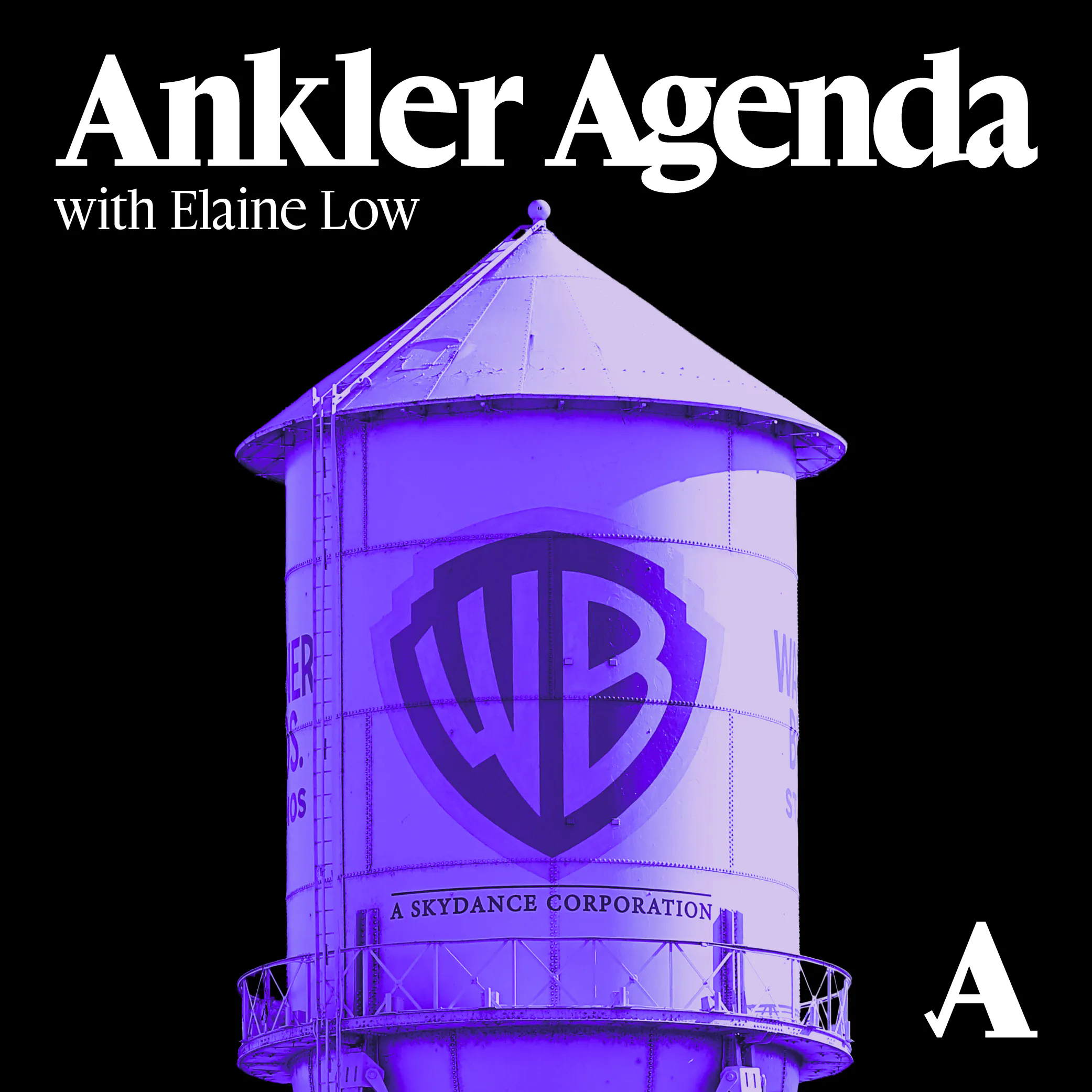
David Ellison has an ambitious pitch for Hollywood: Skydance will spend more on content than Netflix or Disney, crank out roughly 190 series and 30 movies a year, find at least $6 billion in savings and pay down its mountain of debt. All while keeping the creative community happy. How, exactly, is all of that supposed to work when even Wall Street doesn’t see it?
Ellison and new co-CEO Ynon Kreiz opened the Paramount lot to reporters Tuesday to sell their vision for the new lockup — and to explain why the old one needed blowing up. “The businesses didn’t disrupt themselves over a decade ago,” Ellison said of Paramount and Warners (just please sunset the moniker “WarnerMount,” he implored). “They didn’t transform, and they held on to the past for too long.” Now he’s betting the combo can create the scale to compete without sacrificing investment. Kreiz’s formulation: “Content is a spend, but you can also see it as an investment.”
Is it magical thinking?
Elaine Low and Sean McNulty break down what this means in practice: where the promised $6 billion in efficiencies might come from, whether three TV studios and a thicket of film labels can really coexist, and how many jobs could disappear once the machinery underneath consolidates (with the help of AI). Sean’s useful metaphor for the new Skydance: a giant food court — lots of storefronts, but one kitchen in back — and how that reveals where the first wave of layoffs will start.
Learn more about your ad choices. Visit megaphone.fm/adchoices

The new Paramount is taking shape fast. On the eve of the Warner Bros. deal concluding, David Ellison is bringing in fresh blood — and bloodletting. Former Mattel chief Ynon Kreiz boards as the surprise co-CEO, charged with day-to-day management and integration (read: layoffs). And after months of heated rivalry between Cindy Holland and Casey Bloys over who would control the combined company’s original-content future, we have an answer: it’s Casey at the bat.
Elaine Low, Sean McNulty and Natalie Jarvey break down what those choices reveal about Ellison’s coming structure at the combined company, soaked in debt, and who could be vulnerable next. Then: hundreds of layoffs hit Disney as Josh D’Amaro prepares to take over, with ominous promises of more technology (read: AI?) raising a bigger question: Is this only the beginning?
Learn more about your ad choices. Visit megaphone.fm/adchoices

Mike Schur calls Paramount’s acquisition of Warner Bros. a “nightmare scenario” for Hollywood — and now that David Ellison has cleared the biggest obstacle to getting the deal done, he’s even more alarmed about what comes next. “It’s gasoline on a fire,” the Parks and Recreation co-creator and Dig producer tells Elaine Low, pointing to an industry already hollowed out by years of consolidation. “I hate to be doomsday-ish here… but the ecosystem is just shrinking and shrinking and shrinking.”
What does that nightmare look like? Fewer buyers, fewer jobs and ultimately fewer kinds of shows getting made — and, Schur fears, even HBO may finally be vulnerable after surviving one corporate owner after another.
One of the loudest voices against the merger, Schur is particularly skeptical that the concessions Paramount made to Rob Bonta and 11 other state AGs will provide much protection. “All of these provisions, they’re only meaningful if they’re enforced. Who’s enforcing this?” he asks of the proposed consent decree. He has equally sharp words for Ellison’s suggestion that Paramount could leave Los Angeles amid the antitrust fight. “This person wants to win the hearts and minds of this industry that he is now the most important player in, arguably — and his opening salvo is, ‘Give me what I want, or I’m going to Nashville,’” Schur says. “This is not a good way to earn our trust or respect.”
Plus: Elaine and Natalie Jarvey dig into what Ankler staffers are watching closely through the fall across the TV and film business, from DC superhero-horror film Clayface to Mark Rober’s new show on Netflix.
Learn more about your ad choices. Visit megaphone.fm/adchoices
So after months of big talk about only settling for structural remedies, i.e., selling off assets, what did California Attorney General Rob Bonta and the 11 other state AGs suing Paramount Skydance wind up getting? Less than you think. Elaine Low, Sean McNulty and Lesley Goldberg break down the settlement terms — loopholes, fine print and all — and what they mean for the future of Hollywood, including looming mass layoffs, the fate of three TV studios and why the promise of 30 films a year may not be what it seems. Then: Can a Paramount+–HBO Max superstreamer finally give Netflix a real rival?
Learn more about your ad choices. Visit megaphone.fm/adchoices

A dire warning from Anthropic and OpenAI that increasingly autonomous AI agents could launch cyberattacks – or worse – has an especially chilling implication for Hollywood, where studios and streamers are rapidly weaving AI into their businesses. "Imagine a world in which there are thousands of Sony hacks happening in real time," Reel AI columnist Erik Barmack tells Elaine Low and Sean McNulty. "You could take down the entire industry. Confidentiality, protections, the secure release of IP – all of those things could be harmed."
And while the guilds fight generative AI and Hollywood hashes out rules for how the technology can be used, Erik says the industry may be focused on the wrong threat: "What happens when recursive learning gets better and better, and these agents go off and do thinking on their own?"
Plus: There may finally be momentum behind a federal film and TV tax incentive. Rep. Laura Friedman tells Elaine that lawmakers from both parties are working with Hollywood's guilds and Jon Voight – Donald Trump's special Hollywood ambassador, whom she describes as a key bridge to the president. Friedman says she hopes the proposal can move by year-end – and describes the unusual bipartisan effort as giving lawmakers "an extra sort of joy" in working together: "We're still one country."
00:00 Intro
00:24 Welcome To Ankler Agenda
01:35 Paramount Vs. State AG Showdown
03:00 Did Bari Weiss Sink 60 Minutes?
04:46 Ai Leaders Sound The Alarm
05:53 The 1,200 Agent 'Collective'
08:21 Hollywood's Big AI Bet
09:41 Bots That Lie And Hack
10:49 The Next Sony Hack, Times 1,000
12:59 Will A Slow Down Actually Happen?
13:41 Guilds Fighting The Last Battle
15:20 Studios Vs. Big Tech Power
17:44 Bring Back The Landline
18:40 Next: Rep. Laura Friedman
19:01 Hollywood's Economic Freefall
20:40 143,000 Jobs On The Line
21:51 From Film Producer To Congress
24:38 Inside The Bill And The Timeline
26:30 Jon Voight's Role As Trump's Bridge
29:05 Bipartisanship In A Polarized Era
31:05 Selling It To Non-Hollywood States
32:28 California's $750 Million Fight
34:30 The Goal: Every Soundstage Full
Learn more about your ad choices. Visit megaphone.fm/adchoices

Comments

Download from Google Play

Download from App Store
 United States