


 Claim Ownership
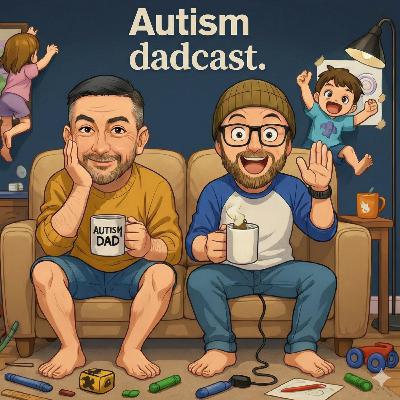
Autism Dadcast
Subscribed: 77Played: 1,576
Subscribe

© Gaz and Andrew
Description
An unfiltered, unflinching, and occasionally inappropriate deep dive into the world of autism parenting, from a dad's perspective.
Gaz and Andy are two dads doing this in real time, not experts with a script. Honest conversations about autism and ADHD, diagnosis and assessment, EHCPs and school, meltdowns and sensory overload, and the parts of SEN parenting nobody warns you about.
Support the show at bit.ly/dadcast-support
58 Episodes
Reverse

Ask someone outside the autism world what's hard about raising an autistic child and they'll probably say meltdowns. Ask us and we'll tell you about a quick trip to the garage for a drink and some sweets, and the low hum of fight or flight that comes with it now.This week Gaz and Andy go back to where it all started, a bit like episode one, and talk through the stuff autism parents deal with that nobody else sees. The checklist that lands through the door and comes back all no's. The hours of late-night googling, hoping for a different answer. Diagnosis day, the what now, and the question every parent here asks: who looks after them when we're gone?Then the everyday stuff. Sleep deprivation that feels like a three-year bender without the fun part. Planning a day out like a military operation. Flying, and a plan for a whole plane full of autism families. Christmas, when you find out not every child loves it, the presents that get ignored for a cardboard slide, and a Santa grotto visit with a hundred photos and not one look at the camera. Birthdays, wedding invitations, the overnight stays that never happen, and whether to have another child.And the bit that makes it all worth it: the small wins. A picture card, a digestive biscuit, and five years in the making.If you're early on in this, it can feel like this is it forever. It isn't. You will get through it.Timestamps0:00 Cold open0:38 Waiting on the studio, and back to episode one2:22 The garage run, and a low hum of fight or flight4:15 Early years and the first checklist9:21 Googling the signs12:07 Assessments built around a child, not your child14:58 Waiting for the diagnosis17:18 Diagnosis day21:55 The what now, and who looks after them when we're gone29:32 Sleep deprivation, and a three-year bender38:01 Planning a day out like a military operation41:06 Holidays and flying43:19 A plane full of autism families45:36 Swimming lessons48:44 Why Christmas isn't what you thought it would be52:23 Presents, and the cardboard slide53:55 The same food every Christmas Day55:01 Every now and then, reality hits56:38 The Santa grotto photo1:00:00 Birthdays1:05:01 Invitations, weddings and never switching off1:09:11 Having another child1:13:05 The small wins1:14:59 A picture card and a digestive biscuit1:17:16 How far they've come1:18:13 The Indi app1:22:42 Neurospicy & Co.Indi app: use code ADC40 for 40% off your first three months after the free trial.Neurospicy & Co.: code DADCAST at neurospicyandco.ukWatch: https://bit.ly/ep52-youtubeListen: https://bit.ly/ep52-listenGaz and Andy are two dads raising autistic children, talking about the bits nobody else says out loud.Link tree in bio.
The government says every household should be ready to look after itself for 72 hours. No power, no water, no shops. Easy enough, until you've got a non-verbal autistic child, a very short list of safe foods and an iPad that's about to die.Gaz and Andy got back from holiday to a "be ready" plan that wasn't written with autistic families in mind, so they've written their own. Fill the bath the second the power goes, before anyone climbs in it. Download the shows now, not when the Wi-Fi's gone. Screenshot the AAC keyboard, print it and laminate it on cardboard, because when Mish tried it at home it got picked up first time. Get the safe foods in, because "suck it up" doesn't work here. Think of it as an EHCP for prepping: plan for the worst day.Then they run the 72-hour challenge together, from Friday 6pm when the lights go out to Monday when they come back on. Water, nappies and wipes, medication, sleeping in one warm room, what you can cook on and what you never bring indoors, with a carbon monoxide story that'll have you checking your alarms tonight. Plus a one-page emergency profile for your child, a chat with school about pick-up, and why writing down one normal day shows you just how much you do that other families don't.Whether you call it a power cut or a power outage, this isn't about panic. It's about not wishing you'd done something. The stakes are too high not to.Timestamps0:00 Cold open0:36 Intro0:44 Back from holiday to a 72-hour warning5:27 The government's be ready plan vs real life7:28 Communication when the devices die11:11 Fill the bath first17:05 Why suck it up doesn't work here21:53 Medication you can't run out of25:33 No heating, living in one room30:36 The 72-hour challenge, hour by hour48:00 Camping stoves and carbon monoxide55:01 The cardboard AAC keyboard1:03:14 A one-page emergency profile1:07:37 Write down one normal dayIndi app: use code ADC40 for 40% off your first three months after the free trial.Watch: https://bit.ly/ep51-youtubeListen: https://bit.ly/ep51-listenGaz and Andy are two dads raising autistic children, talking about the bits nobody else says out loud.Link tree in bio.#autism #nonverbalautism #autismparents #specialneeds #powercut
Fifty episodes in, and last week we asked for one thing: a party that would put a proper plan for SEND families on the table. This week, one did.Gaz and Andy start with the Oxford Half Marathon and the £1,360 you helped raise for Ambitious About Autism, including one anonymous £700 that took the pressure right off. Thank you, whoever you are.Then a listener in our Discord sent in Restore Britain's new SEND policy, and we read it line by line. A lot of it is common sense. Help without needing a diagnosis first. Timely assessments. An end to the postcode lottery. Units inside mainstream schools as well as more specialist schools. A big push on practical, hands-on learning, because school isn't for everybody, and some of the kids who got written off as trouble are running their own firms thirty years on.Some of it raises hard questions. Who decides there is overdiagnosis? Who decides what a "genuine" disability is? Gaz puts it plainly: if you think there's overdiagnosis, show us the evidence. Andy makes the case for paying for help early, before a child who got none ends up somewhere far more expensive.This is not an endorsement of any party. It is two dads asking every party to do the same thing: talk to the families it affects, and show us how it's costed.Then, because last week got serious, your funniest stories. The dad on a work call who got handed something that wasn't a toy. The naked trip down the soft play slide. A lesson in what rhymes with duck. And the half-hour drive for Thomas's sausages that ended on the kitchen floor.Timestamps00:00 Cold open00:19 Intro00:27 Back from the Oxford Half, and £1,360 raised04:04 The Indi app, and why we said yes08:46 What we're wearing10:13 A party finally publishes a SEND policy12:42 Overdiagnosis: who decides?14:01 Help without needing a diagnosis first14:50 Timely assessments and the postcode lottery16:00 More specialist schools, and units in mainstream17:03 School isn't for everybody19:12 The line that will divide people24:15 Pay now, or pay for prisons later25:30 Judging a party on one issue29:18 Politically homeless32:04 Your funny stories32:36 The dad on the work call36:30 What rhymes with duck38:17 Backup sausages39:45 You think it's only happening to you40:52 Studio news, guests, and the bookIndi app: use code ADC40 for 40% off your first three months after the free trial.Gaz and Andy are two dads raising autistic children, talking about the bits nobody else says out loud.Link tree in bio.
Some families are now facing a two-year minimum wait just to be assessed for autism. Around 295,000 people are on the waiting list in England. A private clinic can do it in weeks, if you can pay.Gaz and Andy start with the "golden ticket" debate. The diagnosis opens the door to support, so what happens to the families who cannot afford to skip the queue? Andy remembers the first time he filled in the benefits form for Lydia, writing down her worst day when every instinct as a parent was to build her up. Andy asks how often a private assessment ever says no, and Gaz looks it up while they record. Nobody is tracking it.Then school. A new study links exclusion to worse mental health later on, and there is a big difference between a child who won't behave and a child who can't cope. Two hundred million pounds of new teacher training sounds good, but knowing what autism is and knowing what to do when a child will not walk into the classroom are two very different things. Andy says something he never expected to say: he feels lucky that Lydia's needs are so profound, because the children in between are the ones still fighting to be believed.Along the way: feeling politically homeless as SEND parents, the petition that went past 100,000, and a fear only an autism parent would have. Not what is causing the power cut, but how you get your child through it. Gaz rings home in the middle of recording to sort it.And the National Autistic Society now says autism is genetic. So why do so many of us still lie awake asking whether it was something we did?Timestamps00:00 Cold open00:13 Intro00:22 A week that flew by01:13 A two-year minimum wait for an autism assessment02:02 295,000 people on the waiting list03:12 The diagnosis as a "golden ticket"05:13 The form that makes you describe your child's worst day07:11 Private diagnosis: how often does it say no?09:03 Does money buy a faster route to support?10:19 "She's fine at school. It's at home she isn't."12:07 School exclusion: won't behave, or can't cope?14:34 "Would you mind not bringing your child in today?"16:20 £200 million for SEND teacher training19:30 "I feel lucky her needs are so profound"22:33 The teenager nobody believes23:45 Politically homeless27:39 What a real SEND policy would look like34:33 The petition that went past 100,00041:31 Stockpiling, and a power cut with an autistic child45:39 Gaz rings home mid-episode48:02 The National Autistic Society says autism is genetic50:50 "Was it something we did?"52:34 UK, US, Australia: everyone is waiting53:29 Mailing list, guests, the studio and the Discord55:25 The Oxford Half Marathon, and the fundraiser we forgotGaz and Andy are two dads raising autistic children, talking about the bits nobody else says out loud.Everything we do is in the link tree in our bio.
Not the episode we planned to record.This week a three year old went missing from a playground in Suffolk and was found in a pond the next day. He was non-verbal, partially deaf and on the autism pathway. Thirteen hundred members of the public joined the search.This is not an investigation, and it is not a judgement on a devastated family. It is about a danger that thousands of families live with every single day and almost nobody is warned about: elopement.Elopement is when an autistic person leaves a safe space, a responsible adult or a supervised area without the knowledge or agreement of the person supporting them. It can look like bolting, slipping silently through an exit, following a strong interest, or getting away from something overwhelming. It is not naughtiness. It is not defiance. It is not proof that a parent does not care. And it is not something a child stops doing because you call their name.The numbers are hard to read. Forty-nine percent of autistic children aged four to ten have tried to leave at least once, four times the rate of their own brothers and sisters. Fifty-three percent went missing long enough to cause real alarm. The average time missing is 41.5 minutes. Sixty-five percent had a close call with traffic. Autistic children are 160 times more likely to die from drowning than other children.Gaz and Andy talk about their own near misses, why "never take your eyes off them" is useless advice, what actually lowers the risk, and the one warning every parent should be given on the day of diagnosis and never is.Replace judgment with awareness, and awareness with action.Timestamps00:00 Not the episode we planned04:30 Absconding, eloping, wandering: none of the words fit05:11 Ten seconds, and a barefoot run down the street08:19 Nobody tells you this on the day of diagnosis09:05 What elopement actually is, in plain English09:56 Calling their name does not stop them11:35 What pulls them: water, traffic, trains, and the way out13:47 Forty-nine percent, four times the rate, 41.5 minutes15:27 160 times more likely to drown16:27 Swimming lessons, and the risk they can create17:34 Reins, biting, and the grandparent problem19:30 The mental load: scanning gates, exits, roads and water21:28 "Never take your eyes off them"22:39 Safety comes in layers26:39 "Watch harder", trackers, and what they cannot do30:26 Why people reach for blame33:23 What families can actually do38:06 The photograph you take before you leave the house41:55 If your child goes missing, call 999 straight away44:32 Should elopement risk be written into an EHCP?48:17 Thank you to thirteen hundred people49:47 Replace judgment with awarenessFor Noah.Everything we do is in the link tree in our bio.

Comments

Download from Google Play

Download from App Store
 United States