


 Claim Ownership
Backtest
Subscribed: 0Played: 6
Subscribe

© Backtest Media
Description
27 Episodes
Reverse

Inflation, deficits, questions about the dollar, volatility in the stock market, a single technology driving an economic boom. That’s the set up for the economy in the 1870s. One of the most pressing questions from that era: what does it take for people to trust money, and who pays to win that trust back?The Civil War left the US with nearly $3 billion of debt and a paper currency, the greenback, that couldn’t be traded for gold. Then came the Panic of 1873. Jay Cooke’s bank failed, the New York Stock Exchange closed for the first time in its history, and the railroad boom that had powered the post-war economy stalled. What followed was the longest depression in US history.At the center of it all was President Ulysses S. Grant considering a bill that would pump more paper money into the economy. His party, his cabinet and most of the country expect him to sign it. What he does next leads to six years of economic contraction and political upheaval, but potentially sets up the US economy to dominate for decades after.Chapters(02:40) April 1874: Grant’s sleepless night over the inflation bill(05:18) Three stories that explain Grant: a colt, Vicksburg and Black Friday(12:45) How the Civil War rewired American money(16:18) A small Iowa bank and the plumbing of the banking system(19:00) Jay Cooke fails and the Panic of 1873 hits Wall Street(29:51) Grant vetoes the inflation bill(43:17) John Sherman’s formula for getting back to gold(50:17) The disputed election of 1876(58:19) Sherman brings the dollar back to gold in 1879(59:45) Closing the books: who paid and key takeawaysReferencesThe Greenback Era: A Social and Political History of American Finance, 1865-1879 byIrwin Unger (link)Grant by Ron Chernow (link)The Crisis of 1873: Perspectives from Multiple Asset Classes by Scott Mixon (link)Presidential Leadership in Feeble Times: Explaining Executive Power in the Gilded Age by Mark Zachary Taylor (link)1873: The Rothschilds, the First Great Depression, and the Making of the Modern World by Liaquat Ahamed (link)SponsorsBig thanks to EQT Corporation for helping us bring you the stories of market history and how they apply today. To learn more and explore the latest data on energy affordability, go to eqt.com/eqt.com/permitting-reform-now.Note: this show is for informational purposes only and isn’t investment advice. Backtest hosts and guests may have investments in the companies discussed. This is a public episode. If you would like to discuss this with other subscribers or get access to bonus episodes, visit www.backtestpodcast.com
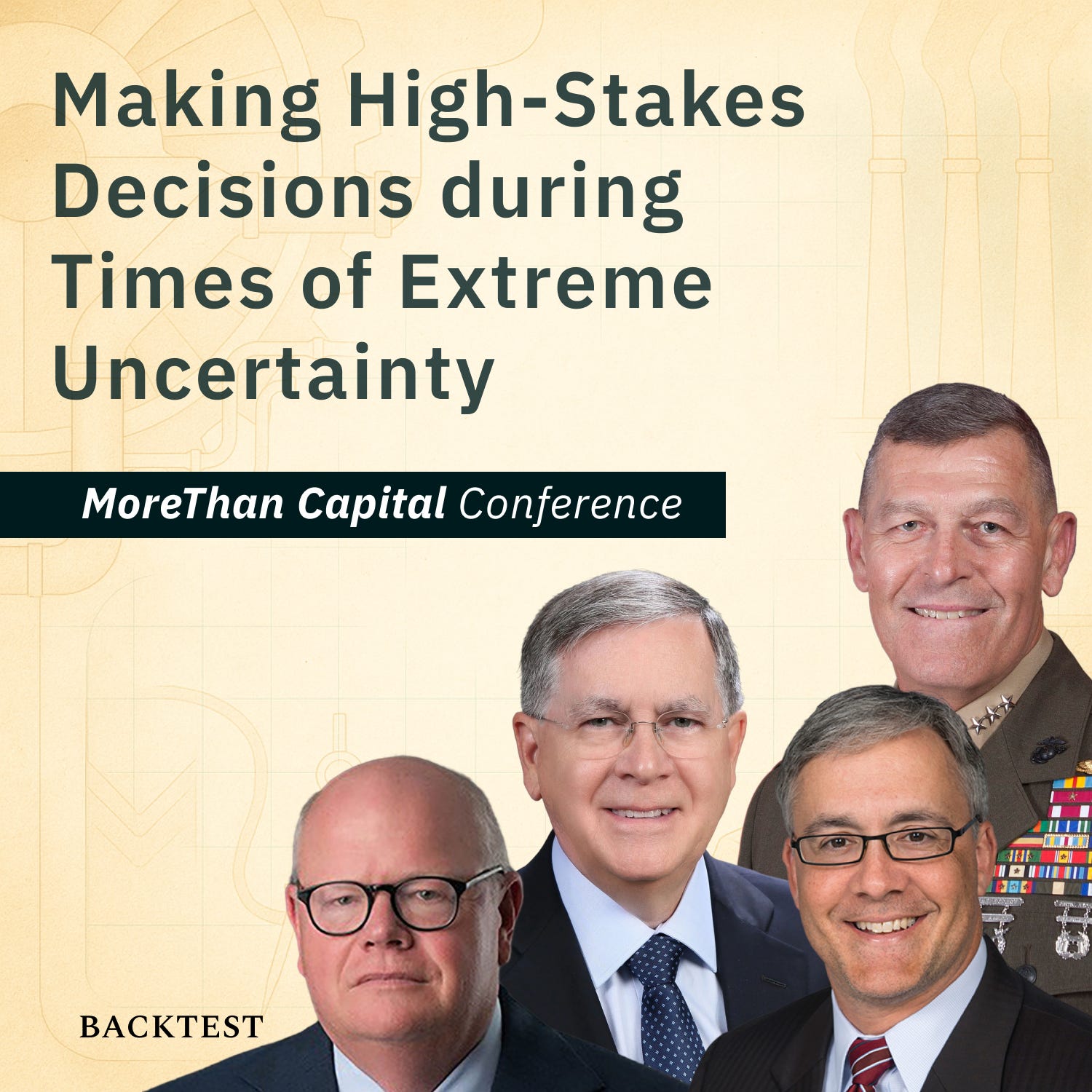
In the darkest days of the Civil War, Abraham Lincoln learned that Confederate cavalry had captured a Union general and a hundred horses. Lincoln knew what was scarce, and it wasn’t the general.In this special episode, recorded at More Than Capital’s Global Annual Meeting at Rice University’s Baker Institute in Houston, we sit down with four leaders who have made consequential decisions under pressure:* Retired Lt. Gen. George W. Smith Jr., former commanding general of I Marine Expeditionary Force* Ambassador David Satterfield, director of the Baker Institute* Dr. Kenneth Medlock, senior director of the Center for Energy Studies* Britt Harris, who has led major financial institutions like Bridgewater, TRS and UTIMCOChapters(00:00) Lt. Gen. George W. Smith Jr. on knowing what’s scarce(05:08) Britt Harris’s seven storms(15:11) Ambassador David Satterfield on the Iran war and its two likely outcomes(19:08) Maritime choke points and asymmetric forces(26:26) Satterfield on the administration’s “two original sins”(29:06) Dr. Kenneth Medlock on how oil markets reorganize(32:24) 1970s industrial power generate and why data centers may follow the same path(40:59) The Marine Corps’ trust tactics(44:52) Britt Harris on leading UTIMCO through COVID(50:18) Core values as a fixed point in uncertain timesSponsorsBig thanks to EQT Corporation for helping us bring you the stories of market history and how they apply today. To learn how EQT is unlocking energy to power AI, go to PoweredByEQT.com.Note: this show is for informational purposes only and isn’t investment advice. Backtest hosts and guests may have investments in the companies discussed. This is a public episode. If you would like to discuss this with other subscribers or get access to bonus episodes, visit www.backtestpodcast.com
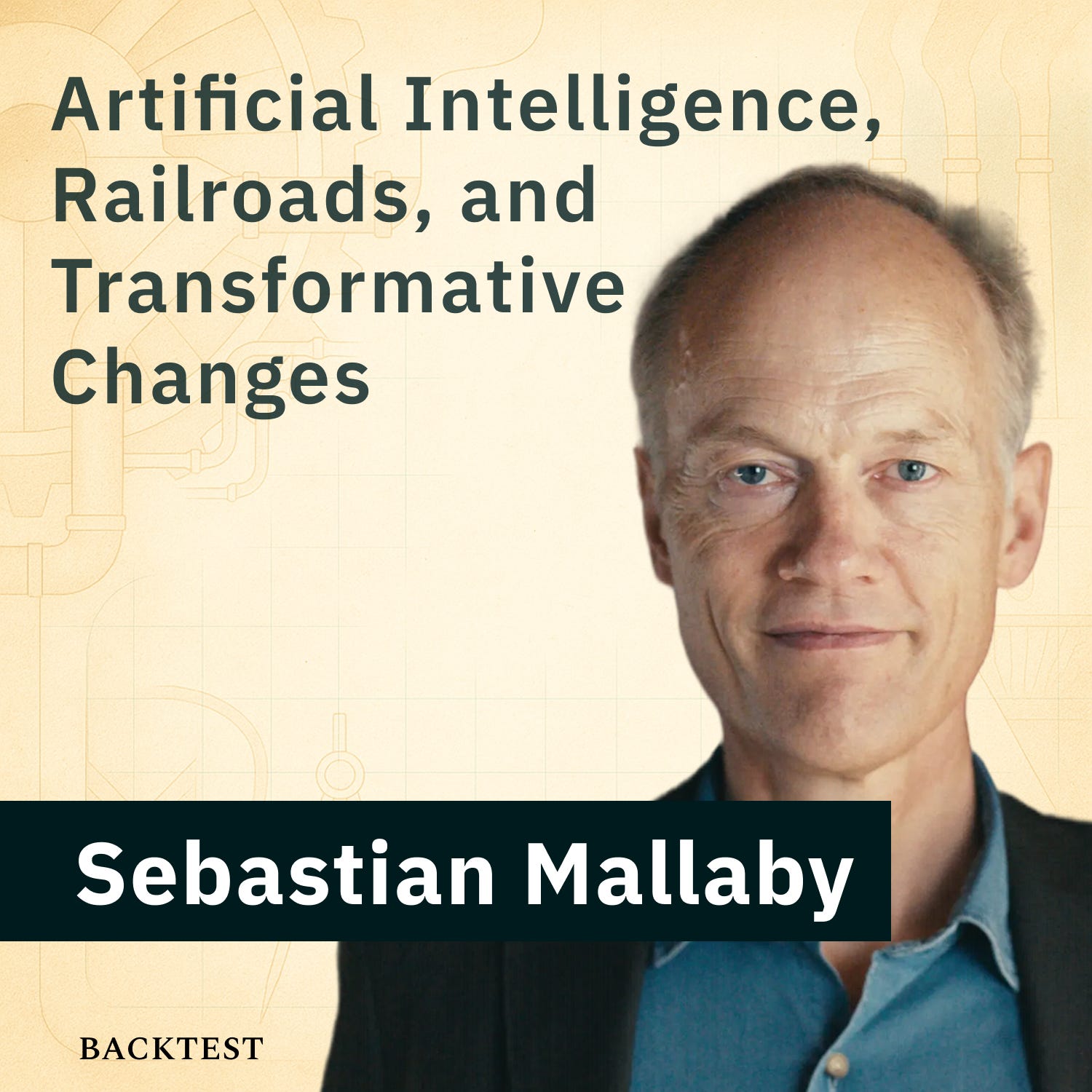
From iron horses to infinity machines, every great technological revolution starts with a curious mind chasing discovery for its own sake. Discoveries lead to technological breakthroughs that, when commercialized, change the capital markets, organizational structures, and living conditions.As a follow up to our railroad series, we chat with Sebastian Mallaby—Paul A. Volcker Senior Fellow for International Economics at the Council on Foreign Relations, co-host of The Spillover podcast, and author of books on hedge funds (More Money Than God), Alan Greenspan (The Man Who Knew), and venture capital (The Power Law). His latest book, The Infinity Machine, is a riveting biography of DeepMind’s Demis Hassabis.Railroads changed more than transportation—they changed corporate scale, financing, market power, the social contract, and the relationship between technological progress and investor returns. Measured as a share of GDP, the railroads were the largest capital investment wave in history. AI is on pace to overtake them.We explore how the market history of railroads helps frame the AI era. We also contrast the similarities and differences between the AI boom and railroads by exploring market power, competitive dynamics, and capital formation.You can find Sebastian at the Council on Foreign Relations (https://www.cfr.org/experts/sebastian-mallaby) and on X (@scmallaby).Chapters(01:37) The sweetness of discovery: why Hinton and Hassabis chased AI(06:01) Why AI carries risk but extinction talk may be overblown(10:16) Railroads, the corporation, and AI’s governance experiments(14:31) How AI outgrew venture capital(23:42) Where the profits will accrue and the fight over open weights(30:18) Bottlenecks, chips, and why AI competition is political(36:57) Data center backlash and the new social contract(40:32) Will AI break the labor market?(53:46) Safety, capital, and the limits of governance(1:03:07) What could knock AI off its trajectory(1:13:09) AI as a tool for learning, not rote outputSponsorsBig thanks to EQT Corporation for helping us bring you the stories of market history and how they apply today. To learn how EQT is unlocking energy to power AI, go to PoweredByEQT.com.Note: this show is for informational purposes only and isn’t investment advice. Backtest hosts and guests may have investments in the companies discussed. This is a public episode. If you would like to discuss this with other subscribers or get access to bonus episodes, visit www.backtestpodcast.com

By 1869, the transcontinental railroad is finished, the Civil War debt is refinanced, and the business that made Jay Cooke reach the pinnacle of private banking in the US is disappearing. He had spent the war building something nobody had built before: a retail distribution machine that sold Union bonds to farmers, mechanics, and merchants. He had created the template for war financing that would inform government playbooks for the next 100 years, and it made him the best known banker in America. But by focusing on that, he had missed the banking business for the major railroads that were booming in financial markets.As the government financing business shrinks and excitement builds over the completion of the Union Pacific and Central Pacific linking New York to California, Cooke turns to the Northern Pacific transcontinental railroad. The structure is elegant on paper but the project combines massive capital needs with a speculative vision on an unprecedented scale.This is the perfect story to answer the question of what happens when enormous capital funds transformative infrastructure ahead of the demand that must eventually pay for it.Chapters(05:01) Jay Cooke in Philadelphia, 1839 as a young banker(11:51) The retail distribution in Pennsylvania(16:38) The financier of the Civil War(22:56) Jay Cooke looks for non-government business after the war(30:19) The Northern Pacific comes calling(36:13) Jay Cook signs a deal with the Northern Pacific(45:47) Harris Fahnestock, Cooke’s partner, warns him about funding the Northern Pacific(50:36) Jay Cooke & Co. almost fails on October 1872(56:10) Fahnestock closes the New York office and triggers the Panic of 1873(59:15) The realization of a visionReferencesJay Cooke, Private Banker by Henrietta Larson (link)1873: The Rothschilds, the First Great Depression, and the Making of the Modern World by Liaquat Ahamed (link)Jay Cooke’s Gamble: The Northern Pacific Railroad, The Sioux, and The Panic of 1873 by M. John Lubetkin (link)Panic on Wall Street: A History of America’s Financial Disasters by Robert Sobel (link)SponsorsBig thanks to EQT Corporation for helping us bring you the stories of market history and how they apply today. To learn more and explore the latest data on energy affordability, go to eqt.com/eqt.com/permitting-reform-now.Note: this show is for informational purposes only and isn’t investment advice. Backtest hosts and guests may have investments in the companies discussed. This is a public episode. If you would like to discuss this with other subscribers or get access to bonus episodes, visit www.backtestpodcast.com
DescriptionIn the 1860s, railroads are rewiring the American economy. The old value chain built around steamboats, canals, and local commerce is coming apart, and nobody knows which parts of the new one will be profitable.Cornelius Vanderbilt is almost 70 years old and one of the wealthiest men in America. He has spent four decades mastering steamboats. He comes to railroads without a master plan for an empire. Instead, he sees a problem he thinks he can fix: the New York and Harlem Railroad, an unprofitable line that Wall Street brokers joke is only good for wrapping paper, and the only railroad running into the heart of Manhattan.What follows is five years of escalating fights, each one set off by a structural problem Vanderbilt discovers as he’s trying to turn railroads from speculative projects to great businesses. Along the way we ask what actually built Vanderbilt’s moat, why he tried diplomacy before waging battles almost every time, and what operating in a fog with enormous amounts of capital, market, and operational risk might teach us about today’s markets.Chapters(02:02) How a technology revolution rewires an entire value chain(06:04) Vanderbilt forcing a boat up the San Juan River in Nicaragua(13:31) Railroads as an accessory and saving the Harlem in the Panic of 1857(16:20) Selling the steamships and buying a railroad nobody wants(20:37) The Harlem Corner(23:21) No market power with the Harlem(27:28) Diplomacy first and taking on the Hudson(38:17) The January 1867 blockade of the Central(47:35) The Erie War against Daniel Drew, Jay Gould and Jim Fisk(1:00:06) The Lake Shore campaign and Black Friday in 1869(1:05:37) The Vanderbilt playbook and what it means for the AI buildoutReferencesThe First Tycoon: The Epic Life of Cornelius Vanderbilt by T.J. Stiles (link)The Invention of the Trillionaire by T.J. Stiles, WSJ Article (link)The Visible Hand: The Managerial Revolution in American Business by Alfred D. Chandler, Jr. (link)History of the New York & Harlem Railroad by E. Clarence HyattIncreasing Returns and the New World of Business by W. Brian Arthur (link)The Innovator’s Dilemma by Clayton Christensen (link)7 Powers: The Foundations of Business Strategy by Hamilton Helmer (link)SponsorsBig thanks to EQT Corporation for helping us bring you the stories of market history and how they apply today. To learn more and explore the latest data on energy affordability, go to eqt.com/energy-affordability.Note: this show is for informational purposes only and isn’t investment advice. Backtest hosts and guests may have investments in the companies discussed. This is a public episode. If you would like to discuss this with other subscribers or get access to bonus episodes, visit www.backtestpodcast.com

Comments

Download from Google Play

Download from App Store
 United States