


 Claim Ownership
Beautiful Business
Subscribed: 0Played: 2
Subscribe

© 2021-2024. Matter Consulting, Inc. and Steven Morris. All rights reserved.
Description
Many business owners strategize the purpose and function of their business, but few strive to make it “beautiful.” Each week, listen in as Steven Morris and his guests discuss brand, culture, and business strategies that will create new ways to shape your beautiful business. If you are ready to evolve your business from functional to beautiful, this is the podcast for you.
69 Episodes
Reverse
In today’s episode, I explore what makes something feel trustworthy in a world where polished communication is increasingly easy to produce.The idea begins with two signs that say the same thing: “Fresh Corn.” One is professionally made and built to last. The other is a rough piece of cardboard with hand-painted letters. When people are asked which one they trust more, they choose the cardboard sign.That instinct points to something deeper. We often trust what carries evidence of effort, experience, and human presence. We look for signs that someone was actually there, that the words came from somewhere lived rather than simply generated.As AI and automated tools make polished communication easier to create at scale, those human signals become more valuable. The challenge is deciding what should be made more efficient and what should still carry the cost of attention, judgment, and presence.What we choose to outsource shapes what others learn to trust.Join me as I explore:✅ Why lived experience makes communication feel more believable✅ How polish can change the way we judge credibility✅ Why visible effort and imperfection can strengthen trust✅ What AI and automation are changing about the way we communicate✅ What deserves to remain distinctly humanKey Takeaways:🔑 Trust often attaches to what carries evidence of real experience🔑 Technical polish alone cannot create credibility🔑 Human presence becomes more valuable as communication becomes easier to manufacture🔑 The tools we use shape the signals other people receive🔑 Trust grows when our words, actions, and lived experience feel connectedSubscribe & ShareSubscribe for more reflections on leadership, culture, meaningful work, and the human experiences that shape how we work together. Share this episode with someone thinking carefully about trust, communication, and what we choose to keep human.#Trust #Authenticity #Communication #Leadership #ArtificialIntelligence
Steven Morris, CEO of Matter Consulting is an ever-curious life-seeker, brand and culture building expert, advisor, author, and speaker. With over 27 years of entrepreneurial experience, he has served as a trusted advisor to over 3,000 business leaders and evolved more than 250 brands and cultures, including Google, Habitat for Humanity, Samsung, and Disney. His best-selling book, "The Beautiful Business," and his widely read Insights blog are a testament to his consulting expertise in creating unignorable, magnetic, and sustainable companies.His diverse interests, including meditation, fine art painting, surfing, and beekeeping, infuse his work with creativity, soul, and a deep understanding of the human experience.You can find more podcasts and join 30,000+ other brilliant and soulful readers of his weekly INSIGHTS blog at MatterCo.
In today’s episode, I reflect on the life and work of Wendell Berry, the poet, farmer, and novelist who spent much of his life tending the same Kentucky land. His writing offers a way of thinking about work that feels particularly relevant to leadership: the things that impede us may also be the things that give our work its shape.Berry wrote about two muses. One gives us the vision. The other reminds us that bringing it into the world will be harder than we imagined. He called this second one the muse of form—the resistance that forces us to adapt, pay attention, and discover another way through.Leadership often asks the same of us.We can easily assume that a healthy team should move without friction. Yet obstacles, difficult questions, competing needs, and human limitations are part of the work itself. Like water encountering a fallen tree, the challenge is learning how to work with what is there rather than simply forcing our way through it.In this episode, I also explore Berry’s idea of thinking downstream. Every decision a leader makes eventually lands with someone else. A reorganization, a new strategy, a shift in priorities, or another demand on a team carries consequences beyond the person making the decision. Leadership requires us to consider not only what a decision achieves, but what condition it leaves others in.That responsibility extends to trust, power, and our capacity for work. Berry described wisdom as “the art of minimums”—knowing when enough has been gathered and when a field needs to lie fallow. Leaders face their own version of that choice: when to keep pushing and when continued extraction will leave too little for the season ahead.At its heart, this episode is about stewardship—reading the obstacles in front of us, understanding who is downstream of our decisions, and recognizing the difference between work that is singing and work that is simply scraping by.Join me as I explore:What Wendell Berry’s relationship with work and the land can teach us about leadershipWhy obstacles can give our work shape rather than simply slow it downWhat the “muse of form” reveals about resistance and constraintWhy healthy teams need boundaries, friction, and difficult questionsHow leadership decisions affect the people downstreamThe relationship between positional power, self-interest, and organizational trustWhat Berry’s “art of minimums” can teach leaders about capacity and restHow to recognize when to push through and when the field needs recoveryKey Takeaways:Obstacles can create the conditions for better thinking, adaptation, and meaningful work.Leadership is less about eliminating resistance and more about learning how to work intelligently with it.Every leadership decision has downstream consequences for other people.Trust grows when people can trace decisions back to a person, a reason, and a responsibility.Good stewardship considers the health of the whole rather than optimizing only for immediate individual gain.Knowing when enough is enough is part of leadership wisdom.Sustainable leadership leaves something worth inheriting for whoever comes next.If this conversation resonated with you, subscribe, leave a review, and share the episode with someone thinking deeply about leadership, stewardship, and the work of caring for what comes next.#Leadership #LeadershipDevelopment #ExecutiveLeadership #OrganizationalCulture #Stewardship #LeadershipWisdom #WorkplaceCulture #SustainableLeadership
Steven Morris, CEO of Matter Consulting is an ever-curious life-seeker, brand and culture building expert, advisor, author, and speaker. With over 27 years of entrepreneurial experience, he has served as a trusted advisor to over 3,000 business leaders and evolved more than 250 brands and cultures, including Google, Habitat for Humanity, Samsung, and Disney. His best-selling book, "The Beautiful Business," and his widely read Insights blog are a testament to his consulting expertise in creating unignorable, magnetic, and sustainable companies.His diverse interests, including meditation, fine art painting, surfing, and beekeeping, infuse his work with creativity, soul, and a deep understanding of the human experience.You can find more podcasts and join 30,000+ other brilliant and soulful readers of his weekly INSIGHTS blog at MatterCo.
In today’s episode, I reflect on a single word that stayed with me after Japan’s prime minister, Sanae Takaichi, described finally getting five hours of sleep: finally.
That word says something about the way many high-performing people experience rest—as something to earn, justify, or reach only after everything and everyone else has been taken care of.
I see this often in the leaders I coach and advise, particularly women carrying demanding careers alongside caregiving, illness, grief, parenthood, and responsibilities that rarely appear on a performance review. I’ve also lived my own version of it, spending years believing that being the person who could always push through was something to be proud of.
In this episode, I explore:
- Why rest can feel like something we have to earn
- The invisible responsibilities people carry alongside their work
- What research tells us about burnout, caregiving, and gender- How endurance and self-reliance can become part of our identity
My own experience with “white knight syndrome” and the cost of always being needed
What leaders can do to create cultures where people can ask for what they need
Healthy workplaces shouldn’t require people to reach their breaking point before they’re allowed to recover. Sometimes, “I need a break” should simply be a complete sentence.
Steven Morris, CEO of Matter Consulting is an ever-curious life-seeker, brand and culture building expert, advisor, author, and speaker. With over 27 years of entrepreneurial experience, he has served as a trusted advisor to over 3,000 business leaders and evolved more than 250 brands and cultures, including Google, Habitat for Humanity, Samsung, and Disney. His best-selling book, "The Beautiful Business," and his widely read Insights blog are a testament to his consulting expertise in creating unignorable, magnetic, and sustainable companies.His diverse interests, including meditation, fine art painting, surfing, and beekeeping, infuse his work with creativity, soul, and a deep understanding of the human experience.You can find more podcasts and join 30,000+ other brilliant and soulful readers of his weekly INSIGHTS blog at MatterCo.
In today’s episode, I explore a tension every leader eventually faces: when to look again, and when to trust the decision you’ve already made.
There’s an important difference between checking the work and questioning the judgment. One can reveal an error. The other can reveal that circumstances have changed—or that we’re simply uncomfortable with committing to a choice.
Using Apollo 11, the premortem, and research on escalation of commitment, I look at why strong decision-making requires both rigor and the willingness to change course.
The challenge is knowing which moment you’re in.
Join me as I explore:
The difference between double-checking and second-guessing
What Apollo 11 teaches us about decisions under pressure
How premortems help teams uncover hidden risks
Why sunk costs make changing course so difficult
When leaders should reopen a decision
Key Takeaways:
Double-check the work when there is something concrete to verify.
Second-guess a decision when meaningful new evidence emerges.
Premortems can expose risks before pressure clouds judgment.
Past investment can make a bad decision harder to leave behind.
Uncertainty alone is not always a reason to reconsider.
Good leadership requires knowing when to look again—and when to decide.
Subscribe & Share
Subscribe for more reflections on leadership, culture, decision-making, and the human side of meaningful work. Share this episode with a leader or teammate navigating a difficult decision.
#Leadership #DecisionMaking #LeadershipDevelopment #CriticalThinking #ExecutiveLeadership
Steven Morris, CEO of Matter Consulting is an ever-curious life-seeker, brand and culture building expert, advisor, author, and speaker. With over 27 years of entrepreneurial experience, he has served as a trusted advisor to over 3,000 business leaders and evolved more than 250 brands and cultures, including Google, Habitat for Humanity, Samsung, and Disney. His best-selling book, "The Beautiful Business," and his widely read Insights blog are a testament to his consulting expertise in creating unignorable, magnetic, and sustainable companies.His diverse interests, including meditation, fine art painting, surfing, and beekeeping, infuse his work with creativity, soul, and a deep understanding of the human experience.You can find more podcasts and join 30,000+ other brilliant and soulful readers of his weekly INSIGHTS blog at MatterCo.
In today’s episode, I explore why a strong strategy can still struggle once it leaves the leadership meeting.
Leadership teams often do the hard work of gathering data, debating trade-offs, pressure-testing assumptions, and arriving at a sound decision. Yet once execution begins, a different reality can emerge. Milestones slip. Priorities compete. Meetings multiply. What seemed clear in the strategy session suddenly requires far more coordination than expected.
The problem is not always the strategy. Often, it is whether the conditions necessary to execute it were ever in place.
I call these conditions the Readiness Triad: Appetite, Capacity, and Skillset.
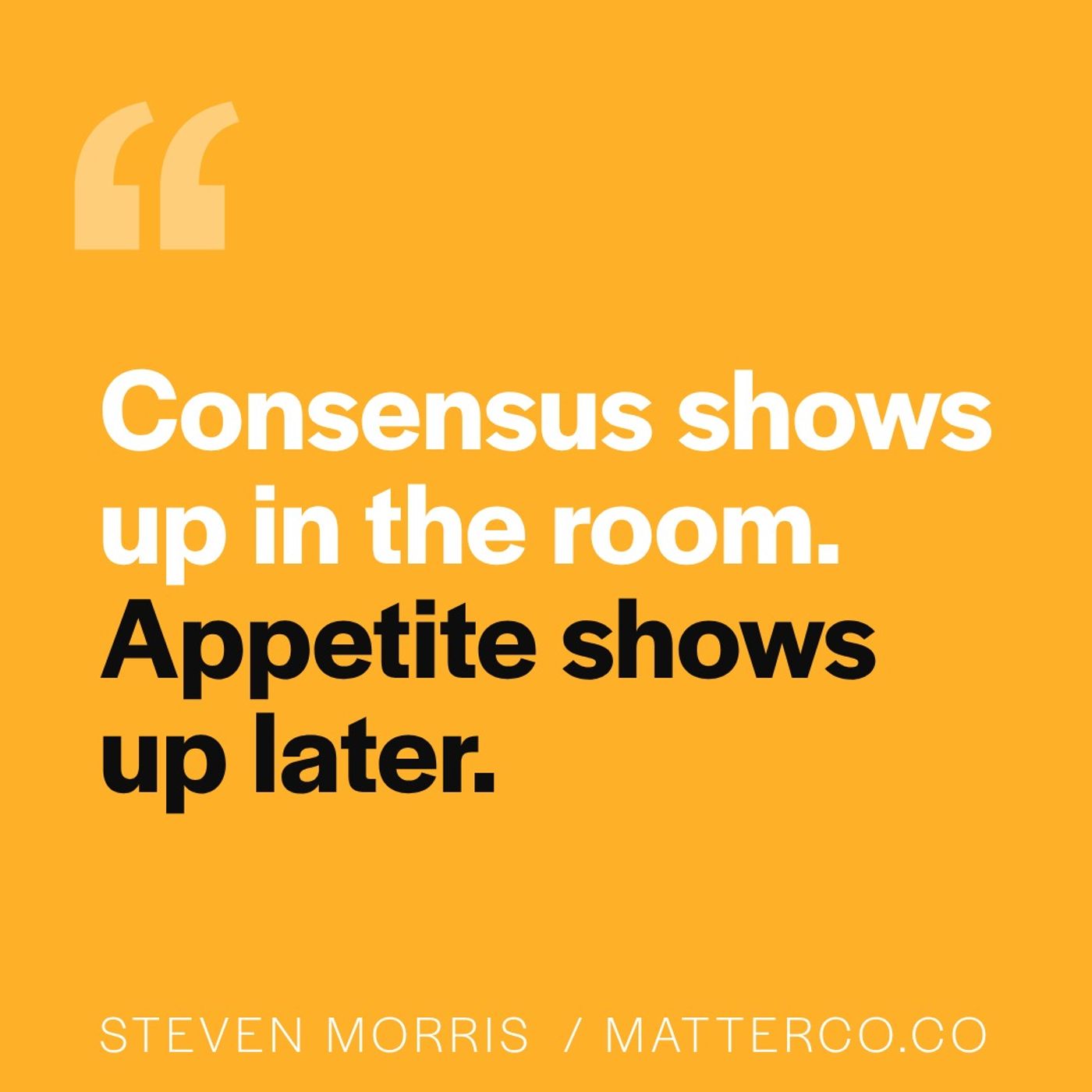
Appetite is about genuine ownership. There is a difference between agreeing with a strategy in the room and continuing to protect it when the work becomes difficult or inconvenient.
Capacity goes beyond whether there are enough hours in the calendar. It includes the focus, bandwidth, and resilience required to sustain demanding work without sacrificing the quality of thinking and decision-making.
Skillset asks whether the people responsible for execution have the capabilities the work actually requires. Capability is task-specific, and significant strategies often ask people to do things they have not done before.
Before moving from strategy to execution, leaders need to understand where their teams stand across all three.
Join me as I explore:
Why sound strategies can struggle during execution
The three elements of the Readiness Triad
The difference between consensus and genuine appetite
Why capacity is about more than time and headcount
How to identify skill gaps without turning them into judgments about people
What leaders can do to build readiness before significant change begins
Key Takeaways:
A strong strategy does not guarantee successful execution.
Appetite is revealed when priorities collide and the work becomes difficult.
Capacity includes focus, resilience, and the conditions surrounding the work—not simply available time.
Capability should be assessed against what the work requires, rather than a person’s title or past performance.
Leaders can deliberately create the conditions their teams need to execute successfully.
Before asking, “Can we fit this in?” ask, “What conditions need to exist for this work to succeed?”
Subscribe & Share
Subscribe for more reflections on leadership, strategy, culture, and the human side of meaningful work. Share this episode with a leader or team preparing to turn an important strategy into action.
#Leadership #Strategy #StrategyExecution #TeamReadiness #OrganizationalChange #LeadershipDevelopment
Steven Morris, CEO of Matter Consulting is an ever-curious life-seeker, brand and culture building expert, advisor, author, and speaker. With over 27 years of entrepreneurial experience, he has served as a trusted advisor to over 3,000 business leaders and evolved more than 250 brands and cultures, including Google, Habitat for Humanity, Samsung, and Disney. His best-selling book, "The Beautiful Business," and his widely read Insights blog are a testament to his consulting expertise in creating unignorable, magnetic, and sustainable companies.His diverse interests, including meditation, fine art painting, surfing, and beekeeping, infuse his work with creativity, soul, and a deep understanding of the human experience.You can find more podcasts and join 30,000+ other brilliant and soulful readers of his weekly INSIGHTS blog at MatterCo.

Comments

Download from Google Play

Download from App Store
 United States