


Behind the Scams | AI Scams & Deepfake Fraud
Subscribed: 21Played: 262
Subscribe

© 2026 Behind the Scams Podcast
Description
Behind the Scams is your essential podcast on AI scams, digital deception, and the social engineering impact shaping modern fraud. Hosts Nick & Sue Henley delve into romance scams, cryptocurrency fraud, email scams, and elder financial abuse with gripping stories and expert insights. Explore how healthcare ransomware, investment fraud, and treasury agent fraud compromise security—and learn cybersecurity tips to protect yourself. Each episode reveals the technology and psychology behind digital deception, empowering you with practical defenses against consumer fraud.
100 Episodes
Reverse

In Part 2 of this investigation, hosts Nick and Sue pull back the curtain on the people running the scam economy, the compounds holding workers captive, and where the stolen money goes. While Part 1 focused on targets on the receiving end of fraudulent messages, this episode follows the trail from recruitment ads and forced labor to crypto laundering networks and FBI enforcement.
Understanding human trafficking and scam compounds is essential because online fraud and coerced labor are two sides of the same operation. Nick and Sue walk through real-world reporting—including MIT Technology Review coverage of "Gavesh," a worker lured from South Asia with promises of a $1,500-a-month hospitality and data-entry job before being moved across the border near Mae Sot. They also examine accounts from survivors in Cambodia, Myanmar, and beyond, showing how deceptive job offers, debt traps, threats, and violence lock workers into running high-volume social media and messaging operations.
The episode also breaks down major enforcement actions and ongoing systemic challenges tied to human trafficking and scam compounds. Nick covers the October 2025 federal indictment in Brooklyn involving Prince Group founder Chen Zhi (also known as Vincent) and a civil forfeiture action involving roughly 127,271 bitcoin valued at around $15 billion at the time, alongside Treasury sanctions involving Zhao Hui and armed groups in Myanmar, as well as the extradition of She Zhijiang (Yatai New City / Shwe Kokko). Nick and Sue also review reporting from Myanmar Witness on the "whack-a-mole" pattern of compound raids and relocations, Amnesty International findings on compounds and mass departures in Cambodia, the tragic murder of South Korean student Park Min-ho, and the February 2026 UN Human Rights Office report highlighting the "dual-victim" problem when coerced workers are treated as criminals.
Looking at human trafficking and scam compounds from the financial and victim side, Nick explains how stolen funds move through "spraying and funneling" and stablecoins like Tether before reaching top operators. He also shares highlights from the FBI's 2025 Internet Crime Report—including nearly $21 billion in reported cyber-enabled losses across more than one million IC3 complaints, over $11 billion in cryptocurrency complaints, $7.7 billion reported by Americans over 60, and the report's first dedicated look at artificial intelligence scams (22,364 complaints and nearly $893 million in losses)—alongside proactive outreach through Operation Level Up.
Finally, Nick and Sue lay out a practical five-part family defense firewall to protect loved ones from human trafficking and scam compounds and digital fraud:
The Second-Person Rule: Talk to one trusted person before acting when money, crypto, or secrecy comes up in an online relationship.
A Family Code Word: Set up a shared word to verify urgent or panicked requests for help or cash.
Verify Overseas Job Offers Independently: Vet high-paying, fast-moving job offers abroad through independent channels and government travel/foreign affairs resources.
Normalize Talking About Shame Early: Make clear at home that asking for help will be met with support, not punishment.
Know Where to Report Fast: Act quickly when someone overseas goes quiet, sounds scripted, or triggers a sudden ransom demand.
Note: Allegations in pending or unfinalized legal proceedings are noted as allegations unless proven in court, and the views shared are for educa...
Chapters
(00:00:00) - Welcome back: following the money and the trafficking link(00:00:49) - Gavesh's story: a job ad that became a trap(00:02:42) - Crossing into Myanmar: the point of no return(00:03:55) - Chen Zi and the Prince Group indictment(00:05:06) - Inside the compounds: phones, accounts, and quotas(00:05:48) - The $15 billion bitcoin forfeiture(00:07:05) - Extradition, victims waiting, and ongoing sanctions(00:08:02) - Shwe Kokko and the architecture of protection(00:10:17) - Scale: 300,000 workers, 80 countries(00:10:55) - KK Park raid: whack-a-mole in practice(00:12:39) - Akshat's story: inside the daily grind of a compound(00:14:12) - Chatter, killer, developer: the scam assembly line(00:14:54) - Quotas, pay, and punishment by violence(00:16:13) - Child survivors and Amnesty's Cambodia report(00:17:15) - Park Min Ho: a student's death and its aftermath(00:19:47) - Justice achieved, but only for the visible cases(00:20:12) - Cambodia's crackdown and the dual-victim problem(00:21:28) - UN Human Rights report: global spread of compounds(00:23:58) - Accountability efforts and the whack-a-mole pattern continues(00:25:13) - Mass escapes and a humanitarian crisis in Phnom Penh(00:26:12) - Survivor testimonies: violence, death, and police inaction(00:27:17) - Aaron West: a prosecutor's view from inside empty compounds(00:28:48) - Following the money: crypto laundering mechanics(00:29:48) - FBI 2025 report: billions lost, elderly hit hardest(00:31:52) - AI deepfakes and the new rules of suspicion(00:33:25) - The family defense firewall: five practical rules(00:35:09) - Closing thoughts and where to get help

What happens when organized crime transforms abandoned casinos and fortified compounds into industrial-scale fraud operations? And what if the person sending you fraudulent messages is also a victim, trapped behind walls and forced to scam strangers?
In Episode 98 of Behind the Scams, hosts Nick Henley, a retired U.S. Treasury Special Agent with 25 years of federal law enforcement experience, and Sue investigate the disturbing global epidemic of scam farms—criminal enterprises that combine human trafficking, psychological manipulation, cryptocurrency fraud, and digital extortion.
Inspired by the FRONTLINE and Associated Press documentary Scammed, this first installment of a two-part investigative series examines how transnational criminal syndicates have transformed online fraud into a sophisticated, multibillion-dollar industry.
Inside Scam Farms: The Global Cybercrime Epidemic
Across Southeast Asia, particularly in Myanmar and Cambodia, fortified compounds have become operational centers for international cybercrime. Many scam farms operate with management hierarchies, performance quotas, detailed training manuals, and specialized teams responsible for manipulating victims worldwide.
These are not simply collections of hackers working independently. They are organized criminal businesses designed to systematically exploit trust, loneliness, financial insecurity, and fear.
Nick and Sue explore the notorious KK Park compound in Myanmar, where reports of armed guards, forced labor, physical abuse, and human trafficking reveal a devastating reality: some of the individuals conducting online scams are themselves captives.
The episode examines the experiences of Vietnamese trafficking survivor Hoc and Chinese actor Wang Xing, whose abduction and subsequent rescue helped expose the international scale of this crisis.
How Scam Farms Use Psychological Manipulation and Cryptocurrency Fraud
Behind the walls of these criminal compounds lies a carefully structured system of deception.
Investigative reporting uncovered extensive operational files, fabricated identities, AI-assisted communication tools, and carefully developed scripts designed to build emotional relationships before introducing fraudulent investment opportunities.
Inside these scam farms, workers may be assigned specialized responsibilities:
Conversation starters: Initiate seemingly innocent contact through messaging applications, dating platforms, or social media.
Relationship builders: Establish emotional connections through daily conversations, fabricated personal histories, and manufactured intimacy.
Cryptocurrency closers: Introduce fraudulent trading platforms and persuade victims to transfer increasingly large sums of money.
This process is commonly associated with pig butchering scams, a form of long-term investment fraud in which criminals cultivate trust before exploiting it financially.
Nick and Sue discuss the case of Alice Lin, a senior citizen who lost more than $500,000 after a relationship initiated on WeChat led her into a fraudulent cryptocurrency investment scheme.
Her experience demonstrates how sophisticated social engineering can devastate financially experienced and otherwise cautious individuals.
Chapters
(00:00:00) - Introduction and series overview(00:01:20) - The scale of fraud losses(00:02:45) - Myth of who gets scammed: Alice Lynn's story(00:04:15) - Episode roadmap and content warning(00:05:33) - Scam compounds in Southeast Asia(00:06:36) - Trafficked workers: Hok and Wang Xing(00:08:23) - Fake job ads and life inside the compounds(00:09:27) - The dual victim reality(00:10:19) - Why enforcement struggles to shut compounds down(00:12:24) - KK Park raid and whack-a-mole enforcement(00:13:47) - US strike force against scam networks(00:14:22) - The leaked 10,000-page scam playbook(00:15:08) - How the documentary gathered its evidence(00:16:06) - Assembly-line roles: starters, builders, closers(00:17:18) - Fake personas and the end of bad-grammar red flags(00:18:41) - AI tools and US tech in the scam supply chain(00:19:42) - The five-step emotional manipulation playbook(00:20:35) - Reciprocity and manufactured intimacy tactics(00:21:36) - Shift-based personas and practical takeaways(00:23:29) - Introducing sextortion and support resources(00:24:25) - Scale of sextortion crimes(00:25:35) - Gavin Guffey's story(00:26:44) - Manufactured panic and isolation tactics(00:28:03) - Advice for victims and parents(00:28:33) - Gavin's Law and the Take It Down Act(00:30:07) - Prosecutions: Ogashi brothers and Gavin's case(00:32:07) - Debrief: key takeaways from the episode(00:33:02) - Losses by age group(00:34:14) - Reporting scams and the IC3(00:34:54) - Operation Level Up and victim outreach(00:35:53) - What to do if you're a victim(00:36:42) - Preview of part two and closing thoughts

In Part 2 of our deep dive into the infamous blood-testing startup, we examine the breaking point of a massive corporate deception. From internal laboratory failures and whistleblower retaliation to regulatory crackdowns by CMS, legal intimidation, and the contrasting federal courtroom verdicts for Elizabeth Holmes and Sunny Balwani, this episode offers a sobering look at accountability. We also explore practical psychological and behavioral patterns—such as borrowed authority, confirmation bias, and the sunk cost trap—to help you spot similar warning signs today.
Key Takeaways
The Reality of Laboratory Quality: Conventional equipment and passing grades mean little if comparison methods and routine patient samples do not share the exact same standardized workflow.
The Cost of Speaking Up: Whistleblowers like Tyler Shultz and Erika Cheung faced intense legal pressure, surveillance, and personal strain for reporting inaccurate data and compliance failures.
Institutions vs. Proof: High-profile endorsements, celebrity board members, and staged laboratory tours (like a Potemkin village) are never a substitute for rigorous, independent verification.
The Difference in Legal Outcomes: Holmes and Balwani faced separate juries and charges, resulting in distinct verdicts and prison sentences that highlight the complexities of proving criminal intent versus operational responsibility.
Recognizing Modern Patterns: Prestige, borrowed authority, and manufactured pressure remain common warning tactics in fraud schemes today.
Resource Links
Behind the Scams Podcast Hub
FINRA: Avoid Investment Fraud Tips
FTC: Spotting and Avoiding Investment Scams
Clinical Laboratory Improvement Amendments (CMS CLIA Overview)
Chapters
(00:00:00) - Introduction and Recap of Part One(00:01:38) - Inside the Lab: Proficiency Testing and Data Manipulation(00:04:46) - Validation vs Quality Control(00:05:19) - Whistleblower Tyler Schultz's Story(00:07:38) - Erica Cheung's Experience and Legal Threats(00:09:41) - The Death of Dr. Ian Gibbons(00:11:19) - Journalism, Biden Visit, and the Potemkin Lab(00:12:22) - CMS Inspections and Regulatory Findings(00:13:54) - Voided Results and Collapsing Partnerships(00:14:53) - Patient Stories: Brittany Gould and Erin Tompkins(00:17:33) - SEC Civil Case Against Holmes(00:19:04) - Criminal Trials: Verdicts for Holmes and Balwani(00:21:19) - Why the Verdicts Differed: Legal Standards Explained(00:23:48) - Lessons Learned: Prevention and the Behind the Scams Playbook(00:29:12) - Honoring the Whistleblowers and Patients(00:30:43) - Modern Warning Signs and Closing Thoughts

Uncovering the Theranos Scam: How Elizabeth Holmes Fooled Silicon Valley (Part 1)
The Real Impact Behind the Theranos Scam
When Elizabeth Holmes and Theranos promised a revolutionary healthcare breakthrough with just a few drops of blood, millions of investors and eager patients wanted to believe it. But beneath the polished corporate image and the famous black turtleneck lay a web of deception, borrowed credibility, and hidden technology failures. In this episode of Behind the Scams, Nick and Sue break down the Theranos scam, examining how everyday persuasion mechanics like false urgency, unverified claims, and unauthorized logos operated at a corporate scale.
Discover the shocking gap between what was promised and what actually worked, and learn the practical steps you can take to protect yourself from a convincing pitch tied to the Theranos scam. We reference critical milestones in the case, including the SEC's findings on proprietary analyzers versus commercial equipment, trial testimonies from whistleblowers like Erika Cheung and Tyler Shultz, and warnings on trust-building and affinity fraud provided by Investor.gov.
Whether you are looking at historical financial crimes or evaluating modern corporate promises, understanding the core anatomy of the Theranos scam remains an essential tool for every consumer. Don't forget to subscribe for Part 2 as we explore the internal whistleblowers, legal reckoning, and the ultimate downfall that capped off the Theranos scam.
Key Resources & Links Mentioned
Learn more about protecting your investments and recognizing affinity fraud via Investor.gov.
Read about sample-collection standards and hemolysis risks with the World Health Organization.
Explore nonprofit consumer protection and media awareness work with the SOS Media Network.
Chapters
(00:00:00) - Introducing the Theranos Documentary Revival(00:00:50) - Why This Old Scam Still Matters(00:02:00) - The Promise: Blood Tests Made Easy(00:03:21) - What the Machine Could Actually Do(00:04:26) - Finger Pricks and Sample Reliability(00:05:20) - The Bait and Switch: Modified Siemens Analyzers(00:06:36) - Misleading Demonstrations(00:07:49) - Fake Pharmaceutical Logos and Borrowed Authority(00:09:26) - Walgreens, Safeway, and Borrowed Trust(00:11:00) - Revenue Projections vs Reality(00:12:07) - Following the Investment Money(00:13:07) - Paper Valuation vs Real Cash(00:14:05) - Where the Money Actually Went(00:16:09) - The Lifestyle Question: Lavish or Modest?(00:18:14) - The Powerful Board and Its Limits(00:19:00) - False Military Deployment Claims(00:20:21) - Affinity Trust and Fear of Missing Out(00:22:09) - Investor Pressure and Staying Quiet(00:23:30) - Crafting the Visionary Image(00:24:53) - Whistleblowers Tyler Schultz and Erika Cheung(00:25:57) - Manipulated Quality Control Results(00:27:30) - Balwani's Role and Authority(00:29:20) - Legal Pressure on Employees and the Press(00:31:16) - Ian Gibbons' Tragic Story(00:31:36) - Patient Testimonies and Harm(00:32:35) - The Verdicts: Holmes and Balwani(00:34:13) - Five-Item Scam Tactics Checklist(00:36:03) - The Black Turtleneck Explained(00:37:21) - Four Practical Verification Checks(00:41:05) - Closing Thoughts and Next Episode Preview
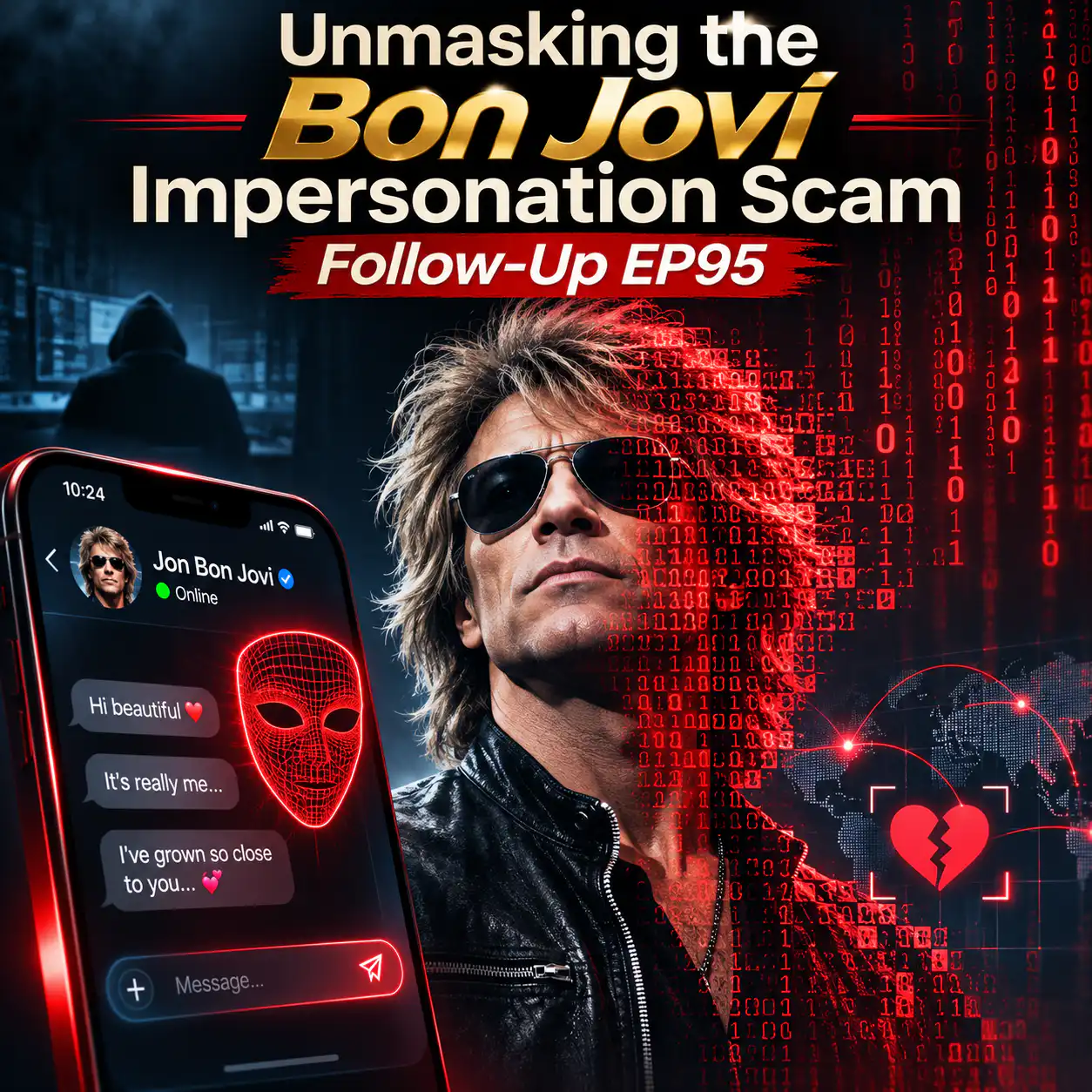
Welcome back to Behind the Scams on the SOS Media Network. In this follow-up episode, we continue our deep dive into the disturbing world of online romance fraud, examining how celebrity impersonations ensnare unsuspecting targets. Following up on Leslie Pickett's harrowing experience with a fake Jon Bon Jovi profile, we analyze the digital footprints, international leads, and psychological manipulation tactics used by bad actors across borders.
The Anatomy of Online Romance Fraud
Understanding how online romance fraud operates requires looking beyond the initial charm of a celebrity or romantic persona. Scammers frequently leverage sophisticated social engineering, fake video evidence, and carefully orchestrated communication loops to build false intimacy before demanding money. Recognizing the early warning signs of online romance fraud can prevent victims from suffering severe emotional and financial devastation.
Investigating Cross-Border Deception
As our investigation reveals, tracking down the perpetrators of online romance fraud involves navigating complex international jurisdictions, from reported locations in Lagos, Nigeria, to confronting scams in Ghana. However, finding a digital lead or a physical location is only the first step and does not automatically equate to an arrest or immediate financial recovery. Victims of online romance fraud often face immense emotional distress, exacerbated by recovery scams that falsely promise to retrieve lost funds for a fee.
Protecting Your Loved Ones
Safeguarding yourself and your family against online romance fraud relies on establishing clear financial boundaries. Never send money, cryptocurrency, or gift cards to someone you have not met in person, regardless of how convincing their video calls or celebrity status may appear. If you or someone you care about has been targeted, approach the situation with empathy rather than judgment, pause all financial transfers immediately, and report the incident through verified channels like the Federal Trade Commission or the FBI's Internet Crime Complaint Center.
Resources & Links
Behind the Scams Website: Behind the Scams
Stamp Out Scams, Inc.: Stamp Out Scams
FTC Romance Scam Guidance: Federal Trade Commission
FBI Internet Crime Complaint Center: IC3 Reporting
Welcome back to Behind the Scams on the SOS Media Network. In this episode, we unpack the reality of online romance fraud and investigate the complex web of celebrity impersonation, focusing on Leslie Pickett's encounter with a fake Jon Bon Jovi profile. We break down the digital bait, look at the limits of international investigative leads in Lagos and Ghana, and examine how fake profiles manipulate emotions and financial decisions.
Understanding Online Romance Fraud
Navigating the digital landscape requires vigilance against sophisticated deception. Online romance fraud often begins with seemingly innocent connections on social media or dating apps, gradually escalating into urgent financial demands through crypto kiosks o...
Chapters
(00:00:00) - Introduction and recap of the Bon Jovi scam(00:00:56) - Meeting the investigator: Mariana Van Zeller's approach(00:03:35) - Leslie's story: Lagos lead and payment demands(00:06:16) - IP tracing, device location and evidence limits(00:07:35) - What the Lagos investigation actually proves(00:10:01) - Jurisdiction, law enforcement limits, and victim support(00:11:28) - Creating Mary Zell: the undercover persona(00:13:33) - How trust and routine build in romance scams(00:15:37) - Rita's case: celebrity impersonation and $90,000 lost(00:16:48) - Talking to loved ones about the relationship's reality(00:17:24) - General Mark persona and celebrity impersonator accounts(00:18:42) - Deepfake videos and verification challenges(00:20:45) - Crypto ATMs and the mechanics of payment control(00:23:12) - Emotional and procedural control over payments(00:25:09) - The Ghana confrontation and face-to-face encounter(00:27:18) - Why scammers keep up the persona after exposure(00:29:58) - Money mules and the danger of receiving funds(00:31:45) - Systemic solutions: platforms, banks, and kiosks(00:33:59) - Three rules: avoiding, verifying, and reporting scams(00:37:25) - Recovery scams and fake FBI impersonators(00:39:06) - Closing thoughts and support resources

Comments

Download from Google Play

Download from App Store
 United States