


 Claim Ownership
Biofounders
Subscribed: 3Played: 32
Subscribe

© Sofia Sanchez
Description
58 Episodes
Reverse
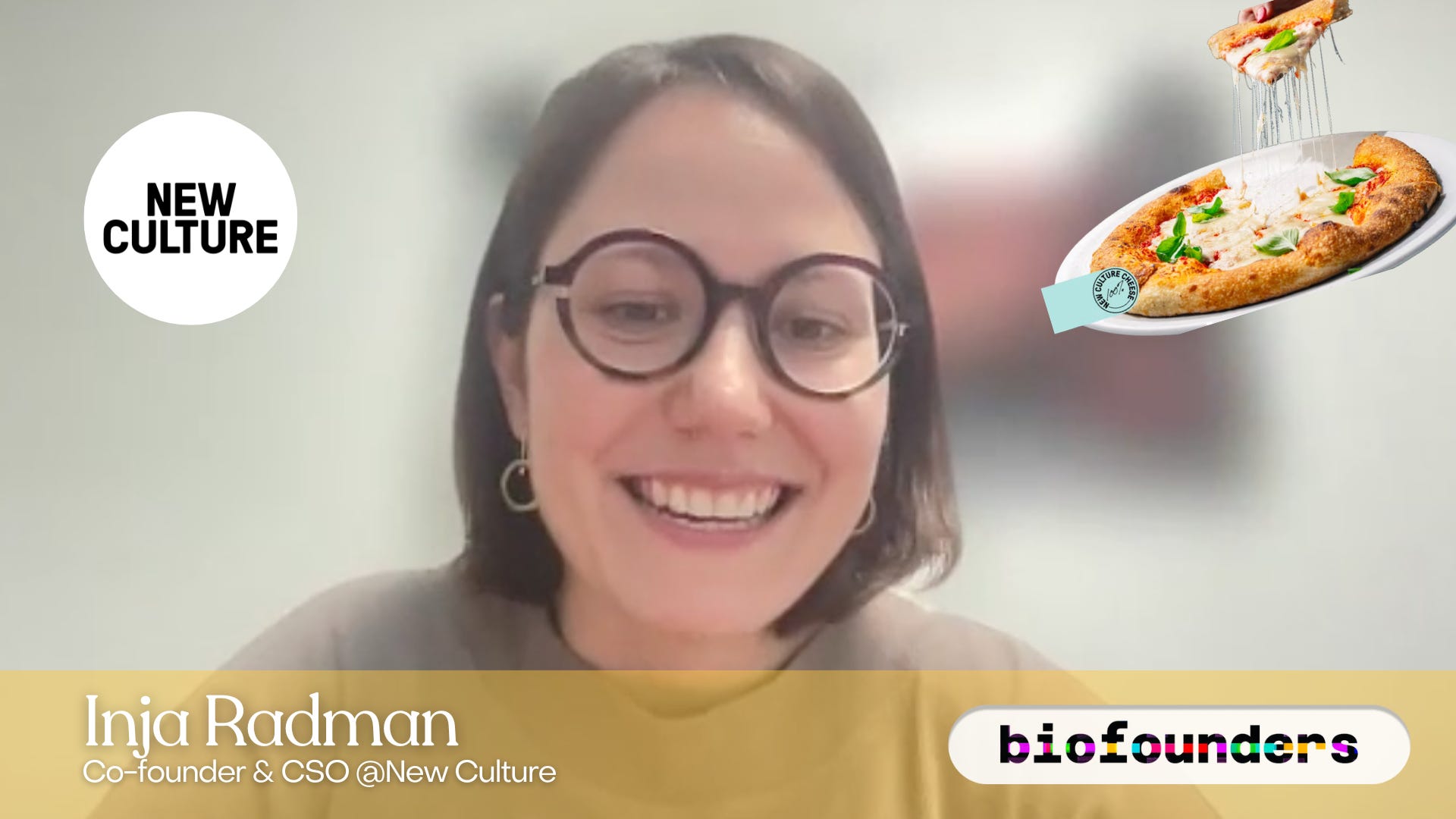
Biofounders Podcast: Fun conversations with the founders, investors, researchers and artists you haven’t heard of | Follow along on LinkedIn, Twitter, YouTube, and Instagram | Support the podcast with a 5-star rating on Spotify ⭐⭐⭐⭐⭐In this Biofounders episode, I interview Inja Radman, a scientist who went from studying optogenetics in worms to cofounding and leading R&D at New Culture, a company that is commercializing new dairy proteins made through precision fermentation.Timestamps* [0:00 - 1:24] Trailer* [2:13 - 6:12] – Academic background and early research journey* [6:51 - 10:08] – Climate obsession and the origin of New Culture* [10:57 - 14:21] – Leaving academia to co-found a company* [15:14 - 19:53] – Assessing economic feasibility at Indie Bio* [20:20 - 24:28] – Building the right technical team as CSO* [24:28 - 30:47] – From engineered strain to finished cheese product* [34:02 - 37:34] – Bioreactors and the real cost driver: downstream processing* [38:00 - 39:42] – Contract manufacturing vs. building in-house* [41:00 - 45:25] – Nutritional value and product positioning* [46:00 - end] – Advice for future bio founders This is a public episode. If you'd like to discuss this with other subscribers or get access to bonus episodes, visit www.biofoundershq.com/subscribe
Biofounders: Fun conversations with unconventional founders, biohackers, CEOs, and investors you haven’t met yet | Follow along on LinkedIn, Twitter, YouTube, and Instagram | Support the podcast with a 5-star rating on Spotify ⭐⭐⭐⭐⭐In this Biofounders episode:* [0:00 - 1:53] Introduction by Sofia* [2:29] Grace introduces herself* [8:14] Turning a design hobby into a job in biotech branding* [11:21] How branding in biotech has changed in the last decade* [16:08] Common fears around branding and storytelling in biotech founders* [18:48] B2B vs B2C biotech branding fears and needs* [22:35] Bringing dinosaurs to the NYSE for Ginkgo’s IPO* [24:21] How AI has changed our jobs* [29:09] Questions relevant in today’s biotech ecosystem* [34:10] Going from biotech tools to products that people want* [35:30] How do you build a brand when everybody’s doing the same thing?* [38:25] New formats for biotech branding and a secret new project* [41:28] What makes Oscillator unique* [43:38] Making things that don’t suck and branding as a means to make science work* [47:33] Working with Christina Agapakis and finding her own voice* [51:29] Rituals to stay creativeGrace is a chemical engineer turned creative director, or as we would both agree, a Biocreative.At Ginkgo Bioworks, she orchestrated branding for the company’s IPO, which was the largest of a biotech startup ever, and she cofounded GROW, a magazine about the societal aspects of biotechnology, which circulated more than 15,000 copies around the world.She was the first scientist to be recognized by Young Guns as one of the top creatives under 30 in the world, and her work has been recognized by the Art Directors Club, Webbys, Society of Publication Designers, and PRINT.In 2022, she started doing freelance work for companies like Bitbiome and Solugen, and last year, she joined forces with Christina Agapakis to start Oscillator, an agency that crafts new stories where biology and technology meet.This episode is definitely for the biocreatives, whether you’re into branding or storytelling, or you’re simply curious to learn how it’s like to work at the intersection of art and science. We talked about why branding can sometimes feel like therapy for scientists, fears of B2B and B2C biotech companies in their storytelling, what questions she would ask if she was leading a biotech magazine today, what biotech is missing these days, new branding formats, and the Oscillator ethos. This is a public episode. If you'd like to discuss this with other subscribers or get access to bonus episodes, visit www.biofoundershq.com/subscribe
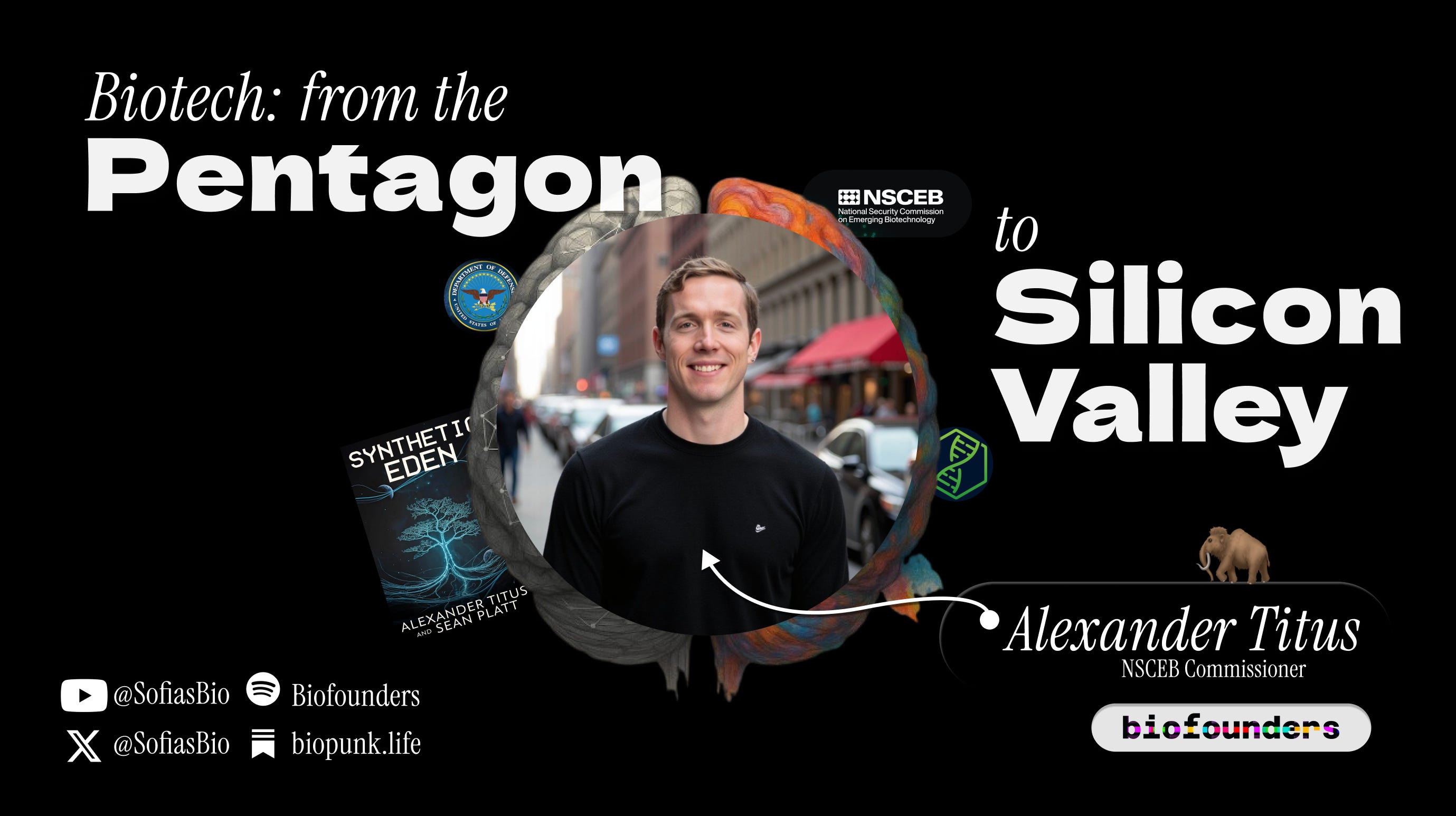
As part of his work in the public sector, Alexander Titus is one of the Commissioners at the United States National Security Commission on Emerging Biotechnology. He previously worked at the DoD as the Head of Biotechnology Strategy, and helped launch PPPs BioMADE and armi.With too many interests to count, Titus was also part of early-stage startups like Colossal Biosciences; he worked at Google’s healthcare and life sciences division, and cofounded Dauntless Ventures and Decycle Bio.We’ve followed each other since he ran the BioXYZ publication in 2020. Today, he writes about the intersection of science, technology, policy, futures, and fiction through The Connected Ideas Project. His first science fiction novel, Synthetic Eden is now available.In this Biofounders episode:0:00-3:53 Introduction3:55 Public and private sector in biotech innovation10:11 Questions the Pentagon asking about biotech during the pandemic13:13 Building credibility as biotechnologists through different storytelling17:49 Lessons from Bioeconomy.XYZ, The Connected Ideas Project, and Synthetic Eden21:05 How to think about genetically engineered human embryos27:11 Increasing our reliance on AI and robotics-powered biotechnology32:35 US-China biotechnological race36:20 Metrics to assess the progress of biotech40:37 Lessons from the last few years of the biotech industry and analogies to the tech industry46:09 How Titus personally decides what to work on at a given timeBiofounders: fun conversations with unconventional founders, biohackers, CEOs, and investors you haven’t met yet | Follow along on LinkedIn, Twitter, YouTube, and Instagram | Support the podcast with a 5-star rating on Spotify ⭐⭐⭐⭐⭐ This is a public episode. If you'd like to discuss this with other subscribers or get access to bonus episodes, visit www.biofoundershq.com/subscribe

In the year 2000, Michael Elowitz and Stanislas Leibler published the first paper on a genetic circuit built in E. coli. A couple of years later, the first mammalian synthetic circuits emerged with work from Fussenegger in human cell lines.Genetic engineers remained blind to plants until the late 2010s, when similar genetic engineering efforts started in the autotrophs. Long time scales, heterogeneous cell types, and high polyploidy are only some of the technical challenges of plant engineering.Meanwhile, plants account for 80% of all biomass on Earth, they are our carbon capture machines by excellence, the original source of most pharmaceuticals in the world, and the basis of all of agriculture.For startups and academic labs alike, the fact that plant (genetic) engineering lags ~15 years behind other organisms means that the ocean is blue, and a green field lies ahead.When engineered, plants can serve as low-cost, natural bioreactors for pharmaceutical and cosmetic ingredients, for textiles and functional food… they can fix more carbon from the air and produce more food and, in some weird cases, they can even be turned into digital data storage devices and metal mining machines.The following is a Biopunk Tour of the Brophy Lab in Stanford, where they are building new genetic engineering tools for plants and their associated microbes, towards a sustainable future. Their PI, Jennifer Brophy, famously built the first logic gates in plants during her postdoc, setting a precedent for the Brophytes 🌱.PhD student Vivian Zhong and Postdoc Alexander Borowsky were kind enough to answer lots of questions about their current work, challenges and opportunities in industrial plant genetic engineering, under- and over-hyped plant biotechnologies, and societal challenges of engineered plants.* 00:00 — Inside the plant incubator* 00:36 — Vivian’s work to overcome random DNA integration* 01:30 — Alex’s work controlling gene expression in plants* 02:10 — The Brophy Lab’s mission* 02:40 — Overhyped plant biotech* 04:00 — Underhyped plant biotech* 07:50 — Why you should consider doing plant genetic engineering* 08:40 — Public Perception & communication about GMOs* 11:30 — Lab Tour: Plant Transformation & Screening* 14:30 — Microscopy: Visualizing edited plant cells* 15:00 — Building gene constructs on Benchling* 16:15 — Bioengineering: for what purpose?* 17:10 — Futuristic plant biotechnologiesMore Biopunk Tours of companies, research labs, and perhaps whole biotech cities could be possible — If you’re interested in supporting this content as a sponsor, drop me a line via LinkedIn, Twitter, a Substack comment or message, or by replying to this email! This is a public episode. If you'd like to discuss this with other subscribers or get access to bonus episodes, visit www.biofoundershq.com/subscribe
Michael Florea is the co-founder and CEO of Olden Labs, an SF-based company developing and shipping AI smart and low cost cages for animal studies. Michael has had a long term vision to advance human longevity since he was a teenager. After his PhD in biology at Harvard Medical School, where he worked on whole body gene delivery systems, he choose to accelerate biotechnology by building Olden Labs. In just one month after launching, they’ve got over 100 labs, companies, and institutions to sign up for their cages. As of February 2025, they’ve shipped close to 40.In this episode, we talk about the state of longevity, the state of the art in animal monitoring, how the Olden Labs smart cage works (watch YouTube video below for that), why animals are still relevant in a world of virtual biology and organoids, how the data they collect can further improve research, and my personal take on longevity.Biofounders: fun conversations with unconventional founders, biohackers, CEOs, and investors you haven’t met yet | Follow along on LinkedIn, Twitter, YouTube, and Instagram | Support the podcast with a 5-star rating on Spotify ⭐⭐⭐⭐⭐Timestamps02:18 Upbringing and early interest in biology and longevity as a teen7:15 PhD work in whole body gene delivery13:02 State of the art and challenges of animal cages in research18:40 Design of Olden Labs cages27:40 Other companies in the space and vision29:14 Cloud Lab vision for the next 5-10 years31:58 Why we still need animals despite advancements in organoids and simulations35:19 Capturing data for biomedical research37:02 Longevity questions and discussionSubscribe to weekly updates on the latest biotech outside trad pharma and never miss a Biofounders episode! This is a public episode. If you'd like to discuss this with other subscribers or get access to bonus episodes, visit www.biofoundershq.com/subscribe

Comments

Download from Google Play

Download from App Store
 United States