


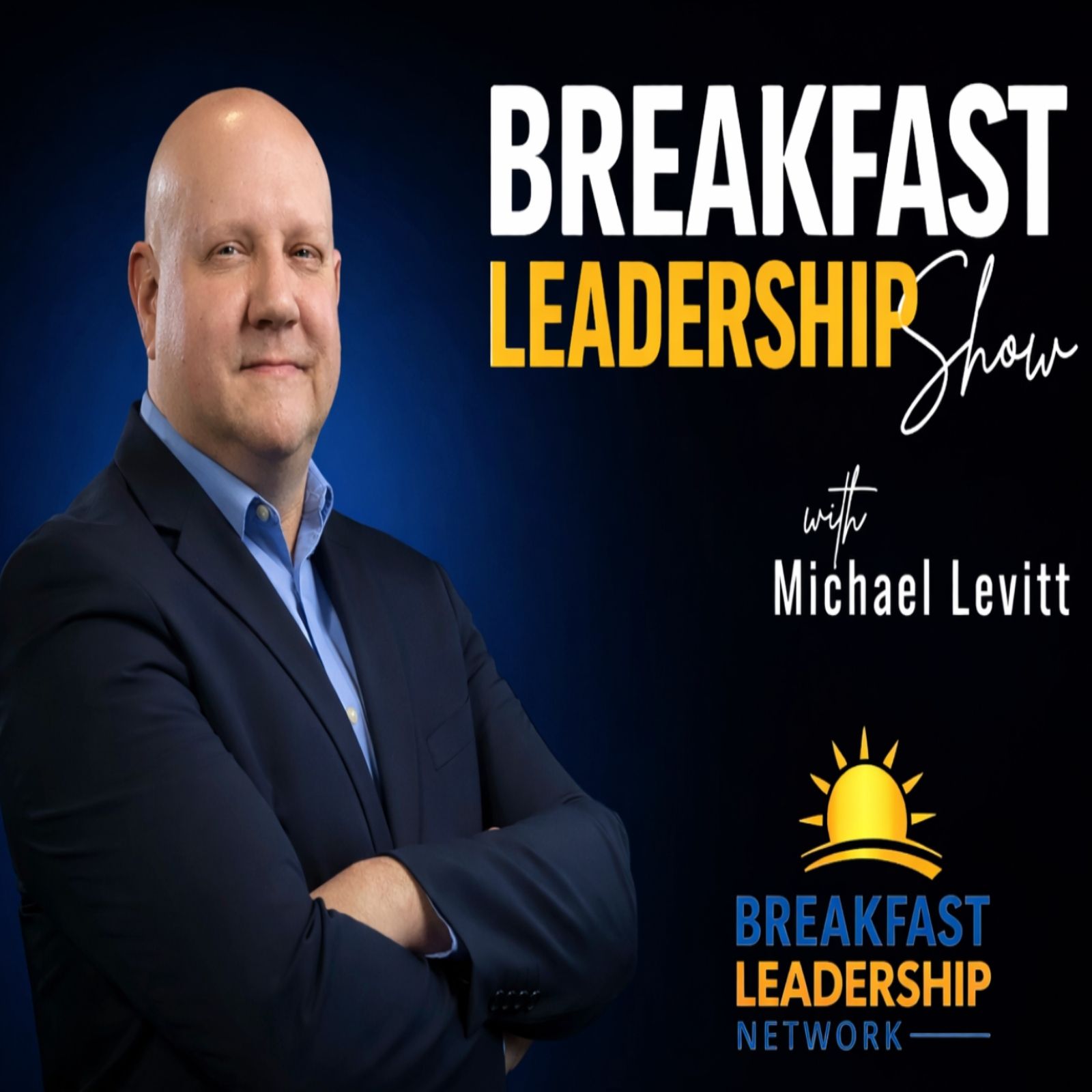
Breakfast Leadership Show
Subscribed: 15Played: 297
Subscribe

© Copyright Breakfast Leadership, Inc. All rights reserved. Breakfast Leadership is a registered trademark of Breakfast Leadership, Inc. All Rights Reserved
Description
The Breakfast Leadership Show, hosted by leadership consultant and burnout expert Michael D. Levitt, is a globally ranked leadership podcast exploring how executives build stronger organizations, better leadership systems, and healthier workplace cultures.
Each episode features conversations with founders, executives, and industry experts on topics such as leadership operating systems, leadership decision making, executive leadership consulting, organizational leadership systems, and leadership burnout prevention.
Listeners gain practical insight into how leadership teams improve performance, reduce burnout, and design the structures that drive sustainable growth. The show covers leadership strategy, workplace culture, decision clarity for leadership teams, leadership infrastructure, and the systems that help organizations operate at a higher level.
With actionable lessons drawn from real executive experience, the Breakfast Leadership Show helps leaders move beyond management tactics and focus on building high-performance leadership systems that scale.
Interested in being a guest on the show?
Visit: https://BreakfastLeadership.com/Podcast
Note: Some episodes may include sponsored guest appearances. In those cases, guests may have provided financial compensation to participate in the podcast.
Each episode features conversations with founders, executives, and industry experts on topics such as leadership operating systems, leadership decision making, executive leadership consulting, organizational leadership systems, and leadership burnout prevention.
Listeners gain practical insight into how leadership teams improve performance, reduce burnout, and design the structures that drive sustainable growth. The show covers leadership strategy, workplace culture, decision clarity for leadership teams, leadership infrastructure, and the systems that help organizations operate at a higher level.
With actionable lessons drawn from real executive experience, the Breakfast Leadership Show helps leaders move beyond management tactics and focus on building high-performance leadership systems that scale.
Interested in being a guest on the show?
Visit: https://BreakfastLeadership.com/Podcast
Note: Some episodes may include sponsored guest appearances. In those cases, guests may have provided financial compensation to participate in the podcast.
605 Episodes
Reverse
Ganzorig Ulziibayar spent twenty years as a CEO, starting as a staff member and rising through the ranks before founding his own business. He is now chairman of a financial group made up of three insurance companies, an asset manager and an investment bank, and he is the author of Strategy as Attitude. He arrived at that title after watching a great many brilliant people fail.What he found was that failure had nothing to do with pedigree, school, an MBA, IQ or EQ. Through fifteen years of productivity psychology research he concluded that psychology accounts for more than seventy percent of what determines a person's productivity, and that the deciding factor sits in the subconscious. He reached the same conclusion a second time from a completely different direction, as a practitioner who once managed 120 executives at a multi-billion dollar bank and watched capable people fail for one reason: they preferred themselves. He describes diagnosing those leaders as deaf, unable to hear customers, staff or colleagues even with reality in front of them.His answer is three attitudes latent in everyone and suppressed by modern education and individualism: being a giver rather than a taker, taking the customer's perspective rather than your own, and being productive rather than merely saving cost, time and energy. He explains why a selfish person can never articulate a strategy, why a product is by definition something given to someone else, and why he ranks customers first, staff second, shareholders third, executives fourth and the CEO fifth. Michael and Ganzorig also get into where companies are getting AI wrong, why strategy is the work AI cannot take, and what it means that more than half the Fortune 500 from the year 2000 no longer exists.What you will learnWhy credentials, IQ and EQ predict so little about who actually succeeds, and what does predict itThe three latent attitudes that make anyone a strategist, and why modern education suppresses all threeWhy a selfish person can never articulate a strategy, explained through what a product actually isThe priority order Ganzorig gives every company: customers, staff, shareholders, executives, then the CEOHow to spot a corporate politician sitting in the seat where a strategist should beWhy organizations with hundreds of billions in resources still get taken down by startupsWhy strategy is the one thing AI cannot do for you, and what that means for how we educate peopleGanzorig Ulziibayar is a practitioner strategist who spent twenty years as a CEO, starting as a staff member and rising through the ranks before founding his own business. He is now chairman of a financial group comprising three insurance companies, an asset manager and an investment bank. He has led as many as 120 executives at a multi-billion dollar bank as well as startups of twenty to thirty people, and has spent fifteen years researching productivity psychology. He is the author of Strategy as Attitude, and of a history book.ConnectStrategy as Attitude, available on Amazon and KindleBreakfast Leadership Network: https://www.breakfastleadership.com
Note: The Breakfast Leadership Show includes occasional paid partner episodes, in which the guest has paid to appear. Hosted by Simplecast, an AdsWizz company. See pcm.adswizz.com for information about our collection and use of personal data for advertising.
Episode OverviewMichael Levitt sits down with Ilene Fischer, a former chemical engineer turned organizational change consultant who spent ten years working alongside Peter Senge at Innovation Associates and eight years with Tom Peters. Ilene's new book, Innovation Ecosystems: A Dynamic Blueprint for Organizational Success and Engagement, publishes October 22nd through Hachette, with a foreword written by Peter Senge himself.The conversation covers why systems thinking has gone from a nice to have to a have to have, why most AI deployments fail because they get layered onto broken processes instead of fixing them, and why the single highest leverage move in any organizational change effort is making people feel heard. Ilene and Michael both draw on real client cases, including a private equity roll up of eight home health and hospice companies and a healthcare insurance client that grew operating margin from 15 million dollars to 52 million dollars in a single year using her WOW Teams methodology.Key TakeawaysSystems thinking is no longer optional. Every decision made in isolation now ripples across an interconnected organization, which is why solving problems linearly creates more problems than it fixes.AI projects fail when they get bolted onto broken systems. Gartner projects that at least 40 percent of AI initiatives will be canceled next year, largely because organizations deployed AI without first fixing the underlying ecosystem.Culture determines whether any initiative, AI or otherwise, can actually take hold. A fear driven, top down culture will reject good ideas even when experimentation proves they work.Being heard, not incentives or new tools, is the top driver of successful change. Roughly 70 percent of failed change initiatives trace back to people not feeling heard.Multidisciplinary talent, not more specialists, is the real talent gap. Organizations need people who can work across domains, such as AI and healthcare together, not deeper expertise in a single lane.Deep listening without an agenda is the starting point for any change effort. Ilene's team interviewed 107 people before facilitating an eight company merger for a private equity client.Engagement and retention follow naturally once people feel heard and see their talent used. One healthcare insurance client moved from a 50 to a 70 Great Place to Work score and became the fifth best place to work in its state within three years.About Ilene FischerIlene Fischer began her career as a chemical engineer and the first woman engineer at Raytheon in Andover, before moving into quality management and eventually organizational change consulting. She spent a decade working directly with Peter Senge at Innovation Associates and eight years with Tom Peters, and she developed the WOW Teams methodology used to align strategic goals with frontline execution.Her book, Innovation Ecosystems: A Dynamic Blueprint for Organizational Success and Engagement, is available for pre-order on Amazon now and releases October 22nd. Peter Senge wrote the foreword. Ilene is hosting a launch event on October 22nd featuring Peter Senge as a speaker.Connect with Ilene:Website: https://sophianetwork.netEmail: [email protected] bring this same systems thinking to your own organization, visit https://www.breakfastleadership.com/leadershipos to schedule your Leadership Operating System diagnostic.
Note: The Breakfast Leadership Show includes occasional paid partner episodes, in which the guest has paid to appear. Hosted by Simplecast, an AdsWizz company. See pcm.adswizz.com for information about our collection and use of personal data for advertising.
SummaryMike Sullivan is co-founder and Chief Growth Officer at OneDigital, an insurance and financial services organization with roughly 6,000 people across the United States and Canada. He is also co-author of the bestselling book Workforce Intelligence. He came on to talk about what three years of deploying AI inside his own company actually taught him, and the answer is not what most executives are being sold.The turning point was a single sentence. When OneDigital stopped thinking about AI as technology and started thinking about it as talent, and began hiring it, everything changed. Their people mentor the AI, teach it the job, and then hand it the work it genuinely does better. Each AI coworker has a name and a personality, and it becomes the repository of institutional knowledge that used to walk out the door when a 35-year employee retired.Mike is direct about the condition that makes any of this work, which is trust. You cannot lay off ten thousand people in the name of AI and then tell the survivors you are all in on them. He also names the question almost nobody has answered yet: when a growing share of your workforce is AI talent, who manages it, and how do you measure a blended workforce? Michael and Mike also get into the disappearing bottom rungs of the corporate ladder, why Gartner expects a wave of companies to table AI projects over missing ROI, and why Mike now jokes that his father, a union ironworker from Buffalo, would finally call him pro-labor.What you will learnThe reframe that changed everything at a 6,000-person company: stop treating AI as technology and start hiring it like talentWhat a capacity dividend is, and the question to ask once AI hands your team their time backHow to build AI coworkers that capture institutional knowledge before your longest-serving people retireWhy trust is the precondition for AI adoption, and how layoff headlines destroy itThe management gap nobody has solved: who owns AI talent when your org chart only knows human capitalWhy the bottom rungs of the corporate ladder are disappearing, and what that does to early-career hiringWhy AI projects stall on ROI when leaders expect an immediate return from something that needs cultivatingAbout Mike SullivanMike Sullivan is co-founder and Chief Growth Officer at OneDigital, an insurance and financial services organization operating across the United States and Canada with roughly 6,000 employees. He is co-author, with Vinay Gidwani, of the bestselling book Workforce Intelligence, written deliberately for non-technical leaders who are trying to run companies through AI adoption without losing the trust of their people.ConnectOneDigital: https://www.onedigital.comWorkforce Intelligence by Mike Sullivan and Vinay GidwaniBreakfast Leadership Network: https://www.breakfastleadership.com
Note: The Breakfast Leadership Show includes occasional paid partner episodes, in which the guest has paid to appear. Hosted by Simplecast, an AdsWizz company. See pcm.adswizz.com for information about our collection and use of personal data for advertising.
GUEST BIO
Stephanie Houser is a former Fortune 500 executive turned consultant, entrepreneur, and speaker. After 12 years in corporate leadership, she now runs a consulting practice focused on process, risk, product, and technology development for growing businesses. She also operates a self-publishing company that helps writers publish their books, and she is building an asynchronous ed tech tutoring platform. Stephanie speaks and serves on boards, bringing a cross-industry, problem-solving lens shaped by careers in writing, education, corporate leadership, and entrepreneurship.
WHAT YOU WILL LEARN
Why fear rooted in layoffs is now the biggest barrier keeping people and businesses from moving forward.
Why unrealistic timelines, fueled by social media highlight reels, cause people to quit before real traction happens.
The difference between chasing virality and building lasting visibility.
Why shiny object syndrome derails long-term strategy, using a cruise liner turn as a metaphor for staying the course.
Why attention spans have dropped from just over two minutes in 2004 to roughly 47 seconds today, and what that means for leaders.
Why personal development starts with empathy, admitting mistakes, and spotlighting others rather than seeking credit.
EPISODE HIGHLIGHTS
Stephanie Houser joins Michael to discuss what separates leaders who build lasting organizations from those who stall out. She describes herself first as a problem solver, a thread running through her varied career across writing, education, corporate leadership, and entrepreneurship. That range gives her more lenses for seeing and solving problems, a point Michael echoes from his own background in healthcare and consulting.
Drawing on her work across an ed tech startup, a self-publishing company, and a consulting practice, Stephanie names three forces holding people and organizations back right now. The first is fear, intensified by waves of layoffs that have eroded job security. The second is a timeline problem: social media rewards overnight success, so people quit when real progress, which usually takes years, does not happen in months. She draws a clear line between virality, a temporary surge, and visibility, a durable state built through consistent, trusted engagement.
The third force is a lack of personal development, which she ties to empathy and staying connected to the people doing the work. She shares an example of a CEO who assumed her team did not need more support, only to learn the team had been asking for it directly. Leaders who disconnect from front-line reality create openings that get exploited or ignored.
Stephanie and Michael return repeatedly to staying the course. She uses the image of turning a cruise liner, which takes three nautical miles of advance planning, to describe how leaders must commit to a long-term direction and resist shiny object syndrome, the short-term distractions that feel exciting but pull an organization off its planned path. Michael shares a cautionary example of a well-funded organization that lost its way chasing shiny opportunities instead of holding to its plan.
They also discuss shrinking attention spans. Stephanie notes that undivided attention today lasts about 47 seconds, down from just over two minutes in 2004, so a message needs to be repeated rather than delivered once. She points to the marketing rule of seven as a reminder that repetition, not length, makes information land.
The episode closes on personal development as an ongoing discipline. Stephanie encourages leaders to listen more than they speak, admit when they are wrong, spotlight the people doing good work, and learn to say no with confidence, backed by reasoning rather than a title.
GUEST CONTACT INFO
Stephanie Houser, corporate speaking and board inquiries: https://stephaniehouser.com
Stephanie Houser, individual and creative fractional work: https://AboutStephanie.com
LEADERSHIP OS CTA
Ready to bring more clarity and long-term focus to your leadership? Visit https://www.breakfastleadership.com/leadershipos to schedule your Leadership Operating System diagnostic for your company.
Note: The Breakfast Leadership Show includes occasional paid partner episodes, in which the guest has paid to appear. Hosted by Simplecast, an AdsWizz company. See pcm.adswizz.com for information about our collection and use of personal data for advertising.
Dr. Santarvis Brown, educator, pastor, author, and Chief Education Officer at ProQ, joins Michael D. Levitt on the Breakfast Leadership Show for a powerful conversation about leading with purpose. With over 20 years in education and 15 years in pastoral ministry, Dr. Brown brings academic rigor, spiritual grounding, and practical business insight to every leadership conversation.The Leader You Have to Lead First: YourselfIn his book "Leading While Limping," Dr. Brown challenges leaders to confront their own "bang-ups and hang-ups" without filters or masks. When you avoid that internal reckoning, you risk inflicting your unresolved issues onto the people you lead. Authentic leadership begins with radical self-honesty. As Michael puts it, you will spend more time with yourself than with any other person on earth. Working through whatever you find within is not optional for any leader who wants to create lasting impact.Impact Over TitleDuring his tenure as the top education official for the Seminole Tribe of Florida's Department of Education, a young student wandered to the executive floor looking for homework help. Dr. Brown pulled up a chair and helped him with his reading. When the boy's mother arrived, the student looked at her and said simply, "He's a teacher." That moment crystallized the principle Dr. Brown carries everywhere: your title comes and goes, but your impact remains.The Story That Became a ChapterDr. Brown shares a defining story from "Leading While Limping." A university student he mentored went silent one evening, breaking from his usual enthusiastic greeting. Dr. Brown turned around in the parking lot, took the student to a nearby Denny's, and had a conversation about everything and nothing. At 1:30 a.m., the student sent an email with the subject line: "You saved my life." He had been on the verge of ending it rather than returning home without finishing his degree. Dr. Brown was on campus at 5:00 a.m. the next morning, and together they secured the funding needed to get him to graduation. Nearly 20 years later, that student still introduces Dr. Brown to everyone with the same words. The lesson: sometimes you are the aspirin to someone else's headache while carrying a migraine of your own.Human Connection Is Not OptionalLeaders who isolate themselves behind titles miss the very thing that makes people want to follow them. Genuine presence, curiosity, and interest in another person are not soft skills. They are the foundation of any leadership worth building.Growth as a Problem: The Chaos TaxProQ, founded on the book "Don't Walk Off a Cliff in Business" by Thomas McDonald, operates on a simple principle: predictable, scalable, reliable progress. Dr. Brown explains that not all growth is good growth. When growth outpaces process, businesses pay a chaos tax in inefficiency, burnout, and lost leadership bandwidth. ProQ helps organizations grow incrementally and intentionally so that progress becomes sustainable. As Dr. Brown puts it, businesses fail today not because they lack opportunity or know-how, but because they lack process.Connect with Dr. Santarvis BrownLearn more about ProQ at ProQSystems.com https://www.proqsystems.comConnect directly with Dr. Brown at [email protected] and subscribe to his YouTube channel, The Leadership Doctor SB (https://www.youtube.com/@TheLeadershipDoctorSB), where he diagnoses leadership challenges every week.Schedule Your Leadership DiagnosticVisit https://www.breakfastleadership.com/leadershipos to schedule a leadership diagnostic for your company today.
Note: The Breakfast Leadership Show includes occasional paid partner episodes, in which the guest has paid to appear. Hosted by Simplecast, an AdsWizz company. See pcm.adswizz.com for information about our collection and use of personal data for advertising.

Comments

Download from Google Play

Download from App Store
 United States