DiscoverBreakthrough AI Operators
Breakthrough AI Operators
Claim Ownership

Breakthrough AI Operators

Author: Roland Siebelink

Subscribed: 0Played: 0
Share

Description

Breakthrough AI Operators is a podcast about how the best startup founders are reinventing how their companies work. Not AI hype. Not vendor pitches. Real operators who've rebuilt significant parts of their business around AI — and can talk honestly about what worked and what didn't.


Hosted by Roland Siebelink and Doug Miller, co-founders of Midstage Accelerator (7 unicorns built between them, 100+ leadership teams scaled), each episode features a founder who's achieved a genuine step-change breakthrough in how their company operates. These aren't productivity wins or tool adoption stories — they're companies that are structurally different because of AI.


If you're a founder at a 20–300 person company actively figuring out what AI means for your operating model and competitive position, this show gives you real stories from people in the field — not consultants theorizing from the sidelines.

35 Episodes
Reverse
What does it look like when the person best positioned to disrupt an industry is the one who used to run the process about to become obsolete? One founder managed a 90-person team deploying water meters the slow, decades-old way, watched a hyperscaler quietly ship a piece of infrastructure almost nobody in her industry noticed, and knew instantly her old job wouldn't exist much longer.Anne Mushow is CEO of Subeca, a water-metering company she built after running Xylem's smart-meter deployment team and a stint inside Amazon Web Services, where she watched Amazon Sidewalk launch and recognized what it would mean for the industry she'd just left.Subeca's device clips onto a water meter already in the ground in under a minute and turns it into a connected one, no rip and replace, no dedicated network to build or maintain. The path there took several pivots. Mushow originally imagined utilities and customers sharing usage data directly, until she learned most utilities didn't have granular data to share in the first place. An early version ran on LoRaWAN alone, until Sidewalk's infrastructureless model, running through Ring cameras and Echo devices already sitting in millions of homes, became what she calls the real unlock. Subeca now runs both as a belt-and-suspenders setup. Revenue grew 10x from 2024 to 2025, and the company is on pace for another 10x this year.The team behind that growth is seven technical people. Mushow estimates the same work would have needed 20 to 25 people fifteen years ago, mostly because AI now lets her team iterate on small, deeply tested pieces of code instead of building everything by hand. AI also does a chunk of lead generation, scanning public municipal and HOA meeting records for the exact language that signals a utility is close to a buying decision. Her clearest competitive edge isn't technical, though. Established meter manufacturers have been slow and skeptical about Sidewalk, and Mushow's own history helping launch it from inside Amazon gave Subeca roughly a two-year head start nobody else could easily copy. She's also chosen to stay a point solution on purpose, happily plugging into partners' existing systems as the last-mile connector instead of trying to own the entire stack.Roland flags the headcount comparison as one of the clearest AI-leverage numbers he's heard on the show: a team of seven doing what took 20 to 25 people a decade and a half ago is the kind of benchmark SaaS founders at the $1M to $50M stage should be measuring themselves against, not vague claims of "using AI more."Key Moments:02:31 — Why Subeca calls itself the data layer AI needs, without calling itself an AI company04:14 — The three market pressures forcing utilities to finally modernize06:47 — Seven technical people doing work that would have needed 20 to 25 people fifteen years ago08:10 — Scanning municipal board minutes with AI to catch a utility right before it's ready to buy11:36 — The 2016 idea that failed once utilities admitted they didn't even have the data13:25 — Why Amazon Sidewalk became "the ultimate game changer" over LoRaWAN and cellular21:55 — The unexpected moat: being the one who helped launch Sidewalk from inside Amazon23:42 — Choosing to be the "last mile" connector instead of building a walled-garden platformIf the AI-leverage math behind your own team isn't as clear as Mushow's seven-person build, Roland works through exactly that kind of benchmarking with SaaS founders inside Midstage. mdstg.ac/drag-erase#SmartWaterMetering #AmazonSidewalk #IoTWaterInfrastructure #FounderGrowth #BreakthroughAIOperators
What happens when you build the right idea a decade too early? Most founders would call that a failure and move on to something else. One founder built the exact same business twice, over ten years apart, and this time the world finally caught up to the idea.Sandra Trittin co-founded a distributed energy management startup back in 2012 and watched the market fail to catch up to the idea. She's doing it again as co-founder of Beebop, the orchestration layer that lets utilities integrate distributed energy resources like solar, storage, and EVs at grid scale.Sandra names three things that had to change before her original thesis could actually work. Homes and businesses now generate and store their own power, so people who used to be pure consumers have become producers too, which scrambles the demand patterns utilities used to plan around. The devices themselves finally became internet-connected and controllable, instead of the 30 or 40 year old hot water tanks she was trying to manage in 2012. And competition increased alongside real customer education, so the pitch no longer has to start from zero. She also tells a story about why none of that replaces field experience: an IT colleague pushed a platform upgrade on a Friday evening in her first startup, and by Saturday morning she had 150 calls from customers with cold showers and furious families, all with her personal phone number.Sandra is candid about the trap of being a repeat founder in the same space. The second time around, she says, you carry pre-assumptions from the first attempt that can blind you as easily as inexperience did the first time. She named two concrete signs she watches for to check whether product-market fit is actually holding: the same competitor names keep coming up across unrelated deals, or sales cycles keep stretching longer across multiple customers at once, both signals that the value proposition has drifted from what the market needs. She's also unusually direct about her own limits, describing herself as a zero-to-one builder rather than a one-to-ten scaler, and structured Beebop's three-person founding team so her CEO holds final say, her CTO owns product and technology, and she owns commercial growth.Roland flags Sandra’s self-assessment as rare among founders at the $1M to $50M stage, most people don't openly say they might be the wrong person for the next phase of growth. The two product-market-fit warning signs she named, repeating competitor names and lengthening sales cycles, are also useful precisely because they're checkable facts rather than a gut feeling.Key Moments:02:08 — The three inflection points that had to line up before Beebop's 2012 idea finally worked05:08 — The Friday night software upgrade that left 150 customers with cold showers by Saturday morning11:46 — The two warning signs Sandra Trittin checks constantly to see if product-market fit is slipping13:22 — Why founders get "blind" to their own product, and what she watches for on other boards15:39 — Realizing she's a zero-to-one builder, not a one-to-ten scaler17:00 — How three co-founders split the CEO, CTO, and commercial roles, and who gets the final word19:07 — Why mission and core values are "the glue" once you give people freedom over how they workIf you've ever wondered whether you're the right person to take your company from one to ten, Roland works through exactly that question with SaaS founders inside Midstage. mdstg.ac/drag-erase#DEROrchestrationPlatform #GridFlexibilitySoftware #VirtualPowerPlant #FounderGrowth #BreakthroughAIOperators
Picture a city government worried about crime: robberies, car accidents, crooks on the street. An AI vendor walks in pitching license plate recognition and predictive policing. It sounds right. Except the city's more urgent problem might be flooded streets, and no security vendor ever thought to ask about that. One AI CEO built his entire company around asking that question first, which is the opposite of how most AI startups go to market.David Ly founded Iveda in 2003 selling IP camera monitoring as a service, built one of America's first human video monitoring centers with 60 people watching screens around the clock, then shut it down once he realized humans couldn't do the job well and trained machine learning on the footage they'd collected instead. He took the company public on NASDAQ in 2022, not to cash out, but to acquire more.Ly's rule for founders is blunt: don't think about AI first, get to know your business and your real, unflattering problems, and only then ask where AI helps. He walks through a real example: a municipality that Iveda assumed cared about crime prevention actually cared more about flooded streets, so his team built detection for that instead of pitching the license plate features they'd planned to sell. They brought the fix back to that same customer before ever marketing it. He calls most competitors "not wrong, just not accurate," because they pitch a bundle of goods before they've confirmed what's actually broken. He also still flies out to shake a customer's hand personally, even running an AI-native business, because that relationship is what makes a deal stick.The bigger turn in the conversation is personal. A few years ago, Ly's newly hired chief of staff asked him a question that stung: if you're this good and this smart, why are you still running a six or seven million dollar company instead of fifty? That forced him to rebuild Iveda's hiring and culture from the ground up, prioritizing attitude and total alignment across every geography the company operates in over pedigree or credentials, and building a company-wide habit of admitting what you don't understand instead of nodding along in meetings full of acronyms.Roland sees the flooding example as the sharpest version of a mistake he watches SaaS founders at the $1M to $50M stage make constantly: reaching for the AI feature that sounds impressive before confirming what the customer is actually stuck on. The other pattern worth sitting with is how much Ly credits one blunt question from someone close to him for a breakthrough his own instincts couldn't produce.Key Moments:02:37 — Why "we are a solutions provider" is a cliché, and what actually breaks AI vendors in the field04:27 — The flooding example: pitching crime prevention when the real problem was something nobody had asked about07:14 — Why "technology makes anybody look and sound clever," and why that's never enough09:07 — Still flying out to shake a customer's hand personally, even in an AI-native business09:49 — Buyer persona versus user persona, and why users just want minimal thinking13:59 — Getting full market intelligence through a reseller channel network instead of a direct sales team20:53 — "Why are you still sitting here running a six, seven, ten million dollar company?"23:01 — Rebuilding hiring around attitude and total alignment instead of degrees and pedigreeIf the question that changed everything for Ly is one you haven't been asked yet, Roland works through exactly that kind of stuck point with SaaS founders inside Midstage. [mdstg.ac/drag-erase]#AIVideoSurveillance #SmartCityAI #AIVideoAnalytics #FounderGrowth #BreakthroughAIOperators
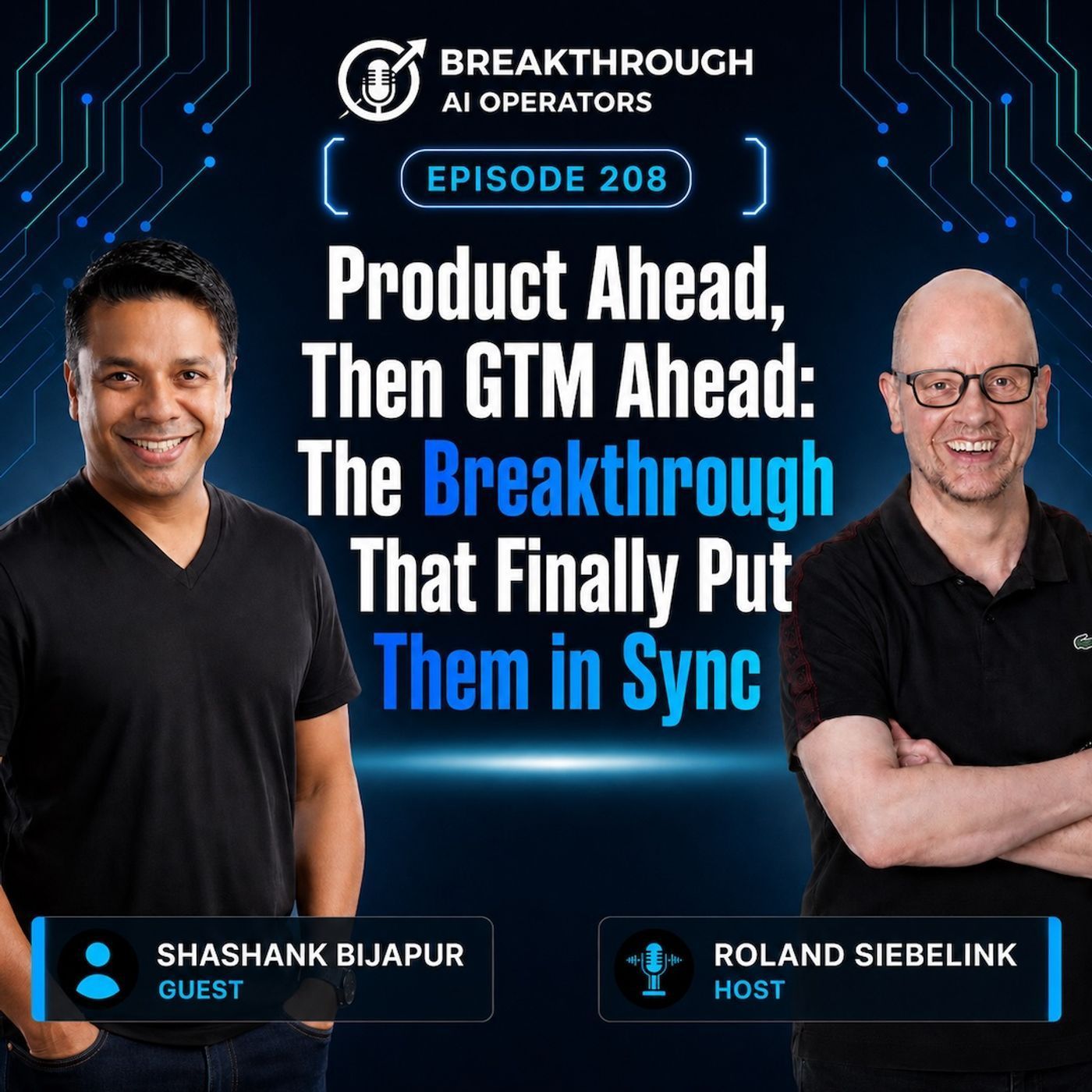
What do you do when the exact data your AI needs to get smart is legally required to stay private forever? A confidentiality agreement doesn't show up in a public training set, by definition it can't. One founder discovered that gap years before generative AI existed, and had to build an entire operating platform just to earn the right to the data his own product needed.Shashank Bijapur is co-founder and CEO of SpotDraft, an AI-native contract lifecycle management platform he built with his co-founder Madhav after leaving a law career at White & Case. SpotDraft has processed more than a million contracts, raised a $54 million Series B, and recently became the first CLM to run contract analysis entirely on-device.The idea started on a New Year's Eve in 2017, when Bijapur was running due diligence reports instead of celebrating, read a headline about Elon Musk building self-driving cars, and couldn't square that cars were driving themselves while he was still copy-pasting contract language by hand. He and Madhav's first hypothesis was straightforward: train a model on legal contracts and automate redlining. It fell apart fast, because confidentiality agreements are confidential. There was no real training data to learn from, only invented data that made accuracy a coin flip. So they took two steps back and built the actual infrastructure lawyers were missing, workflows, a repository, a real system of record, which is what eventually became the CLM. AI was never bolted on afterward. It's the reason the company exists.That same instinct shaped a more recent bet. Industries like pharma and defense kept raising the same objection: where does our data go once it touches an LLM? SpotDraft partnered with Qualcomm to run contract analysis entirely on-device, in airplane mode, with nothing leaving the machine, making it the first CLM to offer that option. Bijapur also described becoming his own company's bottleneck around year five, answering every question himself until his team stopped trying to decide anything without him, a loop his COO broke by introducing OKRs so people knew exactly what they could decide without asking.Roland has seen the founder-as-bottleneck pattern often with SaaS leaders at the $1M to $50M stage, and what he found most useful here is how directly Bijapur named the fix: it's not about hiring smarter people, it's about explicitly telling them what they're allowed to decide without you. The other pattern worth sitting with is SpotDraft spending three full years in pure product mode with no go-to-market function at all, on the belief that great technology speaks for itself. It doesn't, and Bijapur said as much.Key Moments01:49 — The origin story: a recovering lawyer, a due diligence report, and a New Year's Eve at White & Case02:18 — Reading about Elon Musk's self-driving cars while still copy-pasting contract language by hand04:05 — Why training an AI model on legal contracts almost couldn't work: confidential means confidential10:42 — "After Shakespeare, what's the most difficult language you can read? That damn contract"12:27 — The Qualcomm partnership, and why on-device AI mattered for pharma and defense clients18:16 — Realizing he had become his own company's bottleneck, and what broke the loop20:22 — Getting product and go-to-market to finally run in sync instead of chasing each other—If you recognize the moment where your own team stopped deciding anything without checking with you first, that's exactly the kind of stuck point Roland works through with SaaS founders inside Midstage. mdstg.ac/drag-erase#AIContractManagement #LegalAI #CLMPlatform #FounderGrowth #BreakthroughAIOperators
Andrew Laffoon is co-founder and CEO of Mixbook, a photo book platform he has led for 20 years—from hobbyist niche to mainstream storytelling product. In this episode, Andrew explains how Mixbook built Story Mode (an AI-powered photo book creator powered by OpenAI, Claude, and Google, launched 8 days before this recording), what stalled growth after the first $25M, and why the exec team is never the answer when the bottleneck is the founder.Topics covered:- Why 98% of people couldn't make a meaningful photo book before Story Mode—and what that says about storytelling as a market- The exec-team-as-mentors trap: why hiring smart people can't fix a founder who hasn't grown into the role yet- Flywheel thinking: how to identify the bottleneck, measure it, and compound growth on a schedule- "The first job of a CEO is to define reality": what this means for a company at 130 people- Sam Altman's persuasion warning—and what a founder deploying AI should actually be worried about---Mixbook is offering listeners 50% off their first order with code BREAKTHROUGH. Worth trying if you want to see what Story Mode does with your own photos before deciding whether AI-written narration actually holds up. https://bit.ly/4fvDI64If you recognize the wall Laffoon described, growth that's stalled for reasons you can't quite name, Roland works through exactly that kind of stuck point with SaaS founders inside Midstage. mdstg.ac/drag-erase#AIPhotoBook #StoryDrivenAI #PersonalizedPhotoGifts #FounderGrowth #BreakthroughAIOperators
loading
Comments