


 Claim Ownership
CREECA Lecture Series Podcast
Subscribed: 24Played: 752
Subscribe

© All rights reserved
Description
CREECA’s mission is to support research, teaching, and outreach on Russia, Eastern and Central Europe, and Central Asia. We approach this three-part mission by promoting faculty research across a range of disciplines; by supporting graduate and undergraduate teaching and training related to the region; and by serving as a community resource through outreach activities targeted to K-12 teachers and students, other institutions of higher education, and the general public.
As a U.S. Department of Education Title VI National Resource Center, CREECA hosts a variety of events and lectures which are free and open to the public. You can find recordings of past events here.
As a U.S. Department of Education Title VI National Resource Center, CREECA hosts a variety of events and lectures which are free and open to the public. You can find recordings of past events here.
180 Episodes
Reverse

Introduction by Francine Hirsch, Alice D. Mortenson/Petrovich Distinguished Chair in Russian History at UW-Madison.
About the lecture: The denouement of the Great War produced an arc of overlapping crises that stretched from Anatolia to India, which energized a number of anti-imperialist and anticolonial movements in the region. The Russian Revolution, itself a product of the war, offered a radical hope of remaking the world order on completely new lines. The collapse of both the Russian and the Ottoman empires had thrown open imperial borders and made mobility across them possible as never before. In this situation, Tashkent became a crossroads of (often self-proclaimed) revolutionaries from the former Ottoman Empire, Iran, and India. They were overwhelmingly Muslim but engaged in radical politics in which Islam played only a marginal role. The new Soviet regime espoused anticolonial rhetoric from the very outset and sought to harness anticolonial sentiment. In this short-lived conjuncture, Muslim activists encountered each other and the world’s first socialist regime. This talk will provide an account of this episode and explore the many ways in which new solidarities were born but also in which different groups often spoke past each other.
About the speaker: Adeeb Khalid is Jane & Raphael Bernstein Professor of History and Asian Studies at Carleton College. His work focuses on modern Central Asia, broadly defined, and which he situates in wide geographical and conceptual frames. His last book was Central Asia: A New History from the Imperial Conquests to the Present (Princeton University Press, 2021). He is currently working on a book that explores transregional connections made in Tashkent during the era of the Russian Revolution.

This lecture was co-sponsored by European Studies, the Department of German, Nordic, and Slavic+, and the Mosse/Weinstein Center for Jewish Studies at the University of Wisconsin-Madison. Introduction by Professor Irina Shevelenko (GNS+), CREECA Director.
About the Lecture: The talk is based on approximately 800 pages of unpublished correspondence between the Jewish philosopher and musician Evsei Davidovich Shor and the Protestant writer and publisher Rudolf Roessler. After leaving his native Russia in 1922 as the assistant to Vasily Kandinsky, Schor established himself as a student at the University of Freiburg, where he studied with Husserl and Heidegger and began to translate Russian philosophy into German (essays by Viacheslav Ivanov and Nikolai Berdiaev, both of whom he knew personally). In 1932 he moved to Berlin, where he encountered Roessler, at the time the publisher of the leading German theater journal, a position he would soon lose with the advent of the Nazis. The two men and their wives established an intense friendship that developed against the backdrop of the Nazi takeover. Both Shor and Roessler would emigrate, the former in 1933 (for a year in Italy, then in Palestine/Israel), the latter in 1934 (to Switzerland). In Luzern, Roessler founded the anti-Nazi publishing house Vita Nova. The correspondence between Shor and Roessler focuses on the early years of the publishing house’s activities. Wachtel pays special attention to the history of their most audacious publication, "Die Gefährdung des Christentums durch Rassenwahn und Judenverfolgung" (Racism and the Persecution of Jews as a Danger for Christianity, 1935).
About the speaker: Michael Wachtel, Professor in the Department of Slavic Languages and Literatures, has been teaching Russian and European literature at Princeton University since 1990. His scholarship focuses on Russian poetry and poetics as well as German-Russian cultural relations. His most recent book is Viacheslav Ivanov: A Symbolist Life (Columbia University Press, 2025). Among his current projects is an annotated edition of the complete correspondence of Evsei Schor and Rudolf Roessler.
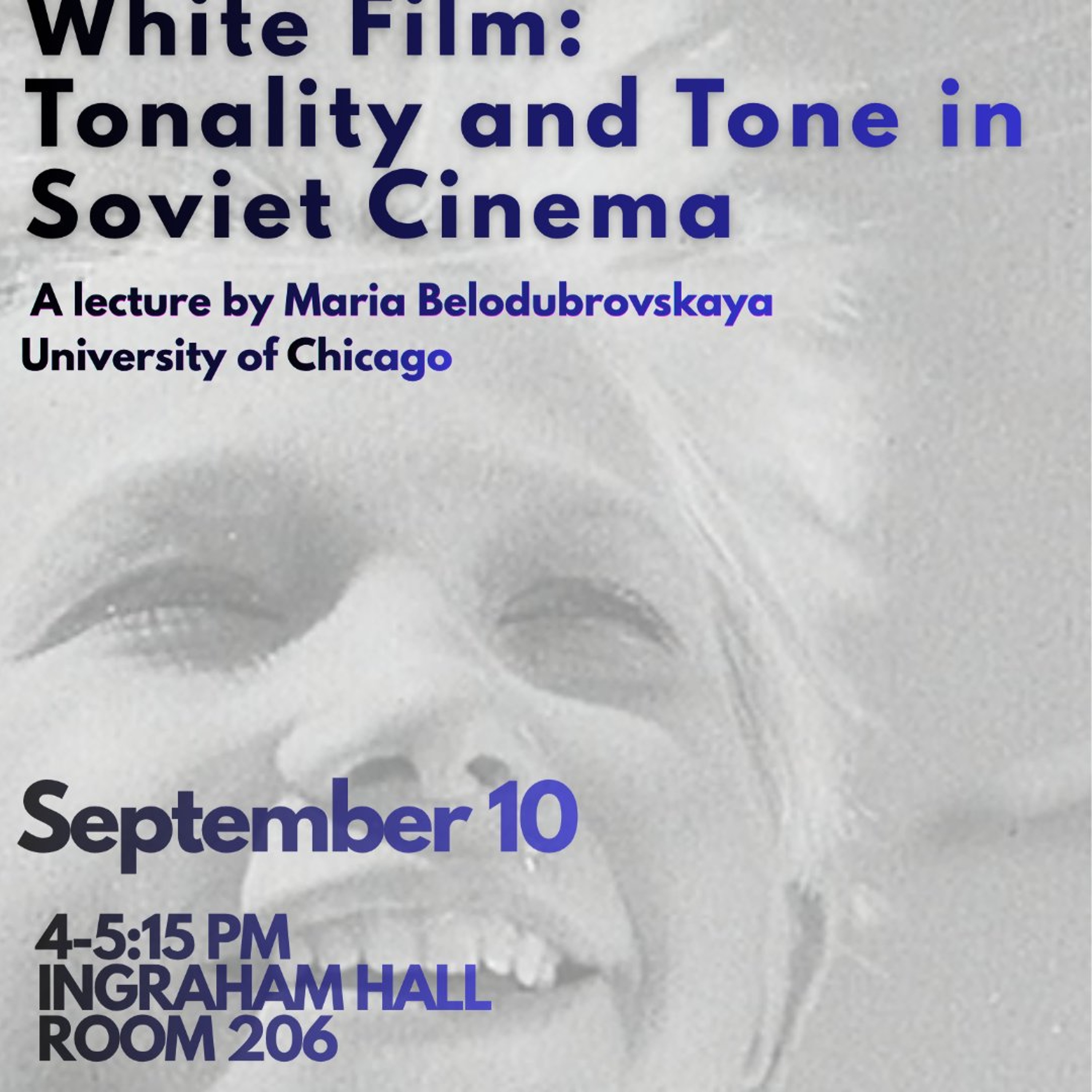
This lecture was co-sponsored by the Alice D. Mortenson/Petrovich Distinguished Chair in Russian History and Department of Communication Arts Film Colloquium. Introduction by Professor Jeff Smith, Department of Communication Arts, UW-Madison.
About the Lecture: When Soviet films were shown in the United States in the 1930s and 1940s, reviewers often complained about their slow tempo and propagandistic appeals but praised their acting and cinematography. Although since 1930 the Soviet film industry relied primarily on domestic film stock, and photography suffered as a result, the feature films that made it to the U.S. were of relatively high technical quality. One of the practices Soviet cinematographers developed to achieve crisper images was “white film”: filming white elements against white backgrounds using sunlight. This approach resulted in a strikingly bright look that distinguished Soviet films from those made in Hollywood, which was then developing a fashion for high-contrast cinematography that eventually resulted in film noir.
About the Speaker: Maria Belodubrovskaya is Associate Professor in the Department of Cinema and Media Studies at the University of Chicago. She is the author of "Not According to Plan: Filmmaking under Stalin" (2017) and has published works on Alfred Hitchcock, Sergei Eisenstein, Soviet cinema, and various issues in film aesthetics.
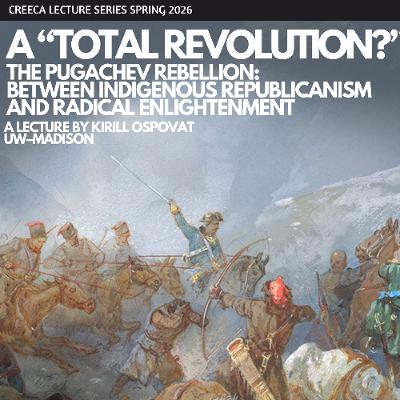
This lecture is co-sponsored by the UW–Madison Department of German, Nordic, Slavic+.
About the Lecture: This talk will address the Pugachev Rebellion (1773-1775) in the Russian Empire, the most massive popular uprising in eighteenth-century Europe which brought together Cossacks, Russian serfs, and Bashkir nomads (to name just the major groups) in a common uprising against the Russian Empire and its colonization of the steppe. Arguing against the common theory of “naïve monarchism”, the talk will aim to uncover the idioms of democratic empowerment and universal rights which so far have been hiding from scholars in the plain sight of the rebellion’s massive published archive. These idioms could take two forms: a secular, juridical form, which combined official concepts of law with those of the unwritten common law in order to affirm democratic self-governance; and the form of a heretical political theology which questioned feudal social hierarchies, established forms of property over land, and the official absolutist vision of authority.
About the speaker: Kirill Ospovat is an associate professor of Russian at the University of Wisconsin-Madison. He is the author of two books on eighteenth-century Russian culture and literature: "Pridvornaia slovesnost’: institut literatury i konstruktsii absolutizma v Rossii serediny XVIII vekaPridvornaia slovesnost’: institut literatury i konstruktsii absolutizma v Rossii serediny XVIII veka" [Courtly Letters: Russian Literature and Visions of Absolutism in the Mid-Eighteenth Century] (Moscow: Novoe literaturnoe obozrenie, 2020), and "Terror and Pity: Aleksandr Sumarokov and the Theater of Power in Elizabethan Russia" (Boston: Academic Studies Press, 2016). He has completed a book-length study of the Pugachev rebellion which is about to come out in Russian.
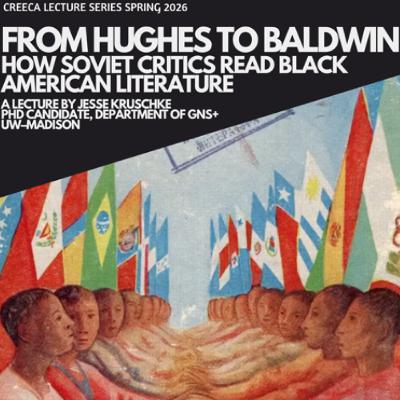
About the Lecture: This talk examines Soviet engagement with Black American literature by tracing unexpected continuities between Imperial Russian and Soviet approaches to race and cultural diplomacy. Through close analysis of literary criticism published in Soviet journals from the 1930s through the 1960s, particularly reviews of works by Langston Hughes, Richard Wright, James Baldwin, and W.E.B. Du Bois in "International Literature" (Internatsional’naia literatura) and "Foreign Literature" (Inostrannaia literatura), this lecture demonstrates how Soviet critics developed formulaic reading practices that served remarkably similar functions to Tsarist-era engagement with American racial issues and western colonialism. Both regimes used American racism as a mirror to reflect their own moral superiority and projected paternalistic leadership over distant oppressed peoples, from Imperial Russia’s relationship with Ethiopia in the nineteenth century to the Soviet Union’s post-war interest in a rapidly decolonizing Africa.
The talk reveals how literary criticism functioned as ideological instruction in the Soviet Union, with critics constructing a carefully curated canon of acceptable Black literature that taught readers how to “properly understand” Black American life, reinforcing the state’s anti-racist credentials while serving Cold War propaganda goals. By attending to these continuities rather than taking revolutionary rhetoric at face value, the lecture offers new insights into Soviet cultural politics and the enduring patterns of Russian soft-power projection that remain relevant to understanding contemporary Russian foreign policy.
About the Speaker: Jesse Kruschke is a PhD Candidate and Teaching Assistant in the Department of German, Nordic, and Slavic+ at the University of Wisconsin-Madison. Her research focuses on the Soviet reception of twentieth-century American literature, with particular attention to how literary journals published, translated, and framed the work of leftist Black

Comments

Download from Google Play

Download from App Store
 United States