DiscoverCask to Glass
Cask to Glass
Claim Ownership

Cask to Glass

Author: David Holmes

Subscribed: 12Played: 335
Share

Description

How do you take your whisky?


Neat? Splash of water? Block of ice? Or even a mixer?


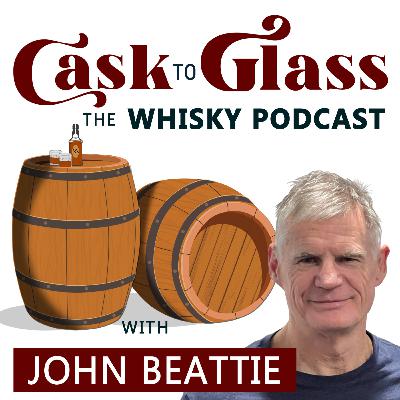
However you take it, join John Beattie, former Scotland rugby international and semi-retired BBC radio and TV news presenter, as he celebrates the heritage and flavour of Scotland's national drink and the world's favourite spirit.


Whether you call it whisky, whiskey, uisge beatha, aqua vitae, or the water of life... there's a story behind every dram; a craftsman behind every drop; an aroma with every nose; and a flavour in every sip.


This is the spirit of Scotland: distilled in a place; shared around the world.


What makes it so special? Why is it so loved? And who are the people that make it, and the aficionados who drink it?


Join John every Thursday as he explores the alchemy that takes place from cask to glass.


Slàinte!


-------

Host: John Beattie

Producer: David Holmes


Socials:

@C2GWhisky

@JohnRossBeattie


Hosted on Acast. See acast.com/privacy for more information.

86 Episodes
Reverse
From craft brewing to craft distilling where Robert the Bruce once lived. Inside Dumbarton’s Levenbank Distillery, one of Scotland’s newest distilleries, where their base malt for beer is their base malt for whisky.“We’re going to keep it cute, keep it small and keep it interesting,” says founder Euan MacEachern. Afterall says George Wotherspoon, Head of Sales and Development, "If you have a brewery, you're only one piece of equipment away from a disitllery."In this episode of Cask to Glass: The Whisky Podcast, host John Beattie sits down with Euan and George from Loch Lomond Brewery who've branched out into distilling with Levenbank Distillery in Dumbarton.Located right where King Robert the Bruce lived and died in 1329, Levenbank is blending rich Scottish heritage with modern distilling innovation. We explore their journey from craft brewing to small-batch single malt production, the historical lore of Dumbarton (including the famous guard geese!), their unique still setups, and their countdown to 2029, marking 700 years since Bruce’s passing with their very first release of – you guessed it – 700 bottles.Stick around as we taste three unique spirit samples, including bespoke Bourbon and Oloroso cask maturations and a peated new-make spirit.Slàinte!-------Socials: @C2GWhisky | @JohnRossBeattieCreator & producer: David HolmesArt work & design: Jess RobertsonMusic: Water of Life (Never Going Home)Vocals: Andrea CunninghamGuitars: John BeattieBass: Alasdair VannDrums: Alan HamiltonBagpipes: Calum McCollAccordion: Gary InnesMusic & Lyrics: Andrea Cunningham & John BeattieRecorded & mixed by Murray Collier at La Chunky Studios, Glasgow, Scotland Hosted on Acast. See acast.com/privacy for more information.
David Brodie might have one of the best commutes in the world.“On a clear day,” he says, as you come round the hairpin bend at the one-mile barrel, “you’re seeing all the way to Mull. Maybe see the Garvellochs on the right-hand side. You'll see all the way to the top of Jura. You'll see a tiny little slither of Colonsay coming out and you'll see the Ruvaal Lighthouse. And it’s like this is very special. Wander down the road and that’s you.”Destination? Bunnahabhain Distillery on Islay.“I’ve been driving that road for 11 years and it’s never looked the same twice. Constantly changing.”David is Bunnahabhain's "man-about-the-distillery": tour guide, tasting host and resident guitarist.“I’m adamant that drinking whisky shouldn’t be a chore. It should always be enjoyable. And if the enjoyment level gets too high, that's when the guitar comes out,” he chuckles. That will kill the enjoyment."David came to the whisky industry comparatively late.He arrived on Islay with the Royal Bank; escaped banking in 2005 and moved into hospitality, pouring drams in various whisky bars on the island, before joining Bunnahabhain as its visitor experience was beginning to grow.“Huge regret,” he complains, “I didn’t do it years before.”Islay is famous for its peaty, smoky, iodiney whiskies like Bowmore, Laphroaig, Ardbeg and Lagavulin.“We’re the polar opposite,” David explains. “It’s not entirely a USP because Bruichladdich, our friends at Bruichladdich, operate on a similar kind of vein, largely unpeated.“If we go back six and a half decades, if we go back to the very early 1960s, Bunnahabhain was exactly the same as all these other distilleries that you're familiar with in Islay. It was heavy oily, peaty whisky that they made and nothing else.“But the big important, keynote is that back then almost nobody drank single malt whisky as a whisky in its own right. Everybody was drinking blends and our owners at that time had a blended whisky which the name is hugely familiar to people, but maybe not so many people have tasted it, and that's Cutty Sark.”Bunnahabhain’s owners, David continues, “needed unpeated malt whisky to go in the Cutty Sark blend. So Bunnahabhain got a makeover.“We got basically almost a full rebuild. We stopped doing our own malting for a start. We had our mash tun replaced. Prior to that, we had an 11-ton capacity open top cast iron mash tun. That was replaced with the one that's still there, which is a 15-ton capacity.“The original from 1881, that made its weary way down to Bruichladdich, where it still serves them well. We doubled our capacity by adding another pair of stills. But crucially we went to all unpeated. We never did any peated product again until about 96, 97.”Bunnahabhain’s other distinction is that it’s mostly sherry matured.“But we do plenty of fancy stuff,” David says. “We'll do wine casks, we'll do other fortified wines, we'll do port and we'll do Madeira. I love a Madeira cask. Just beautiful. We've just taken a Marsala cask into Warehouse Nine that people are absolutely loving. But we'll do some rum casks and we'll do brandy casks, all these different things.”And it’s Bunnahabhain’s unpeated, sherry flavour that David says makes it a “gateway whisky” for anyone who says they don’t like whisky - especially Bunnahabhain 12-year-old. “If they can’t do that, they probably can’t do anything."Join John as David takes him on a tour of Bunnahabhain; gives him a peek inside its fabled Warehouse Nine; and finishes with a couple of island tunes.Slàinte!-------Socials: @C2GWhisky | @JohnRossBeattieCreator & producer: David HolmesArt work & design: Jess RobertsonMusic: Water of Life (Never Going Home)Vocals: Andrea CunninghamGuitars: John BeattieBass: Alasdair VannDrums: Alan HamiltonBagpipes: Calum McCollAccordion: Gary InnesMusic & Lyrics: Andrea Cunningham & John BeattieRecorded & mixed by Murray Collier at La Chunky Studios, Glasgow, Scotland Hosted on Acast. See acast.com/privacy for more information.
At 80 phenolic parts per million, Bruichladdich Distillery's Octomore whiskies are almost twice as peaty as traditional Islay whiskies. Released at just 5 years old & around 60% ABV, Bruichladdich's Master Distiller Adam Hannett jokes they're "too young, too strong & too peaty". In this episode he & John sample three expressions from the Octomore 17 range."You'll still be tasting that tomorrow morning when you wake up," Adam laughts as John gives Octomore a go.Tune in to find out what the world's peatiest whisky really tastes like.Slàinte!-------Socials: @C2GWhisky | @JohnRossBeattieCreator & producer: David HolmesArt work & design: Jess RobertsonMusic: Water of Life (Never Going Home)Vocals: Andrea CunninghamGuitars: John BeattieBass: Alasdair VannDrums: Alan HamiltonBagpipes: Calum McCollAccordion: Gary InnesMusic & Lyrics: Andrea Cunningham & John BeattieRecorded & mixed by Murray Collier at La Chunky Studios, Glasgow, Scotland Hosted on Acast. See acast.com/privacy for more information.
What are the 3 whiskies you MUST try before you die? John speaks to Ardnamurchan Distillery’s Connal Mackenzie to uncover his ultimate bucket-list drams & explore Scotland’s wild west coast of whisky. Perched on the rugged Ardnamurchan Peninsula - Scotland’s westernmost mainland point - this distillery is crafting some of the most exciting, sustainable and character-rich Scotch whisky in the world today. Connal, who had to go to New Zealand to enter the whisky business, descirbes how independent bottler Adelphi established Ardnamurchan, the secrets behind their signature spirit profile, & how they balance peated & unpeated styles.“We didn’t want to make a pretty whisky,” says Connal Mackenzie, Sales Director for Ardnamurchan Distillery, on the far West Coast of Scotland. “We wanted to create a true Highland style of whisky. Not fully blown peated, but there certainly, and a suggestion of a bit more.“We wanted it to be rugged… We wanted to have lots of character; weight; palate weight; and an oily, viscous style.”Connal’s speaking to John from Inverness as Storm Boelo batters parts of Scotland.It’s the second named storm of the autumn, and Ardnamurchan – “on the sandwich of the peninsula between Islay, Skye and the Isle of Mull… as far west as you possibly can get on the mainland of Scotland” – is bearing the brunt.There’s no electricity and, Connal says, “We have no lights on anywhere on the peninsula.”This is not the first time production has been halted because there’s no power.A year ago, when Storm Amy struck, Ardnamurchan had no power for nine days. The distillery was forced to shut down again. Except this time their wash – “the beer that you make before you distil” – was still in the washback.Nevertheless, the wash was eventually turned to spirit and casked.But, Connal admits, “we got the warehouse team to mark the casks ‘Storm Amy’… because we have no idea how that whisky is going to taste because it was unprecedented fermentation times for us.”This is whisky production in the “wild west” of Scotland. In one of Scotland’s newest distilleries.Ardnamurchan’s been famous for its rugged beauty for centuries. But Ardnamurchan Distillery was only established in 2014. So its spirit is now approaching 12-years-old. But, Connal says, “we’re seeing some nice fruits of labour coming through now.”And there are some new releases. A 10-year-old that will be released just before Christmas and two variations of 6,000 bottles each using “heritage barley” out now. One is matured in ex-Bourbon casks; the other in ex-sherry casks.People don’t speak enough about barley, Connal suggests. Most distilleries, he says, use commercial barley. But there are other barley varieties out there such as Golden Promise “which was put on the map by Macallan back in the 70s”.This “heritage” variety “was really known,” he continues, “for its oily, viscous texture in the mid-palate. It’s a bit more expensive to use and it yields a lot less than a commercially available malt would do.”Special maturations aside, Ardnamurchan “as a new brand”, Connal says, is “sort of hitting our stride a wee bit now.” And it’s establishing markets in Japan, the US, Germany, Greece and Cyprus.Right now their International Sales Manager, American Carl Crafts, is in Tennessee on tour appropriately called “Ardnamerica”.It’s all part of establishing on a new distillery in a global market.Join John as he talks to Connal about Ardnamurchan Distillery; its place in the Scotch whisky landscape; the distilleries he most admires; and three must drink whiskies you must try before you die.Slàinte!-------Socials: @C2GWhisky | @JohnRossBeattieCreator & producer: David HolmesArt work & design: Jess RobertsonMusic: Water of Life (Never Going Home)Vocals: Andrea CunninghamGuitars: John BeattieBass: Alasdair VannDrums: Alan HamiltonBagpipes: Calum McCollAccordion: Gary InnesMusic & Lyrics: Andrea Cunningham & John BeattieRecorded & mixed by Murray Collier at La Chunky Studios, Glasgow, Scotland Hosted on Acast. See acast.com/privacy for more information.
How do you take over an iconic whisky brand like Highland Park from a “Hall of Famer”, who’s shaped and directed its flavour and style of nearly 30 years? And how do you keep its signature taste and feel consistent, so consumers know exactly what they’re getting, yet make it exciting and refreshing?It’s a problem Marc Watson has been grappling with daily for the last 19 months since he took over the role of Master Whisky Maker for Highland Park from Gordon Motion, who retired in July last year.Marc’s conclusion? With “trepidation”. But he says of the challenge: “I played high level sport. You want that level of stuff.”Highland Park is one of Scotland’s oldest distilleries. Founded in Orkney in 1798, it was Scotland’s most northerly distillery for almost 225 years. “It’s an island distillery,” Marc says, “with this incredible sense of place.”“Highland Park,” he continues, “really encapsulates loads of different essences about what it is to make Scotch Whisky.”It still has its own malting floor. Peat is still cut from nearby Hobbister moor as it has been “for generations upon generations.”Yet Highland Park is not a peaty whisky in the Islay sense, Marc says. “I think we’re approachably peated. It’s very sweet the type of peat we have. It’s all heather. And it’s not iodiney. It’s very bright and light and sweet."The new spirit is distilled in Orkney. And some of it is matured there. Some of it isn’t. But Marc works in Glasgow, “on the bench” at owner Edrington’s blending and bottling facility on Great Western Road, some eight miles north-west of the Glasgow city centre.Here he puts his “nose to work”, sampling 250 samples a week; 5,000 a year.As the latest “custodian” of the Highland Park brand, Marc says, “My job is protecting the core, making sure it never changes.”Afterall, "it's dram everybody knows."“Highland Park has got such a signature taste and such a signature feel. For me it’s like: ‘Well, how do I keep that same but also excite people at the same time?’ And that’s the job. That’s the exciting bit of the job.”Join John and Marc as they discuss:➡️continuing a brand tradition➡️what Highland Park whiskies mean➡️following in the footseps of a master - Gordon Motion - who had a spreadsheet for everything➡️Marc's collaboration with the Egyptian artist Laila Gohar to produce "Between You And I" a 17 year old single malt: "Very rarely have I been asked to make a whisky for a person."➡️how "rules make you creative"➡️how Marc's go-to is a highball: "Some of the best whisky experiences I've had have been with some incredible whisky cocktails.""From a person who makes whisky," Marc concludes, "I feel I've poured everything into making the best whisky I can, and it's up to the consumer to experience it how they want to." Slàinte!-------Socials: @C2GWhisky | @JohnRossBeattieCreator & producer: David HolmesArt work & design: Jess RobertsonMusic: Water of Life (Never Going Home)Vocals: Andrea CunninghamGuitars: John BeattieBass: Alasdair VannDrums: Alan HamiltonBagpipes: Calum McCollAccordion: Gary InnesMusic & Lyrics: Andrea Cunningham & John BeattieRecorded & mixed by Murray Collier at La Chunky Studios, Glasgow, Scotland Hosted on Acast. See acast.com/privacy for more information.
loading
Comments