


 Claim Ownership
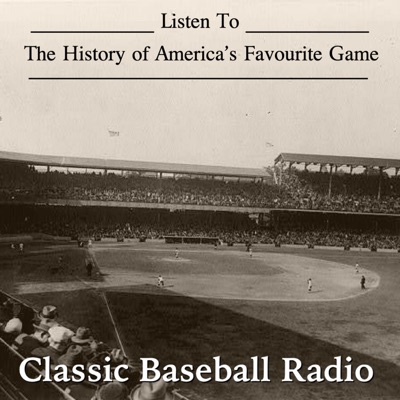
Classic Baseball Radio
Subscribed: 27Played: 1,581
Subscribe

© Ewan Spence
Description
Through recreations of the original radio broadcasts, the history of America's favorite pastime is retold, one classic game at a time. We use archived news reports, articles, and historical records to recreate the sound and style of the broadcasts. Listen and relive key moments, historical hits, and the legends of today taking to the field when they were at the peak of their career.
Add Classic Baseball radio to any podcast app or service; just copy "tinyurl.com/baseballpod" into the "Add RSS Feed" of your app.
Add Classic Baseball radio to any podcast app or service; just copy "tinyurl.com/baseballpod" into the "Add RSS Feed" of your app.
127 Episodes
Reverse

The police are lined up around Griffith Stadium to keep the peace as the Washington Senators are visited by the New York Yankees. There’s little love between the two teams or their fans; the last meeting in July ended with the Yankees’ catcher Bill Dickey punching Carl Reynolds onto the injured list with a broken jaw. Dickey Today’s game will be Reynolds first game back, and following a 30-game suspension, Bill Dickey is catching once more.The 1932 Yankees are somewhat romanticised as a mythical and unstoppable force of nature; not every team can win 107 games and sweep the opposition in the World Series. Nor can most teams boast of nine future Hall of Fame players in the same roster, or go the entire season without being shut out.Except today. Washington pitcher Tommy Thomas is carrying a long-standing locked elbow and bone bruises in an arm lacking stamina, but he’s ready to take the Yankees out. And take them out he does, shutting down both Lou Gehrig and Babe Ruth in a combined 0-8 game.The opposing pitcher, Red Ruffing, is on course to top the American League for strikeouts. The powerhouse right-hander is going to post one of the most statistically rare and dominant individual performances of the live-ball era, cementing the legend of the 1932 Yankees' march to the pennant.One of them is going to be on the wrong side of the boxscore…Ewan Spence and the Classic Baseball Radio team bring you this recreated radio broadcast from August 13, 1932. This should not be considered a complete or fully accurate historical record. Nevertheless, this is our story of the game.We thank Retrosheet, Sports Reference, Sports Logos Net, Tom R Audio, and Crafting The Call.** Links **You can find the boxscore here:https://www.baseball-reference.com/boxes/WS1/WS1193208130.shtml The team that was never shut out, a look at the New York Yankees in 1932.https://www.baseballhistorycomesalive.com/1932-new-york-yankees/ The unique career of Red Ruffing.https://tht.fangraphs.com/the-unique-career-of-red-ruffing/Red Ruffing’s route to Cooperstown.https://www.cooperstowncred.com/hall-of-famer-red-ruffing-world-series-star/ Biography of Washingont Nationals pitcher Tommy Thomas.https://sabr.org/bioproj/person/tommy-thomas/The story of the Home Plate Punch on July 4th following a collision between Bill Dickey and Carl Reynolds, the resulting 30-game suspension, and the physical fallout.https://sabr.org/gamesproj/game/july-4-1932-yankees-catcher-bill-dickey-punches-carl-reynolds-draws-30-game-suspension/ “He Called It,” Scott Pitoniak looks at the evidence of Babe Ruth's immortal at bat in Game Three of the 1932 World Series.https://baseballhall.org/discover-more/stories/baseball-history/ruth-called-it Columbia Magazine's deep dive into Lou Gehrig’s early life in Yorkville, his parents' German immigrant background, and his rise to collegiate famehttps://magazine.columbia.edu/article/lou-gehrig-columbia-legend-and-american-hero The stars of the New York Yankees Murderers Row.https://bronxpinstripes.com/yankees/eras/murderers-row The Senators' Griffith Park, nestled into its urban environment, including details about the famous wildcat bleachers.https://www.loc.gov/exhibitions/baseball-americana/about-this-exhibition/at-the-ballpark/the-ballpark-community/baseball-on-the-map/

The Chicago White Sox are up two games to one as they visit the Philadelphia Athletics for the last time, yet the final game in the series is played in the shadow of death. The previous night, the White Sox’ Cass Michaels was beaned by a high fastball from the Athletics’ Marion Fricano. Rushed to the emergency room with a fractured skull, the two-time All Star’s career was over. Only the crude plastic insert Michaels had added to his cap prevented an instantaneous fatal blow.The White Sox would mandate protective batting helmets for all players starting in 1955, accelerating a league-wide push that would improve safety standards.The game itself captures the differing fortunes of the two clubs. The building blocks of the “go-go” era are quietly being put in place. Manager Paul Richards is forging the identity of the South Siders: elite pitching, tight defence, and aggressive running on the basepaths. Young pitchers, such as opening pitcher Jack Harshman and Hall of Famers Nellie Fox and Minnie Miñoso, would go on to a pennant-winning run in 1959.The Athletics are ready to leave Philadelphia. Facing financial strain and dwindling attendance, the charter franchise helmed for decades by Connie Mack will be sold off at the end of the season, moving to Kansas City for 1955. The seeds of the new club are on the field - notably Jim Finigan and Vic Power - but less than 2,000 fans are there to watch the final game in the series, the season, and the league records of the White Sox and Connie Mack’s Athletics.Ewan Spence and the Classic Baseball Radio team bring you this recreated radio broadcast from August 28, 1954. This should not be considered a complete or fully accurate historical record. Nevertheless, this is our story of the game.We thank Retrosheet, Sports Reference, Sports Logos Net, Tom R Audio, and Crafting The Call.** Links **You can find the boxscore here:https://www.baseball-reference.com/boxes/PHA/PHA195408280.shtml Departure Without Dignity: The Athletics Leave Philadelphiahttps://sabr.org/journal/article/departure-without-dignity-the-athletics-leave-philadelphia/ The history of Connie Mack Stadium (formerly Shibe Park) and how it set the tone for Stadium design when it opened in 1909.https://www.ballparksofbaseball.com/ballparks/shibe-park/ Profiling the career of Philadelphia southpaw Alex Kellner, detailing his 20-win 1949 rookie campaign and his 1954 season.https://sabr.org/bioproj/person/alex-kellner/ A retrospective celebrating Minnie Miñoso's decades- long relationship with Chicago fans and his role in the 1950s "Go-Go" White Sox.https://www.mlb.com/news/minnie-minoso-was-mr-white-sox Details the career of second baseman Nellie Fox, the core of the White Sox’s infield and the 1959 American League MVP.https://baseballhall.org/hall-of-famers/fox-nellie How Jack Harshman moved from a power-heavy first baseman in the Minors to a starting pitcher in the Majors.https://sabr.org/bioproj/person/jack-harshman/ The Top Ten catchers not in the Hall of Fame, including Sherm Lollar.https://bleacherreport.com/articles/162558-the-top-10-eligible-catchers-not-in-the-hall-of-fame Cass Michaels biographyhttps://en.wikipedia.org/wiki/Cass_Michaels History of the Baseball Helmethttps://www.timelesspatents.com/blogs/patent-stories/history-of-the-baseball-helmets-patent Cass Michaels’ Newspaper Report, Gettysburg Timeshttps://news.google.com/newspapers?nid=2202&dat=19540828&id=ESkmAAAAIBAJ&sjid=E_4FAAAAIBAJ&pg=4581,1371382&hl=en

A Saturday game in May can be both an inconsequential checkmark in a season and a game that can be looked back on as a captivating moment in history. It’s impossible to look back at 1972 and ignore the first players' strike that disrupted the first two weeks of the season. Spring training was curtailed, and both hitters and pitchers are still struggling with timing in May. 86 games were wiped from the schedules, never to be rescheduled. The Padres will end up playing just 153 games, while the Mets will play 156.Also looking to find his way in the season is Mets manager, Yogi Berra. Following the sudden passing of Gil Hodges, Berra is finding his feet and beginning to understand the core of the Mets' line-up. It’s an intense spotlight that will shine brightly on him during the 1972 season, as the Mets finish a credible third. That core would head into 1973 ready to claim the National League pennant.The biggest name in the Mets’ line-up is surely Tom Seaver. He has already posted two 20-win seasons (with 25 wins in 1969 and an on-the-nose 20 wins in 1971) and has a Cy Young to his name. Facing him was seen as a near-automatic loss. Not only that, but his record against the San Diego Padres is even more impressive. In terms of overpowering presence, he’s less Mr Terrific and more Mr Terrifying.Can the Padres, with rookie pitcher Bill Grief, hurl the ball and swing the bat to find some magic?Ewan Spence and the Classic Baseball Radio team bring you this recreated radio broadcast from May 6, 1972. This should not be considered a complete or fully accurate historical record. Nevertheless, this is our story of the game.We thank Retrosheet, Sports Reference, Sports Logos Net, Tom R Audio, and Crafting The Call.** Links **You can find the boxscore here:https://www.baseball-reference.com/boxes/NYN/NYN197205060.shtml A deep look at the legendary life and career of Tom Seaver, detailing his journey from Fresno, California, to his status as the premier pitcher of his generation. https://sabr.org/bioproj/person/tom-seaver/Why is Tom Seaver the undisputed Franchise player of the Mets, and how does he compare to other players?https://sny.tv/articles/mets-all-time-team-26-manProfiling Bill Grief, the durable 6'5" right-handed Texas native who out-duelled Seaver on this afternoon, examining his high-strikeout velocity and post-baseball academic achievements. https://sabr.org/bioproj/person/bill-greif/A tribute to Nate Colbert, the Padres' first true superstar, recounting his 163 franchise home runs and his devotion to youth ministry.https://www.mlb.com/news/nate-colbert-diesAn account of the sudden passing of Mets manager Gil Hodges just days before the delayed 1972 season, detailing how a grief-stricken clubhouse transitioned under Yogi Berra's leadership.http://www.centerfieldmaz.com/2020/04/remembering-mets-history-1972-mets.htmlYogi Berra’s 1972 Hall of Fame Induction, including context for his managing duties with the 1972 Mets. https://baseballhall.org/discover/inside-pitch/berra-koufax-inducted-amid-star-studded-class-of-1972The history of the youth-heavy Padres rosters, Buzzie Bavasi’s ticket-promotion strategies, and the physical toll of injuries on the 1972 rotationhttps://eastvillagetimes.com/the-history-of-the-san-diego-padres-volume-1-1969-1973/2/. A comprehensive breakdown of the historic 13-day player strike in April 1972, analysing how it changed labour relations and shortened the schedule.https://sabr.org/journal/article/the-strike-of-1972-when-cooperation-failed/How the 1972 player strike served as Marvin Miller’s first monumental victory, earning players pension increases and third-party salary arbitration.https://blogs.fangraphs.com/marvin-millers-legacy-and-the-decline-of-labor/

The Chicago Cubs are on a tear. The Northside faithful can feel a dynasty building beneath their feet, with every pitch, every hit, and every run coming home. And now they have a hero.In what was seen as the most lopsided and controversial transfers in baseball, even while it was happening, the New York Yankees placed their star pitcher Hank Borowy on waivers, and the Cubs slammed $100,000 into the Bronx Bombers’ outstretched hands. The Cubs needed to win right now, and the chequebook is wide open. Two days after he went on waivers, Borowy is stepping on the mound at Wrigley Field, ready to prove the Yankees wrong and take his new club to the National League pennant. It’s a five-game series against the Cincinnati Reds, and the Cubs have won the first four games. Handing his new team a sweep would make for a memorable first game.It’s also worth noting that we have players such as the anchorman Stan Hack at third base, and Phil Cavarretta on his way to the NL Batting Championship and the 1945 NL MVP, for the Cubs. For the Reds, you have the inspirational Dick Sipek, the first deaf player in the majors since Herbert Murphy in 1914, and the Iron Man Frank McCormick, fresh from his 652 consecutive appearances record during World War 2.The Cubs are heading to the top of the mountain; they are unstoppable, and they have the world at their feet. But, as we know thanks to the advantage of history, there’s a billy goat waiting for the Cubs at the end of the season. Until that happens, let’s share the joy in Wrigley Field as the Cubs charge towards the pennant with their brand new pitcher.Ewan Spence and the Classic Baseball Radio team bring you this recreated radio broadcast from July 29, 1945. This should not be considered a complete or fully accurate historical record. Nevertheless, this is our story of the game.We thank Retrosheet, Sports Reference, Sports Logos Net, Tom R Audio, and Crafting The Call.** Links **You can find the boxscore here:https://www.baseball-reference.com/boxes/CHN/CHN194507292.shtml The Associated Press obituary for Phil Cavarretta, the 1945 MVP, with personal anecdotes from his son about his father's "all-out" playing style.https://www.legacy.com/us/obituaries/latimes/name/phil-cavarretta-obituary?id=60242123 The Dunn County Historical Society: A local history perspective on Andy Pafko’s upbringing on a 200-acre Wisconsin dairy farm and his community legacy. https://www.dunnhistory.org/andy-pafko The history of the 1952 Topps set and why Pafko’s card became a "Holy Grail" of the hobby. https://www.baseball-almanac.com/hero/Andy_Pafko_Biography.shtmlHank Borowy’s Pinstripe Tenure – A look at Borowy’s career in New York before the shock waiver deal that sent him to Chicago. https://www.yankeenumbers.com/210/HankBorowy Shoestring Catches analyses the financial "robbery" that saw the Yankees sell their ace for $100,000. https://shoestringcatches1999.wordpress.com/2015/07/27/baseball-history-hank-borowy-and-cubs-win-nl-pennant/Reading the Signs, The story of mentor Dummy Taylor and his protégé Dick Sipek, the first player to escape the "Dummy" nickname. https://www.humanitieskansas.org/get-involved/kansas-stories/people/reading-the-signsA tribute to the Kansas City native Vern Kennedy, highlighting the pitcher’s collegiate career and his 1935 no-hitter.https://mosportshalloffame.com/inductees/vern-kennedy-2/A tribute to "Smiling Stan" Hack, the leadoff master and retroactive three-time Gold Glove winner.https://sabr.org/bioproj/person/stan-hack/The biography of "Big Bill" Nicholson, the slugger who terrified pitchers and achieved legendary RBI totals.https://sabr.org/bioproj/person/bill-nicholson/

Just another Friday night in the Steel Capital of the world, and the defending World Series champions welcome the St Louis Cardinals to Pittsburgh? Think again.The Pirates’ 1960 World Series win feels like it is from another era, as the team struggled through injuries and performance, but was still adrift in the middle of the National League. The NL is looking tired as well, stuck with 8 teams and a 154-game season, waiting for the expansion and a league-wide draft to rip up the old order.Yet the new order is on the field tonight, as the Forbes Field crowds witness what we now know is a Hall of Fame showcase: the legendary Stan Musial in the twilight of his career, the power of Roberto Clemente on his way to his first batting title, the defensive wizard Bill Mazeroski, and a young, ferocious Bob Gibson. It’s Bob Gibson who stands out. In 1961, Gibson unlocked his pitching, moving from a sophomore-year ERA of 5.61 to throwing 10 complete games and posting an ERA of 3.24. He’s tonight’s starting pitcher, throwing to the young Tim McCarver, also on his way to changing the baseball world forever.Ewan Spence and the Classic Baseball Radio team bring you this recreated radio broadcast from June 16, 1961. This should not be considered a complete or fully accurate historical record. Nevertheless, this is our story of the game.We thank Retrosheet, Sports Reference, Sports Logos Net, Tom R Audio, and Crafting The Call.** Links **You can find the boxscore here:https://www.baseball-reference.com/boxes/PIT/PIT196106160.shtml An overview of Forbes Field’s unique characteristics, including "Death Valley" and the hard infield.https://www.brooklineconnection.com/history/Facts/ForbesField.html A comprehensive look at Gibson’s career, including his intimidation tactics and Harlem Globetrotters background.https://sabr.org/bioproj/person/bob-gibson/ How Bill White, Curt Flood, and others integrated the Cardinals' spring traininghttps://www.stlredbirds.com/2020/11/08/how-bill-white-curt-flood-and-others-integrated-cardinals-spring-training/ Tribute to Ken Boyer, still the only Cardinal to hit for the cycle twice.https://www.baseballhistorycomesalive.com/tribute-to-ken-boyer/ Carl Warwick’s aggressive pinch-hitting approach coming off the bench for St. Louis.https://retrosimba.com/2025/04/21/carl-warwick-came-through-in-a-pinch-for-cardinals/ A look at Dick Groat’s role in one of the most efficient double-play tandems in baseball history. https://www.psacard.com/cardfacts/baseball-cards/1961-topps/dick-groat-1/45518 Was Left-Handed catcher Smokey Burgess one of the best-hitting catchers of all time? https://tht.fangraphs.com/bl-tr-part-2-the-best-left-handed-hitting-catchers-in-major-league-history/ Examining Clem Labine’s durability as a reliever and his success in neutralising great hitters like Stan Musial.https://thisdayinbaseball.com/clem-labine-page/ Tim McCarver’s transition from a bonus-baby catcher to a three-time Emmy-winning broadcaster.https://sabr.org/bioproj/person/tim-mccarver/Tim McCarver and Chris Cannizzaro’s catching duel during 1961.https://retrosimba.com/2017/01/04/catching-competition-chris-cannizzaro-vs-tim-mccarver/ The 1961 MLB Expansion Draft: How the Cardinals and Pirates lost key players like Bob Lillis and Hal Smith to the new franchises. https://sabr.org/journal/article/the-colt-45s-and-the-1961-expansion-draft/ “Tim McCarver Sings Selections From The Great American Songbook.”https://www.discogs.com/release/12488582-Tim-McCarver-Sings-Selections-From-The-Great-American-Songbook

Comments

Download from Google Play

Download from App Store
 United States