


 Claim Ownership
Conspicuous Cognition Podcast
Subscribed: 13Played: 89
Subscribe

© Dan Williams
Description
A podcast about big questions in philosophy, psychology, evolution, politics, artificial intelligence, and more.
www.conspicuouscognition.com
www.conspicuouscognition.com
20 Episodes
Reverse
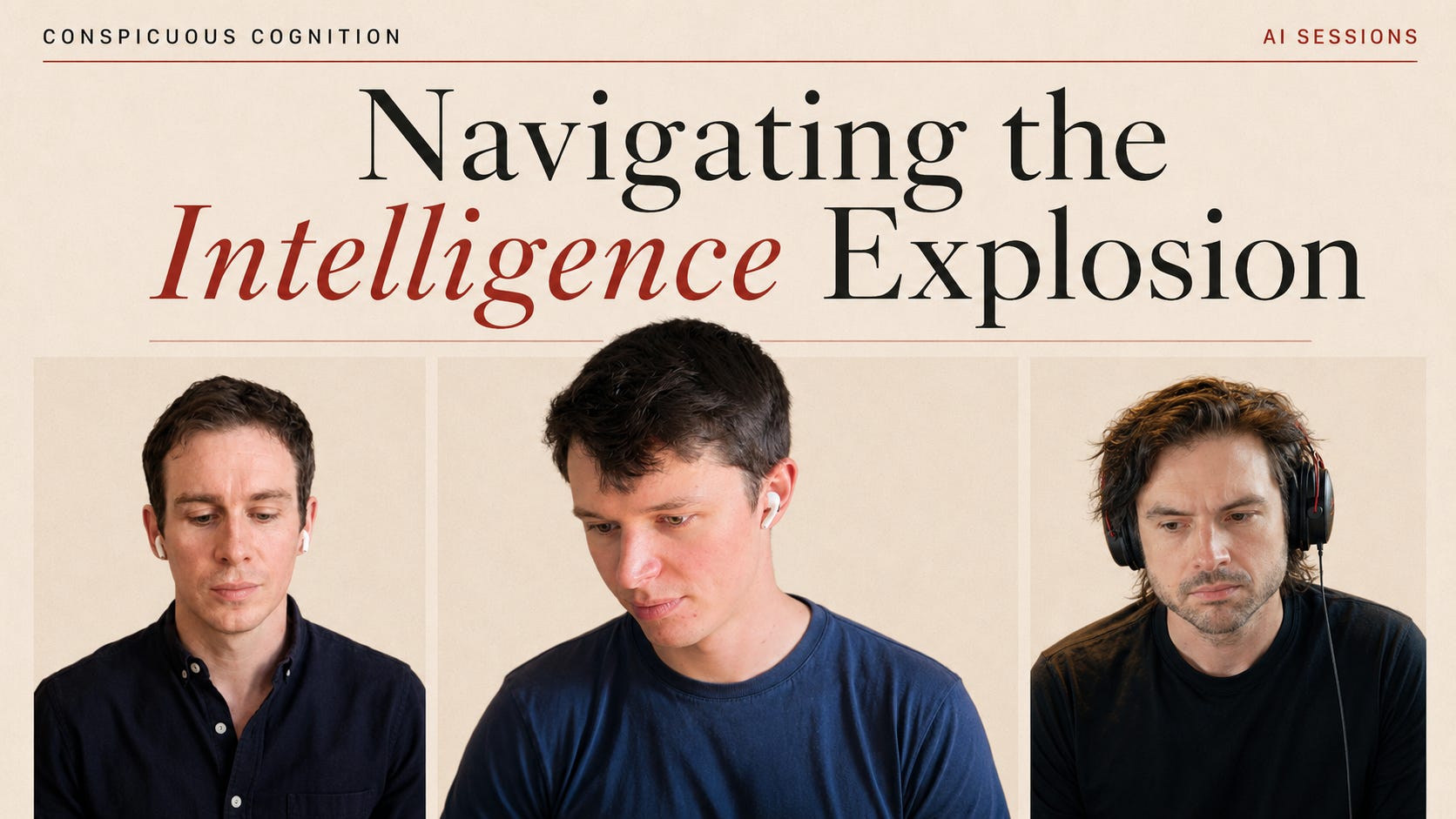
Dan and Henry are joined by Fin Moorhouse to discuss what an AI-driven "intelligence explosion" might look like: rapidly accelerating science, factories building factories, radical abundance, space expansion, and the profound political, ethical, and social challenges that remain even if advanced AI is "aligned". They also debate AI consciousness, illusionism, digital minds, and whether consciousness is necessary for thinking about AI welfare and rights.Fin currently works at Google DeepMind and speaks here in a personal capacity. This is a public episode. If you'd like to discuss this with other subscribers or get access to bonus episodes, visit www.conspicuouscognition.com/subscribe
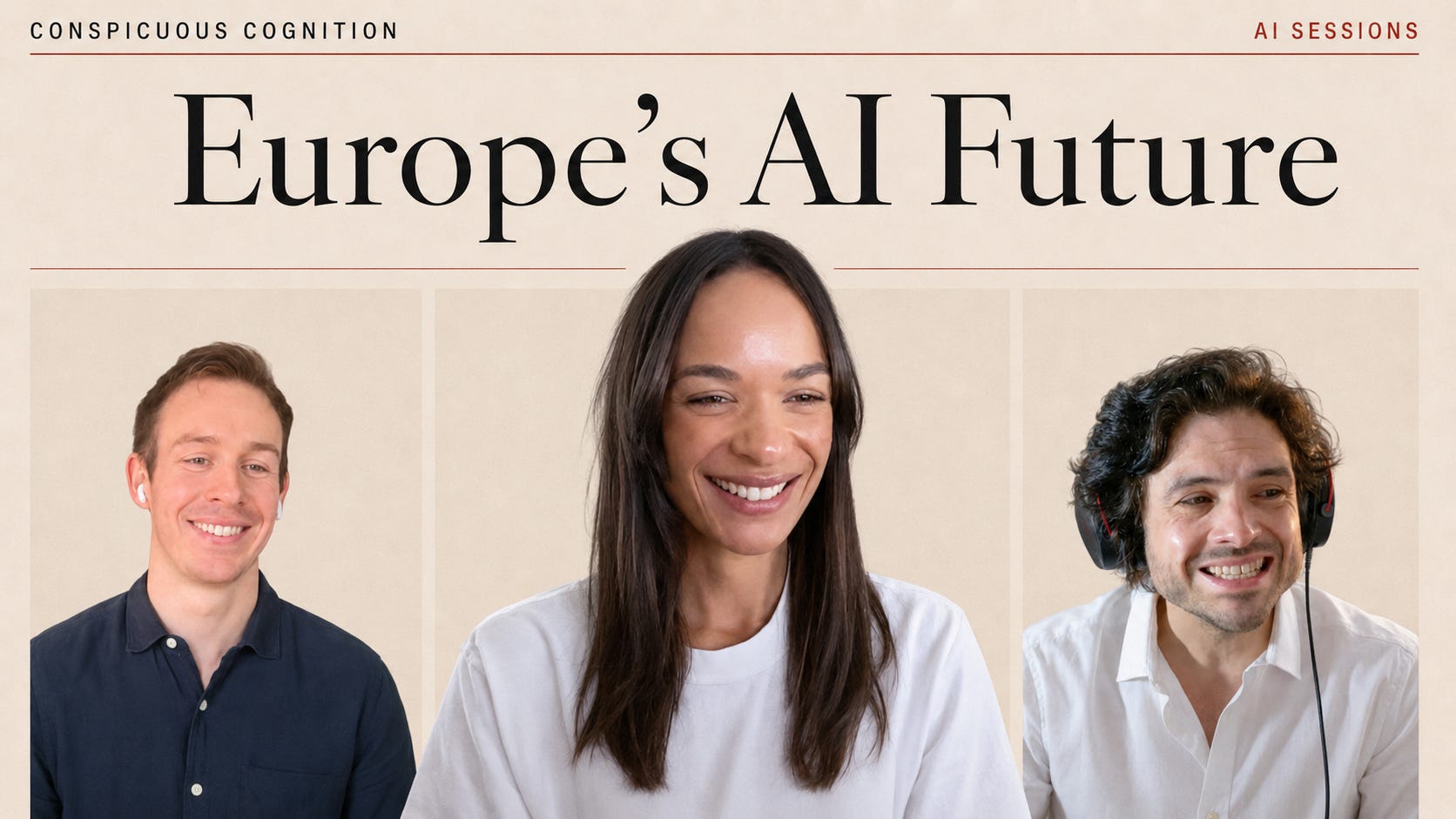
Europe risks entering the age of advanced AI without the infrastructure needed to control its own future.In this episode, Henry and I speak to Judith Dada, co-author of Europe 2031, about its warning that Europe could become dangerously dependent on American AI companies and infrastructure.We discuss:- Whether Europe is underestimating the speed and significance of AI progress- What a fictional scenario can tell us about the future- Why AI adoption may lag behind technical progress- Whether Europe needs its own OpenAI- Why Judith thinks Europe should invest heavily in data centres and compute- Whether European control of compute would provide real geopolitical leverage- The tensions between AI sovereignty, economic growth, regulation and environmental goals- What human abilities may become more valuable as intelligence becomes abundant This is a public episode. If you'd like to discuss this with other subscribers or get access to bonus episodes, visit www.conspicuouscognition.com/subscribe

Robert Wright joins Dan Williams and Henry Shevlin to discuss his new book, The God Test: Artificial Intelligence and Our Coming Cosmic Reckoning.Bob argues that AI is not merely another powerful technology. It is a moral, political, and even cosmic test for humanity: can we coordinate as a species before the race to superintelligence destabilises society, geopolitics, and the future of human agency?We discuss:• Why Bob thinks AI is a “God test” for humanity• Whether current AI systems really understand meaning• Why the AI revolution may be more significant than the internet, electrification, or the Industrial Revolution• The case for slowing down AI development• AI, China, and the dangers of a race to superintelligence• Whether American AI dominance could backfire• How AI might empower authoritarianism• Dan’s challenge that AI discourse may be too negative and alarmist• Whether AI is a “normal technology”• Evolution, purpose, consciousness, and Bob’s more speculative cosmic arguments This is a public episode. If you'd like to discuss this with other subscribers or get access to bonus episodes, visit www.conspicuouscognition.com/subscribe

Benjamin Todd, co-founder of 80,000 Hours, joins Dan and Henry to discuss whether artificial intelligence progress could become explosive.Benjamin explains why he thinks transformative artificial intelligence by 2030 is a serious possibility, how feedback loops in artificial intelligence research could accelerate progress, and why the most important risks now go beyond classic alignment problems. The conversation covers artificial intelligence timelines, bottlenecks in chips and research talent, the future of work, mass unemployment, concentration of power, engineered pandemics, space governance, and how young people should think about their careers in a rapidly changing world.Topics discussed include:• Why 80,000 Hours increasingly focuses on artificial intelligence• The case for short timelines to transformative artificial intelligence• Whether artificial intelligence progress could become explosive• Feedback loops in artificial intelligence research• Chip bottlenecks, data centres, and geopolitical risk• Whether artificial intelligence will cause mass unemployment• Why “become a plumber” may be bad career advice• Alignment, control, and concentration of power• Misuse risks, engineered pandemics, and future governance• How to think clearly under extreme uncertaintyBenjamin Todd is the co-founder of 80,000 Hours and the author of 80,000 Hours, a new book about how to choose a career that is both personally rewarding and socially impactful. This is a public episode. If you'd like to discuss this with other subscribers or get access to bonus episodes, visit www.conspicuouscognition.com/subscribe

The political scientist Alexander Kustov recently published a Substack post with a provocative claim: that AI can already do social science research better than most professors. The post went viral. It attracted more than a million views and over a thousand responses, many of them very angry. (Some people even demanded that Alex’s university fire him.)In this conversation, we talk about this controversy and the claims that triggered it, including:* What agentic AI tools like Claude Code and Codex can already do for research, from coding and data analysis to literature reviews, translation, and brainstorming, and why only around 20% of quantitative social scientists currently use them.* What best predicts whether researchers adopt or reject AI: ignorance, openness to experience, methodological background, or the awkward role of self-interest.* How much published academic research is genuinely mediocre, and whether the cause is laziness, lack of skill, or a broken incentive structure, with a detour through the replication crisis and some high-profile fraud cases.* Whether AI will raise the quality of research or simply flood the literature with more slop, and what journal editors could do about it.* Whether AI can be genuinely creative or only recombine what already exists, by way of Margaret Boden’s three kinds of creativity, Thomas Kuhn on paradigm shifts, and AlphaGo’s “Move 37”.* The fight over AI writing and detection tools like Pangram, and why current disclosure norms end up punishing the honest.* The angry response to Alex’s series, and what is really driving reflexive opposition to AI among academics.Conspicuous Cognition is a completely reader-supported publication. To receive new posts and support my work, consider becoming a free or paid subscriber.Links and further reading* Alexander Kustov — Alex’s homepage, with an overview of his research on immigration, public opinion, and effective governance.* Popular by Design — Alex’s Substack on public opinion, persuasion, and the politics of getting good ideas adopted.* Academics Need to Wake Up on AI — followed by a Part II and Part III* Pangram — the AI-detection tool discussed at length, which labels text as human, AI-assisted, or AI.* AlphaGo versus Lee Sedol — the 2016 match, including the famous “Move 37” that Henry raises as a candidate for genuinely transformative machine creativity.* Margaret Boden — the cognitive scientist whose distinction between combinational, exploratory, and transformative creativity frames part of the discussion.* The Structure of Scientific Revolutions — Thomas Kuhn’s account of normal science and paradigm shifts, referenced in the exchange about AI and discovery.* “AI Is a Better Researcher Than You” — The Chronicle of Higher Education‘s account of the controversy around Alex’s series.Transcript* Please note that this transcript is lightly AI-edited and may contain minor mistakes. Dan Williams: Welcome back. I’m Dan Williams, and I’m back with my co-host, Henry Shevlin. Today we are honoured to be joined by Bluesky’s favourite academic, Alexander Kustov. Alex is a political scientist at the University of Notre Dame and the author of one of my favourite Substacks, Popular by Design. His primary research is on immigration and public opinion, but that’s not really what we’re going to be talking about today. We’re going to be talking about a fascinating and hugely viral series he published at his Substack titled “Academics Need to Wake Up on AI,” about what AI can already do when it comes to research, and what that means for the academics who are not paying attention, which is many of them. It was very widely read, and it generated, let’s say, a somewhat polarised response. So Alex, to kick us off: what’s the central thesis of this series, and what motivated you to write it?Alexander Kustov: Thanks, Dan, for having me. I’m a huge fan of the Substack and the whole podcast series with you and Henry. So, like some of us, I’ve been using some of these AI tools. I’ve been reading some of the other folks like yourself, and it really transformed everything I do in my life. And I should say I was also on sabbatical, so I had a little bit more time than some of my colleagues to try some of these tools. I just hadn’t really seen any of my colleagues talk about it. And when they did talk about it, they usually tried not to be vocal about it. I just didn’t think it was a good equilibrium, where basically people were using these tools to be ten times more productive and not talk about it. It really heightened this sense of inequality for me, which I do care about. You’d have a situation where someone would publish ten papers in a year and someone else would publish one, and the only difference is that the person publishing more is the one using Codex or whatever. I just wanted to write about it. And I saw that the prevailing academic discourse on the issue, especially on platforms like Bluesky, was very counterproductive.I didn’t really say much, to be honest. I didn’t think it would be that controversial. But the biggest thesis that really rubbed people the wrong way was that right now a lot of these tools are better at a lot of the tasks that we do as professors. I’ve refined this idea a little bit, going back and forth with some of my critics, but I feel comfortable right now saying that if you look at it globally, and think about what professors do around the world, in social science and adjacent fields especially, AI agentic tools can do most of the tasks they do in terms of literature review, data analysis, and even coming up with some research questions, better than those professors on average. I think that’s a pretty uncontroversial statement at this point, but obviously a lot of people were very, very upset about it.Dan Williams: Empirically speaking, it is a controversial statement, in the sense that it provokes controversy when you say it. In a minute we can get to the question of what AI can actually do in the context of research. But for what it’s worth, I completely agree with you that on many tasks AI is clearly better than what human beings can do. Is your sense that lots of people just weren’t aware of that fact, that they literally didn’t have exposure to these tools? Or was your sense that the reason people weren’t really talking about it is because of all the controversy surrounding the use of these tools, not just mere ignorance?Alexander Kustov: I think it’s both, for sure. There was recent research done by Anthropic. They tried to do, not a representative survey, because obviously the population is very hard to define here, but they surveyed something like 1,200 quantitative social scientists, and the estimate right now is that about 20% of folks use agentic tools. That doesn’t seem like much at all, and if anything it’s probably an overestimate, because they’re more likely to tap into well-resourced universities. So I do think it’s both: the little uptake we have, and the fact that people who do use these tools don’t want to talk about it.There are two things here. First, you want to maintain your comparative advantage. This moment right now is exactly the moment where, if you’re one of the few people using these tools, you can write a bunch of papers and get tenure while the tenure system is still in existence. And the other thing is that if people are very upset about anything AI-related, you don’t want to talk about it and be shamed by your colleagues. Just to give you one funny anecdote: at the height of the vitriol I experienced, where hundreds of people literally were quoting me and trying to tag my employer to get me fired, the exact same people were often DMing me and asking for my setup and prompts. So it’s very crazy to me that you have this big disconnect between what people say publicly and what they actually do privately.Dan Williams: I find it crazy that it’s only 20% of social scientists, or whatever the exact number is, that’s actually using agentic AI. Just before moving on, maybe we should explicitly address: in your view, what is it that agentic AI, as it exists right now, can do? What are the kinds of tasks it can do better than human beings, and how can it improve the workflow of an average social scientist?Alexander Kustov: Coding is the first thing. It’s literally in the name, Claude Code. That’s what these tools were designed for. If you talk to any coding person, a computer scientist, or even someone who isn’t a computer scientist but does a lot of coding for their work, I don’t think anyone would doubt that it’s a huge productivity improvement tool. And the vast majority of quantitative social scientists who do any kind of data analysis do a lot of coding, so they have to be very receptive to this by definition. And I think they often are.What happens is that social scientists are comprised of a bunch of different tasks and topics that people can disagree over, depending on the field. Economics is pretty homogeneously quantitative and formal, so there you can definitely see the biggest uptake. But a lot of disciplines, like political science or sociology, are a mix of qualitative and quantitative folks. And a lot of this AI polarisation overlapped with that pre-existing divide. People who didn’t like stats, who didn’t believe in positivism, the idea that you can learn something about the social world using evidence, were also more reluctant to believe that AI is helpful for them. Which is funny, because, as I also mentioned in some of my writing, if anything those people are going to benefit from these tools, because Claude cannot really interview people and do ethnography yet. So in a way there will be more demand for very high-quality qualitative work. And there are some good examples of qualitative people I respect who embraced AI completely.You can still use a lot of these tools to boost productivity outside the coding realm. You can write emails. One thing I think anyone would acknow

Comments

Download from Google Play

Download from App Store
 United States