


 Claim Ownership
CyberCode Academy
Subscribed: 23Played: 384
Subscribe

© Copyright CyberCode Academy
Description
Welcome to CyberCode Academy — your audio classroom for Programming and Cybersecurity.
🎧 Each course is divided into a series of short, focused episodes that take you from beginner to advanced level — one lesson at a time.
From Python and web development to ethical hacking and digital defense, our content transforms complex concepts into simple, engaging audio learning.
Study anywhere, anytime — and level up your skills with CyberCode Academy.
🚀 Learn. Code. Secure.
You can listen and download our episodes for free on more than 10 different platforms:
https://linktr.ee/cybercode_academy
Get the books of the CyberCode Academy podcast:
📚 The book series: 416 lessons, 12 books, hundreds of original diagrams: security, networking and programming.
https://cybercodeacademy.gumroad.com/
435 Episodes
Reverse

NIST Cybersecurity Framework & Risk Management Framework (RMF) EssentialsExplore how organizations establish cybersecurity governance and manage risk using the NIST Cybersecurity Framework (CSF) and key NIST publications, including SP 800-39 and SP 800-37. This episode examines the three-tiered risk governance model and the complete seven-step Risk Management Framework (RMF) lifecycle, from system categorization and security control selection to authorization and continuous monitoring.Key Topics Covered:Three-tiered risk governance: organizational, mission/business process, and information system levelsRisk assessment, mitigation, transfer, avoidance, and acceptanceSystem categorization under FIPS 199 and NIST SP 800-60Security control selection and tailoring using FIPS 200 and SP 800-53System Security Plans (SSPs) and control implementationControl assessments, Security Assessment Reports (SARs), and POA&MsAuthorization decisions and Authority to Operate (ATO)Continuous monitoring under NIST SP 800-137Cyber Supply Chain Risk Management (C-SCRM) under SP 800-161Key Takeaway: Understand how the NIST RMF connects governance, risk assessment, security controls, authorization, and continuous monitoring to build and maintain an effective organizational cybersecurity program.You can listen and download our episodes for free on more than 10 different platforms:https://linktr.ee/cybercode_academyGet the books of the CyberCode Academy podcast:📚 The book series: 416 lessons, 12 books, hundreds of original diagrams: security, networking and programming.https://cybercodeacademy.gumroad.com/
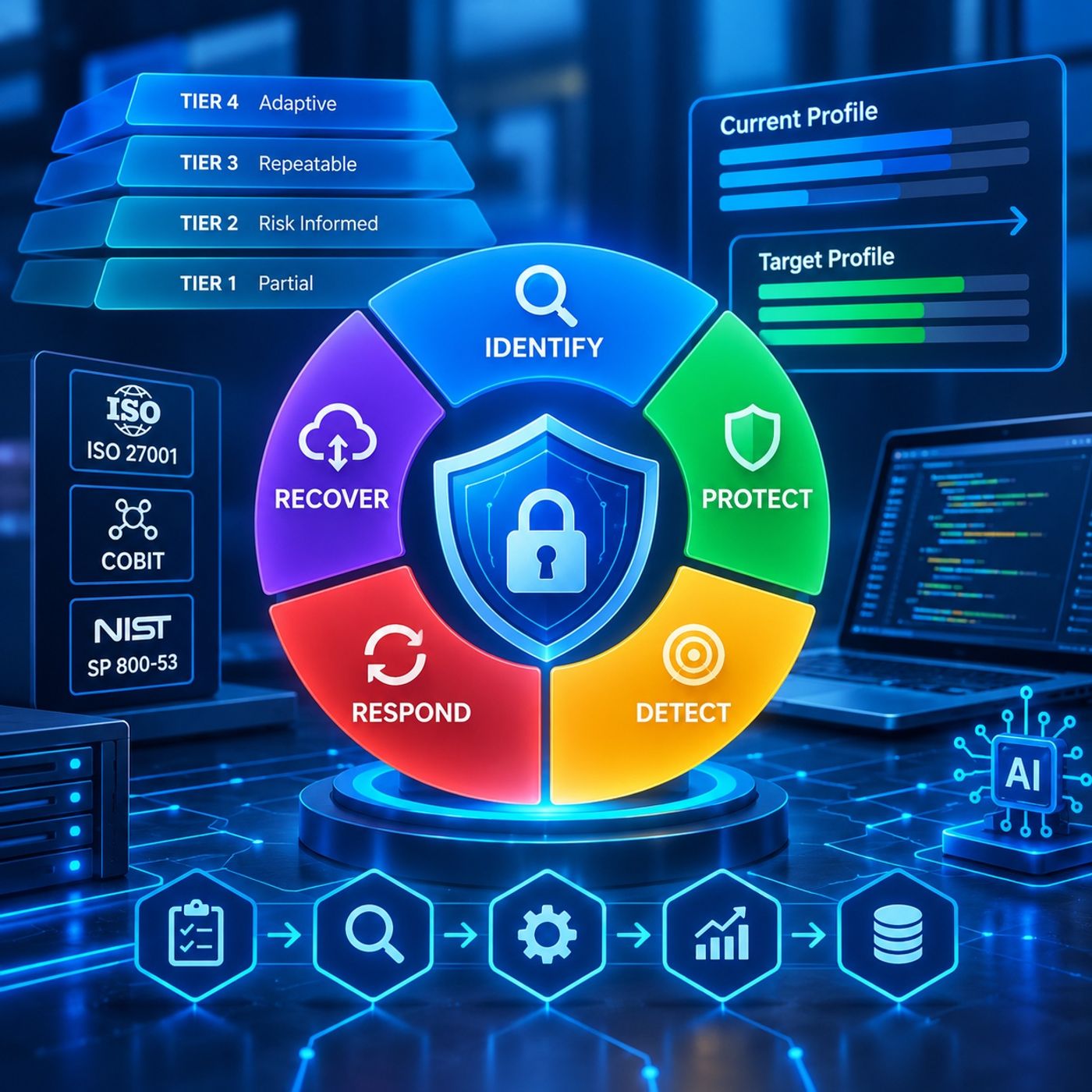
NIST Cybersecurity Framework: Core Functions, Implementation Tiers & ProfilesExplore how the NIST Cybersecurity Framework (CSF) helps organizations assess, communicate, and improve cybersecurity risk management. This episode breaks down the framework’s three main components: the Core, Implementation Tiers, and Profiles, showing how they connect business priorities with practical security activities.Key Topics Covered:The five Core Functions: Identify, Protect, Detect, Respond, and RecoverFramework categories, subcategories, and references to standards such as ISO 27001, COBIT, and NIST SP 800-53The four Implementation Tiers: Partial, Risk Informed, Repeatable, and AdaptiveCurrent and Target Profiles for measuring security gapsThe seven-step implementation process and risk assessmentGap analysis, prioritization, and security investment planningUsing assessment results to support budgeting and executive decisionsKey Takeaway: Learn how to use the NIST CSF as a flexible, risk-based roadmap to evaluate cybersecurity maturity, prioritize improvements, and align security investments with organizational goals.You can listen and download our episodes for free on more than 10 different platforms:https://linktr.ee/cybercode_academyGet the books of the CyberCode Academy podcast:📚 The book series: 416 lessons, 12 books, hundreds of original diagrams: security, networking and programming.https://cybercodeacademy.gumroad.com/

Cybersecurity Law & Governance: Federal Regulations and the NIST Cybersecurity FrameworkExplore the legal foundations of cybersecurity and how the NIST Cybersecurity Framework (CSF) translates policy and regulatory requirements into practical risk management. The episode examines major U.S. cyber laws, including the CFAA, ECPA, FISMA, and Privacy Act, alongside key executive orders that shaped federal cybersecurity policy.It also explains the CSF’s flexible, evolving approach to managing cybersecurity risks, its role in balancing security with privacy and civil liberties, and its roadmap for addressing emerging challenges such as supply chain security and evolving cyber threats.Key Topics Covered:Cybersecurity laws: CFAA, ECPA, FISMA, and the Privacy ActExecutive Orders 13636 and 13800Federal cybersecurity governance and regulatory mandatesNIST CSF principles, structure, and risk managementVoluntary adoption in private industry versus federal requirementsPrivacy and civil liberties in cybersecurity monitoringThe CSF Roadmap and emerging security challengesSupply chain risk and evolving cyberattack life cyclesKey Takeaway: Understand how cybersecurity laws, executive actions, and adaptable frameworks work together to guide organizational security and protect critical digital infrastructure.You can listen and download our episodes for free on more than 10 different platforms:https://linktr.ee/cybercode_academyGet the books of the CyberCode Academy podcast:📚 The book series: 416 lessons, 12 books, hundreds of original diagrams: security, networking and programming.https://cybercodeacademy.gumroad.com/

Cybersecurity Fundamentals: Core Principles, Access Control & Risk ManagementExplore the foundations of cybersecurity, beginning with the distinction between information security and cybersecurity. The episode examines the CIA triad and its threats, essential access control mechanisms, and the role of cryptography in protecting data integrity and accountability.It also introduces risk management, threat and vulnerability assessment, business impact analysis, defense-in-depth, and enterprise security architecture frameworks such as TOGAF, Zachman, and SABSA.Key Topics Covered:Cybersecurity vs. information securityCIA and DAD triadsIdentification, authentication, authorization, and MFALeast privilege and need-to-know principlesHashes, checksums, encryption, and digital signaturesThreats, vulnerabilities, risk appetite, and residual riskBusiness impact analysis (BIA) and defense-in-depthEnterprise architecture and the NIST Cybersecurity Framework (CSF)Key Takeaway: Understand the principles and frameworks that guide effective cybersecurity programs, from protecting information and managing access to assessing risk and building layered defenses.You can listen and download our episodes for free on more than 10 different platforms:https://linktr.ee/cybercode_academyGet the books of the CyberCode Academy podcast:📚 The book series: 416 lessons, 12 books, hundreds of original diagrams: security, networking and programming.https://cybercodeacademy.gumroad.com/

ICS & SCADA Security: Application Whitelisting, Active Directory & Group PolicyEpisode OverviewExplore two essential defense strategies for industrial control environments: restricting software execution through application whitelisting and strengthening identity management through Active Directory and Group Policy. Learn how to reduce malware risks, isolate control systems from corporate networks, and enforce consistent security configurations without disrupting critical operations.Key Topics CoveredApplication Whitelisting: Default-deny policies, trusted software baselines, file paths, digital signatures, and cryptographic hashes.Implementation & Monitoring: Windows AppLocker, Software Restriction Policies, Linux AppArmor and SELinux, and staged deployment to identify false positives before enforcement.Active Directory Isolation: Dedicated SCADA domains or forests to reduce dependencies on corporate identity infrastructure and limit breach propagation.Organizational Units & Group Policy: Structuring users and devices, applying security baselines, and aligning configurations with CIS benchmarks.Authentication & Authorization: PKI certificates, smart cards, Kerberos authentication, and role-based access controls.Key TakeawaysIndustrial security benefits from tightly controlled software execution, isolated identity infrastructure, and centrally managed security policies. Test changes carefully, apply least privilege, and validate configurations against operational requirements before enforcement.You can listen and download our episodes for free on more than 10 different platforms:https://linktr.ee/cybercode_academyGet the books of the CyberCode Academy podcast:📚 The book series: 416 lessons, 12 books, hundreds of original diagrams: security, networking and programming.https://cybercodeacademy.gumroad.com/

Comments

Download from Google Play

Download from App Store
 United States