


 Claim Ownership
Cycling Science Podcast
Subscribed: 16Played: 204
Subscribe

© 2026 Richard Davison
Description
Welcome to Cycling Science Podcast, where we and invited guests chat about the latest developments in Cycling Science
21 Episodes
Reverse
In this episode of the Cycling Science Podcast, Professor Richard Davison speaks with Dr. Fran Oficial Casado of the Universidad de Valencia about pacing in long, mountainous Gran Fondo events. Using data from the Quebrantahuesos race, they discuss why starting too hard early can damage performance later, why lower pacing variability is linked with better results, and what recreational cyclists can learn from endurance research.Fran shares how his background as a swimmer, triathlete, coach, and researcher led him to study pacing, and he offers practical advice for riders and coaches: start very conservatively, trust perceived effort, and make smarter decisions about when to push and when to hold back.If you race Gran Fondos or long climbs, this conversation will help you think differently about pacing, fatigue, and strategy.Reference: Sánchez-Jiménez, J.L., Priego-Quesada, J.I. and Oficial-Casado, F. (2026) ‘Pacing strategies in Gran Fondo cycling: a large-scale analysis of the Quebrantahuesos race’, Sport Sciences for Health, 22(3), p. 236. Available at: https://doi.org/10.1007/s11332-026-01828-0.
Every year hundreds of talented young cyclists compete for a handful of world tour contracts. For decades, selectors relied on race results and raw power numbers. John and colleagues built a new framework — the Compound Score — that predicts podium performance with 83% accuracy. But the most important factors, he argues, still can't be measured at all.John Wakefield is highly experienced and well known for his broad expertise in cycling science. He is currently the Director of Coaching, Sports Science and Technical Development at Red Bull – BORA – hansgrohe World Tour cycling team. Before this, he spent four seasons with UAE Team Emirates, with the role of Performance Coordinator and Coach.John’s expertise spans two decades, earning him multiple accolades, working with Multiple Tour de France and Cape Epic winners, World Champions and numerous National titleholders, while being an advocate for developing youth riders and shaping their careers.In addition, John manages the Science to Sport performance laboratory based in Girona, Spain. In his free time, he remains active in the cycling community, contributing his insights through interviews and articles in sports science publications.Leo, Spragg, Wakefield & Swart (2022). The Compound Score in elite road cycling. Journal of Science and Cycling. https://www.jsc-journal.com/index.php/JSC/article/view/733
In this episode I interview Prof Rob Lamberts and we discuss his recent publication ‘Reliability of Recovery Heart Rate Variability Measurements as Part of the Lamberts Submaximal Cycle Test and the Relationship with Training Status in Trained to Elite Cyclists’. European Journal of Applied Physiology. https://doi.org/10.1007/s00421-023-05385-z.
Prof. Rob Lamberts, head of Research at the Division of Movement Science and Exercise Therapy at Stellenbosch University, is renowned for his work in high-performance cycling, focusing on optimizing training prescriptions to manage fatigue and prevent overreaching. With a PhD from the University of Cape Town, where he developed the Lamberts Submaximal Cycle Test, Rob is a leading applied exercise physiologist and expert in cycling physiology. He serves as an associate editor for the International Journal of Sports Physiology and Performance, contributes as a Scientific board member to the European College of Sport Science, and has collaborated with top cycling teams and associations. Lamberts boasts over 100 peer-reviewed publications, a Scopus h-index of 26, and more than 2300 citations.
Consider attending the European College of Sport Science Congress in Glasgow 2-5th July https://sport-science.org/index.php/congress/glasgow-2024. I am the President of the congress and Rob will be there too.
In this episode I speak to Prof Gerry McCann who is a heart specialist with a subspecialist interest in MRI scanning; he conducts experimental research in people to better understand heart disease and clinical trials to assess the optimal investigation strategies and treatments for patients with, or at risk of developing, heart disease.
Professor McCann is the Cardiovascular theme lead for NIHR Leicester Biomedical Research Centre, the immediate past-chair of the British Society of Cardiovascular MRI research group, lead of the PhOSP-COVID cardiovascular working group and East Midlands Cardiovascular Clinical Research network.
Gerry and I actually studied together at Glasgow University and in this interview we discuss atrial fibrillation, or AF as it is known, as it relates to cyclists. There is some evidence that high volumes of endurance training like cycling may be a contributory factor the the development of atrial fibrillation therefore we discuss exactly what it is, what are the specific risks and potential treatments.
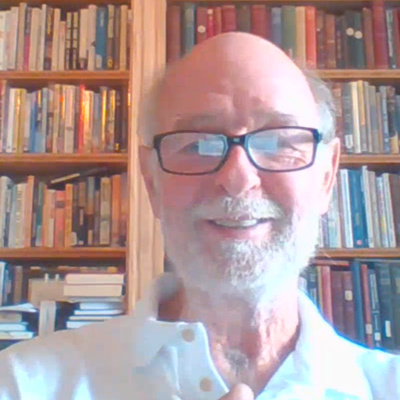
Ron Maughan obtained his BSc (Physiology) and PhD from the University of Aberdeen, and was based in the Medical School there for almost 25 years before moving to England. He is now semi-retired but is still a Visiting Professor in the School of Medicine at St Andrews University. He spent much of his career trying to understand the physiological and metabolic responses to exercise and the nature of fatigue, but has included many digressions along the way. He chairs the Nutrition Working Group of the Medical and Scientific Commission of the International Olympic Committee. He is a director of the IOC Diploma programs in Sports Nutrition, Sports Medicine, and Sports Physical Therapies. He organised the IOC Consensus Conferences on Nutrition in Sport in 2003 and 2010, the FIFA/F-MARC Consensus Conferences on Nutrition in Football in 2005 and 2011, and the IAAF Consensus Conference on Nutrition in Athletics in 2007. More recently, he organised the 2017 IOC Consensus conference on Dietary Supplements in Elite Sport. He has published extensively in the scientific literature and is author or editor of a number of books on sports nutrition and exercise biochemistry. Not only that he has inspired, educated and supported a large number of sport scientists throughout their career, myself included. In this episode we discuss a number of the core themes in sports nutrition and debunk a few myths. In particular we talk about one of his more recent publications. The 'IOC consensus statement: dietary supplements and the high-performance athlete'. In particular to emphasise on of the key findings that "Supplements claiming to directly or indirectly enhance performance are typically the largest group of products marketed to athletes, but only a few (including caffeine, creatine, specific buffering agents and nitrate) have good evidence of benefits."

Comments

Download from Google Play

Download from App Store
 United States