DiscoverDatabase
Database

Database

Author: Tony Chang

Subscribed: 4Played: 138
Share

Description

I will upload clips that I deem worthy of listening to here!
24 Episodes
Reverse

For thousands of years, mathematicians have used the timeless art of logic to see the world more clearly. Today, truth is buried under soundbites and spin, and seeing clearly is more important than ever. In this talk, Eugenia Cheng will show how anyone can think like a mathematician to understand what people are really telling us – and how we can argue back. Taking a careful scalpel to fake news, politics, privilege, sexism and dozens of other real-world situations, she will teach us how to find clarity without losing nuance.Eugenia Cheng is Scientist In Residence at the School of the Art Institute of Chicago. She won tenure in Pure Mathematics at the University of Sheffield, UK, where she is now Honorary Fellow. She has previously taught at the Universities of Cambridge, Chicago and Nice and holds a PhD in pure mathematics from the University of Cambridge. Alongside her research in Category Theory and undergraduate teaching, her aim is to rid the world of “math phobia”. Her first popular math book, How to Bake Pi, was published by Basic Books in 2015 to widespread acclaim including from the New York Times, National Geographic, Scientific American, and she was interviewed around the world including on the BBC, NPR and The Late Show with Stephen Colbert. Her second book, Beyond Infinity, was shortlisted for the Royal Society Science Book Prize.This talk and Q&A was filmed in the Ri on 2 July 2018.
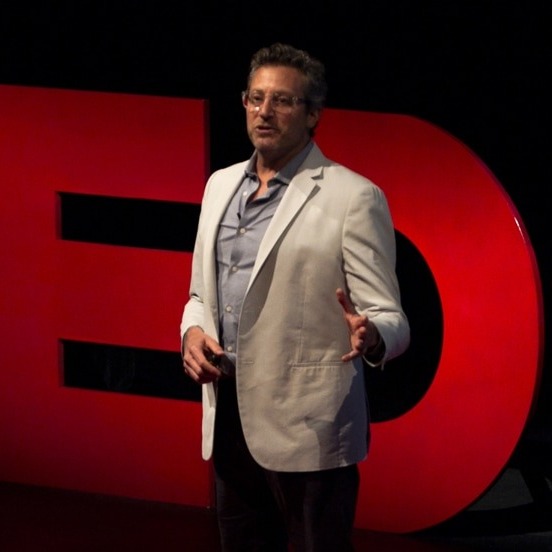
How you define Stephen Duneier depends on how you came to know him. Some define him as an expert institutional investor, while others know him as a large scale installation artist, avid outdoorsman, professor, decision strategist, coach, business leader, mindfulness extremist, author, speaker, daredevil or Guinness world record holder. In his talk, Stephen explains that what truly defines him aren't titles, but an approach to decision making that transformed him from someone who struggled with simple tasks to a guy who is continuously achieving even his most ambitious dreams. For thirty years, he has applied cognitive science to investing, business and life. The result has been the turnaround of numerous institutional businesses, career best returns for managers who have adopted his methods, the development of a $1.25 billion dollar hedge fund and a rapidly shrinking bucket list. Mr. Duneier teaches graduate courses on Decision Analysis in UCSB’s College of Engineering. His book, AlphaBrain is due for release in early 2017 from Wiley & Sons. Through Bija Advisors, he helps business leaders improve performance by applying proven, proprietary decision-making methods to their own processes. His artwork has been featured around the world and is represented by the Sullivan Goss Gallery. As Commissioner of the League of Professional Educators, Duneier is using cognitive science to alter the landscape of American education. He is the former Head of Currency Option Trading at Bank of America and Emerging Markets at AIG International.
Entrepreneur Andrew Yang answers questions from two undecided Democratic voters. NPR’s Noel King hosts. Click "Show More" below for topic time codes. INTRO 2:05 - Yang sings Prince 2:34 - Yang discusses riding his bike in New York City UNIVERSAL BASIC INCOME - 3:42 4:22 - What is universal basic income and the freedom dividend? 11:08 - Yang defends his preference for VAT taxes over wealth taxes 21:00 - Yang on “winners and losers” in an economically divided country 24:09 - Will people have to choose between welfare and the freedom dividend? 28:53 - How would the freedom dividend combat inequality in education? 33:05 - Why not set an income threshold for the freedom dividend? CLIMATE CHANGE - 37:01 39:04 - “[Climate change] is already changing lives and destroying lives.” 40:12 - Yang on thorium, a “next-generation fuel for nuclear reactors” 43:16 - How will he reach people who “don’t believe in climate change”? 47:18 - What does he mean by moving people to “higher ground”? 50:16 - Is the idea for people to use their freedom dividends to prepare for climate change? OUTRO 51:32 - Yang’s views on impeachment 52:08 - Yang on Asian-American identity 53:56 - “Are you running for president to win?” 55:44 - “Why you're so averse to a wealth tax?” 57:21 - “If you don’t become president, how are you going to continue to work on these ideas?”
Award-winning expert in negotiation, Deepak Malhotra, leads an interactive session to give you the tools to negotiate with confidence. Source: https://www.youtube.com/watch?v=VsaxtLqh4h0
Former FBI Hostage Negotiator Chris Voss of The Black Swan Group and author of “Never Split The Difference” Keynote at AREC 2017 Australian Real Estate Conference Brisbane Australia May 29, 2017 Source: https://www.youtube.com/watch?v=PPfhZsAGsEI
June 2016. This video is from a talk by William Ury at the University of Geneva on the art of negotiation. Source: https://www.youtube.com/watch?v=sajCKwxXG_g
During the bicentennial session, “Negotiations for Lawyers: Bird’s-Eye View of Negotiations and Dispute Resolution,” hosted by Harvard Law School Professor Robert Mnookin ’68, panelists Sheila Heen ’93 and David Hoffman ’84, both HLS Lecturers on Law; J. Mark Iwry ’75, fellow of the Brookings Institute; Jennifer Reynolds ’07, associate professor at the University of Oregon School of Law, discussed negotiation, mediation, and dispute resolution. Each panelist showcased a brief story, styled on the popular NPR Radio program, Stories from the Moth, and shared a unique perspective on negotiation and conflict management. Their talk was part of the HLS in the World bicentennial summit which took place at Harvard Law School on Friday, October 27, 2017. Source: https://www.youtube.com/watch?v=lPq2VyyEwdQ
How do your actions and relationships frame your ability to impact, influence and persuade? Gillian Ku, Professor of Organisational Behaviour, shares six interpersonal principles of how we interact with people that affect one’s ability to influence and persuade others. Professor Ku also teaches on Negotiating and Influencing Skills for Leaders programme at London Business School: https://bit.ly/2VPPX2v Source: https://www.youtube.com/watch?v=uKbcmlKb81c
Stanford Graduate School of Business | Negotiation is an inevitable aspect of starting a business. Joel Peterson talks about how to conduct a successful negotiation. Recorded: January 31, 2007 Source: https://www.youtube.com/watch?v=rCmvMDrCWjs
William Ury, author of "Getting to Yes," offers an elegant, simple (but not easy) way to create agreement in even the most difficult situations -- from family conflict to, perhaps, the Middle East.
From the founder and director of The Harvard International Negotiation Program comes a guide to successfully resolving your most emotionally charged conflicts. In this landmark book, world-renowned negotiation expert Daniel Shapiro presents a groundbreaking, practical method to reconcile your most contentious relationships and untangle your toughest conflicts.
From https://www.mckinsey.com/business-functions/strategy-and-corporate-finance/our-insights/creating-value-an-interactive-tutorial
In the competitive environment of technology, speed to market is often a key to success. But creating every capability internally often takes the time and skills many startups fail to have. In this session, we examine when to look outside the firm for missing pieces, how to find a company with the right fit, and how to price the deal in a way that retains value. Panelists: David Wessels, ENG'92, W'92 Adjunct Professor of Finance, The Wharton School Vicente de Baca, WG'09 Partner, v2 Ventures Anton Hanebrink, WG'04 Chief Corporate Strategy & Development Officer, Intuit Jamie Kim, WG'14 Corporate Development & Strategy, E la Carte Inc.
Lemonade CEO and cofounder Daniel Schreiber tells Disrupt 2018 that being newcomers to insurance allows Lemonade to create something truly different: an insurance company powered by AI and behavioral economics, making it instant, transparent, and delightful. Lemonade gathers 100X more data than incumbents thanks to the digital infrastructure its built on. So while legacy insurers have an average age of 104, and Lemonade is celebrating its two-year anniversary, the data collected and analyzed in orders of magnitude will allow Lemonade to outperform incumbents.
On the occasion of the 25th anniversary of the death of Herbert von Karajan on 16 July 2014, Sir Simon Rattle talks about his predecessor.
Dear banks, Game Over. Disruptive challenger banks are here to wipe the floor with traditional banks, who have, according to Chad West, head of comms and marketing at challenger bank Revolut, failed to make their offering open and transparent to customers, and failed to give them control over their money. Digital bank alternative Revolut has scaled to 1.8 million customers in three years – and now offers cryptocurrency processing.
From their bestselling books, to a documentary film, to a podcast boasting 8 million monthly downloads, authors Levitt and Dubner have been creating a data culture all their own, showing the world how to make smarter, savvier decisions with data. With their trademark blend of captivating storytelling and unconventional analysis, the duo will teach you to think more productively, more creatively, and more rationally — in other words, they’ll teach you how to think like a Freak! Levitt and Dubner will get below the surface of modern business practices, discussing the topics that matter most to today’s businesses: how to create behavior change, incentives that work (and don’t work), and the value of asking unpopular questions. Their keynote will leave the audience energized, prepared to solve problems more effectively, and ready to succeed in fresh, new ways.
Steven J. Dubner joined us in the Google London office to talk about his new book When to Rob a Bank. Why don't flight attendants get tipped? If you were a terrorist, how would you attack? And why does KFC always run out of fried chicken? Over the past decade, Steven D. Levitt and Stephen J. Dubner have published more than 8,000 blog posts on Freakonomics.com. Now the very best of this writing has been carefully curated into one volume, the perfect solution for the millions of readers who love all things Freakonomics. Discover why taller people tend to make more money; why it's so hard to predict the Kentucky Derby winner; and why it might be time for a sex tax (if not a fat tax). You'll also learn a great deal about Levitt and Dubner's own quirks and passions. Surprising and erudite, eloquent and witty, Freaks and Friends demonstrates the brilliance that has made their books an international sensation.
Pieces of advice from Casey's vlogs
In this talk from the Harvard Business School Digital Initiative's Future Assembly on April 6, 2018, Sunil Gupta (Harvard Business School) present a talk called "Driving Digital Strategy ."
loading
Comments 
loading
