


 Claim Ownership
Dear SQL DBA
Subscribed: 985Played: 4,806
Subscribe

© Kendra Little 2023
Description
Kendra Little's podcast discussing database performance tuning, software development, and working with data.
83 Episodes
Reverse
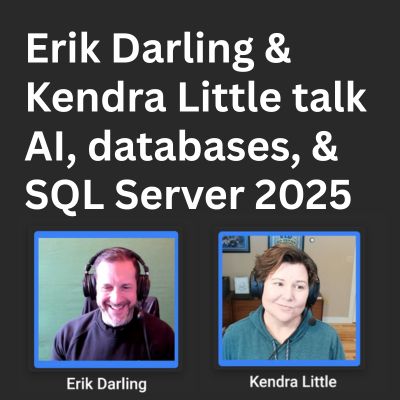
Erik Darling joins Kendra to chat about AI tools, why they work better for Python and PowerShell than SQL, and what's exciting (and what's not) in SQL Server 2025. Along the way we describe the ONE THING we always want to configure in Resource Governor, why at least one SQL Server 2025 feature should be backported to 2022, and why the universe is text files all the way down.
Erik Darling joins Kendra Little to rate different SQL Server Performance Tuning Techniques in episode 81 of the Dear SQL DBA podcast. We share our opinions of... (deep breath) Recompile hints, Query Store hints and plan forcing, CTEs, Resource Governor, the legacy cardinality estimator, Table Variables, Automatic Plan Correction, Batch Mode, index rebuilds, Hekaton, NOLOCK, page compression, partitioning, filtered indexes, columnstore, join hints, PSPO, indexed hints, indexed views, optimize for unknown, RCSI, adding more memory, restarting the damn thing, scalar UDFs, and Persisted Memory Grant Feedback.
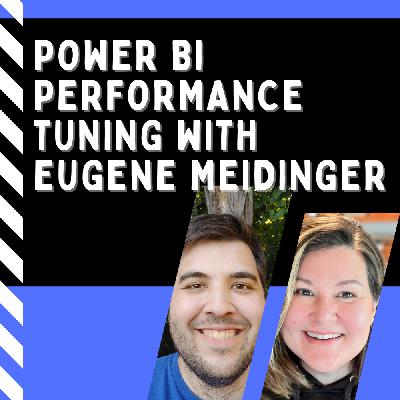
Eugene Meidinger stops by to chat about Power BI Performance Tuning with Kendra. We talk about the various engines and languages used in Power BI and big-picture strategies for getting performance from the start. Eugene then talks about the community of tools and techniques that can be used to dig in and solve performance problems in Power BI. Eugene's new Pluralsight course on Perf tuning Power BI launches on February 5th, 2024. The first 50 sales will be only $20. If you don't get one of those lucky spots, use code RACOONS to get 50% off. Find more of Eugene's content at sqlgene.com.
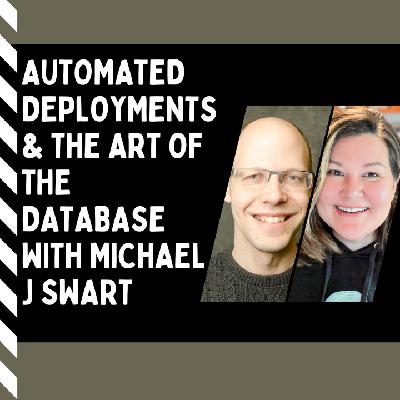
In this episode, Michael J Swart joins the Dear SQL DBA podcast to talk about databases, automation, and how he's come to illustrate some of the coolest blog posts ever to be written about data. Check out Michael's art and blog posts at michaeljswart.com, and explore his posts by illustration at https://michaeljswart.com/browse-articles-by-illustration/.
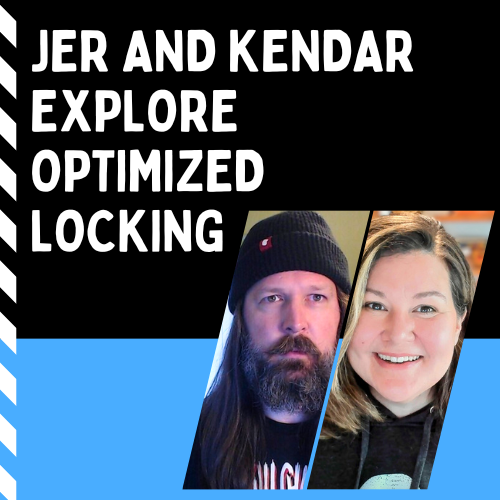
SQL Server has a new feature that's currently only available in Azure SQL Database: Optimized Locking. Jeremiah Peschka joins the podcast to talk through the docs and nerd out on locks, blocks, and how to pronounce the acronym "LAQ". Learn more about this feature online: Optimized locking article from Microsoft Learn Transaction locking and row versioning guide <– A much longer read on Microsoft Learn Kendra's Sketchnote diagram of Optimized Locking

Ever wondered what it's like to be a VP or Director of Engineering? Kendra chats with Alex Robson about leadership in technology, what you can get out of coaching or an MBA program (should you be interested), and what makes a high performing team. We'll also chat about recommended content to hone your tech leadership skills. Alex Robson's site and blog: https://robsonconsulting.services Alex's content recommendations for folks who want to think more about technical leadership: "I believe Camille Fournier and Will Larson are wonderful writers with invaluable insights and advice. For product thinking, I recommend folks read The Lean Startup by Eric Ries, Principles of Lean Product Development Flow by Don Reinertsen, Safer Sooner Happier by Jonathan Smart, and Accelerate by Dr. Nicole Forsgren. Be sure to read books on leadership that are outside of engineering. Dan Pink's Drive and Eliyahu Goldratt's The Goal are two of my usual recommendations. Last but not least - read books that are about human behavior. Both economists and psychologists ask important questions that may help you unlock better ways to relate to and understand others. I love Daniel Kahneman's Thinking Fast and Slow, and highly recommend Mistakes Were Made (but not by me) by Carol Tavins and Elliot Aronson."
SQL Server performance tuning expert Erik Darling joins the podcast today to chat about how good queries can go bad, how bad queries can get better, and the question on everyone's mind: if he was a database, what database would he be? This episode contains some mildly explicit language. Erik's blog: https://erikdarlingdata.com/blog/ Erik's YouTube: https://www.youtube.com/@ErikDarlingData
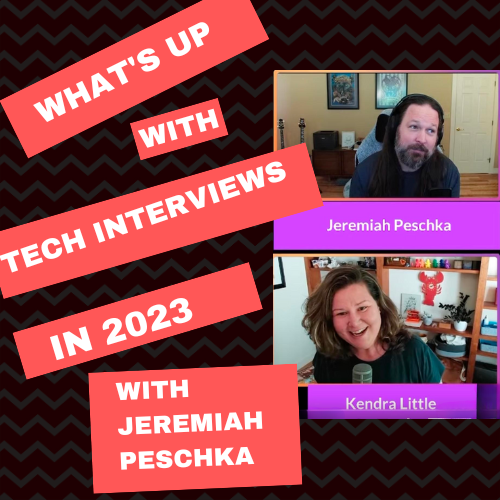
Tech interviews are weird and wacky. How did they get this way, and how SHOULD they be? Jeremiah Peschka joins us to discuss.
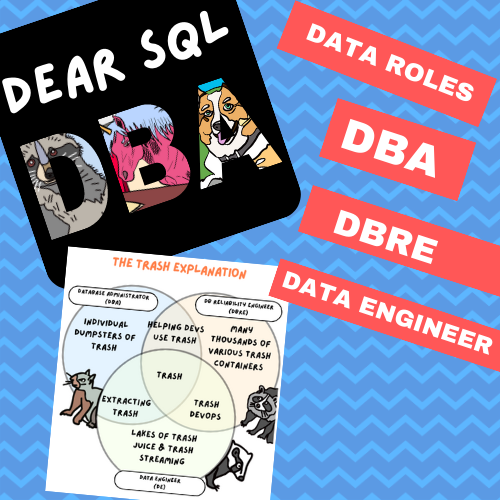
There are lots of jobs for data folks. In this episode, I'm discussing three hot job titles: Database Administrator (DBA), Database Reliability Engineer (DBRE), and Data Engineer (DE) To see the venn diagrams I made for these roles, visit https://catalyzesql.com/blog/1/01/01/dear-sql-dba-data-roles-dba-dbre-de/
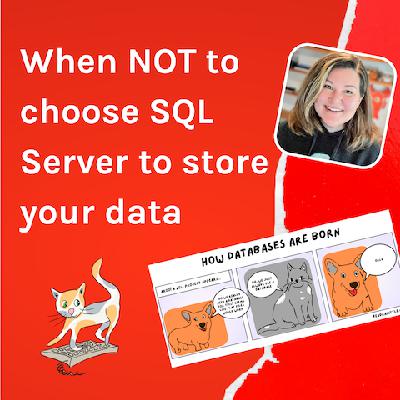
I wrote a blog post inspired by Stephen Vakil's excellent suggested interview question, but I inverted it: When should you NOT choose SQL Server to store your data? My thoughts: * When you don't actually need a database * When you're not using structured data * When you want pure analytics, or something other than a workload involving OLTP * When you need to write to multiple nodes for a single database * When your team wants a PAAS solution (lil pedantic on this, the hosted versions are slightly different) * When your team needs a cheap solution What do you think? This podcast is available in blog post form: https://littlekendra.com/2023/06/21/when-not-to-choose-sql-server/
It's Down Tools Week at Redgate. I share what "Down Tools Week" is, what I'm working on this week, and why I think it's a terrific experience for fostering creativity, innovation, and teamwork. In closing I share some thoughts on variations of this kind of project which you might use in your own organization, whether you are a developer, DBA, or have another role.
Many people use entrenched processes for database development that have been in place so long that it's hard to imagine doing it any other way. In this episode, I share three things that should NOT be normal for database development-- but which are incredibly common. This episode is inspired by the book, "The Unicorn Project", by Gene Kim.
I'm not an expert on collation in SQL Server, but there are a few important facts which I've had to learn the hard way. In this episode I share the basics, along with helpful resources to learn more. One small localization correction: the default collation on a SQL Server install will be "the oldest available version that's associated with each specific locale." So if your Windows installation has a different localization than mine (which are generally English USA), then you'll see a different default collation -- but it still won't be the recommended collation for *new* development.
Learning Git can be daunting for DBAs. In this 20 minute episode, I discuss why learning a VCS is necessary for DBAs, then give three tips on scoping your project, choosing the right tools, and making sure the project is successful. The cheat sheet I mention in the episode is at https://littlekendra.com/2019/11/27/my-git-cli-cheat-sheet/
You're a DBA, and your development team is all-in on doing DevOps, and they want to include the database. Should your DBA team limit the permissions or options for automation? Or should you instead re-think how your two teams work together? In this episode, Kendra discusses DevOps team topologies, the changing role of DBA teams in DevOps, and the opportunities available in creating communities of practice around database development.
I've been working as an 'Evangelist' at Redgate for close to six months now, and one question keeps coming up: what exactly does an Evangelist do at a software company? In 21 minutes, I explain the core mission of Evangelists, and why I think being part of the sales process is an important part of the future of software evangelism.
Jobs change over time, and database administrator jobs are no different. In this 35 minute recorded Twitch livestream (my first ever!) I talk about threats to DBA jobs and the related opportunities.
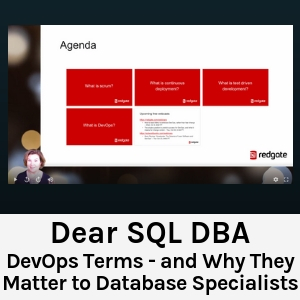
In this session, I discuss scrum, continuous deployment, test driven development, DevOps, and related concepts. I close with a quick discussion of why Database Administrators and Developers should care about DevOps.
So you've got an employee agreement in front of you: now what? In this 23 minute episode, I talk about practical steps you should take to make sure that you understand the terms of your contract, and how to potentially negotiate the terms.
When you take a new job in software engineering or in IT, within the paperwork there often lurks an employee agreement: a contract between you and your employer. In this half-hour live episode we'll talk about why these contracts exist, and multiple anti-patterns you should avoid. This is the first of a two part series. In the next episode, we'll talk best practices for understanding and negotiating the contract.

Comments

Download from Google Play

Download from App Store
 United States